Chindia Alert: You’ll be Living in their World Very Soon
aims to alert you to the threats and opportunities that China and India present. China and India require serious attention; case of ‘hidden dragon and crouching tiger’.
Without this attention, governments, businesses and, indeed, individuals may find themselves at a great disadvantage sooner rather than later.
The POSTs (front webpages) are mainly 'cuttings' from reliable sources, updated continuously.
The PAGEs (see Tabs, above) attempt to make the information more meaningful by putting some structure to the information we have researched and assembled since 2006.
Investors are seen at a stock exchange in Hangzhou, east China’s Zhejiang Province, Feb. 11, 2019, the first trading day of the Year of the Pig. China’s major stock indices ended notably higher Monday as investors greeted the Year of the Pig in China’s lunar calendar with bullish sentiment. The benchmark Shanghai Composite Index closed 1.36 percent higher at 2,653.9 points while the Shenzhen Component Index surged by 3.06 percent to close at 7,919.05 points. (Xinhua/Long Wei)
BEIJING, Feb. 11 (Xinhua) — China’s major stock indices ended notably higher Monday as investors greeted the Year of the Pig in China’s lunar calendar with bullish sentiment.
The benchmark Shanghai Composite Index closed 1.36 percent higher at 2,653.9 points while the Shenzhen Component Index surged by 3.06 percent to close at 7,919.05 points.
Companies in the agricultural sector were among the biggest winners, with Jiangxi Zhengbang Technology, a Shenzhen-listed agro-processing firm, jumping by the daily limit of 10 percent.
Liquor makers saw a strong performance, with the share price of top liquor brand Kweichow Moutai jumping 4.71 percent, bringing the company’s market capitalization to over 911 billion yuan (135 billion U.S. dollars).
Beijing Jingxi Culture & Tourism Co., Ltd, an investor of Chinese sci-fi blockbuster “The Wandering Earth”, surged by the daily limit after the film claimed the winner of the Chinese box office during the week-long Spring Festival holiday.
The film had earned over 1.94 billion yuan (about 288 million U.S. dollars) since its release on Tuesday as of 7:00 p.m. Sunday, according to Maoyan, a professional box office tracker.
The ChiNext Index, China’s NASDAQ-style board of growth enterprises, gained 3.53 percent to close at 1,316.1 points.
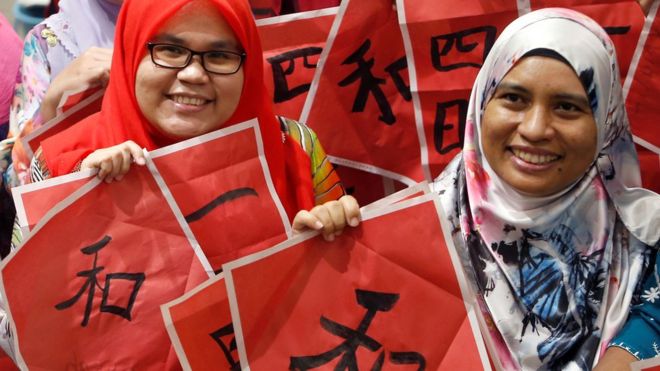
Image copyrightREUTERSImage captionMuslim teachers attend a Chinese calligraphy event in Kuala Lumpur, Malaysia to mark the Year of the Pig
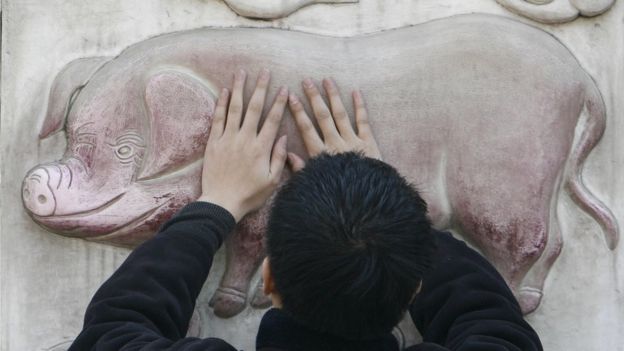
Communities around the world are gearing up to celebrate the lunar new year, which this time ushers in the Year of the Pig.
New Year celebrations usually mean the animal is depicted everywhere – in decorations, toys, gifts and advertising.
But the pig, the last animal on the Chinese zodiac calendar, is considered unclean by Muslims and a sin to consume. So does this cause problems for people celebrating lunar new year in Muslim-majority countries in South East Asia?
Like most Chinese-Malaysian families, the lunar new year is serious business for the Chow family, who live in the sleepy town of Batu Pahat in Johor, Malaysia.
This year is particularly significant because Chow Yoon Kee, his wife Stella and their daughter were all born in pig years.
“We will display lots of lucky pig ornaments at home and of course, have our relatives, friends, workers and neighbours over to visit, no matter what race or religion. Celebrations are for all,” said Mr Chow, a floor manager at a local biscuit factory.
He isn’t worried about his celebrations offending fellow residents as he believes there is no sign of new year controversy.
“There was a lot of fuss last year,” he recalls, when it was the Year of the Dog, also seen as impure animals by some Muslims.
Image copyrightAFPImage captionMalaysian authorities trod cautiously last year, being careful not to overdo the canine decorations
Malaysia is multicultural but the official religion is Islam, and there have been increasing reports of intolerance towards activities and actions considered insulting to Muslims.
So many shops and merchants avoided using images of dogs in fear of offending Muslim communities.
But Mr Chow feels local authorities have overlooked the feelings of the Chinese community, who actually celebrate the holiday.
“Malaysia is a country made up of many races, it isn’t just Malay Muslims. We have Chinese and Indian communities too, as well as other religions like Christianity, Hinduism, Taoism and Buddhism so we should be respecting each other’s beliefs and celebrations.”
But he adds that “the spirit of censorship” did not seem to carry on into the pig year.
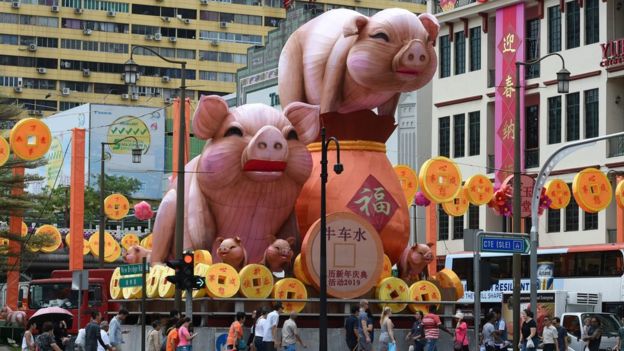
Image copyrightAFPImage captionThat’s some pig! Celebrations are under way in Chinatown, Singapore
Each animal of the Chinese zodiac is believed to have its own unique traits and qualities. Those born in the year of the pig are said to be intelligent, compassionate and loyal.
Does it matter if one’s zodiac animal isn’t welcome?
“There’s absolutely no reason to worry,” said Kuala Lumpur-based Feng Shui consultant Joey Yap. He told the BBC there didn’t seem to be any sensitivities around celebrations in Malaysia this year, compared to last.
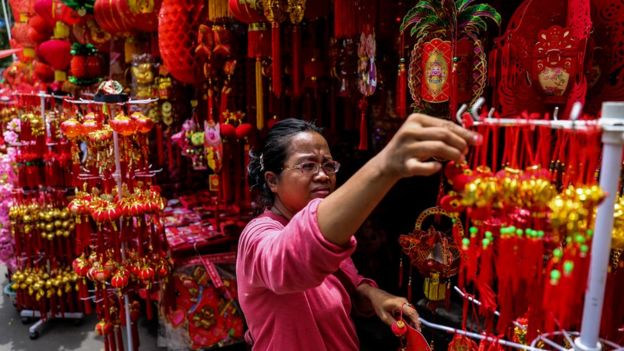
Image copyrightGETTY IMAGESImage captionRed decorations galore in Jakarta’s Chinatown
“Pigs will be fine,” he said, adding that whether you display objects or not “does not affect one’s personal luck”.
“Colours, emblems; they all aren’t important. In reality, one’s luck all boils down to one’s actions, so embrace positivity,” he said.
‘The first pigs Muslims can eat’
Even though it’s the world’s most populous Muslim nation, the lunar new year is a national holiday in Indonesia. Public celebrations are widely accepted – lanterns, colourful parades and performances are often seen in many cities.
Merry Olivia in Jakarta said her Muslim friends welcomed the image of pigs.
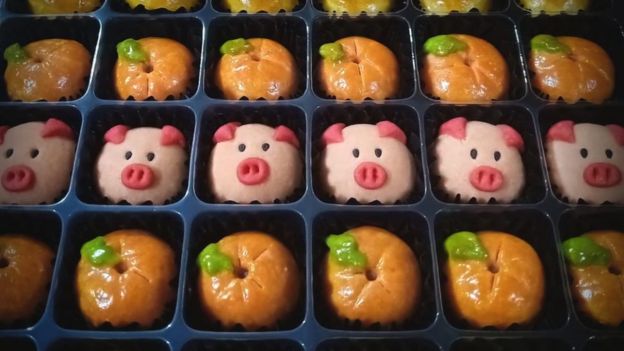
Image copyrightDAPUR MAMA LOEImage captionBaker Valeria Rita says her special cookies were a holiday hit with Muslim customers
“I grew up with many Indonesian Muslims so I know pigs will not make them feel uneasy,” she said, adding that the creatures looked more “festive” than other zodiac animals.
“If you compare pigs with snakes, pigs are more adorable so people would rather buy decorations embellished with them. Not many people in Jakarta like snakes.”
Baker Valeria Rita was rolling out special treats in time for the new year: pig shaped cookies with sweet pineapple jam fillings.
She said the response had been really good. “Orange or tangerine is a popular symbol for the lunar new year. This year, we decided to create pig-shaped treats and the quota for pre-orders was full within two weeks.”
Many of her customers are also Muslim.
“They buy my cookies for Chinese colleagues and friends who celebrate the holiday. Some also order for themselves because they like the pigs,” she said, sharing a joke made by her best friend, also a Muslim. “My goodies were the first pigs Muslims are allowed to eat.”
‘I don’t want to offend’
But it’s a different situation for 24-year-old Rangga Sastrajaya, from Bogor city. He bought pig toys and decorations but remains cautious in displaying them openly as he feels many Indonesians still do not accept cultural diversity.
“I could wear pig shirts or display pig-themed decorations at home but I will be quite careful in showing them off in public because I do not want to offend anyone,” he admitted.
Image copyrightAFPImage captionWill the new year spirit provoke widespread resentment among conservative Muslims?
But there are those who condemn the festivities. Forum Muslim Bogor (FMB), a conservative Islamic organisation in West Java, released a letter demanding the cancellation of festivities. They said it was “inappropriate” for Muslims because it could “undermine Islamic faith”.
Their actions follow other groups like Pemuda Pancasila (PP) and the Malayan Persatuan Forum Komunikasi Pemuda Melayu (PFKPM), who previously condemned the celebrations by Chinese communities.
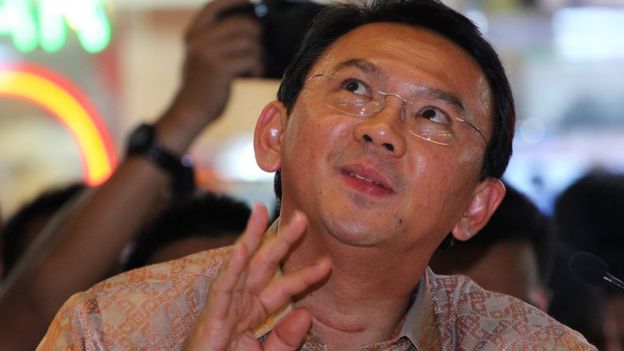
Image copyrightGETTY IMAGESImage captionIn 2017 Chinese-Christian Jakarta governor Basuki Tjahaja Purnama was jailed for blasphemy against Islam
Analyst Thung Ju-Lan from the Indonesian Institute of Science considers such sentiments the “impact of intolerant and political narratives”, the same kind which rocked Jakarta two years ago.
“It is the impact of the gubernatorial election in Jakarta, in Ahok’s case. The same sentiment has been spreading,” she told the BBC.
“The problem of intolerance continues because we have narrow understandings of what is actually happening. The more we do not understand, the more intolerant we are.”
In the case of celebrating the lunar new year, many Indonesian Muslims feel it is “more religious than cultural”.
But one politician has spoken out in defence of the Chinese community. Religious Affairs Minister Lukman Hakim Saifuddin encouraged beliefs of people from different cultures, faiths, and traditions to be respected.
“Regardless of what people understand about such celebrations, I invite all to respect tradition,” he said.
She’s unlikely to feature on many lists of the all-time top British cultural icons.
But Peppa Pig – the UK-made children’s cartoon character – is right up there with the best of them, at least in China.
With the series racking up 18 billion online views since its launch here seven years ago, the story of Peppa and her unfeasibly English middle class family is, arguably, doing more for Brand Britain than the Beatles, Manchester United and any of the culinary delights – for which the UK is rightly so renowned – put together.
Pork scratching anyone?
It is then no surprise that, when a Peppa-shaped opportunity came knocking, the British powers that be seized the moment.
After watching an episode in which the precocious piglet and her friends visit the Queen in Buckingham Palace – and encourage her to join them jumping in muddy puddles – two Chinese twins posted a video message online, addressed to none other than Her Royal Majesty.
They too, like Peppa, wanted to visit her in her palace, they said.
And it worked.
Well, sort of.
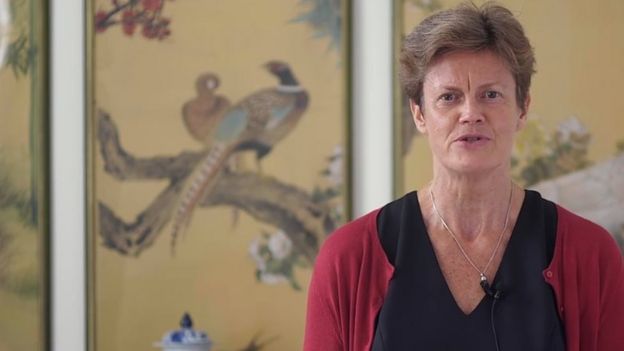
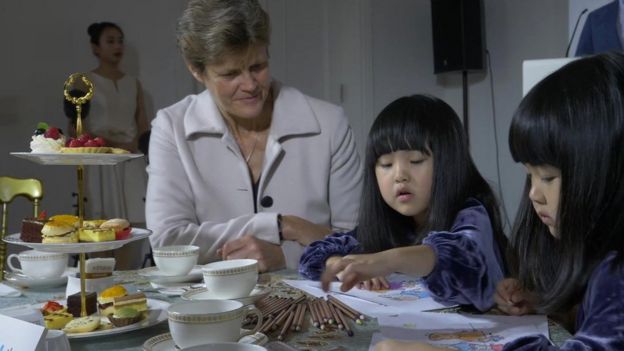
Image copyrightBRITISH EMBASSY CHINAImage captionDame Barbara Woodward, British ambassador to China, invited the twins to her Beijing residence
The British ambassador to China, Dame Barbara Woodward, posted her own video message in reply.
“Hello Mi Ni and Mi Ai,” she said. “I’m the British ambassador, so I’m the Queen’s representative in China.
“I’d like you to come and visit me in my house in Beijing,” she went on, “and we can perhaps have tea and scones in a British style.”
The post has been viewed more than nine million times in China – a multiple of 10 times more views than anything else Dame Barbara has posted in her entire four years as ambassador.
Image copyrightHUW EVANS PICTURE AGENCYImage captionThe twins might travel to the UK next
And so it was that two slightly bewildered five-year-olds found their way to her residence and munched on scones and chocolate cake, and sat colouring in pictures of Peppa Pig, in front of the assembled media.
“Do you think that the Queen really has muddy puddles in her garden?” I asked them.
They nodded. It is a big garden after all.
The whole experience may not have been quite the same as the real deal, but they have also been promised a trip to the UK where they will, at least, get to see Buckingham Palace.
And the British embassy has launched a competition along with Youku – the online channel with the Chinese rights to Peppa Pig – the young winners of which will also join the twins for the trip.
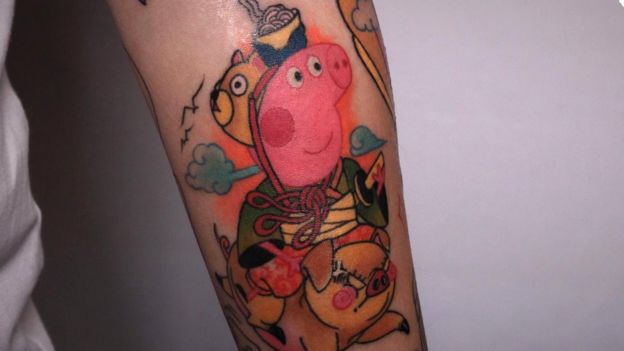
Image copyrightYUNTIANZHONG TATTOOImage captionPeppa Pig tattoos have become the symbol of a certain counter-culture in China
The whole Peppa phenomenon, it must be said, has a bit of a dark side in China.
A couple of years ago, pictures began to appear online of people sporting Peppa Pig tattoos.
She appeared to have become the chosen symbol for a counter-culture known as “shehuiren” – literally “society people”.
Early last year, one popular Chinese streaming site, Douyin, began removing Peppa videos en masse.
The nationalist, Communist Party-controlled tabloid Global Times described Shehuiren as people who are “poorly educated with no stable job” and “unruly slackers roaming around and the antithesis of the young generation the party tries to cultivate”.
Soft power
But Peppa has survived this brush with subversion.
A new Peppa Pig movie – made especially for the Chinese market – is due to be launched this coming Chinese New Year.
It is a collaboration between China’s Alibaba Pictures and Canada’s Entertainment One; although still made in the UK, Peppa Pig is now owned by the Canadian company.
The viral trailer for the film – which artfully grafts the story of Peppa onto seasonal themes of Chinese family and belonging – has received more than 300 million hits to date.
With the need for stronger ties with major economies in a post-Brexit world, I asked the UK ambassador whether she thought that a certain pink pig was proving rather more adept at it than British politicians.
“I wouldn’t put it quite as zero sum as that, to be honest,” Dame Barbara laughs in reply.
There are three components to good UK-China ties, she tells me – a strong government-to-government relationship, a strong business-to-business relationship and a strong people-to-people relationship.
“Peppa Pig is as much a part of the latter as the Royal Family, Wimbledon, the Premier League and all the other things we think of when we think of soft power.”
With cute twins, a great British-made product, and massive Chinese media exposure, she must be wishing all UK-China diplomacy could end so happily.




 CHINDIA ALERT: You'll be living in their world, very soon