23/04/2020
- Test in Xiong’an, the new city being built south of Beijing, will focus on everyday goods and services for the first time
- American food outlets to be included in the digital currency tests, conducting small transactions with local firms
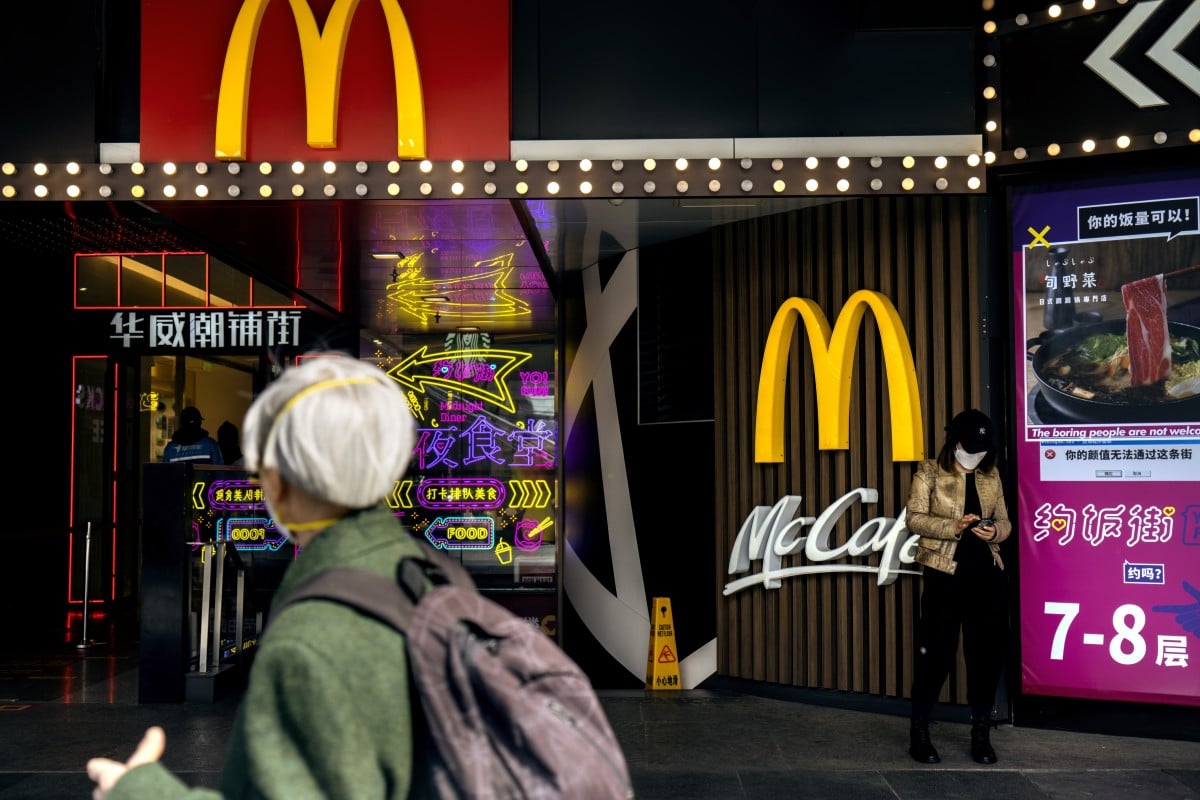
American chains Starbucks, McDonald’s and Subway were named on the People’s Bank of China’s list of firms that will test the digital currency in small transactions with 19 local businesses. Photo: Bloomberg
China’s central bank has accelerated the testing of its new sovereign digital currency and, for the first time, will include some foreign consumer brands in the programme.
American chains Starbucks, McDonald’s and Subway were named on the People’s Bank of China (PBOC)’s list of firms that will test the
digital currency in small transactions with 19 local businesses.
The global names will be joined by local hotels, convenience stores, a stuffed bun shop, a bakery, a bookstore and a gym, according to details revealed at a promotional event in the Xiong’an New Area, a city being built south of Beijing, news portal Sina.com reported.
The inclusion of businesses providing everyday goods and services marks an expansion of the PBOC’s testing. It follows a previous disclosure that last week in Suzhou the digital currency was used to pay half public sector workers’ travel subsidies for May.
Is China a currency manipulator?
Wednesday’s promotional event was organised by the local branch of the National Development and Reform Commission, the powerful planning agency, and attended by representatives of the Big Four state-owned banks and two of the country’s internet giants – Alibaba and Tencent.
China has not released a timetable for launching the digital yuan, but last week’s reports on new testing have fanned speculation that it could be imminent.
The tests were reportedly accelerated after Facebook launched its Libra project in June last year, an attempt to create a
global digital currency pegged to a basket of currencies and backed by global commercial giants.
The Libra Association, the consortium managing the project, announced changes last week in an attempt to win regulatory approval and pave the way for an official launch sometime later this year. The consortium said it would create multiple digital units tied to existing currencies such as the US dollar or the euro, rather than a single token based on a basket of currencies.
China’s official digital currency, known as Digital Currency Electronic Payment (DCEP), came into the public spotlight last week
when a screenshot of a test version of an app developed by the Agricultural Bank of China circulated online.
The digital currency app has several basic functions, similarly to other Chinese online payment platforms such as Alipay and WeChat Pay – the country’s two most popular online payment tools – allowing users to make and receive payments, and transfer money.
“It’s certain that the DCEP is now in its final testing stage and should be officially launched,” BlockVC, an investment firm, said in a research note.
The PBOC’s digital currency research institute confirmed last Friday that testing was being conducted in four cities: Shenzhen, Suzhou, Xiong’an and Chengdu. In addition, venues for the 2022 Winter Olympics in Beijing and Zhangjiakou will join the testing programme in the future.
What is the Hong Kong Dollar Peg?
The institute, which was inaugurated in 2017, said that the test versions and applications of the currency had not been finalised.
The project testing is based on two principles: the central bank issues the virtual money to commercial banks who then pass it on to consumers, and that is aimed at replacing cash in all transactions.
China is the first major economy to publicly announce plans for a sovereign digital currency, aiming to better control the rapid rise of digital payments worldwide.
The PBOC has, however, cracked down on the trading of other digital currencies and banned banks from accepting cryptocurrencies, which it views as a risk to financial stability.
Source: SCMP
Posted in 2022, accelerated, Agricultural Bank of China, Alibaba, American, among, bakery, Beijing, Big Four, bookstore, built, Chengdu, China’s, conducting, consortium, convenience stores, cryptocurrencies, digital currency, Digital Currency Electronic Payment (DCEP), everyday, Facebook, first time, focus, food outlets, Foreign firms, goods and services, Gym, included, internet giants, June, Libra, Libra Association, local firms, local hotels, May, McDonald’s, National Development and Reform Commission, New Area, new city, news portal, People’s Bank of China (PBOC)’s, People’s Bank of China’s, planning agency, public sector workers’, reported, set to, Shenzhen, Sina.com, small, South, sovereign, starbucks, stuffed bun shop, Subway, Suzhou, TENCENT, test, transactions, travel subsidies, Uncategorized, Winter Olympics, Xiongan, Zhangjiakou |
Leave a Comment »
29/12/2019
Photo taken on Dec. 28, 2019 shows the automatic ticketing office of the Badaling Changcheng Railway Station in Beijing, capital of China. The high-speed railway line connecting Beijing and Zhangjiakou in north China’s Hebei Province will go into service on Monday, China Railway Corporation said Saturday. (Xinhua/Peng Ziyang)
BEIJING, Dec. 28 (Xinhua) — The high-speed railway line connecting Beijing and Zhangjiakou in north China’s Hebei Province will go into service on Monday, China Railway Corporation said Saturday.
The railway line is a major project for the 2022 Olympic and Paralympic Winter Games. It will reduce the travel time between Beijing and Zhangjiakou, the co-host city of the 2022 Olympics, from currently over three hours to 47 minutes.
The railway is 174 km long, with a maximum design speed of 350 kph.
Ten stations are along the railway line, namely Beijing North, Qinghe, Shahe, Changping, Badaling, Donghuayuan North, Huailai, Xiahuayuan North, Xuanhua North and Zhangjiakou.
Chongli railway, a branch line of the Beijing-Zhangjiakou high-speed railway, will also come into service on Monday. It is 53 km long, with a maximum design speed of 250 kph.
Construction of the Beijing-Zhangjiakou high-speed railway began in the first half of 2016. The railway underwent test runs earlier this month.
Source: Xinhua
Posted in 2022 Olympic and Paralympic Winter Games, Badaling, Beijing, Beijing North, Changping, China Railway Corporation, Chongli railway, Donghuayuan North, Hebei province, high-speed railway, Huailai, Qinghe, service, Shahe, Uncategorized, Xiahuayuan North, Xuanhua North, Zhangjiakou |
Leave a Comment »
12/05/2019
BEIJING, May 11 (Xinhua) — With the official 1000-day countdown timer of the Beijing 2022 Olympic Winter Games having been launched at Beijing’s iconic Olympic Park on Friday evening, various commemorative activities related to winter sports and Olympic culture were held across China on Saturday.
At Beijing’s Shijingshan District, where the 2022 Beijing Organizing Committee of Winter Olympic and Paralympic Games (BOCWOG) located, Gaojinglu community was named as the first Winter Olympic Community for its efforts in developing winter sports among the residents.
Supported by the community since 2018, people living in the area were provided with the chances to experience winter sports like skating and curling. Many have shown great interests and established their own teams.
In the Yanqing District, which serves as one of the three competition zones of Beijing 2022, lectures about the Games were taken into schools and students are learning more about Olympic culture through the course.
At Zhangjiakou competition zone in Hebei province, a video which tells the story of Zhangjiakou engaging in the bidding and preparing work of Beijing 2022 came to the public.
Except for Beijing and Hebei, other parts of China also engaged in the milestone moment of Beijing 2022. In Altay of northwestern Chinese Xinjiang Uygur Autonomous Region, a skiing competition was held to promote Olympic culture in the area.
Altay has a long history of skiing as discoveries have shown that ancient people there already skied 12,000 years ago. In recent years, the local government has spent a lot of efforts in promoting winter sports, especially in schools. Over 9,000 students have benefited from a plan which aims to bring PE lessons to the skiing resorts.
Source: Xinhua
Posted in 1000-day countdown, Altay, Beijing, Beijing 2022, eijing Organizing Committee of Winter Olympic and Paralympic Games (BOCWOG), Gaojinglu, Hebei province, Olympic Winter Games, PE lessons, Shijingshan District, skiing resorts, Uncategorized, Various activities, Xinjiang Uygur Autonomous Region, Yanqing District, Zhangjiakou |
Leave a Comment »




 CHINDIA ALERT: You'll be living in their world, very soon