South Korea has voiced its frustration about repeated intrusions into its air defence identification zone by Chinese military aircraft, moves that analysts say reflect Beijing’s opposition to strengthening ties between Seoul, Tokyo and Washington.
SCMP TODAY: INTL EDITION
Get updates direct to your inbox
South Korean authorities said a Chinese plane, possibly a Shaanxi Y-9 electronic warfare and surveillance aircraft flew into the Korean zone Monday last week without notice. The plane entered near Socotra Rock in the Sea of Japan, or East Sea, at about 11am and flew out and into Japan’s air defence identification zone about 40 minutes later.
The plane re-entered the South Korean air defence zone, near the southeastern city of Pohang, at about 12.43pm. Then it travelled up to South Korea’s Exclusive Economic Zone in the Sea of Japan, cutting between the South Korean mainland and Ulleung island.
It was unusual for a Chinese aircraft to have taken that route. The plane was reported to have left the zone at 3.53pm.
Air defence identification zones are not covered by any international treaty and it is standard practice to notify the country concerned before entering its airspace.
The aircraft did not enter South Korean territorial airspace, which under the United Nations Convention on the Law of the Sea is defined as 12 nautical miles from shore.
According to the South Korean Air Force, the number of Chinese military aircraft entering its identification zone is rising. In 2016, there were about 60 incursions, 70 in 2017 and 110 were reported up to September this year.
Seoul called Du Nongyi, the Chinese military attaché to South Korea, to its defence ministry after Monday’s incident to expressed its “serious concerns” and called for “measures to prevent recurrences”.
A middle-ranking South Korea Air Force officer said Seoul paid “extra attention” to the incident.
Security analysts said the flights were a demonstration of China’s worries about increased US military activity in the region if US-North Korea negotiations failed.
Sending military planes over area allowed China to extend its surveillance and sent a message that it was watching and, if necessary, willing to act to protect its interests in the region, analysts said.
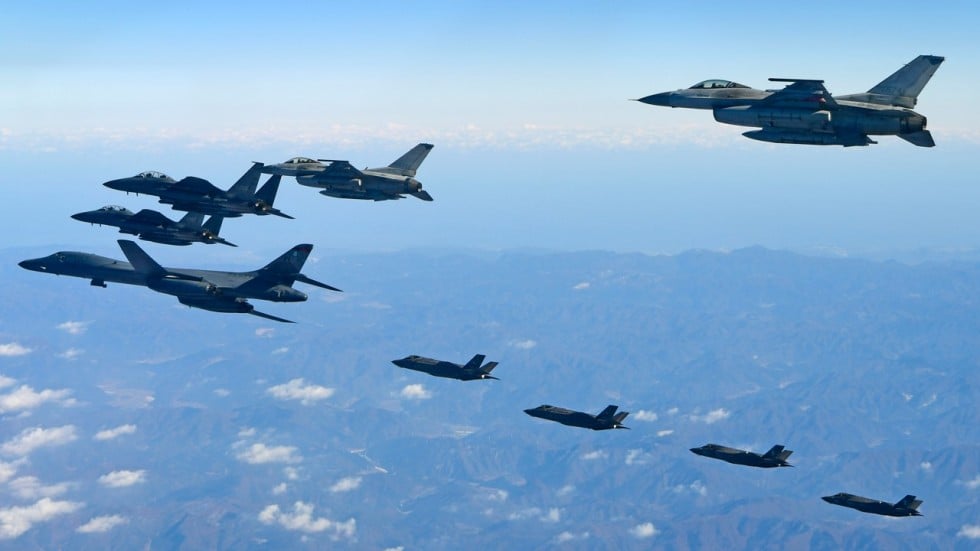
The US has sent military assets, including nuclear-capable B-52 bombers, to the Sea of Japan, prompting criticism from Beijing and Pyongyang. The US has long said North Korea’s behaviour was justification for joint military exercises with South Korea. These were stepped down this year to encourage Pyongyang at the negotiation table but could be stepped up again if talks on denuclearisation fail.
“China’s moves are part of its grand strategy to exert greater influence, presence, and pressure in the Indo-Pacific region … Possible failure of US-North Korea negotiations would be in [Beijing’s] calculations,” said Ryo Hinata-Yamaguchi, a visiting professor at Pusan National University in South Korea and adjunct fellow at the Pacific Forum – a donor-funded, non-profit foreign policy research institute based in Honolulu, Hawaii.

“I expect the [US-South Korea] exercises to resume at full scale [if] the US-North Korea negotiations or inter-Korean relations deteriorate … when both Washington and Seoul view that [the drills are] necessary.”
Zhao Tong, a fellow with the nuclear policy programme at the Carnegie-Tsinghua Centre for Global Policy in Beijing, said Monday’s overflight had several meanings.
The resumption of US-South Korea drills and Japan’s recent military modernisation “would be viewed by China as a direct threat to its own security and the overfly of Chinese aircraft could be used to send a deterrence signal”.
“Japan, in particular, is hosting increasingly advanced US military assets on its territory. Chinese reconnaissance aircraft flying in the Sea of Japan can help it keep an eye on what is going on in that region,” Zhao said.
Beijing fears the strengthening of an alliance network between the South Korea and Japan and, consequently, the completion of a US-South Korea-Japan triangle, often referred to as an Asian Nato.
South Korea and Japan signed a military intelligence pact in 2016, which China criticised as a deal between countries that shared a “cold-war mentality”.
“For China, the formation of a US-South Korea-Japan alliance triangle would be one of their biggest concerns as it would essentially be a powerful containment strategy against Beijing,” Hinata-Yamaguchi said.
“China would take, and has taken, measures to avoid the formation of an US-South Korea-Japan alliance triangle, such as the [push for] ‘three positions’ promised between China and the South Korea in the autumn of 2017,” Hinata-Yamaguchi said.

But Beijing played down the flight and called it a “routine arrangement”.
Ren Guoqiang, spokesman at the Ministry of National Defence, said last week that Chinese forces were “in line with the international law and practice” and the South Korea side “didn’t have to be too surprised about it”.
The ministry did not respond to requests for further comment.








 CHINDIA ALERT: You'll be living in their world, very soon

2