Chindia Alert: You’ll be Living in their World Very Soon
aims to alert you to the threats and opportunities that China and India present. China and India require serious attention; case of ‘hidden dragon and crouching tiger’.
Without this attention, governments, businesses and, indeed, individuals may find themselves at a great disadvantage sooner rather than later.
The POSTs (front webpages) are mainly 'cuttings' from reliable sources, updated continuously.
The PAGEs (see Tabs, above) attempt to make the information more meaningful by putting some structure to the information we have researched and assembled since 2006.
BEIJING, Oct. 15 (Xinhua) — An article by President Xi Jinping on ecological protection and high-quality development of the Yellow River basin will be published Wednesday in the 20th issue of the Qiushi Journal this year.
The article is a transcript of a speech by Xi, also general secretary of the Communist Party of China Central Committee and chairman of the Central Military Commission, at a symposium during his inspection tour to central China’s Henan Province in mid-September.
The article stresses adherence to prioritizing ecological conservation and boosting green development, and calls for joint efforts from various sectors to protect the river and facilitate high-quality development of the basin.
It highlights the Yellow River basin’s important role in the country’s economic and social development and ecological security, adding that ecological protection and high-quality development of the Yellow River basin is regarded as a major national strategy.
Noting the tremendous achievements in harnessing the Yellow River after the founding of New China in 1949, the article points out that difficulties and problems still exist, with the risk of flooding as the biggest threat.
Efforts should be made in pushing for environmental protection, long-term stability, efficient use of water resources, high-quality development of the basin, as well as the protection, inheritance and promotion of the Yellow River culture, according to the article.
Chinese Vice Premier Han Zheng, also a member of the Standing Committee of the Political Bureau of the Communist Party of China Central Committee, meets with Singaporean Deputy Prime Minister Heng Swee Keat in southwest China’s Chongqing, Oct. 15, 2019. (Xinhua/Liu Weibing)
CHONGQING, Oct. 15 (Xinhua) — China and Singapore on Tuesday announced that the upgraded version of the China-Singapore Free Trade Agreement will take effect on Oct. 16.
The two sides made the announcement after four bilateral cooperation mechanism meetings co-chaired by Chinese Vice Premier Han Zheng and Singaporean Deputy Prime Minister Heng Swee Keat in Chongqing.
The four meetings were the 15th China-Singapore Joint Council for Bilateral Cooperation Meeting, the 20th China-Singapore Suzhou Industrial Park Joint Steering Council Meeting, the 11th China-Singapore Tianjin Eco-City Joint Steering Council Meeting and the third China-Singapore (Chongqing) Demonstration Initiative on Strategic Connectivity Joint Steering Council Meeting.
During the meetings, the two sides comprehensively reviewed the implementation of the high-level consensus and the process of practical cooperation.
The two sides exchanged views on the high-quality joint construction of the Belt and Road, promoting regional development and cooperation, and upholding multilateralism and free trade, and made plans for the direction and focus of their cooperation in the future.
The two sides agreed to enhance connectivity, financial support, third-party cooperation, law and judicial cooperation under the framework of the Belt and Road Initiative, increase investment in the new land-sea corridor and promote upgrading of major cooperation projects.
The two sides agreed to improve regional free trade arrangements, promote regional integration, enhance multilateral economic and trade cooperation, and push forward the building of an open world economic system.
Prior to the four meetings, Han met with Heng.
Commending the positive development momentum of bilateral relations, Han, also a member of the Standing Committee of the Political Bureau of the Communist Party of China Central Committee, called on the two sides to implement the important consensus reached by the leaders of the two countries that have established strategic guidance of the development of bilateral relations. The two countries should make good use of the mechanism meetings to deepen cooperation in various fields, Han said.
“China’s reform will not stop, but will only accelerate. China’s door of opening-up will not be closed, but will only open wider,” said Han, adding that China welcomes Singapore to participate in its process of reform and opening-up in a larger scope, wider areas and at a deeper level.
Han said China and Singapore must work with each other to guard against the headwinds of unilateralism and protectionism, and resolutely safeguard the international system based on multilateralism and international laws, with the UN as its core.
Heng extended congratulations on the 70th anniversary of the founding of the People’s Republic of China and spoke highly of China’s great development achievements.
He said the friendship between Singapore and China has remained unshakable and become increasingly stronger over the years.
Heng said Singapore attaches great importance to the building of cooperation mechanisms and is ready to work with China to promote cooperation to a new height and to upgrade bilateral relations to a new level. Singapore stands ready to work with China to jointly safeguard the rules-based multilateral trading system and address global challenges.
After the mechanism meetings, Han and Heng witnessed the signing of a series of cooperation documents covering exchanges and training, technological innovation, smart city and intellectual property.
BEIJING, Oct. 15 (Xinhua) — Chinese President Xi Jinping and French President Emmanuel Macron agreed in a phone conversation Tuesday to join hands to uphold multilateralism and tackle global challenges.
Xi told Macron that China will continue to unswervingly pursue an opening-up strategy of mutual benefit, and work together with peoples around the world, including the French people, to forge ahead with the construction of a community with a shared future for mankind.
Xi thanked Macron for his warm congratulatory message on the 70th anniversary of the founding of the People’s Republic of China (PRC).
Noting that the French government and people have rendered much help and support to the construction and development of the PRC, Xi stressed that China’s development cannot be separated from the rest of the world, and the world’s development cannot be separated from China.
This year marks the 55th anniversary of China-France diplomatic ties, the Chinese president said, recalling his successful state visit to France in March at the invitation of Macron, during which the two leaders together opened a new chapter for bilateral ties.
The two sides have continuously consolidated political mutual trust, achieved new results in practical cooperation in economy, trade, culture, people-to-people and other fields, and made more effective communication and coordination in international affairs, Xi said.
The Chinese president said he is willing to maintain exchanges and communication with Macron, and join hands with the French president to push forward bilateral cooperation to yield more high-quality results, uphold multilateralism, oppose unilateralism, promote an open world economy, and tackle global challenges.
The Chinese side actively supports France in holding the second Paris Peace Forum, and welcomes France to participate in the second China International Import Expo (CIIE) as a guest country of honor, Xi said.
For his part, Macron once again congratulated the PRC on its 70th founding anniversary, saying that France and China enjoy close and lasting relations.
He said Xi’s state visit to France in March effectively pushed forward the development of the comprehensive strategic partnership between the two countries.
Under the current circumstances, Macron said, it is of great significance to maintain bilateral strategic communication.
He said France stands ready to deepen exchanges and cooperation with China in such fields as trade, civil nuclear energy, aviation and culture, jointly revitalize multilateralism, and work together to address major global issues including the environment and climate change.
Macron said he is willing to maintain close exchanges with Xi and looks forward to visiting China again in the near future.
The French side actively supports the second CIIE, he said.
The two heads of state also exchanged views on major international and regional issues of common concern.
Chinese Premier Li Keqiang, also a member of the Standing Committee of the Political Bureau of the Communist Party of China (CPC) Central Committee, visits a startup community in Xi’an, capital of northwest China’s Shaanxi Province, Oct. 15, 2019. Li made an inspection tour in the cities of Xi’an and Xianyang in northwest China’s Shaanxi Province from Monday to Tuesday. (Xinhua/Pang Xinglei)
XI’AN, Oct. 15 (Xinhua) — Chinese Premier Li Keqiang has stressed deepening reform and opening-up to facilitate steady economic growth and continuously improve people’s livelihood.
Li, also a member of the Standing Committee of the Political Bureau of the Communist Party of China (CPC) Central Committee, made the remarks during his inspection tour in the cities of Xi’an and Xianyang in northwest China’s Shaanxi Province from Monday to Tuesday.
In his visit to a community in Xi’an, Li stressed that the renovation of old residential communities can improve the livelihood of people, especially those with financial difficulties, and is conducive to boosting effective investment and consumption.
In this regard, Li called for efforts to upgrade community facilities and enhance public services such as elderly care and childcare.
When visiting a restaurant, Li said measures should be taken to guarantee the supply of pork and stabilize vegetable prices to ensure the basic livelihood of those facing difficulties. He also urged the implementation of policies of cutting taxes and fees for private businesses.
The country will make unswerving efforts to open up wider, give equal treatment to both domestic and overseas businesses registered in China, continuously improve the business environment, and intensify the protection of intellectual property rights, said the premier during his visit to Samsung China Semiconductor Co., Ltd.
Commenting on the great development potential of China’s western regions, Li urged greater efforts to create a good business environment, pledging more targeted policy support.
At the construction site of the Yinchuan-Xi’an high-speed railway, the premier underscored the acceleration of key infrastructure projects in west China and encouraged effective investment in spurring development and improving people’s livelihood.
Li, while visiting a startup community, urged efforts to improve the business environment for entrepreneurship and innovation.
Luo Zhaohui, who was credited with helping to resolve 2017 Doklam stand-off peacefully, joins group set up to tackle global warming
Luo Zhaohui previously served as China’s ambassador to India. Photo: Handout
China’s former ambassador to India Luo Zhaohui has joined a national team in charge of fighting climate change, the Chinese government website has announced.
The team, led by Premier Li Keqiang, will be responsible for coming up with proposals to tackle the problem, develop proposals for energy conservation and analyse the impact of climate change on socio-economic development.
China is currently the world’s largest polluter, accounting for a quarter of the world’s total emissions, making it crucial in the effort to curb global warming.
The US withdrawal from the Paris Climate Agreement in 2017 also makes China the largest single economy committed to the efforts to limit emissions.
In this post, Luo is in charge of Beijing’s relations with its Asian neighbours, replacing Kong Xuanyou, who was named China’s new ambassador to Japan.
Luo was credited by diplomatic observers as having helped bring relations with India back on track after the 2017 Doklam stand-off, one of the worst border disputes in decades between the two sides.
In July 2017, Luo told media in New Delhi that the Chinese people were deeply angry over the “occupation” by Indian troops of its sovereign territory but helped to resolve the situation through diplomatic means, paving the way for an informal summit between President Xi Jinping and Prime Minister Narendra Modi in Wuhan last year.
Luo, 57, has also served in diplomatic missions in Singapore and the US and was head of the foreign ministry’s department for Asian affairs.
He previously served as ambassador to Pakistan and Canada before being posted to the embassy in New Delhi in India in 2016.
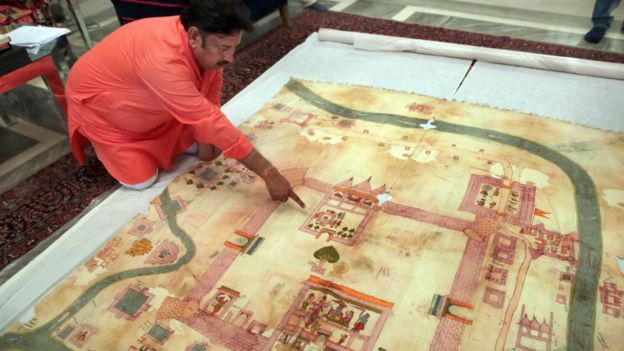
Image copyright AFPImage caption The dispute turned to violence in 1992 when a Hindu mob destroyed a mosque at the site
The Ayodhya dispute, which stretches back more than a century, is one of India’s thorniest court cases and goes to the heart of its identity politics.
Hindus believe that Ayodhya, a city in the northern state of Uttar Pradesh, is the birthplace of one of their most revered deities, Lord Ram.
But Muslims say they have worshipped there for generations.
A court case pertaining to the ownership of the land has been dragging on in the Supreme Court for years, but a verdict is expected next month.
The court concluded its final hearing into the case on Wednesday.
What is the row actually about?
At the centre of the row is a 16th Century mosque that was demolished by Hindu mobs in 1992, sparking riots that killed nearly 2,000 people.
Many Hindus believe that the Babri Masjid was actually constructed on the ruins of a Hindu temple that was demolished by Muslim invaders.
Muslims say they offered prayers at the mosque until December 1949 when some Hindus placed an idol of Ram in the mosque and began to worship the idols.
Over the decades since, the two religious groups have gone to court many times over who should control the site.
Since then, there have been calls to build a temple on the spot where the mosque once stood.
The case currently being heard by five judges in the top court is to determine who the land in question belongs to.
A verdict is expected between 4 and 15 November.
Hinduism is India’s majority religion and is thought to be more than 4,000 years old. India’s first Islamic dynasty was established in the early 13th Century.
Who is fighting the case?
The long and complicated property dispute has been dragging in various courts for more than a century.
This particular case is being fought between three main parties – two Hindu groups and the Muslim Waqf Board, which is responsible for the maintenance of Islamic properties in India.
Image copyright GETTY IMAGES
The Hindu litigants are the Hindu Mahasabha, a right-wing political party, and the Nirmohi Akhara, which is a sect of Hindu monks.
They filed a title dispute in the Allahabad High Court in 2002, a decade after the mosque was demolished.
A verdict in that case was pronounced in September 2010 – it determined that the 2.77 acres of the disputed land would be divided equally into three parts.
The court ruled that the site should be split, with the Muslim community getting control of a third, Hindus another third and the Nirmohi Akhara sect the remainder. Control of the main disputed section, where the mosque once stood, was given to Hindus.
The judgement also made three key observations.
It affirmed the disputed spot was the birthplace of Lord Ram, that the Babri Masjid was built after the demolition of a Hindu temple and that it was not built in accordance with the tenets of Islam.
The Supreme Court suspended this ruling in 2011 after both Hindu and Muslim groups appealed against it.
What are the other important legal developments?
In 1994 the Supreme Court, which was ruling on a related case, remarked that the concept of a mosque was “not integral to Islam”. This has bolstered the case made by Hindus who want control of the entire site.
In April 2018, senior lawyer Rajeev Dhavan filed a plea before the top court, asking judges to reconsider this observation.
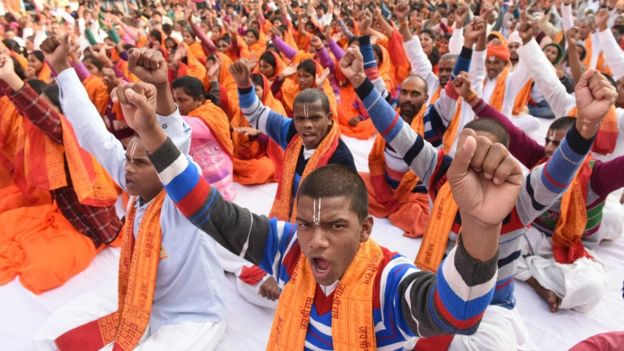
Image copyright GETTY IMAGESImage caption Hindu activists are demanding the construction of the Ram Temple
Have religious tensions eased in India in recent years?
Ever since the Narendra Modi-led Hindu nationalist BJP first came to power in 2014, India has seen deepening social and religious divisions.
The call for the construction of a Hindu temple in Ayodhya has grown particularly loud, and has mostly come from MPs, ministers and leaders from the BJP since it took office.
Restrictions on the sale and slaughter of cows – considered a holy animal by the majority Hindus – have led to vigilante killings of a number of people, most of them Muslims who were transporting cattle.
An uninhibited display of muscular Hindu nationalism in other areas has also contributed to religious tension.
Most recently, the country’s home minister Amit Shah said he would remove “illegal migrants” – understood to be Muslim – from the country through a government scheme that was used recently in the north-eastern state of Assam.
Nepali President Bidya Devi Bhandari hosts a grand farewell ceremony for Chinese President Xi Jinping at the airport in Kathmandu, Nepal, Oct. 13, 2019. Nepali Vice President Nanda Bahadur Pun, Prime Minister K.P. Sharma Oli, Chairman of the National Assembly Ganesh Prasad Timilsina, cabinet members and senior army generals also attended the ceremony. Chinese President Xi Jinping returned to Beijing from Kathmandu on Sunday. (Xinhua/Gao Jie)
BEIJING, Oct. 13 (Xinhua) — Chinese President Xi Jinping returned to Beijing Sunday evening after his second informal meeting with Indian Prime Minister Narendra Modi in India and a state visit to Nepal.
Xi’s entourage, including Ding Xuexiang, member of the Political Bureau of the Communist Party of China (CPC) Central Committee, member of the Secretariat of the CPC Central Committee, and director of the General Office of the CPC Central Committee; Yang Jiechi, member of the Political Bureau of the CPC Central Committee and director of the Office of the Foreign Affairs Commission of the CPC Central Committee; State Councilor and Foreign Minister Wang Yi; and He Lifeng, vice chairman of the National Committee of the Chinese People’s Political Consultative Conference and head of the National Development and Reform Commission, also returned to Beijing on the same plane.
As Xi and his entourage were leaving Kathmandu on Sunday noon local time, people of Nepal flocked to both sides of a road leading to the airport, waving flags and playing music to see the Chinese guests off.
Nepali President Bidya Devi Bhandari hosted a grand farewell ceremony for Xi at the airport. Nepali Vice President Nanda Bahadur Pun, Prime Minister K.P. Sharma Oli, Chairman of the National Assembly Ganesh Prasad Timilsina, cabinet members and senior army generals also attended the ceremony, which featured a 21-gun salute and the playing of national anthems of China and Nepal.
Calling his visit to Nepal a “very successful” one, Xi told Bhandari that upon his arrival, he had been warmly welcomed by the Nepali government and people.
Xi said he was convinced that the China-Nepal friendship enjoyed lasting popularity among the two peoples and will be unbreakable.
Expressing his appreciation for the arrangements made by the Nepali president, government and people, Xi said he was very satisfied with the visit that had resulted in the upgrading of bilateral relations.
He called for joint efforts to further develop the friendly relations between the two countries.
Bhandari said Xi’s successful and fruitful visit has become a milestone in the history of bilateral ties.
The Nepal-China relationship has entered a new era and stepped on a new height, Bhandari said, adding that Nepal will resolutely work with China to promote friendly and good neighborly relations and strategic cooperative partnership.
Beijing joins global condemnation of attack launched by Ankara on Kurdish fighters after US President Donald Trump decided to pull out troops
Foreign ministry spokesman says issue should be resolved with ‘political solutions’ and the operation may result in a revival of Islamic State
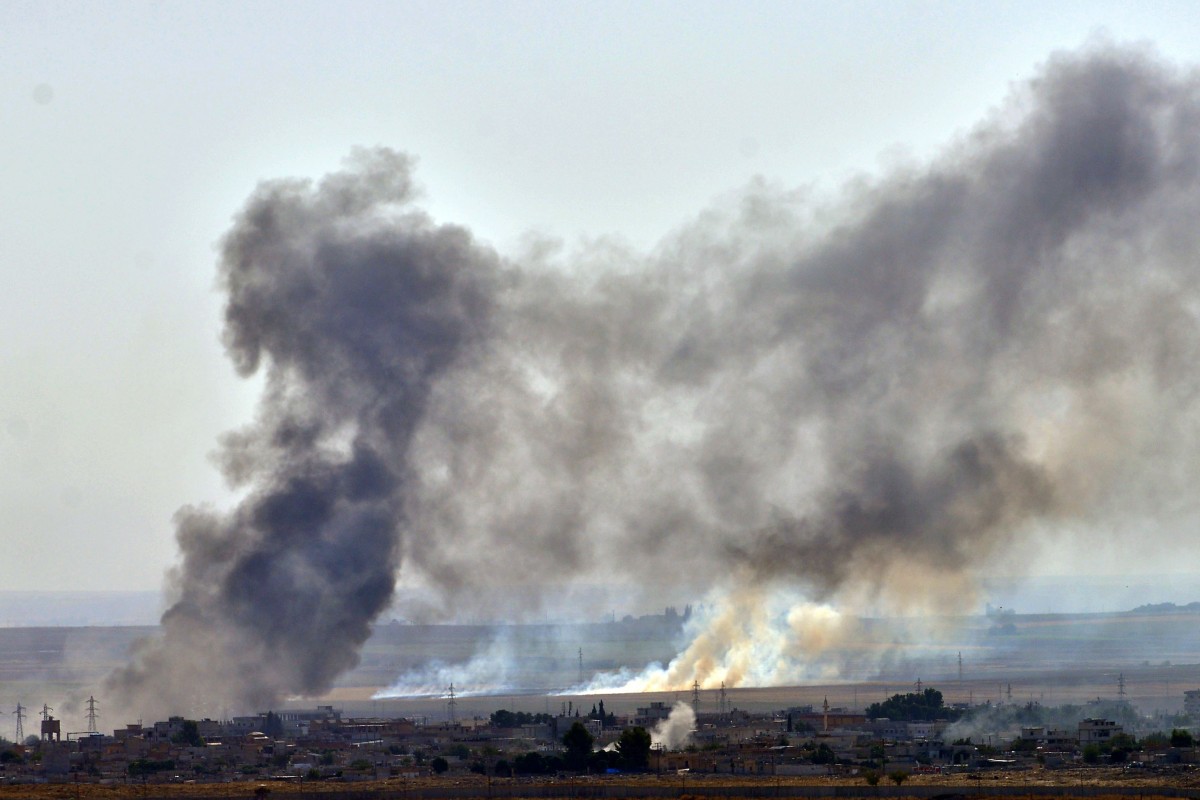
Turkey launched the attack on Kurdish fighters in northeastern Syria last week. Photo: Xinhua
China has urged Turkey to stop the military offensive it began in northeastern Syria last week and “return to the right track”.
Beijing is the latest to join global condemnation of the cross-border attack launched by Ankara on Kurdish fighters last Wednesday following US President Donald Trump’s decision to withdraw US troops from the region.
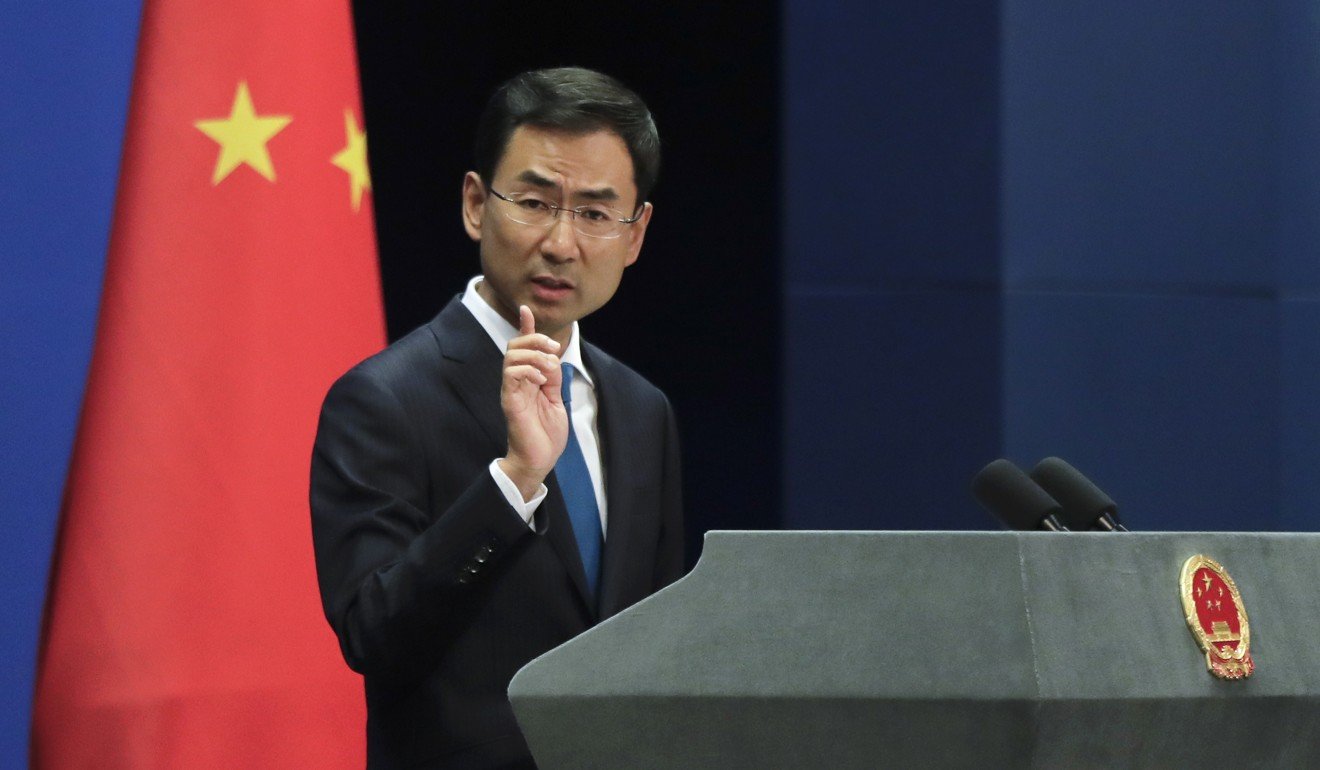
Foreign ministry spokesman Geng Shuang on Tuesday called for a ceasefire.
“The Chinese side has always opposed the use of force in international relations and has advocated for adherence to the Charter of the United Nations, and to resolve problems through political and diplomatic channels,” Geng said during a regular press briefing, when asked about Beijing’s position on the situation.
“Sovereignty, independence, unification and territorial integrity should be respected and protected,” he said. “We urge Turkey to halt military action and to return to the right track, resolving the issue with political solutions.”
Chinese foreign ministry spokesman Geng Shuang called on Turkey to “work with the international community in fighting against terrorism”. Photo: AP
Geng also said the “anti-terrorism situation in Syria is still severe”, and the military operation could result in a comeback by Islamic State.
“We urge Turkey to take responsibility and work with the international community in fighting against terrorism,” he said.
Explained: why are Syria’s Kurds accusing the US of betrayal?
Trump’s move has drawn sharp criticism from around the world. Critics say he has abandoned the allies that helped fight against Isis, and that withdrawing troops could pave the way for a resurgence of the jihadist group whose violent takeover of Syrian and Iraqi land five years ago was the reason US forces went in.
The US president said about 1,000 US troops who had been partnering with local Kurdish fighters to battle Islamic State in northern Syria were leaving the country. He said they would remain in the Middle East to “monitor the situation” and to prevent a revival of Isis – a goal that even Trump’s allies say has become much more difficult as a result of the US pull-out.
Turkey says the offensive aims to remove the Kurdish-led Syrian Democratic Forces from the border area and create what it calls a “safe zone” to relocate 1 million Syrian refugees.
on Turkey, halted bilateral trade negotiations and called for an immediate ceasefire.
Vice-President Mike Pence also said Trump was sending him to the Middle East because the president was concerned about instability in the region.
Beijing has long worried that conflict in the region could spill over to Chinese soil after thousands of Uygurs – the Turkic-speaking Muslim minority from far western China – travelled to Syria to train and fight as jihadists.
HANOI (Reuters) – Vietnamese President and Communist Party chief Nguyen Phu Trong has called for restraint in the disputed South China Sea amid a tense months-long standoff between Chinese and Vietnamese ships, state media reported on Tuesday.
China claims almost all the energy-rich waters but neighbours Brunei, Malaysia, the Philippines, Taiwan and Vietnam also have claims.
Tension escalated when Beijing dispatched a research ship to conduct an energy survey in waters controlled by Vietnam in July.
“On the subject of foreign policy, including the East Sea issue, the General Secretary stressed the importance of maintaining a peaceful and stable environment, and resolutely fighting to protect Vietnam’s independence, sovereignty and territorial integrity,” the state-run Voice of Vietnam (VOV) said on its website.
The South China Sea is known as the East Sea in Vietnam.
Vietnam has good relations with China but should “never compromise” on its sovereignty and territorial integrity, VOV quoted Trong as saying.
The Chinese vessel, the Haiyang Dizhi 8, was continuing its survey in Vietnam’s exclusive economic zone late on Tuesday, under escort from at least three Chinese ships, according to data from Marine Traffic, a website that tracks vessel movements.
Vietnam’s foreign ministry has repeatedly accused the vessel and its escorts of violating its sovereignty and has demanded that China remove its ships from the area.
On Sunday, Vietnam pulled DreamWorks’ animated film “Abominable” from cinemas over a scene featuring a map which shows China’s unilaterally declared “nine-dash line” in the South China Sea.
The U-shaped line is used on Chinese maps to illustrate its claims, including large swathes of Vietnam’s continental shelf, where it has awarded oil concessions.
In August, police broke up a brief protest outside the Chinese embassy in Hanoi over the survey vessel.
Trong has made more public appearances in recent weeks after suffering from an unspecified illness..
The 75-year-old has presided over a widespread crackdown on corruption in the Southeast Asian country that has seen several high-ranking ministers and politicians, including one Politburo member, sent to prison on charges ranging from embezzlement to economic mismanagement.
Nyima Cering (R), deputy director of the Standing Committee of the Tibet Autonomous Region People’s Congress, poses for a group photo with President of Zurich City Parliament Heinz Schatt in Zurich, Switzerland, Oct. 11, 2019. A Tibetan delegation of the Chinese National People’s Congress (NPC), led by Nyima Cering, visited Switzerland from Wednesday to Sunday. (Photo by Ruben Sprich/Xinhua)
ZURICH, Switzerland, Oct. 13 (Xinhua) — A Tibetan delegation of the Chinese National People’s Congress (NPC) visited Switzerland from Wednesday to Sunday and briefed Swiss lawmakers and officials on Tibet’s historic achievements in economic and social development.
The delegation, led by Nyima Cering, deputy director of the Standing Committee of the Tibet Autonomous Regional People’s Congress, met with First Vice President of the Swiss Council of States Hans Stockli, Deputy Governor of Canton of Bern Pierre Alain Schnegg, President of Zurich City Parliament Heinz Schatt and local Chinese compatriots.
Based on his personal experience and citing detailed figures, Nyima Cering recounted the major economic and social developments in Tibet in the past 60 years since the start of democratic reform there, thanks to the full support of the central government, assistance from all over the country and the concerted efforts of all ethnic groups in Tibet.
Stockli applauded the major economic and social developments in Tibet, and expressed the willingness to enhance mutual understanding to boost China-Switzerland exchanges and cooperation between legislative bodies.





 CHINDIA ALERT: You'll be living in their world, very soon