Chindia Alert: You’ll be Living in their World Very Soon
aims to alert you to the threats and opportunities that China and India present. China and India require serious attention; case of ‘hidden dragon and crouching tiger’.
Without this attention, governments, businesses and, indeed, individuals may find themselves at a great disadvantage sooner rather than later.
The POSTs (front webpages) are mainly 'cuttings' from reliable sources, updated continuously.
The PAGEs (see Tabs, above) attempt to make the information more meaningful by putting some structure to the information we have researched and assembled since 2006.
BEIJING (Reuters) – The Chinese military suffered casualties in a border clash with Indian soldiers, the editor-in-chief of China’s Global Times newspaper said on Tuesday.
“Based on what I know, Chinese side also suffered casualties in the Galwan Valley physical clash,” Hu Xijin said in a tweet. He did not give further details.
The Global Times is published by the People’s Daily, the official newspaper of China’s ruling Communist Party.
BEIJING (Reuters) – Several districts in Beijing reinstated security checkpoints, ordered residents be tested and closed schools on Monday in response to an unexpected resurgence of the coronavirus in the Chinese capital.People wearing face masks commute inside a subway station during morning rush hour, following new cases of coronavirus disease (COVID-19) infections in Beijing, China June 15, 2020. REUTERS/Tingshu Wang
After nearly two months with no new infections, Beijing officials have reported 79 cases over the past four days, the biggest concentration of infections since February.
The return of COVID-19 in Beijing has shrouded the city, home to the headquarters of many big corporations, in uncertainty at a time China is trying to shake off the economic torpor of the virus.
“The risk of the epidemic spreading is very high, so we should take resolute and decisive measures,” Xu Hejiang, spokesman at the Beijing city government, said at a press conference on Monday.
The outbreak has been traced to the city’s Xinfadi, the biggest wholesale food market in Asia, where thousands of tonnes of vegetables, fruits and meats change hands each day.
A complex of warehouses and trading halls spanning an area the size of nearly 160 soccer pitches, Xinfadi is more than 20 times larger than the seafood market in Wuhan where the outbreak was first identified.
The spate of new cases prompted officials in many parts of the city to swiftly bring back tough counter-epidemic measures, with at least three districts entering “war-time mode.”
Measures imposed included erecting round-the-clock security checkpoints, closing schools and sports venues, and reinstating temperature checks at malls, supermarkets and office buildings.
Some districts also dispatched officials to residential compounds in what they described as a “knock, knock” operation to identify people who have visited Xinfadi or been in contact with somebody who has.
Beijing began testing on masse on Sunday, conducting tens of thousands of examinations.
Samples of 8,950 people who were identified as recently being at Xinfadi had been collected as of early Monday, said Gao Xiaojun, a spokesperson for the Beijing public health commission, at Monday’s briefing. Results from the 6,075 tested so far were negative, Gao said.
A vegetable wholesaler at Xinfadi said he had to stay in quarantine for 14 days at a designated hotel even after his test was negative.
“I’ve to take another test after the 14 days,” he said, speaking on condition of anonymity.
The World Health Organization said on Sunday it was informed of the outbreak and a subsequent investigation by Chinese officials.
“WHO understands that genetic sequences will be released as soon as possible once further laboratory analyses are completed,” it said in a statement.
An epidemiologist with the Beijing government said on Sunday a DNA sequencing of the virus showed the Xinfadi outbreak could have come from Europe.
SPREAD CONCERNS
Governments in some other cities and provinces warned their residents against non-essential travel to the capital, and implemented isolation protocols for some visitors from the capital.
Wang Xiaoyang, who works in public relations in the southern boomtown of Shenzhen, said she received a text message from local authorities telling her to stay at home for 14 days after returning from Beijing on Friday.Slideshow (6 Images)
The northeastern Liaoning province and northern Hebei province reported a combined handful of cases connected to the Beijing infections. Sichuan in the southwest reported one suspected case.
Baoding, a highly industrialised city in Hebei about 150 kilometres southwest of Beijing, was closely monitoring entry. “Every gate to Baoding should be strictly guarded to prevent the contagion from spreading in the city,” state media quoted Baoding officials as saying.
A man carries his bicycle as he crosses a flooded road after heavy rains in Ahmedabad, June 8, 2020. REUTERS/Amit Dave
MUMBAI (Reuters) – Annual monsoon rains key to farm output and economic growth have covered more than a third of India and could spread further into its eastern and western regions this week, the weather office said on Thursday.
The rains are critical for farming, which makes up about 15 percent of Asia’s third-biggest economy at a size of nearly $2 trillion, since about 55% of arable land in the south Asian nation is rain-fed.
“Conditions are becoming favourable for further advance of southwest monsoon into more parts of the central Arabian Sea and Maharashtra,” the India Meteorological Department (IMD) said in a statement.
In the next 48 hours, the monsoon would also advance into some more parts of the eastern states of Odisha and West Bengal, it added.
The western state of Maharashtra is India’s second biggest producer of cotton, soybean and sugar, while West Bengal is the top rice producer.
The monsoon’s progress will help farmers speed up sowing of summer crops such as soybean, cotton, rice and pulses.
Since the season began on June 1, the rains brought by the monsoon have been 32% greater than normal, weather department data shows, particularly as a cyclone, Nisarga, brought heavy rain last week to the west coast.
India is likely to receive above average monsoon rain for the second straight year in 2020, the IMD said this month, boosting hopes for higher farm output in an economy reeling under the impact of the coronavirus.
FILE PHOTO: A worker walks past the logo of Reserve Bank of India (RBI) inside its office in New Delhi, India July 8, 2019. REUTERS/Anushree Fadnavis/File Photo
NEW DELHI (Reuters) – India’s central bank proposed on Thursday stricter governance rules for commercial banks, following a series of financial and governance problems at lenders in recent months.
The Reserve Bank of India’s (RBI) proposal includes limiting the length of time a major shareholder can serve as CEO to 10 years; setting clear divisions of responsibilities between a bank’s board and management; and improving the supervisory oversight of senior management.
In a 74-page document drawn up for a public consultation on the plan, the RBI said the objective of tougher guidelines was to “align the current regulatory framework with global best practices while being mindful of the context of (the) domestic financial system.”
In the past six months the RBI has stepped in to take control of three major financial institutions following financial problems.
Dewan Housing Finance Corp (DWNH.NS), one of the country’s biggest housing finance companies was rescued as it owed creditors billions of dollars, and the RBI took control of Punjab & Maharashtra Co-operative Bank after the central bank said it found irregularities including under-reporting of bad loans.
In March it also rescued Yes Bank (YESB.NS), then the country’s fifth-largest private lender, as it reeled under a mountain of bad loans due to its exposure to troubled shadow lenders and real estate companies.
“Recent events in a dynamic and rapidly evolving financial landscape have led to increasing scrutiny of the role of promoter(s), major shareholder(s) and senior management vis-a-vis the role of a board,” the RBI said.
MUMBAI (Reuters) – Annual monsoon rains key to farm output and economic growth have covered more than a third of India and could spread further into its eastern and western regions this week, the weather office said on Thursday.
The rains are critical for farming, which makes up about 15 percent of Asia’s third-biggest economy at a size of nearly $2 trillion, since about 55% of arable land in the south Asian nation is rain-fed.
“Conditions are becoming favourable for further advance of southwest monsoon into more parts of the central Arabian Sea and Maharashtra,” the India Meteorological Department (IMD) said in a statement.
In the next 48 hours, the monsoon would also advance into some more parts of the eastern states of Odisha and West Bengal, it added.
The western state of Maharashtra is India’s second biggest producer of cotton, soybean and sugar, while West Bengal is the top rice producer.
The monsoon’s progress will help farmers speed up sowing of summer crops such as soybean, cotton, rice and pulses.
Since the season began on June 1, the rains brought by the monsoon have been 32% greater than normal, weather department data shows, particularly as a cyclone, Nisarga, brought heavy rain last week to the west coast.
India is likely to receive above average monsoon rain for the second straight year in 2020, the IMD said this month, boosting hopes for higher farm output in an economy reeling under the impact of the coronavirus.
NEW DELHI (Reuters) – Indian and Chinese military commanders made progress in talks on Wednesday to defuse a standoff along their disputed border in the western Himalayas after pulling back some troops in confidence-building gestures, Indian government officials said.
Hundreds of soldiers have been ranged against each other in the remote snow desert of Ladakh since April in the most serious border flare-ups for years after Chinese patrols advanced into what India deems its side of the de facto border, Indian officials say. China claims the territory to be its own and has objected to the Indian construction of roads in the area.
The two sides made headway in their talks on Wednesday, officials in Delhi said, speaking on the condition of anonymity because of the sensitivity of the situation.
After weeks of tension including an incident in which patrolling soldiers from the two sides came to blows on the banks of Pangong Lake, resulting in injuries, friction has eased somewhat, one of the Indian officials said.
The two armies have since thinned out some forces in a positive signal but soldiers, tanks and other armoured carriers remained heavily deployed in the high-altitude region, the official said.
“There has been some kind of disengagement, there will be more talks to resolve this over the next days, it could be weeks even,” the official said. Another Indian official said the Chinese military had moved back some tents and vehicles from the forward areas but there was still a large presence.
China’s state-run Global Times quoted Foreign Ministry spokeswoman Hua Chunying as saying the two countries were communicating through diplomatic and military channels over issues concerning the border and that a “positive consensus” has been reached. It did not elaborate.
India and China fought a brief border war in 1962 and have not been able to settle their border despite two decades of talks. Both claim thousands of kilometres of territory and patrols along the undemarcated Line of Actual Control – the de-facto border – often run into each other, leading to tensions.
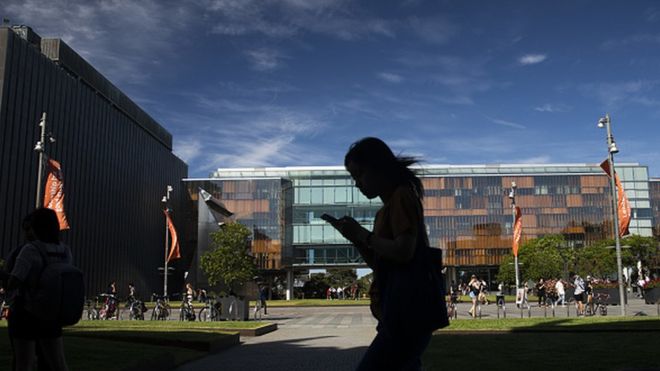
“The spread of the new global Covid-19 outbreak has not been effectively controlled, and there are risks in international travel and open campuses,” the ministry said. “During the epidemic, there were multiple discriminatory incidents against Asians in Australia.”
In response, Australian Education Minister Dan Tehan said the country was a “successful, multicultural society” which provides a “world-class education”.
He also made reference to Australia’s success in flattening its virus curve which meant that it was “one of the safest countries in the world for international students to be based in right now”.
What are the broader tensions?
The advisory marks the latest escalation in tensions between China and Australia during the coronavirus pandemic.
Relations worsened after Australia echoed the US in calling for an independent inquiry into the origins of the coronavirus, first detected in China late last year.
China has dismissed that call as politically motivated. It has since imposed a tariff and blocked shipments of some Australian imports, but has denied this is economic retaliation.
Last week, it also warned citizens against travelling to the country, saying there had been a “significant increase” in racist attacks on Asian people in Australia.
Image caption China has warned about a surge in racist attacks in Australia
Education and tourism are Australia’s third and fourth biggest exports overall, and significant contributors to the economy.
Students from China represented 28% of the more than 750,000 international students in Australia last year, government numbers show.
Australia’s universities have already faced financial difficulties during the pandemic, as border closures have deterred international students. Several institutions have said they are facing financial crisis.
Australia’s Tourism Minister Simon Birmingham said China’s assertions about the dangers to tourists had “no basis in fact”.
However, government bodies, community groups and media outlets have all catalogued hundreds of racist attacks and abuse on Asian people in Australia since the pandemic began.
In one of several high-profile incidents caught on film, a woman was accused of a racist attack on two students from the University of Melbourne in April.
Media caption Karen Ji spent 16 days in Bangkok to get around Australia’s Covid-19 ban on arrivals from mainland China
On Wednesday, a coalition of Australia’s leading universities called China’s advisory “unjustified”. The Group of Eight said they had asked the Chinese embassy in Australia for examples of racism, which were not provided.
“It is concerning that yet again, international education, and particularly with China, is yet again the pawn in a political game that is not of our making,” said chief executive Vicki Thomson.
However, Australia’s universities have long been accused by researchers of not providing better support to international students.
Surveys of Chinese students in Australia have found many struggle to develop stronger social bonds with their Australian-born peers due to existing prejudices.
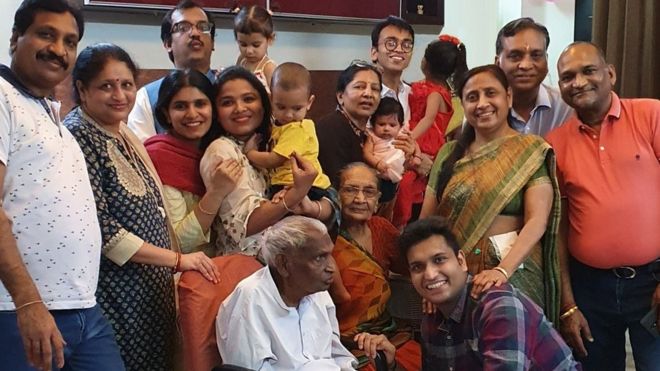
Image caption All 17 members of the Garg household
Mukul Garg wasn’t too worried when his 57-year-old uncle developed a fever on 24 April. Then, within 48 hours, two others in his family of 17 also became ill.
The symptoms trickled in as expected – temperatures spiked and voices grew hoarse with coughing.
Mr Garg initially chalked it up to seasonal flu, unwilling to admit it could be coronavirus.
“Five or six people often fall sick together in this house, let’s not panic,” he told himself.
Over the next few days, five more people in the house showed Covid-19 symptoms. And the pit in his stomach grew.
Soon, the Garg family would become its own coronavirus cluster as 11 of its 17 members tested positive.
“We met nobody from the outside and no-one entered our house. But even then the coronavirus entered our home, and infected one member after the other,” Mr Garg would later write in his blog, which has since attracted hundreds of comments from readers.
The exhaustive account shows how the multi-generational family, a mainstay of Indian life, poses a unique challenge in the fight against Covid-19.
The country’s stringent lockdown, which began on 25 March and lasted until this week, focused on keeping people at home, off its busy streets and out of packed public spaces.
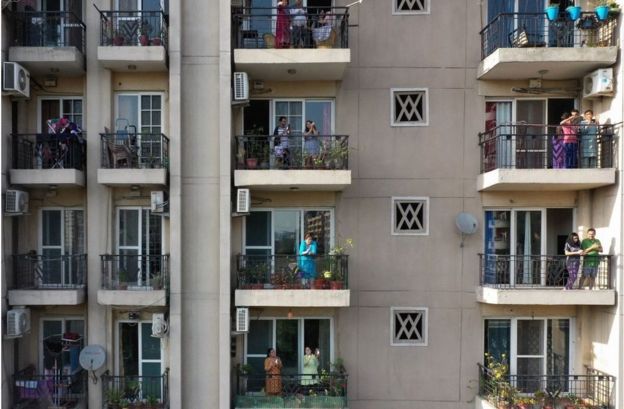
But in India – where 40% of households comprise many generations (often three or even four living together under one roof) – home is a crowded place.
“All families under lockdown become clusters the moment someone is infected, that is almost a given,” says virologist Dr Jacob John.
And, as the Gargs discovered, social distancing isn’t possible within large families, especially during a lockdown when you are already cut off from the outside world.
‘We felt so alone’
The Gargs live in a three-storey home in a packed neighbourhood in north-west Delhi.
Mr Garg, 33, his wife, 30, and their two children, aged six and two, live on the top floor, along with his parents and grandparents.
On the two floors below them live his uncles – his father’s brothers – and their families. Members range from a four-month-old baby to a bedridden grandfather of 90.
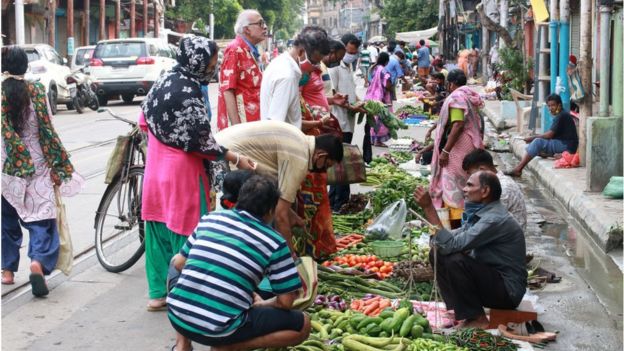
Image caption Mr Garg’s uncle may have caught the virus from a vegetable vendor
Contrary to cramped joint family homes where many people share a room and a bathroom, the Garg home is spacious. Each floor is about 250 square metres, roughly the size of a doubles tennis court, with three bedrooms, en suite bathrooms and a kitchen.
And yet, the virus spread quickly, travelling across floors and infecting almost all the adults in the house.
They identified patient zero – Mr Garg’s uncle – but the family is still not sure how he caught the virus.
“We think it could be from a vegetable vendor or from someone at the grocery store because that was the only time anyone from the family stepped outside,” he says.
But as the virus spread, fear and shame kept them from getting tested.
“We were 17 of us, but we felt so alone. We worried that if something happened to us, would anyone even come to the funeral because of the stigma associated with coronavirus?”
But in the first week of May, when his 54-year-old aunt complained of breathlessness, the family rushed her to a hospital. And, Mr Garg says, they knew they all had to get tested.
‘The month of the disease’
All of May was spent fighting the virus.
Mr Garg says he would spend hours talking to doctors over the phone, while everyone checked in on each other on WhatsApp daily.
“We also kept changing the position of the members depending on symptoms, so no two people with high fever were in the same room.”
Six of the 11 infected have co-morbidities – diabetes, heart disease and hypertension – which made them more vulnerable.
“Overnight, our home became a Covid-19 healthcare centre with all of us taking turns to play nurse,” Mr Garg says
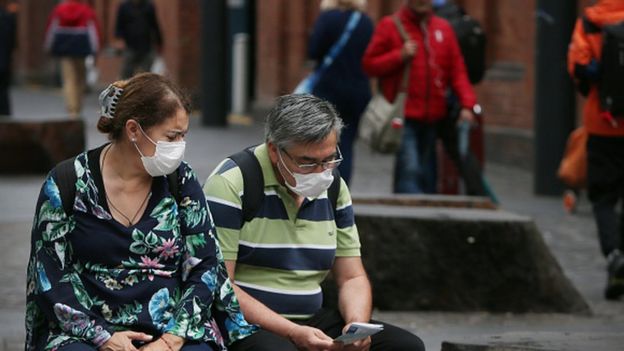
Image caption Families are particularly vulnerable to widespread infection in a lockdown
Virologists say large families are like any other cluster, except for the range in ages.
“When you have a range of age groups sharing common spaces, the risk is disproportionately distributed, with the elderly at most risk,” says Dr Partho Sarothi Ray, a virologist.
This weighed heavily on Mr Garg, who worried about his 90-year-old grandfather.
But the virus, which continues to confound medical experts around the world, also held surprises for the Gargs.
It wasn’t unusual that he and his wife, both in their early 30s, were asymptomatic. But it was bewildering that his grandfather was also asymptomatic. And one member of the family, who had no comorbidities, was taken to hospital. The others showed typical symptoms.
Mr Garg says he wrote the blog because he wanted to reach out to people worried about seeking help.
“In the beginning, we cared so much about what people would think. And reading the comments, it’s so nice to see people saying it’s ok if you get it, it’s not something to be ashamed of.”
In the second week of May, symptoms began to vanish and the family watched as more and more negative tests rolled in, bringing relief. This was also when Mr Garg’s aunt was discharged from hospital after testing negative.
They finally felt like the worst was over.
By the end of May – “the month of the disease” as Mr Garg called it – only three people, including him, were still positive.
On 1 June, they got tested for the third time and the results came back negative.
‘Our best and worst’
India’s large families can be a source of support and care, but also friction and thorny property disputes. But at times like these they can also come to the rescue.
“Can you imagine an elderly person in quarantine all by themselves with no-one to help? Despite the challenges, joint families benefit from the young taking care of the old,” Dr John says.
Cases in India have sprinted past the 250,000-mark, spurring a debate over whether the pandemic could threaten extended families, as young people worry about carrying the infection home to older relatives.
Image caption India re-opened this week after a strict lockdown
“It’s a system that has survived hundreds of years of an onslaught of Western values and colonisation,” says Prof Kiran Lamba Jha, who teaches sociology at Kanpur’s CSJM university. “Coronavirus is not going to destroy the joint family.”
The Gargs would agree.
Before the virus struck, the family was thriving. It was almost reminiscent of a 90s Bollywood flick, Mr Garg says.
“As a family, we had never spent so much time together than we did that first one month of the lockdown. It was also the happiest the family had ever been,” he says, adding that it only made it harder to watch as one person after another fell sick.
“We saw each other at our best and worst but we came out of it stronger,” he says.
“We’re still cautious about reinfection but right now, we’re basking in the glory that we managed to beat this virus and come out on the other side.”
LONDON (Reuters) – The coronavirus might have been spreading in China as early as August last year, according to Harvard Medical School research based on satellite images of hospital travel patterns and search engine data, but China dismissed the report as “ridiculous”.
FILE PHOTO: A computer image created by Nexu Science Communication together with Trinity College in Dublin, shows a model structurally representative of a betacoronavirus which is the type of virus linked to COVID-19, better known as the coronavirus linked to the Wuhan outbreak, shared with Reuters on February 18, 2020. NEXU Science Communication/via REUTERS
The research used satellite imagery of hospital parking lots in Wuhan – where the disease was first identified in late 2019 – and data for symptom-related queries on search engines for things such as “cough” and “diarrhoea”.
“Increased hospital traffic and symptom search data in Wuhan preceded the documented start of the SARS-CoV-2 pandemic in December 2019,” according to the research.
“While we cannot confirm if the increased volume was directly related to the new virus, our evidence supports other recent work showing that emergence happened before identification at the Huanan Seafood market (in Wuhan).”
“These findings also corroborate the hypothesis that the virus emerged naturally in southern China and was potentially already circulating at the time of the Wuhan cluster,” according to the research.
It showed a steep increase in hospital car park occupancy in August 2019.
“In August, we identify a unique increase in searches for diarrhoea which was neither seen in previous flu seasons or mirrored in the cough search data,” according to the research.
Chinese Foreign Ministry spokeswoman Hua Chunying, asked about the research at a daily press briefing on Tuesday, dismissed the findings.
“I think it is ridiculous, incredibly ridiculous, to come up with this conclusion based on superficial observations such as traffic volume,” she said.
The two B777 aircraft will be operated by pilots of the Indian Air Force and not of Air India.
PTI | New Delhi | June 8, 2020 5:46 pm
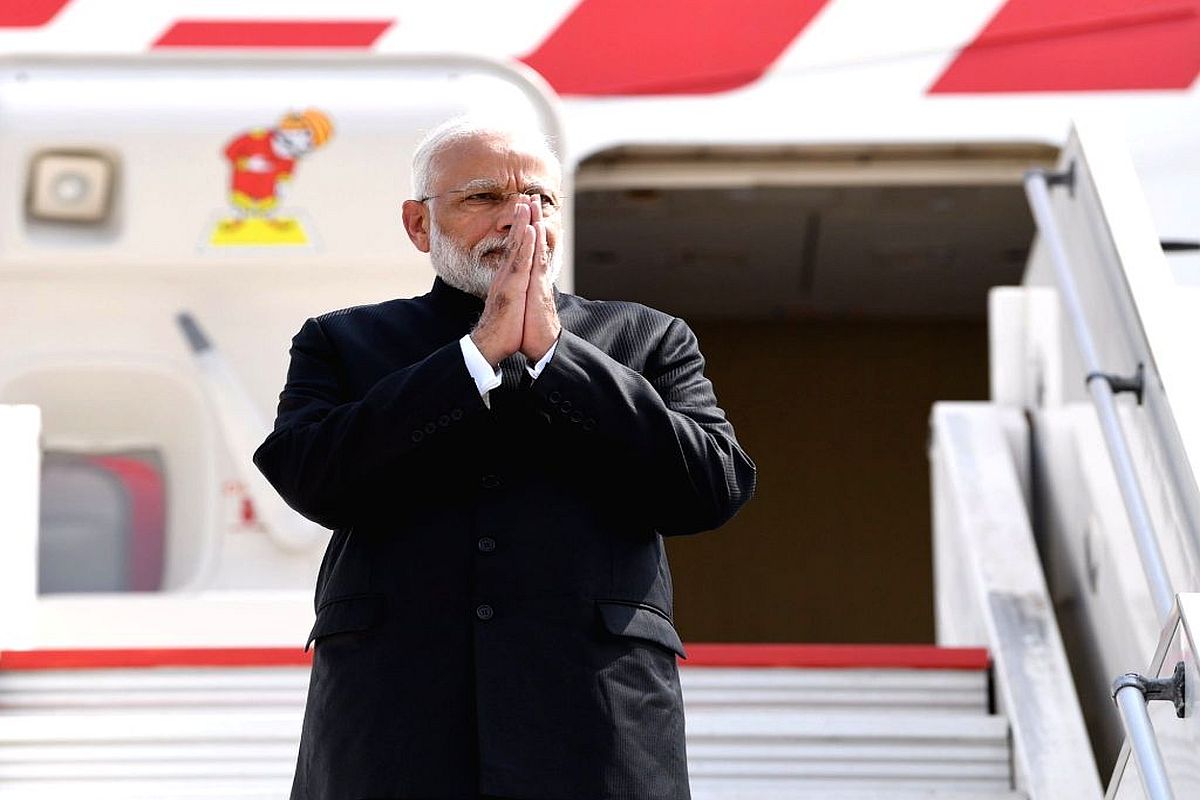
Currently, the Prime Minister, the President and the Vice President fly on Air India”s B747 planes, which have the call sign ”Air India One”. (Photo: IANS)
Two custom-made B777 aircraft, which will be used to fly Prime Minister Narendra Modi and other top Indian dignitaries, are likely to be delivered by Boeing to Air India by September, senior officials said, on Monday.
In October last year, government officials had said that the delivery of these two planes, which are earmarked for VVIP travel only, would be done by July.
“There has been some delay, primarily because of COVID-19. The two planes are likely to be delivered by September,” the officials said on Monday.
The two B777 aircraft will be operated by pilots of the Indian Air Force and not of Air India.




 CHINDIA ALERT: You'll be living in their world, very soon