26/04/2019

China eyes new regional development plans to bolster growth

BEIJING, April 26 (Xinhua) — Chinese authorities are looking to renew regional development plans for the country’s less developed western and northeastern regions to bolster broader growth, according to a report by the China Securities Journal.

New guidelines on advancing western development in the new era are set to be released soon, which will focus more on environmental protection and implementation of the Belt and Road Initiative, said the paper.

Supply-side structural reforms will be deepened, and technology innovation will be encouraged in the west to foster high-quality growth.

After China put forward the West Development Strategy in 1999, the country’s western regions have achieved remarkable progress in the past decades.

Since 2012, the western regions have sustained an average annual GDP growth rate of 8.9 percent, 1.8 percentage points higher than the national growth rate, suggesting an ever-shrinking development gap between the country’s east and west.

The upgraded strategy is likely to unleash another round of fast growth for the west, and industries including construction and machinery will benefit the most as infrastructure construction will remain a focus, the paper cited Xu Liying, an analyst with Lang Steel Information Research Center.

The paper also reported that plans on reviving the country’s northeastern regions had been drafted for further deliberations.

In recent years, the northeast, an old industrial base, has faced more difficulties than the rest of the country as the region relies largely on heavy and chemical industries, energy resources, raw materials and a large number of state-owned enterprises.

The government has already released a set of measures aimed at revitalizing the northeast, but more efforts are needed to optimize industrial structure and improve the business environment to narrow the development gap with the rest of the country, said the paper.

The upcoming regional plans came as the government seeks to tap development potential in less-developed regions to support growth while reducing regional disparities.

Official data showed the Chinese economy expanded 6.4 percent year on year in the first quarter, remaining flat with the GDP expansion in the previous quarter.

Source: Xinhua

26/04/2019

Interview: Belt and Road helps Latin America to achieve UN 2030 agenda, says ECLAC official

BEIJING, April 26 (Xinhua) — The China-proposed Belt and Road Initiative (BRI) facilitates the compliance with the UN 2030 Agenda for Sustainable Development and the realization of the 17 Sustainable Development Goals in Latin America, said a senior official of a UN body based in Latin America.

Mario Cimoli, deputy executive secretary of the Economic Commission for Latin America and the caribbean (ECLAC), made the remarks in an interview with Xinhua.

Also as chief of the division of production, productivity and management of ECLAC, Cimoli has arrived in Beijing to participate in the second Belt and Road Forum for International Cooperation on April 25-27.

So far, 18 Latin American countries have signed the Memorandum of Understanding on jointly building the Belt and Road cooperation with China.

“The countries in Latin America view China as a fundamental actor,” he said. “The fact that 18 Latin American countries have joined the Belt and Road Initiative means that these countries think that China is necessary and China is also aware of the importance of dialogue. It’s a historical process.”

In his opinion, the BRI makes “greater integration, greater multilateralism and more dialogue” possible and “does good to Latin America.”

He said that both the 2030 Agenda and the BRI seek sustainable development and reduction of inequality and poverty, without contradicting with the proper model of each country.

“Given that the growth rates of Latin America will not be very high for the next few years, a rational process of cooperation such as the Belt and Road will surely help the region and allow each country to seek and improve their model of development and growth,” the ECLAC official said.

The BRI is a much more horizontal dialogue, a platform, in that sense that it is a process that helps and allows a much more positive coexistence despite current global tensions, he said.

In the dialogue with China, Latin America can demonstrate the importance of being an integrated area of trade, policies, and infrastructures in order to trade better with Asia, he said.

Cimoli also affirmed that the incorporation of new technologies in Latin America is a course under discussion, and dialogue with China can accelerate and improve the process.

Cimoli said his one observation of his ongoing China trip is the extensive use of electronic commerce among ordinary people.

He said when he went out to buy something, he found almost everyone use e-payments.

The way in which technologies immerge into the daily life of Chinese citizens is an example and would be a valuable contribution of China to the world and especially to Latin America, Cimoli said.

“The example of China shows the role that a state should play to trigger the technological development. In this dialogue with China, Latin America surely has to learn from the pragmatism of China,” he said.

The ECLAC official mentioned that China invests over 2 percent of its GDP in science and technology, while the average investment of Latin American countries in the field is between 0.4 and 0.5 percent of its GDP, plus, it appears to be swaying instead of stable state policies.

“There is a lot of cooperation to be done, much experience to be shared and much a platform for dialogue like the Belt and Road Initiative could do,” said Cimoli.

Source: Xinhua

26/04/2019

Chinese top legislator meets Malaysian prime minister

(BRF)CHINA-BEIJING-LI ZHANSHU-MALAYSIAN PM-MEETING (CN)

Li Zhanshu (R), chairman of the Standing Committee of the National People’s Congress, meets with Malaysian Prime Minister Mahathir Mohamad, who is here to attend the Second Belt and Road Forum for International Cooperation, in Beijing, capital of China, April 25, 2019. (Xinhua/Zhang Ling)

BEIJING, April 25 (Xinhua) — Li Zhanshu, chairman of the Standing Committee of the National People’s Congress, on Thursday met with Malaysian Prime Minister Mahathir Mohamad, who is here to attend the Second Belt and Road Forum for International Cooperation.

Li said China is willing to work with Malaysia to implement the consensus reached by the leaders of the two countries and outcomes to be achieved at the Second Belt and Road Forum for International Cooperation.

He asked for enhanced cooperation between the two countries in agriculture, fishery, e-commerce, technological innovation and people-to-people exchanges, as well as parliamentary exchange and mutual learning in state governance, legislation and supervision.

Mahathir said Malaysia welcomes the Belt and Road Initiative and is willing to learn from China’s development experience and strengthen bilateral cooperation in all areas.

Source: Xinhua

26/04/2019

Premier Li meets Philippine president

(BRF)CHINA-BEIJING-LI KEQIANG-PHILIPPINE PRESIDENT-MEETING (CN)

Chinese Premier Li Keqiang (R) meets with Philippine President Rodrigo Duterte, who is here to attend the Second Belt and Road Forum for International Cooperation, in Beijing, capital of China, April 25, 2019. (Xinhua/Li Tao)

BEIJING, April 25 (Xinhua) — Chinese Premier Li Keqiang on Thursday met with Philippine President Rodrigo Duterte, who is here to attend the Second Belt and Road Forum for International Cooperation.

China and the Philippines are neighbors facing each other across the sea, and their development and stability is closely related, Li said, adding that bilateral relations had achieved positive turnaround and consolidation, and had been progressing on the right track, after the joint efforts of the two sides over the past three years.

China is willing to see new achievements in the economic and social development of the Philippines, and align the Belt and Road Initiative (BRI) with the “Build, Build, Build” program of the Philippines, he said.

Peace and stability in the South China Sea is in line with the common interests of China, the Philippines and other countries in the region, Li added.

China supports the Philippines in fulfilling its responsibilities as the country coordinator for China-ASEAN relations, and expects negotiations on the Code of Conduct (COC) in the South China Sea to be completed soon, Li said.

Li also expressed confidence that countries around the South China Sea will be able to jointly safeguard peace and stability in the region with wisdom, adding that it is necessary to properly manage existing issues through dialogue and consultation, so as to realize common development.

Noting the contribution of the BRI to global prosperity and connectivity, Duterte said the Philippines is ready to deepen the cooperation with China under the BRI framework.

The Philippines will further improve its business environment, and welcomes more investments from Chinese companies, said the president.

Duterte said the Philippines will firmly make the South China Sea a sea of peace, friendship and cooperation, and is looking forward to working with other parties to conclude the negotiations on the COC as soon as possible.

Source: Xinhua

26/04/2019

Xi meets Indonesian vice president

(BRF)CHINA-BEIJING-XI JINPING-INDONESIAN VICE PRESIDENT-MEETING (CN)

Chinese President Xi Jinping (R) meets with Indonesian Vice President Jusuf Kalla, who is here to attend the Second Belt and Road Forum for International Cooperation, in Beijing, capital of China, April 25, 2019. (Xinhua/Wang Ye)

BEIJING, April 25 (Xinhua) — Chinese President Xi Jinping on Thursday met with Indonesian Vice President Jusuf Kalla, who is here to attend the Second Belt and Road Forum for International Cooperation.

Xi received a letter from Indonesian President Joko Widodo handed over by Kalla, and asked Kalla to convey his sincere greetings to the Indonesian president.

“I proposed the 21st Century Maritime Silk Road during my visit to Indonesia,” Xi said, adding that the two countries have made new progress in bilateral relations and achieved remarkable results in cooperation in various fields over the past few years by taking the Belt and Road Initiative as an opportunity.

Aligning the joint building of the Belt and Road and Indonesia’s Global Maritime Axis is the overall framework of the bilateral cooperation in the new era, Xi said.

Both sides should identify key areas and directions for cooperation as soon as possible, and implement key projects such as the Jakarta-Bandung High-Speed Railway, he said.

“I have proposed to build a new model of international relations featuring mutual respect, fairness, justice and win-win cooperation, with an aim to give a Chinese solution to the problems in today’s world,” Xi said.

That is in line with the “Ten Principles of Bandung Conference” jointly advocated by China and Indonesia 64 years ago, Xi said.

The two sides should communicate and coordinate closely, jointly safeguard the legitimate rights and interests of developing countries, and build a community with a shared future for humanity, Xi said.

Kalla said that Indonesia is an important partner in international cooperation under the Belt and Road Initiative, and is willing to strengthen exchanges and cooperation with China in trade, investment, education and other fields.

Indonesia is willing to work with China to firmly uphold multilateralism, and jointly promote global and regional peace, stability and prosperity, Kalla said.

Source: Xinhua

26/04/2019

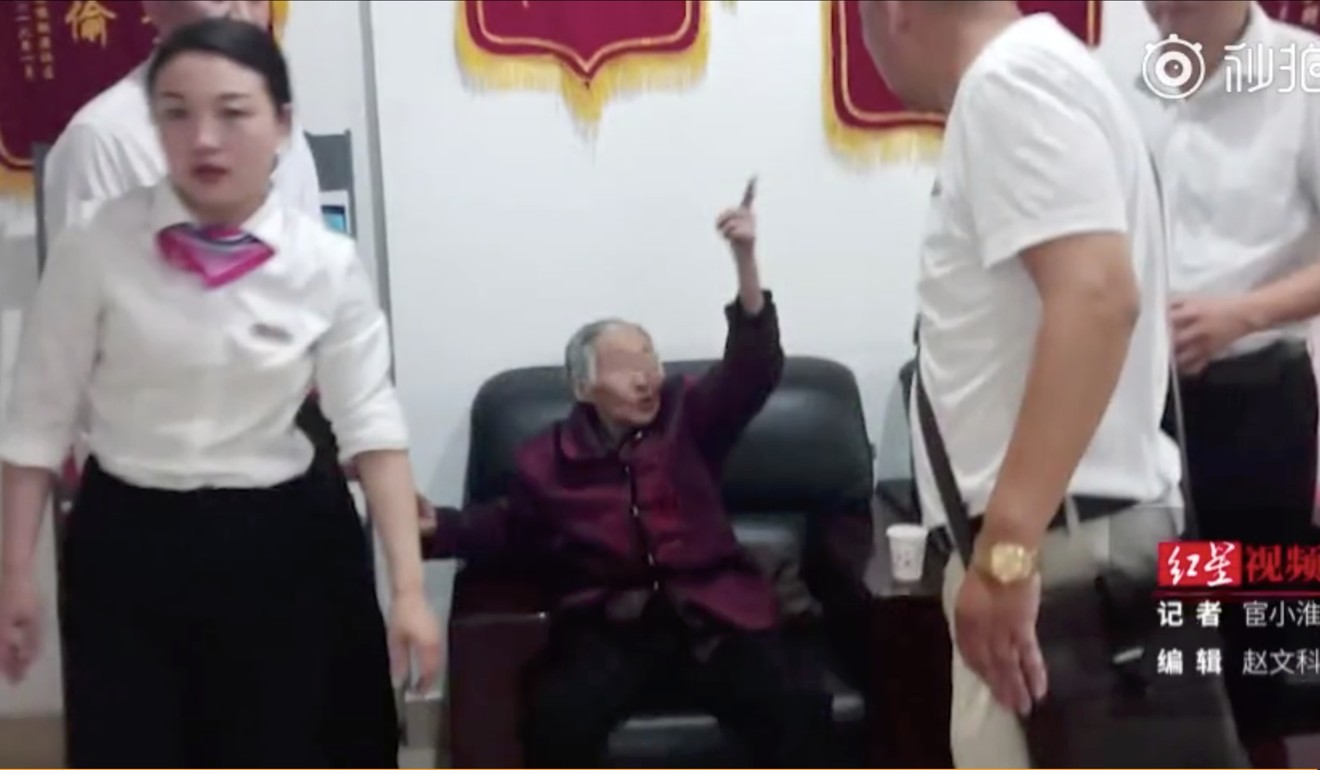
Chinese Spider-Gran rescued unharmed after heart-stopping high-rise escape

  • Property management workers pull to safely elderly woman with Alzheimer’s disease climbing down side of building
The elderly woman with Alzheimer’s climbs down the outside of her residential building in Chengdu, Sichuan province, on Thursday. Photo: Weibo
An 84-year-old woman with Alzheimer’s disease in southwestern China stunned her neighbours by climbing out of a lavatory window in a high-rise building and down from her 14th-floor flat.
The octogenarian was rescued by property management workers, who were waiting near the window of a flat on the fifth floor to intercept her, news website Thepaper.cn reported.
The woman squeezed through the window of her home’s toilet in a residential block in Chengdu, Sichuan province, on Thursday after she was locked in by relatives, a property management employee said.
“She couldn’t open the door from inside. But she wanted to go out as it was so humid and hot today,” the unnamed worker said.
As she climbed down the outside of the building, her neighbours unfolded a bedsheet on the ground, hoping to catch her if she fell.
The elderly woman survived the incident unscathed. Photo: Weibo

Property management workers gave the woman water and food after rescuing her. She was later picked up by her relatives and was reported to have no injuries from her adventure, the report said.

There were 6 million Alzheimer’s disease patients in China in 2015, with around 300,000 new cases reported each year, news portal Sohu.com reported.

Chinese taxi driver takes his wife with Alzheimer’s to work every day

A 2016 white paper released by the Zhongmin Social Assistance Institute, a Beijing-based research NGO, said half a million old people got lost in China each year, with a quarter of them diagnosed with Alzheimer’s.

“China is seriously hit by Alzheimer’s disease based on the country’s rapidly ageing population,” Dr Wang Luning, chairman of the Chinese Alzheimer’s Disease Association, told Legal Daily.

“But many people, even some doctors, have little knowledge about this disease, leading to low rates of people seeking diagnosis, the rate of them being diagnosed and being treated all being low.”

Source: SCMP

25/04/2019

Indian officials travel deep into jungle to allow one temple priest to vote

NEW DELHI (Reuters) – Indian officials travelled nearly 70 km (45 miles) through lion-infested jungle this week to ensure a 69-year-old holy man got his chance to take part in the world’s biggest democratic exercise.

A four-member team of election officials, accompanied by a policeman, set up a special polling station deep in the Gir wildlife sanctuary in Gujarat state so a sole voter – Bharatdas Darshandas – could vote in the general election.

A priest who has lived at his remote forest temple for two decades, Darshandas has not missed an election since 2002, and cast his vote on Tuesday by walking nearly a kilometre to the special polling station.

Darshandas looks after a Shiva Temple in the 350 square kilometre (850-square-mile) wildlife sanctuary, home to some 600 of the last remaining Asiatic lions.

India has more than 900 million eligible voters who can cast their ballots at 1 million polling stations.

Officials often have to travel to remote regions over days to get to voters. But an arduous trip for just one voter is not so common.

“The fact that the government is taking so much effort to ensure the casting of one vote speaks to the importance of each and every vote,” Darshandas told Reuters partner ANI in an interview.

“Just the way voting is 100 percent in Banej, there should be 100 percent voting everywhere,” Darshandas said, referring to the place he lives.

The staggered general election has seven phases. It began on April 11 and will end on May 19. Votes will be counted on May 23.

Sourabh Pardhi, an election official from the area, said the Election Commission had worked hard to ensure everyone got a chance to vote.

“We want to make sure that no voter is left behind,” he told ANI.
Source: Reuters
25/04/2019

China to promote space cooperation for UN sustainable development

CHANGSHA, April 24 (Xinhua) — China will promote international space cooperation to contribute to sustainable development goals set by the United Nations, a senior official with the China National Space Administration (CNSA) said here Wednesday.

“China is to build a new type of cooperative and win-win relationship with other space agencies and international organizations around the world, to jointly enhance the role of space industries in facilitating sustainable development,” said CNSA deputy director Wu Yanhua at the United Nations/China Forum on Space Solutions: Realizing the Sustainable Development Goals.

Over the years, the use of space has been recognized as one of the key components to successfully achieve the 17 Sustainable Development Goals (SDGs) of the 2030 Agenda for Sustainable Development adopted by the UN, according to Simonetta Di Pippo, director of United Nations Office for Outer Space Affairs.

In order to quantify the impact, a dedicated study was published in early 2018 and shows that around 40 percent of the 169 targets underpinning the 17 SDGs benefit from the use of geo-location and earth observation satellites, said Simonetta at the forum.

Committed to better service for countries along the Belt and Road Initiative, especially developing countries, China is constructing a space information corridor and sharing satellite resources, according to Wu.

“China’s earth observation satellites have actively supported the construction of the Belt and Road spatial information corridor, vigorously developed space international cooperation,” said Wang Cheng, a researcher from the CNSA.

FY-2H, the meteorological satellite located over the Indian Ocean, can fill the observation gap and provide weather monitoring service to countries along the Belt and Road, said Tang Shihao from China Meteorological Administration.

The unique strength of satellites in supporting telemedicine, epidemic prevention and control, and distance education, social security services can be improved, Wu said.

Independently constructed and operated by China, the BeiDou Navigation Satellite System has been widely used in many countries and regions. “The system started to provide RNSS (Radio Navigation Satellite System) services worldwide last December,” said Gao Weiguang from China Satellite Navigation Project Center.

Wu Yanhua said that China was developing a space economy and supporting commercial space development by pushing forward the commercialization of space technologies.

As the provider of Long March launch services, the China Great Wall Industry corporation (CGWIC) has performed 48 dedicated launch services and 17 piggyback launch services for international clients with high successful rate and competitive pricing, according to Zhou Yuanying from CGWIC.

Wu said that China would undertake monitoring and research of global climate change by taking advantage of satellites, to achieve the goals outlined in the Paris Agreement.

By pushing forward international space cooperation, China is also committed to joint efforts to tackle contemporary issues with global impact including poverty, hunger, natural disasters and environmental pollution, Wu added.

Many countries, in particular developing countries, need to make the best possible use of space assets to support the SDGs. At the same time, a lot of space agencies and companies are struggling to find partners/users to which they can offer their particular space solutions, Simonetta said.

“This Forum will build on previous UN workshops and symposiums to provide a unique platform for users and space solution providers to forge partnerships and thus contribute concretely to the achievement of the SDGs.” Simonetta said.

Also on Wednesday, the CNSA inked agreements on space cooperation separately with the UN Office for Outer Space Affairs, Turkey, Ethiopia and Pakistan.

Since 2016, China has set April 24 as the country’s Space Day. Activities on Space Day have become a window for the Chinese public and the world to gain a better understanding of China’s aerospace progress.

The theme this year is to “pursue space dreams for win-win cooperation.”

Source: Xinhua

25/04/2019

China’s top political advisor meets Azerbaijani president

(BRF)CHINA-BEIJING-BELT AND ROAD FORUM-WANG YANG-AZERBAIJANI PRESIDENT-MEETING (CN)

Wang Yang (R), chairman of the Chinese People’s Political Consultative Conference National Committee, meets with Azerbaijani President Ilham Aliyev ahead of the Second Belt and Road Forum for International Cooperation in Beijing, capital of China, April 24, 2019. (Xinhua/Gao Jie)

BEIJING, April 24 (Xinhua) — China’s top political advisor Wang Yang on Wednesday met with Azerbaijani President Ilham Aliyev ahead of the Second Belt and Road Forum for International Cooperation to be held from April 25 to 27 in Beijing.

Hailing the long-term friendship between China and Azerbaijan, Wang, a member of the Standing Committee of the Political Bureau of the Communist Party of China Central Committee and chairman of the Chinese People’s Political Consultative Conference National Committee, said that the two countries have continued to strengthen their mutual political trust and promoted cooperation in various fields in recent years.

“Azerbaijan was one of the first countries to respond to the Belt and Road Initiative, and cooperation between the two countries in various fields has seen a series of early harvest,” said Wang, adding that China is willing to work with Azerbaijan to seize the great opportunity of jointly building the Belt and Road and deepen bilateral ties and cooperation in various areas to benefit the two countries and the peoples.

Aliyev also expressed the willingness of the Azerbaijani side to contribute to the implementation of the Belt and Road Initiative and promote the continuous development of bilateral relations.

Source: Xinhua

25/04/2019

English, French editions of Xi’s discourses on BRI published

(BRF)CHINA-BEIJING-XI JINPING'S DISCOURSES ON BRI-ENGLISH AND FRENCH EDITIONS (CN)

Guests unveil the English and French editions of a compilation of President Xi Jinping’s discourses on the Belt and Road Initiative during a launch ceremony in Beijing, capital of China, April 24, 2019. (Xinhua/Zhang Yuwei)

BEIJING, April 24 (Xinhua) — The English and French editions of a compilation of President Xi Jinping’s discourses on the Belt and Road Initiative were published Wednesday.

The book contains 42 articles from September 2013 to July 2018 by Xi, also general secretary of the Communist Party of China Central Committee.

The new editions were translated and published by the China Foreign Languages Publishing Administration and the Foreign Languages Press.

Source: Xinhua

Law of Unintended Consequences

continuously updated blog about China & India

ChiaHou's Book Reviews

continuously updated blog about China & India

What's wrong with the world; and its economy

continuously updated blog about China & India