05/02/2019

China’s CATL, Honda plan to co-operate on EV battery development

TOKYO (Reuters) – Contemporary Amperex Technology Ltd and Honda Motor have signed an agreement to co-operate on jointly developing lithium ion batteries for electric vehicles, as China’s top EV battery maker expands its tie-ups with Japanese automakers.

CATL said on Tuesday it had signed a memorandum of understanding with Honda under which it would guarantee supply of lithium-ion EV batteries with storage capacity of around 56 gigawatt hours (GWh) to the automaker by 2027, and set up an office near Honda’s research unit in Tochigi Prefecture, outside Tokyo.

“The agreement focuses on supply of EV batteries in Asia,” Honda spokeswoman Tomoko Takemori said, declining to give further details on which of its models would use CATL batteries.

“We could also consider some supply for the North American market.”

Sources with knowledge of the matter told Reuters that the agreement to explore using CATL technology in Honda EVs was part of Honda’s moves to diversify its battery supply bases to ensure stable stock in the longer term, and that the Japanese automaker has also been in talks with other battery makers, including current supplier Panasonic Corp.

As it pushes to meet China’s stringent “green car” quotas, Honda is planning to launch its first mass-production battery EV in China later this year, while it is building a new plant for new-energy vehicles, including battery EVs and plug-in hybrid cars.

CATL, one of the world’s biggest EV battery makers, adds Honda to its list of partners which already includes BMW, Volkswagen AG and SAIC Motor Corp.

The Fujian-based company has been eager to secure more Japanese clients, and established a sales and development support hub in Yokohama last year. It already counts Nissan Motor Co as a customer, supplying the batteries for the battery-electric version of its Sylphy sedan in China.

Source: Reuters

05/02/2019

US-China trade war: UN warns of ‘massive’ impact of tariff hike

05/02/2019

Chinese navy veteran warns training, not hardware is key to military preparedness

  • As China expands its military might a retired naval officer points out that size is not everything in modern warfare
  • ‘It is the people who use these weapons that count’
The cloud was low and the sky was murky and overcast. “The cloud was barely 200 to 300 metres above ground and the jets immediately disappeared into the cloud after take-off,” Wang said.

“In China, [our military planes] would not have taken off [for training] if the cloud was lower than 400 metres above ground,” he explained.

“Such conditions are dangerous [for military aircraft to take off] but they were able to carry on training despite the weather.”

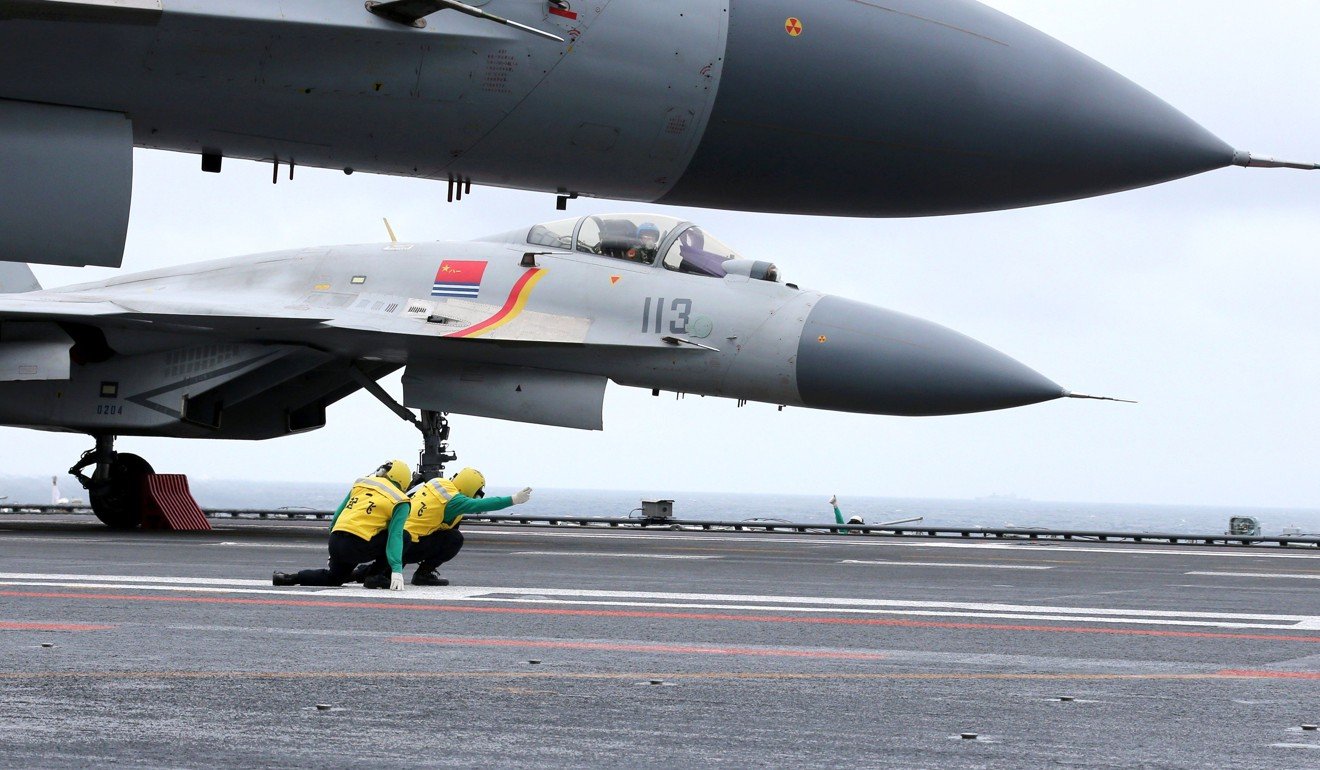
As China expands its military might with new aircraft carriers, advanced fighter jets and other world-class weaponry, questions have been raised about whether the People’s Liberation Army can compete with other advanced forces.

Wang, now a naval armament expert, pointed out that size was only one determining factor in modern warfare, and hardware could only answer part of the question as China raced to catch up with leading powers like the US and its top allies, including Japan“It is the people who use these weapons that count, and that essentially boils down to our level of training.

“Some people hold the view that our military planes are more advanced than others. But if we look at the level of training of our forces … We are not at the same level [as others] yet.”

Antony Wong Dong, a military expert based in Macau who has spent years studying the PLA, agreed with Wang’s assessment.

Although the PLA – which has not fought a major war since the Korean war – has made great strides in improving training for its rank and file in past decades, Wong said there was much room for improvement to raise its “preparedness”.

That was in fact the message from President Xi Jinping in December in a speech reminding the top brass that strengthening training and preparation for war would be the top priorities for the PLA in 2019.

Naha, in Japan’s Okinawa prefecture, is home to the 9th Air Wing, which was set up three years ago with 40 F-15 fighter jets. It was a time of growing assertiveness by China in the East China Sea, including over the contested Diaoyu Islands, which are administered by Tokyo but also claimed by Beijing and Taipei.

According to the Joint Staff of the Japanese defence ministry, in the 2017 fiscal year, which started on April 1, there were 500 scrambles by Japan’s Air Self-Defence Force to intercept Chinese military aircraft flying over the region, compared with 851 scrambles in 2016.

But in the first three quarters of the 2018 fiscal year, the number of scrambles reached 476, as Xi pushed the PLA to conduct more training, including exercises further from home.

And, as China starts testing its first home-made aircraft carrier, Tokyo announced in December that it would convert its helicopter carrier, the destroyer Izumo, into an aircraft carrier capable of launching American F-35B fighter jets.
Against such a background, Wang said China needed to reflect deeply on its overall military strength in addition to investing in cutting-edge weaponry.

This was the reason for his heavy heart at Naha Airport, as he watched the extent of Japanese military training.

“On that day it was not just the F-15s taking off [at Naha], but also Ospreys and Sikorsky Seahawks, and the training went on non-stop the whole day,” Wang said.

“It immediately came to my mind that we should not look down upon the Japanese forces. We must bear in mind that the level of training reflects your level of combat preparedness.

“Our fleet of warships and military planes far outnumber the Japanese forces, even by the number of more advanced generations of fighter jets … but in real combat, the size of the battlefield is limited, whether it is at sea or in the sky.

“You cannot deploy everything you have. And when both sides deploy the same resources into the battlefield, we must not be blindly [optimistic] about our chance of winning.”

The rapid development of new hardware could also pose challenges for training Chinese troops, especially in helping them master the skills necessary to use and understand the new weapons.

“We are still exploring. It is not that we are slack. [These new weapons] are just too advanced,” Wang said.

“Like [the stealth fighter jet] J-20… or [carrier-based fighter jet] J-15, we initially didn’t know how to make the best use of them in different circumstances.

“We only recently mastered how to take off and land [J-15s] at night. It is not certain if we are ready to undertake evening flight missions of these aircraft when they are loaded with heavy missiles,” he said.

Military expert Wong said the PLA had yet to resolve many issues, including pairing up its J-15 fighter jets and its aircraft carriers.

“To what extent can PLA troops and these weapons work seamlessly in executing tactics?” Wong said.

“From what we saw on the news, [I would say that] there are still gaps in the quality and quantity of weapons that [our carrier-based aircraft] can actually carry.”

Source: SCMP

05/02/2019

China to remain NYSE’s major contributor of int’l IPOs in 2019

NEW YORK, Feb. 4 (Xinhua) — China has been a major market for the New York Stock Exchange (NYSE) when it comes to international initial public offerings (IPOs) over the past few years, and the trend will continue in 2019, according to the exchange.

The wholly-owned subsidiary of Intercontinental Exchange finished 2018 with 125 billion U.S. dollars in proceeds raised from 356 transactions. In a year marked by elevated volatility in U.S. equity markets, NYSE issuers raised 30 billion dollars in proceeds from 73 IPOs, statistics showed.

A total of 25 international IPOs were executed during the year, raising 10 billion dollars in proceeds, including Tencent Music Entertainment Group from China, PagSeguro Digital Ltd. from Brazil, and Hudson Ltd. and Farfetch Ltd. from Britain.

A total of 18 Chinese companies raised more than 4 billion dollars in proceeds last year, the exchange said in its response to Xinhua’s inquiry. The companies are from a variety of industries, including education, hospitality, technology, and automotive.

Alex Ibrahim, head of international capital markets at NYSE, told Xinhua that it was a “huge highlight” to have companies like Tencent Music Entertainment listing on the exchange and raising over 1 billion dollars.

The IPO of Nio, a leading Chinese electric vehicle maker, also raised more than 1 billion dollars and was a very successful transaction, he noted. “It was super exciting to see those cars in front of the exchange and in Times Square,” Ibrahim said in an exclusive interview with Xinhua.

Asked why so many Chinese companies chose to list in NYSE over other stock exchanges, Ibrahim said one major reason is that U.S. market is the deepest in the world and companies want to have access to liquidity.

He added that the companies also want to be next to their competitors that have already been listed in NYSE so as to make sure the evaluation is aligned and make themselves available to the vast number of investors.

“This trend will continue because I think there are fantastic companies in China,” he said.

He said that the human element the NYSE has is also an important reason companies are willing to be listed there.

On the other hand, the demand from U.S. investors’ side for Chinese companies and products is high.

Ibrahim said there are a lot of great entrepreneurs creating and selling new technologies and tapping the growth of Chinese economy.

“Investors want to be part of this growth,” he said, adding that the way to access the growth is through IPOs.

NYSE-listed companies traded with 45 percent lower volatility compared to companies listed and traded on other U.S. exchanges, according to the stock exchange.

Source: Xinhua

05/02/2019

People from various industries stick to their posts on eve of Spring Festival

#CHINA-SPRING FESTIVAL-EVE-WORK (CN)

Sanitation workers clean a street in Hohhot, capital of north China’s Inner Mongolia Autonomous Region, Feb. 4, 2019. People from various industries stick to their posts on the eve of the Spring Festival which falls on Feb. 5 this year. (Xinhua/Ding Genhou)

Source: Xinhua

05/02/2019

Across China: Migrant workers find easier way home at Spring Festival

GUANGZHOU, Feb. 4 (Xinhua) — Migrant worker Liao Guiren was more than excited to take a bullet train on his Spring Festival journey back home, the first time for the middle-aged man.

Each year during the past two decades, the 45-year-old had to endure an exhausting eight-hour bus ride from his workplace in south China’s Guangdong Province to his hometown in the city of Guigang in Guangxi Zhuang Autonomous Region, for a large annual family gathering.

But this year, the bullet train cut his travel time to less than three and a half hours.

“The traffic jams on the roads during the holiday must be worse,” Liao said when having his ticket checked at the railway station in Guangdong’s Zhongshan. “The expressways back home must be more crowded than the railway station.”

Liao said it was no easy job to buy the bus ticket back home during the festival. “I used to line up for hours at the station for tickets, and the prices often ticked up due to high demand.”

However, it took Liao a couple of minutes to buy the train ticket back home on his smartphone this year.

Liao is among a growing number of Chinese travelers who have benefited from a more convenient and efficient way to return home during the Spring Festival travel rush in recent years.

It is estimated that the annual travel rush that lasts 40 days will see 413 million railway trips across the country, up 8.3 percent from the previous year.

To meet the growing demand, China has been expanding its railway network at an unprecedented pace for decades, with the total operational length of high-speed railways reaching 29,000 km by the end of last year.

One of the country’s major newly-built railways is the Guangzhou-Shenzhen-Hong Kong Express Rail Link, which started service last year and links Hong Kong with more than 40 cities on the Chinese mainland via direct rail services.

“The railway makes it more convenient for those working in Hong Kong to return to the mainland for family gatherings,” said Siu Kin-Po, head of the Guangzhou center of the Hong Kong Federation of Trade Unions.

SMARTER TRAVEL

Liao has taken trains several times, but it was his first time to use a self-service machine to check in at the railway station.

Liao followed the instructions on the machine that explicitly explains what to do.

He put both his ticket and ID card onto the slot of the machine and waited for the facial recognition system to identify his face before the gate opened to let him pass. The whole process took less than 10 seconds.

A total of 595 self-service check-in machines have been deployed at the railway stations in Guangdong, Hunan and Hainan to streamline the check-in process, according to China Railway Guangzhou Group Co. Ltd.

Other smart technologies such as virtual reality and smart navigation machines have also been used in Chinese railway stations to help travelers ease the pressure during the travel rush.

“Smart technologies have made the rail services more fun and convenient,” Liao said. “I want to take bullet train again next year when I go home.”

Source: Xinhua

05/02/2019

Rail travel demand remains robust on Lunar New Year’s eve

BEIJING, Feb. 4 (Xinhua) — China’s railway system continued to see a surge in passengers on Monday, the Lunar New Year’s eve, as Chinese rushed home for family gathering.

Chinese railway network is expected to see 5.48 million trips on Sunday, up 3.6 percent year on year. Nearly 270 extra trains will be put into service to meet the booming travel demand.

About 9.3 million train trips were made on Saturday, up 5.4 percent year on year.

The Spring Festival travel rush started from Jan. 21 and will last till March 1, during which railway trips are expected to hit 413 million in total, up 8.3 percent from a year ago.

Air travel demand also boomed in recent weeks. From Jan. 21 to Feb. 3, China Eastern Airlines sent almost 2 million passengers, up 8 percent year on year.

According to the Chinese zodiac calendar, the Year of the Pig starts on Feb. 5, and the public holiday associated with it lasts from Feb. 4 to 10.

Hundreds of millions of Chinese return to their hometowns for family gathering during the holiday.

Source: Xinhua

05/02/2019

China firmly opposes mercenary activities in Africa, says Chinese envoy

UNITED NATIONS, Feb. 4 (Xinhua) — China firmly opposes mercenary activities in Africa, and will always support African nations’ pursuit of peace and prosperity, Chinese Ambassador to the United Nations Ma Zhaoxu said Monday.

Mercenary activities are a threat to peace and stability in African countries, and China calls for greater international efforts to address the problem, said Ma as Chinese President Xi Jinping’s special envoy at a UN Security Council high-level debate on mercenary activities in Africa.

Source: Xinhua

05/02/2019

China’s winter tourism attracts nearly 200 mln tourists in 2017-2018 season

BEIJING, Feb. 4 (Xinhua) — A total of 197 million people took part in winter tourism from November 2017 to March 2018, according to an annual report released by the China Tourism Academy recently.

Winter tourism refers to tourist activities related to ice and snow.

The cost associated with winter tourism has been decreasing while the public shows increasing interest in participating, said Han Yuanjun, editor-in-chief of the report.

Winter tourism is conducive to rural vitalization and local economic transformation, the report said.

Winter tourism has been booming in China since Beijing won its bid in 2015 to host the 2022 Winter Olympic Games. Local governments of Beijing and the provinces of Hebei, Jilin and Heilongjiang have unveiled policies to promote winter tourism.

Source: Xinhua

05/02/2019

Happy New Year (of the Pig)

To all my readers and blog followers – Happy New Year.

The Pig is one of 12 animals in the Chinese calendar. The others are: Rat, Ox, Tiger, Rabbit (my birth year), Dragon, Snake, Horse, Goat, Monkey, Rooster, Dog.  Pigs have a beautiful personality and are blessed with good fortune in life.

This zodiac system has existed in Chinese culture since the Qin dynasty, more than 2,000 years ago.  This in turn gave rise to various compatibilities (and incompatibilities) between each zodiac, and play a major role in marriage and career decisions, fortune-telling and more!

Paired with the Celestial Stems (天干—Tiān gān), there is a 60-year calendrical cycle. Although hài is associated with earth, the years also cycle through the five elements of nature (五行—wǔ xíng).

See the table below for the full details of each year.

YEAR CELESTIAL
STEM
EARTHLY
BRANCH
ZODIAC ELEMENT YIN YANG
1935 Hài Pig Wood Yin
1947 ding Hài Pig Fire Yin
1959 Hài Pig Earth Yin
1971 xīn Hài Pig Metal Yin
1983 guǐ Hài Pig Water Yin
1995 Hài Pig Wood Yin
2007 ding Hài Pig Fire Yin
2019 Hài Pig Earth Yin
2031 xīn Hài Pig Metal Yin

https://chinesenewyear.net/zodiac/pig/

Law of Unintended Consequences

continuously updated blog about China & India

ChiaHou's Book Reviews

continuously updated blog about China & India

What's wrong with the world; and its economy

continuously updated blog about China & India