18/01/2019

Chinese nanny caught on home security camera ‘abusing’ 10-month-old infant

  • Video triggers police investigation and an online conversation among mothers about the struggles of combining career and caring for children

PUBLISHED : Friday, 18 January, 2019, 4:38pm
UPDATED : Friday, 18 January, 2019, 6:35pm

In the video, which is understood to have been recorded in Changsha, in the central province of Hunan, a woman in a black shirt can be seen hurling the child on to a sofa and holding him upside down before dropping him head first on to the floor.

According to the person who this week posted the video to Weibo, China’s version of Twitter, it was originally shared by a relative of the child to a closed chat group.

“The child’s parents wanted to report it to the police, but were not sure if this qualified for a police complaint. The nanny even wanted to settle it privately, so I posted the video for them,” she wrote.

The internet user who shared the video on Weibo said the infant’s parents had hired a friend of the child’s grandmother to take care of him in the morning while they were at work.

The nanny did not know there was a security camera in the flat

Local police said on Thursday they were still investigating whether the video was authentic.

Many women responded to the video on social media by talking about their own struggles in raising children.

“It’s best to take care of your child yourself. Old people sometimes lack patience, just like my mum. She won’t beat my child but will often ignore him. So I quit my job to look after him until he starts going to kindergarten,” one woman wrote in an online fo

“I can either find a job after my child grows up or start a business at home, but my parents would not allow me to work and my husband does not want to give up his high-paying job,” another wrote.

There has been a profusion of such cases in China where the number of housekeepers – including nannies and part-time cleaners – exceeded 25 million people in 2016, a rise of 9.3 per cent on the previous year, according to the Ministry of Commerce.

But the supply of nannies has failed to keep up with demand, fuelled by young families moving away from their home provinces to cities in search of work, along with changing attitudes as more women prioritise a career.

In Beijing, for example, the number of available nannies did not even meet half the demand in the capital last year, according to NetEase News.

Nearly 80 per cent of women born after 1995 want to be financially independent, according to a March 2018 survey by LinkedIn and L’Oreal in China.

In September last year a nanny in Datong, in the northern province of Shanxi, was captured by a hidden camera repeatedly hitting and slapping an eight-month-old baby while the parents were away.

Source: SCMP

18/01/2019

China upbeat about 2019 foreign trade growth: MOC

BEIJING, Jan. 17 (Xinhua) — China is confident in its ability to keep foreign trade growth stable while improving its quality this year despite greater external uncertainties, the Ministry of Commerce (MOC) said Thursday.

“The development of China’s foreign trade remains on a strong and solid foundation,” MOC spokesperson Gao Feng told a news conference.

The confidence derives from deepening supply-side structural reform, improvement in the country’s foreign trade structure and increasing internal impetus to growth, Gao said.

The ministry has unveiled a list of 30 key markets for foreign trade expansion this year, which will see China actively tap into the potential of emerging and developing economies related to the Belt and Road Initiative while continuing to explore the traditional markets in developed countries.

Gao said the ministry will offer enterprises greater support including trade promotion, public information services and government institutional safeguards for trade market diversification.

“We will roll out more measures in a targeted and timely manner to help foreign trade firms turn challenges into opportunities and achieve innovational development,” Gao said.

Commenting on the decline of China’s foreign trade growth in December, Gao said the growth in the fourth quarter was still within reasonable range despite the monthly fluctuation.

“The fluctuation was mainly caused by weaker demand in the international market and a high basis the previous year,” he said.

China’s import and export volume hit a historic high of 30.51 trillion yuan (about 4.5 trillion U.S. dollars) in 2018, up 9.7 percent year-on-year, official data showed.

Source:Xinhua

18/01/2019

China urges U.S. to stop damaging China’s interests

BEIJING, Jan. 17 (Xinhua) — China on Thursday urged the United States to stop interfering in China’s internal affairs and damaging China’s interests, and to do more things that are conducive to mutual trust and cooperation.

Foreign Ministry spokesperson Hua Chunying made the remarks at a press conference when responding to reports about U.S. Vice President Mike Pence’s accusation against China at Global Chiefs of Mission Conference on Jan. 16.

Hua said that the United States recently smeared and made groundless accusations against China on issues including debts, trade, the South China Sea, international rules and religious freedom, “yet facts have refuted all those accusations.”

The United States baldly adopted double standards on the application of international rules, said Hua, adding that the U.S. side is not eligible to wag fingers at China on this issue.

This year marks the 40th anniversary of the establishment of China-U.S. diplomatic ties, said Hua, urging certain U.S. people to view China’s development and China-U.S. ties from a correct and reasonable perspective, stop interfering in China’s internal affairs and impairing China’s interests, do more things that are conducive to mutual trust and cooperation, and work with China to maintain the healthy and stable development of bilateral ties.

Source: Xinhua

18/01/2019

Chinese vice premier meets German counterpart

CHINA-BEIJING-HAN ZHENG-GERMANY-MEETING (CN)

Chinese Vice Premier Han Zheng (R), also a member of the Standing Committee of the Political Bureau of the Communist Party of China (CPC) Central Committee, meets with German Vice Chancellor and Finance Minister Olaf Scholz in Beijing, capital of China, Jan. 17, 2019. Scholz is here to attend the second China-Germany High Level Financial Dialogue. (Xinhua/Chen Jianli)

BEIJING, Jan. 17 (Xinhua) — Chinese Vice Premier Han Zheng here on Thursday met with German Vice Chancellor and Finance Minister Olaf Scholz.

Han, also a member of the Standing Committee of the Political Bureau of the Communist Party of China Central Committee, expected the two sides to make good use of the bilateral high-level financial dialogue mechanism, implement the important consensus of the leaders of the two countries, and promote new achievements through cooperation in various fields.

Han also called on the two sides to jointly safeguard multilateralism and rule-based international order, and to become models and leaders for promoting mutual benefit, win-win cooperation and common development in the global arena.

Scholz said Germany is willing to strengthen pragmatic cooperation with China, implement the results reached by the consultations between the German and Chinese governments, jointly safeguard the multilateral trading system and promote the stability and prosperity of the world economy.

Scholz is here to co-chair the second China-Germany High Level Financial Dialogue with Chinese Vice Premier Liu He on Friday.

Source: Xinhua

18/01/2019

Xi Jinping inspects Tianjin

CHINA-TIANJIN-XI JINPING-INSPECTION (CN)

Xi Jinping, general secretary of the Central Committee of the Communist Party of China, Chinese president and chairman of the Central Military Commission, talks to academicians, specialists and teachers at Nankai University in Tianjin, north China, Jan. 17, 2019. Xi was on an inspection tour in Tianjin Thursday. (Xinhua/Xie Huanchi)

Source: Xinhua

17/01/2019

Meghalaya miners: Drone locates one body in flooded Indian mine

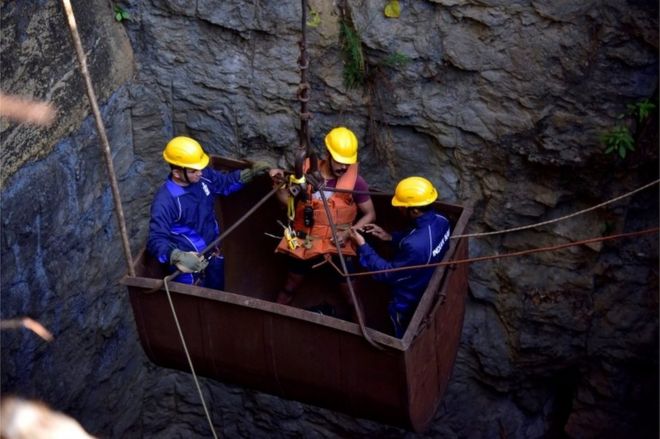
Divers use a pulley to enter a coal mine that collapsed in Ksan, in the northeastern state of Meghalaya, India, December 29, 2018.Image copyrightREUTERS
Image captionThe miners have been trapped since mid-December

Indian navy divers have found the body of a worker who was trapped with 14 others inside a flooded coal mine in the north-eastern state of Meghalaya.

The men had entered the illegal pit, known as a “rat hole”, on 13 December, and were trapped when floodwater from a nearby river poured in.

An underwater drone (ROV) first detected the body at a depth of 160ft (48m), the navy said.

The fate of the other trapped miners is unclear.

The navy added that the body would be brought out from the mine under the supervision of doctors.

The Indian Navy gave some details of the operation in a series of tweets early on Thursday.

Source: The BBC

17/01/2019

Mysterious naked holy men a huge draw at India’s Kumbh Mela

PRAYAGRAJ, India (Reuters) – Ash-smeared and dreadlocked Naga sadhus or Hindu ascetics, naked except for rosary beads and garlands and smoking wooden pipes, are a huge draw at the world’s largest religious festival that began this week in India.

At the Kumbh Mela, or “festival of the pot”, held this year in Prayagraj in north India, organisers expect up to 150 million people to bathe at the confluence of three holy rivers: the Ganges, the Yamuna and a mythical third river, the Saraswati.

The festival is one of the only opportunities to see the reclusive Naga sadhus, some of whom live in caves after taking a vow of celibacy and renouncing worldly possessions.

Their charge down to the waters to bathe at the opening of the Kumbh, many armed with tridents and swords, is one of the highlights of the festival.

“It is a confluence of all Naga sadhus at the meeting point of these holy rivers,” said Anandnad Saraswati, a Naga sadhu from Mathura, a holy city in north India.

“They meet each other, they interact with each other and they meditate and pray here at the holy confluence. They give their message to the people and they transform people.”

Most of the Nagas enter the orders in their early teens, leaving their friends and families to immerse themselves in meditation, yoga and religious rituals. It can take years to be conferred with the title of a Naga, they say.

“One has to live a life of celibacy for six years. After that the person is given the title of a great man and 12 years after that he is made a Naga,” said Digambar Kedar Giri, a Naga sadhu from Jaipur.

During the eight-week Kumbh, generally held every three years in one of four cities in India, the Nagas live in makeshift monasteries called Akhara erected on the eastern banks of the Ganges.

They spend their days meditating, smoking cannabis and receiving a stream of visitors who come to pay their respects.

“It feels surreal: all this time you have read about them. They are almost like fictional characters and then you meet them,” said a woman who gave her name as Pallavi, on a visit to the Akharas.

The Kumbh Mela has its roots in a Hindu tradition that says the god Vishnu wrested a golden pot containing the nectar of immortality from demons. In a 12-day fight for possession, four drops fell to earth, in the cities of Prayagraj, Haridwar, Ujjain and Nasik, who share the Kumbhs as a result.

Source: Reuters

17/01/2019

‘One step ahead of Pak, giving them befitting reply’: Northern Army chief

Lt General Ranbir Singh said 2018 was a great year for the security forces as more than 250 terrorists had been killed, 54 were caught alive and another 4 had surrendered to them.

INDIA Updated: Jan 17, 2019 16:58 IST

Ravi Krishnan Khajuria
Hindustan Times, Jammu
lt general ranbir singh,pakistan ceasefire violation,kalai bridge
Northern Army Commander Lt Gen Ranbir Singh said that the Indian Army has been giving a befitting response to the Pakistani ceasefire violations.(HT Photo)

The Northern Army commander Lt Gen Ranbir Singh on Thursday said the Indian Army was one step ahead of Pakistan and was giving a befitting reply to every single ceasefire violation by the neighbouring country.

Talking to media after inaugurating a bridge at Kalai in Poonch district, General Singh said, “We are one step ahead of Pakistan and are giving befitting reply to them.”

“2018 has been a great year for the security forces, more than 250 terrorists were killed, 54 were caught alive, and 4 surrendered to the forces,” he said.

When asked about the increased ceasefire violation by Pakistani forces since January 1 this year and the elimination of five Pakistani soldiers by Indian forces in retaliation in the last few days, Gen Singh said the answer lies in the query itself.

On Thursday, Pakistani army again resorted to heavy firing in Jhangar, Laam, Pukherni and Peer Bhadreshwar areas of Rajouri district, prompting the Indian Army to retaliate in equal measure.

On Tuesday, Pakistan killed BSF’s assistant commandant in sniper firing on the international border in Hiranagar sector of Kathua district on Tuesday.

Notably, PM Narendra Modi is scheduled to visit the border district of Samba on February 3 to kick-start the BJP’s election campaign in the state.

Despite repeated calls for restraint and adherence to the 2003 ceasefire agreement to maintain peace and tranquility, Pakistani troops have been indulging in ceasefire violations including BAT attacks, sniper attacks and planting IEDs inside Indian territory to kill Indian personnel.

Meanwhile, General Ranbir Singh dedicated the Kalai Bridge to the country on Thursday. The bridge spans over the Suran River and connects Kalai area to Chandak area in Poonch district.

During the inauguration function, the Army Commander addressed the gathering of Army, GREF and local residents and said the Kalai bridge is an important milestone towards enhancing the road communication and for socio-economic development of the area.

The bridge is an important strategic asset as it will enhance the movement of military equipment and troops in a faster timeframe. The Indian Army and BRO has been working towards infrastructure development in the remote and far-flung areas of the state and have been improving road connectivity.

The bridge will reduce traffic congestion in the city and reduce the inconvenience caused to the people specially while moving towards Budha Amarnath Shrine in Mandi as it reduces the travelling time considerably.

Also watch:

First Published: Jan 17, 2019 15:17 IST

Source: Hindustan Times

17/01/2019

China watchdog bans officials from close ties with liquor giant Moutai

BEIJING (Reuters) – The anti-graft watchdog in China’s southwestern Guizhou province on Thursday banned officials and their family members from taking part in operations or using their position to influence sales for liquor giant Kweichow Moutai Co Ltd.

Guizhou-based Moutai is the world’s largest alcohol firm by market cap, valued at around $110 billion (£85.32 billion), and sells the pungent liquor baijiu for more than $200 per 500 ml bottle.

The brand has close ties to Chinese politics and has largely weathered a crackdown on luxury spending under President Xi Jinping, who has called on Communist Party officials to be frugal, upright and disciplined.

Officials, their spouses and children are prohibited from taking part in the operations of Moutai, according to new rules posted online by the Guizhou Discipline Inspection Commission, the provincial anti-corruption watchdog.

Cadres are also banned from using the power and influence of their position to acquire Moutai business licenses for people they have a “special relationship” with, or to raise sales targets and help facilitate resales at a profit, the rules said.

Cadres should “educate and properly manage” relatives and those close to them to avoid breaking the new rules, the document said.

Officials who engage in any form of business-related interaction with the company have to be recorded in a new registry and failing to do so will trigger a “serious” investigation, the watchdog said.

Moutai’s baijiu liquor is often a lubricant at official banquets and business dinners, and it was once hailed as helping China’s Red Army survive the tortuous Long March in the 1930s.

The company in October posted its weakest quarterly profit since 2015, depressing its shares and raising concerns about the luxury liquor market.

Moutai on Jan. 2 announced a higher than expected sales target for 2019, leading analysts to predict sustained stable growth in the medium-and-long run.

Reporting by Christian Shepherd; editing by Darren Schuettler

Source: Reuters

17/01/2019

Why are the Chinese buying fewer cars?

President Trump's Cadillac limousineImage copyrightGETTY IMAGES
Image captionThe fact that President Trump’s limousine is a Cadillac is said to have helped the US carmaker’s sales in China

If you’re selling Cadillacs in China, it helps that the US president is driven around in one.

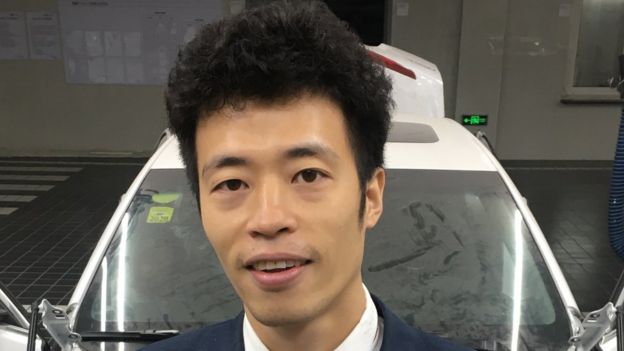
Cao Chenyi, the boss of a Cadillac dealership near Shanghai, told me that customers know that Donald Trump’s presidential limousine is made by the US carmaker. He says they like the prestige.

But Mr Cao’s had a bad year. Demand dropped 30% in 2018. He’s had to shut five of the 11 dealerships his family business owned. Almost half, gone.

“The sales on every new vehicle is causing us to lose money. Basically the more we sell the more we lose,” he says.

Loss leaders are painful. Mr Cao has been forced to shift excess stock, and quickly. The red Cadillac he drove me around in is currently on sale at half price.

Cao Chenyi's Cadillac dealership near Shanghai
Image captionCao Chenyi’s family have had to close five of their dealerships – these customers did not make a purchase

Nationally, 2018 was a very hard year for the car industry in China, the world’s biggest car market.

Just over 22 million new cars were sold last year. But that’s a near 6% drop on 2017. The first fall in two decades.

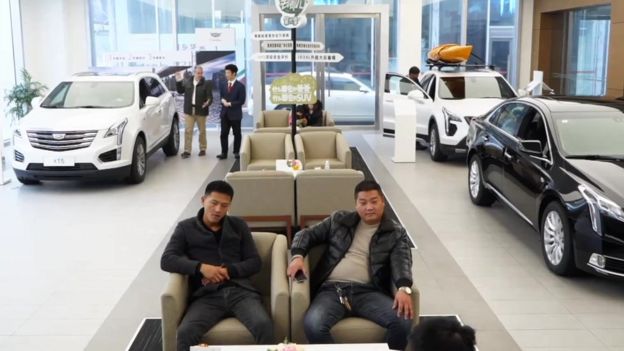
Inside Mr Cao’s Cadillac showroom various models are side by side. An SUV at the back has a canoe on its roof rack.

I watched a group of three youngish men come in and sit down for the sales treatment. They didn’t buy.

They didn’t even have a good look inside the cars. Mr Cao thinks the main reason is a tax cut that has gone away.

“In 2018 the government cancelled the tax subsidy on car purchases, which was a shock to us,” he says.

This benefit has been gradually wound down. Others think a credit squeeze has caused the demand for cars to drop.

Cao Chenyi
Image captionCao Chenyi thinks that the end of a tax credit is the main reason behind falling car sales

After a decade of near doubling its debt – to almost 300% of China’s GDP – 2018 was the year that the government tried to deal with the aftermath of a credit crisis. That crisis was centred on peer-to-peer lending, known as P2P.

P2P lenders offer loans to individuals from a pool of funds supplied by other individuals and other businesses, thereby cutting out banks.

Cars and houses

Economist Andy Xie says the previously increasing national debt kept demand high, particularly in the property and car sectors.

“Now the property market has tipped over, and it’s affecting a lot of things,” he says.

So why is property so important?

“Auto sales are highly correlated to property sales,” Mr Xie says.

“When people buy property it seems they buy a car at the same time. So when the property market is not doing well the auto demand is down.”

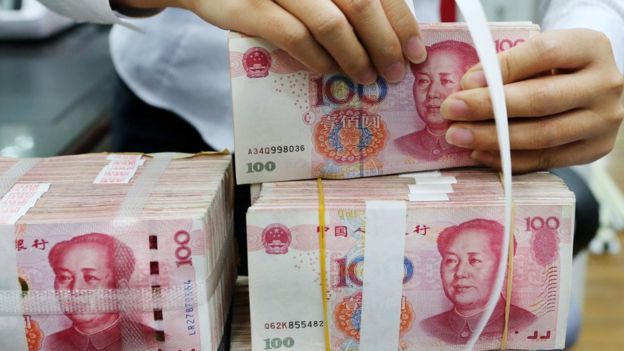
A woman holding bundles of yuan notesImage copyrightGETTY IMAGES
Image captionThe Chinese government is moving to reduce the country’s debt level

The collapse of many of the P2P lending platforms is thought to have had a significant impact on both house and car sales, because borrowed money was being used as down payments for both.

Mr Xie says the credit system “used to be lubricated by these guys” and suddenly that has stopped.

“They lent to people who could not pay back. [Borrowers] shifted their debt from one platform to another.”

He tells me he’s heard statistics suggesting one in four such borrowers “have no ability to pay back”.

Slowing economy

China’s car industry is also a key driver of industrial output and a barometer of consumer demand.

But growth in China’s economy is slowing, and the trade war with the US is starting to bite. Retail sales have slowed to a pace not seen for more than a decade.

A couple of hours away from the car dealership is a tiny hair salon, in the heart of Shanghai’s old west side.

Sun Qiang is the owner and haircutter-in-chief. For a few hours I sat and watched him deal with a handful of customers. First up were three women, two of whom had curlers in, and didn’t look happy to be there.

Sun Qiang
Image captionHairdresser Sun Qiang is saving money to pay for education and healthcare

He told me he’d cut my hair for 40 yuan ($6; £4.50). His place is at the bottom end of what you might call the barometer of China’s consumption.

But business isn’t dropping off. He is, though, a barber who also cuts women’s hair.

When it comes to cars he’d like a Chinese brand SUV. But it’s not likely any time soon. He doesn’t live that far from work and the buses are good. Plus he doesn’t want to borrow.

“I think some car dealers, they want to boost their sales, so they need such consumers who love to pay by loans,” he explains.

“But as a traditional Chinese person, I think we should only buy stuff that we can afford.”

Source: The BBC

Law of Unintended Consequences

continuously updated blog about China & India

ChiaHou's Book Reviews

continuously updated blog about China & India

What's wrong with the world; and its economy

continuously updated blog about China & India