24/05/2017

Chinese Student’s Speech at U.S. College Sparks Uproar Back Home – China Real Time Report – WSJ

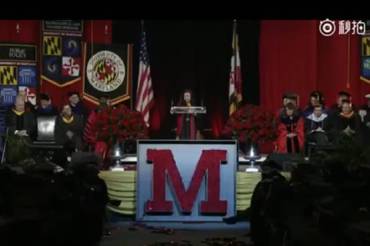
A Chinese student in the U.S. apologized for a commencement speech that criticized China’s air pollution and praised American free speech after she faced a storm of online criticism ​back home.

The incident highlighted how nationalist fervor in China can quickly become vitriolic at a time when President Xi Jinping is pushing a narrative of China’s rise on the geopolitical stage that allows little room for​​ ​ideological​ ​​dissent.

In her remarks, Yang Shuping, a psychology and theater graduate at the University of Maryland, cheered American air quality, saying she found it to be “fresh and sweet, and oddly luxurious.” In China, Ms. Yang said, she wore a face mask to protect against the polluted air.

She went on in her speech to compliment another refreshing aspect of American life—free speech.

“I have learned the right to freely express oneself is sacred in America,” she told about 8,000 graduating students in attendance.

Ms. Yang said she was shocked to discover that politically sensitive issues like the 1992 Los Angeles riots can be openly discussed on campus. “Democracy and freedom are the fresh air that is worth fighting for,” she said. “Enjoy the fresh air and never let it go.”

China, in contrast, censors discussion of certain sensitive topics on social media and in public discourse, such as the 1989 killings at Tiananmen Square​ in Beijing.

The video of Ms. Yang’s speech was posted online and went viral in China. It was viewed more than 30 million times on the nationalist tabloid Global Times’ account on Sina Weibo, a Twitter-like service. A hashtag “overseas student said U.S. air is even sweet” was clicked on more than 50 million times, according to Weibo.

Ms. Yang couldn’t be reached for comment.

Some accused her of belittling China and groveling to the U.S. by exaggerating the severity of China’s pollution. Online activists said they discovered Ms. Yang hailed from the southwest city Kunming, known as the City of Eternal Spring for its mild weather and fresh air. The Wall Street Journal couldn’t verify her home city.

Others said she pandered to the audience by implicitly criticizing China on human rights and freedom of speech. Western nations have chastised China on those matters, making it them sensitive issues.

“Some people are not able to stand up once they knelt down for too long,” one viewer posted on social media.Some analysts said ​Ms. Yang’s speech may have offended ordinary Chinese, but the incident ​was magnified by online activists with an agenda of stoking nationalistic sentiment.

“Whether this Chinese student’s speech is accurate or appropriate is something that remains to be discussed,” but online media users amplified the incident with sensationalist headlines, wrote Fang Kecheng, a media researcher, in an article.

Some Chinese students at the University of Maryland also took to Weibo to protest against what they saw as the stereotypical description of China in Ms. Yang’s speech.

“I understand that China is improving and we need to embrace the suggestions from outside world, but I would be so pissed off if anyone disgraced my country with deceptions,” said Xinling Jiang, a communications student at the University of Maryland, in a video she posted online.

In a statement on its website, ​the ​University of Maryland said it supported Ms. Yang and her “right to share her views and her unique perspective, and we commend her on lending her voice on this joyous occasion.”

Still, Ms. Yang felt the need to apologize, saying she loved her homeland and was proud of its prosperity and development.

“The speech is just to share my overseas experience and comes with no intention to negate or belittle my country…I sincerely apologize, hope for forgiveness, and will learn this lesson,” she said on her Weibo account.

Source: Chinese Student’s Speech at U.S. College Sparks Uproar Back Home – China Real Time Report – WSJ


24/05/2017

Kung phooey: A fist-fight in China turns into a clash between tradition and modernity | The Economist

MOST lovers of Chinese martial arts take the magical aspects of kung fu, as demonstrated by the flying fighters of legend and film, with a pinch of salt. But Wei Lei built his career in China on a claim that his mastery of tai chi, a branch of kung fu, had given him supernatural power. In a programme about kung fu that was broadcast on state television in 2015, Mr Wei demonstrated that he could keep a dove standing on his hand with an invisible force-field and smash the inside of a watermelon without damaging its rind.

The broadcaster itself appeared to be among the credulous.There were many sceptics, too. Earlier this year one of them stepped forward to challenge Mr Wei: Xu Xiaodong, a practitioner of mixed martial arts—a fighting form drawing on Eastern and Western traditions that began to take off in America in the 1990s (and is picking up fans in China). Mr Xu mocked tai chi as a slow-motion form of aerobics. Last month the two men decided to settle their argument in hand-to-hand combat. The fight on April 27th was quick and decisive. Just 12 seconds in, Mr Wei ended up on the ground, his nose bleeding.

A fist-fight in China turns into a clash between tradition and modernity

A video of the clash spread rapidly online. Some commentators in China sided with Mr Xu, and urged him to expose other kung fu “masters”. Mr Xu promised to do so. His aim, he said, was not to disparage Chinese martial arts, but to expose deceitful practitioners.

But many netizens accused Mr Xu of trying to besmirch the country’s ancient fighting techniques: how, they asked, could a single fight prove anything? Guancha.cn, a news portal, said Mr Xu’s posts over the years on Weibo, a microblog website, had insulted the Chinese army and Mao Zedong. Ye Yincong of Lingnan University in Hong Kong wrote that the reaction demonstrated a common tendency in China to view the world in terms of a struggle between Chinese tradition and Western influence.

Some kung-fu fighters have expressed willingness to take up Mr Xu’s challenge. But faced with a barrage of hate messages, Mr Xu appears to have lost his zeal. On May 4th he appeared in a live video-stream, looking stressed. “I have lost my career and everything,” he said, implying the pressure had been affecting his work as a mixed-martial-arts coach.

The authorities appear eager to put an end to the debate. China’s president Xi Jinping is a fan of traditional Chinese culture, and says he wants to use it promote the country’s “soft power” abroad. The recent criticism of kung fu may have triggered too much questioning of it for his taste. On May 7th Mr Xu’s Weibo account was deleted, as was some of the online reporting and commentary about his fight with Mr Wei. Mr Xu told the BBC that he would keep quiet from now on, and study traditional Chinese martial arts.

Source: Kung phooey: A fist-fight in China turns into a clash between tradition and modernity | The Economist

Tags:
24/05/2017

India’s electric vehicles push likely to benefit Chinese car makers | Reuters

India’s ambitious plan to push electric vehicles at the expense of other technologies could benefit Chinese car makers seeking to enter the market, but is worrying established automakers in the country who have so far focused on making hybrid models.

India’s most influential government think-tank unveiled a policy blueprint this month aimed at electrifying all vehicles in the country by 2032, in a move that is catching the attention of car makers that are already investing in electric technology in China such as BYD and SAIC.

The May 12 report by Niti Aayog, the planning body headed by Prime Minister Narendra Modi, recommends lower taxes and loan interest rates on electric vehicles while capping sales of petrol and diesel cars, seen as a radical shift in policy.

India also plans to impose higher taxes on hybrid vehicles compared with electric, under a new unified tax regime set to come into effect from July 1, upsetting car makers like Maruti Suzuki and Toyota Motor.

The prospect of India aggressively promoting electric vehicles was a “big opportunity”, a source close to SAIC, China’s biggest automaker, told Reuters.

“For a newcomer, this is a good chance to establish a modern, innovative brand image,” the source said, although they added the company would need more clarity on policy before deciding whether to launch electric vehicles in India.

Earlier this year SAIC set up a local unit called MG Motor which is finalising plans to buy a car manufacturing plant in western India. A spokesman at SAIC did not comment specifically on the company’s India plans.

Warren Buffett-backed BYD already builds electric buses in the country, while rival Chongqing Changan has said it may enter India by 2020.

BYD said in a statement the company would have “a lot more confidence” to engage in the Indian market if the government supported the proposed policy. The company said it would look at increasing its investment in India but did not give details on how it would expand its business and market share.

HIGH COSTS

While the Niti Aayog report has not yet been formally adopted, government sources have said it was likely to form the basis of a new green cars policy.

If so, India would be following similar moves by China, which has been aggressively pushing clean vehicle technologies. But emulating China’s success could be tough.Electric vehicles are expensive due to high battery costs, and car makers say a lack of charging stations in India could make the whole proposition unviable.

The proposed policy focuses on electric vehicles, and is likely to also include plug-in hybrids. But it overlooks conventional hybrid models already sold in India, such as Toyota’s Camry sedan, Honda Motor’s Accord sedan and so-called mild hybrids built by Maruti Suzuki.

Hybrids combine fossil fuel and electric power, with mild hybrids making less use of the latter.

In doubling down on electric power India would be shifting away from its previous policy, announced in 2015, that supported hybrid and electric technology.

That could delay investments in India, expected to be the world’s third-largest passenger car market within the next decade, according to industry executives and analysts.

“All these policy changes will affect future products and investments,” said Puneet Gupta, South Asia manager at consultant IHS Markit, adding that most car makers would need to rethink product launches, especially of hybrids.

ECONOMIC GAP

Mahindra & Mahindra is the only electric car maker in India but has struggled to ramp up sales, blaming low buyer interest and insufficient infrastructure.

Pawan Goenka, managing director at Mahindra said the company was working with the government and other private players to set up charging stations in India. Mahindra was also focusing on developing electric fleet cars and taxis, Goenka said.

The cost of setting up a car charging station in India ranges from $500 to $25,000, depending on the charging speed, according to a 2016 report by online journal IOPscience.

While the proposed policy suggests setting up battery swapping stations and using tax revenues from sales of petrol and diesel vehicles to set up charging stations, it does not specify the investment needed or whether the government would contribute.

“For full electric vehicles, the economic gap remains huge and the charging infrastructure needed does not exist,” said a spokesman at Tata Motors. The company makes electric buses and is working on developing electric and hybrid cars.

DELAYED PLANS

Most automakers have focused on bringing in hybrid models that are seen as a stepping stone to electrification. Toyota recently launched its luxury hybrid brand Prius in India, while Hyundai Motor plans to debut its Ioniq hybrid sedan next year.

Maruti’s parent Suzuki Motor, along with Toshiba and Denso, plans to invest 20 billion yen ($180 million) to set up a lithium ion battery plant in India which would support Maruti’s plan to build more hybrids.

But the apparent sharp shift in policymakers’ thinking in favor of electrification is forcing automakers like Toyota and Nissan Motor to seek more clarity before finalising future products for India, while Hyundai may delay new launches.

Toyota, the world’s No. 2 carmaker by sales, had planned to have a hybrid variant for all its vehicles in India, but the company’s future launches would now depend on the new policy, said Shekar Viswanathan, vice chairman of its Indian subsidiary.

Nissan, which plans to launch a hybrid SUV later this year, said in a statement it was waiting for more clarity before deciding whether to bring electric cars to India.

A plan by Hyundai to launch at least three hybrid cars in India in 2019-2020 would likely to be delayed, said a source.

Hyundai did not comment on queries related to delays.

“If the government will be aggressive on electric vehicles and not support other technologies, companies will need to rethink investments,” said an executive with an Asian carmaker.

Source: India’s electric vehicles push likely to benefit Chinese car makers | Reuters

22/05/2017

Indian woman ‘sets new Everest dual ascent record’ – BBC News

An Indian has climbed Mount Everest twice in under a week in what may be a new woman’s record for fastest double ascent of the world’s highest peak.

Anshu Jamsenpa, a 37-year-old mother-of-two, reached the summit on 16 and 21 May, tourism official Gyanendra Shrestha confirmed to BBC Nepali.

The current Guinness record for woman’s fastest double ascent is seven days.

News of Ms Jamsenpa’s climbs came as at least three climbers were killed on the mountain over the weekend.

An Australian climber died on the Tibetan side, while a Slovak and an American died on the Nepalese side. Rescuers have failed to locate a fourth climber – who is from India – who disappeared shortly after reaching the summit.

Hundreds of mountaineers are hoping to scale the world’s highest peak before the monsoon sweeps in next month.


It’s the second time Ms Jamsenpa, who is from the Indian state of Arunachal Pradesh, has notched up an Everest double ascent. Her previous feat was in 2011, but those ascents came 10 days apart.

She will now have to approach Guinness World Records to register her climbs after they have been certified by Nepal’s ministry of tourism.

The current woman’s record was set by Nepalese climber Chhurim Sherpa in 2012.

Apart from her two double ascents, Ms Jamsenpa also scaled the mountain in 2013.Her husband, Tsering Wange, told the BBC that her plan was always to do a double ascent twice, but her second attempt did not succeed in 2014 due to an avalanche and in 2015 because of the devastating Nepal earthquake.

Source: Indian woman ‘sets new Everest dual ascent record’ – BBC News

22/05/2017

India announces policy for strategic partnerships in defence | Reuters

India on Saturday finalised a policy that would allow local private companies to work with foreign players to make high-tech defence equipment, in a boost to Prime Minister Narendra Modi’s bid to cut reliance on imports.

The policy, whose finer details are still to be formalised, will initially allow the entry of private companies into the manufacture of submarines, fighter aircrafts and armoured vehicles through foreign partnerships, a statement issued by the Defence Ministry said.”In future, additional segments will be added,” the statement said.

Industry experts have said that delays in finalising procurement policies have undermined India’s efforts to get local, largely inexperienced, companies to tie up with foreign manufacturers, a necessary step if domestic firms are to utilise the latest technology.

Prime Minister Modi has vowed to reverse India’s dependence on imports by building a local manufacturing industry. The government is forecast to spend $250 billion on modernisation of its armed forces over the next decade.The policy, announced on Saturday, would allow Indian companies to partner with global defence majors “to seek technology transfers and manufacturing know-how to set up domestic manufacturing infrastructure and supply chains,” the statement said.

Foreign manufacturers such as Lockheed Martin, Boeing, BAE Systems and Saab are looking to India as one of the biggest sources of future growth.

Source: India announces policy for strategic partnerships in defence | Reuters

22/05/2017

China, Russia formalize Shanghai venture to build wide-body jet | Reuters

China and Russia on Monday completed the formal registration of a joint venture to build a proposed wide-body jet, kickstarting the full-scale development of a program that aims to compete with market leaders Boeing (BA.N) and Airbus (AIR.PA).

State planemakers Commercial Aircraft Corporation of China (COMAC) [CMAFC.UL] and Russia’s United Aircraft Corp (UAC) said at a ceremony in Shanghai the joint venture would aim to build a “competitive long range wide-body commercial aircraft”.

COMAC, which is increasingly looking to break the hold Boeing and Airbus have over the global commercial jet market, successfully completed the maiden flight of its home-grown C919 narrow-body passenger jet earlier this month.

“The long-haul, wide-body passenger jet is a strategic project for China and Russia, followed closely by the two governments,” said Guo Bozhi, general manager of COMAC’s wide-body department.

COMAC and UAC first announced the twin-aisle jet program in 2014 but the project has so far been slow to materialize.

In November, the firms said they had set up a joint venture in Shanghai and unveiled a mock-up of the wide-body jet, based around a basic version that would seat 280 and have a range of up to 12,000 kilometers (7,500 miles).

UAC president Yuri Slyusar said the firms were aiming to complete the wide-body jet’s maiden flight and first delivery between 2025-2028. He added the plane would look to take 10 percent of the market from the Boeing 787 and Airbus 350.

Previously, the firms had been aiming for a maiden flight of the jet in 2022 and delivery from 2025 or later.

While the target is tough, it is more realistic than recent aircraft programs that have sought results in 5-7 years and then come in late, industry analysts said. COMAC’s first homegrown jet, the ARJ-21, obtained permission to enter domestic service more than 10 years behind its original schedule.

COMAC and UAC hold equal shares in the joint venture.

Last July, Boeing forecast the world’s airlines would need 9,100 wide-body planes over 20 years to 2035, with a wave of replacement demand to come between 2021-2028.China has plowed billions of dollars over the past decade into a domestic jet development program as it looks to raise its profile in the global aviation market and boost high-tech manufacturing at home.

Source: China, Russia formalize Shanghai venture to build wide-body jet | Reuters

18/05/2017

Why are millions of Indian women dropping out of work? – BBC News

Why are millions of women dropping out of work in India?

The numbers are stark – for the first time in India’s recent history, not only was there a decline in the female labour participation rate, but also a shrinking of the total number of women in the workforce.

Nearly 20 million Indian women quit work between 2004-05 to 2011-12

The labour force participation rate for women of working age declined from 42% in 1993-94 to 31% in 2011-12

Some 53% of the total drop – the largest chunk – happened among women aged 15-24 and living in villages

In rural areas, the female labour force participation rate dropped from 49% to 37.8% between 2004-05 and 2009-10

While more than 24 million men joined the work force between 2004-5 to 2009-10, the number of women in the the work force dropped by 21.7 million

Using data gleaned from successive rounds of National Sample Survey Organisation and census data, a team of researchers from World Bank have attempted to find out why this is happening.

“These are significant matters of concern. As India poises itself to increase economic growth and foster development, it is necessary to ensure that its labour force becomes fully inclusive of women,” says the study, authored by Luis A Andres, Basab Dasgupta, George Joseph, Vinoj Abraham and Maria Correia.

So what accounts for the unprecedented and puzzling drop in women’s participation in the workforce – at a time when India’s economy has grown at a steady pace?

Women need better and more suitable job opportunities outside farming, the authors say

Predictable social norms are attributed to women quitting work in India: marriage, motherhood, vexed gender relations and biases, and patriarchy.

But they may not be the only reasons. Marriage, for example, does affect the rate of participation of women in the workforce. But in villages, the workforce participation rate of married women has been found to be higher than that of unmarried women – whereas in the cities, the situation is reversed.

Significantly, rising aspirations and relative prosperity may be actually responsible for putting a large cohort of women out of work in India.

Remember, the largest drop has been in the villages.

After calculating the labour force participation rates and educational participation rates (young women in schools) the researchers believe that one plausible explanation for the drop in the participation rate among rural girls and women aged 15-24 is the recent expansion of secondary education and rapidly changing social norms leading to “more working age young females opting to continue their education rather than join the labour force early”.

The study says there has been a “larger response to income changes among the poor, rather than the wealthy, by sending children to school”.

Also, casual workers – mainly women – drop out of the workforce when wages increased for regular earners – mainly men – leading to the stabilisation of family incomes.

“Improved stability in family income can be understood as a disincentive for female household members to join the labour force,” says the study.

Many women work outside the home, and on their farms

“This largely resonates with the existing literature, which suggests that with rising household income levels, women in rural India withdraw from paid labour and engage in status production at home.

“But dropping or opting out of the workforce to go to school and get an education may not ensure that these women will eventually go to work.

After studying the relationship with the female labour participation rate and levels of educational achievements, the researchers found that having a high school-level education was “not found to be an incentive for women” to work.

The lowest rate of participation is among those who had secured school and high school education in the cities and villages. And the rate is actually highest among illiterates and college graduates.

But there has been a general drop in the rate in recent years, indicating that irrespective of educational attainments, “the incentive for women to participate in the workforce has declined over this period”.

Will new maternity law help keep Indian women in work?

The Indian women who took on a multinational and won

To be sure, India has a poor record of female participation in the workforce: the International Labour Organisation ranked it 121 out of 131 countries in 2013, one of the lowest in the world.

Also, India is not an outlier when it comes to women dropping out of the workforce.

Between 2004 and 2012, the female labour force participation rate in China dropped from 68% to 64%, but the participation rate remains very high compared with India. In neighbouring Sri Lanka, for example, the participation rate has dropped, but only by 2%.

“India stands out because of a such a sharp decline within such a short period. In levels, it is very low in international rankings now,” the researchers told me.

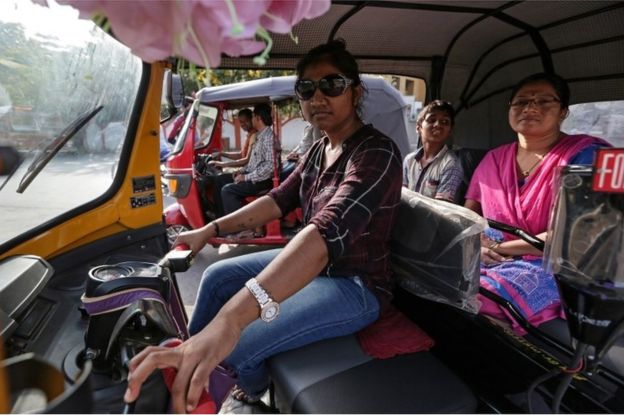
Indian woman auto rickshaw driver Rajani Jadhav pose for photographs during her training session of rickshaw driving in Mumbai, India, 14 April 2017.India needs to offer more opportunities to women, the researchers say

Clearly women need better and more suitable job opportunities, outside agriculture. Rural labour markets need to offer jobs that are acceptable and attractive to women and their families.

The World Bank study suggests that gains will not be realised unless social norms around women’s – and men’s – work also change:

“Strategies to communicate the importance of women’s work should take into account the roles of women, husbands and in-laws.”

Also, as another study says, the “ongoing decrease in the availability of farm-based work, has led to women focusing on economic activities within their households”. Should home-based workers then be counted as members of the labour force?

Source: Why are millions of Indian women dropping out of work? – BBC News

18/05/2017

China taps into cool future for global energy | South China Morning Post

China has succeeded in extracting methane gas from solid deposits under the sea in an experiment that could eventually lead to the commercial production of what is being touted as an abundant new source of energy.In a first for the country, engineers extracted the gas from the so-called “flammable ice” – methane hydrate, where the gas is trapped in ice crystals – and converted it to natural gas in a single, continuous operation on a floating production platform in the Shenhu area of the South China Sea, about 300km southeast of Hong Kong, the Ministry of Land and Resources said on Thursday.

Methane hydrate is formed in such abundance that the US Department of Energy has estimated the total amount could exceed the combined energy content of all other fossil fuels, sparking interest in the resource worldwide.

The US, Canada and Japan have been leading research into it, and Japan said earlier this month it had successfully produced natural gas from methane hydrate off its Pacific coast and plans to conduct continuous production for three to four weeks. Japan’s tests are being carried out on a ship, whereas China is using a floating platform.

China was a latecomer to the methane hydrate scene, but has been catching up fast since the discovery of promising reserves in the South China Sea in 2007. Earlier this year scientists built the nation’s first land-based drilling platform on the Tibetan Plateau, where abundant methane is trapped under the permafrost.

In the latest breakthrough, a bore head was lowered to extract the gas and convert it to natural gas, according to video footage shown on China Central Television.

“We brought the gas to the surface and have lit it up since May 10. By now, the drill has been running continually for eight days,” Ye Jianliang, project leader and deputy chief engineer at the China Geological Survey, told the broadcaster.

“The daily output [of gas] exceeds 10,000 cubic metres. The best day recorded 35,000 cubic metres,” Ye said.Chen Yifeng, associate researcher with the Key Laboratory of Marginal Sea Geology at the Chinese Academy of Sciences in Guangzhou, said the trial run was different from previous operations by other countries because it followed the procedures of commercial production.

“The technology and equipment they use is no longer for experimental purposes. They mean business,” she said.But methane hydrate has its disadvantages, according to Chen. Unlike oil and natural gas reserves which are usually concentrated in confined spaces, the hydrates are often scattered over large areas on the sea floor, and extracting them was like “picking strawberries in a field”.

Also, unlike mineral ores, the “ice” cannot be taken straight out of the water because it would disintegrate with the loss of pressure. Sophisticated machinery and technology was required to depressurize or melt it on the sea bed and channel the gas to the surface.

She also noted that one reason why some countries had put commercial exploitation on hold was because of a fear of a massive escape of methane, a greenhouse gas, into the atmosphere, which could occur if drilling machines destroyed the stability of a seabed.

Some researchers have speculated that methane hydrate had caused a rapid buildup of pipeline pressure that led to the deadly explosion and subsequent massive oil spill on BP’s Deepwater Horizon oil rig in the Gulf of Mexico seven years ago.

A mainland government energy researcher, who declined to be named, doubted whether commercialisation could begin any time soon.

“The government statement has not disclosed the cost, but at this stage, to produce natural gas from combustible ice is likely to make no economic sense,” the researcher said.

“China became the world’s first because no other country has the motivation to do it while oil prices remain low.”

Source: China taps into cool future for global energy | South China Morning Post

18/05/2017

Indian cabinet approves plans to build 10 nuclear reactors | Reuters

India’s cabinet approved plans on Wednesday to build 10 nuclear reactors with a combined capacity of 7,000 megawatts (MW), more than the country’s entire current capacity, to try fast-track its domestic nuclear power programme.

The decision by Prime Minister Narendra Modi’s government marks the first strategic response to the near collapse of Westinghouse, the U.S. reactor maker that had been in talks to build six of its AP1000 reactors in India.Westinghouse, owned by Japan’s Toshiba, filed for Chapter 11 bankruptcy in March after revealing billions of dollars in cost overruns at its U.S. projects, raising doubts about whether it can complete the India deal.

India has installed nuclear capacity of 6,780 MW from 22 plants and plans to add another 6,700 MW by 2021-22 through projects currently under construction. The 10 additional reactors would be the latest design of India’s Pressurised Heavy Water Reactor.

“This project will bring about substantial economies of scale and maximise cost and time efficiencies by adopting fleet mode for execution,” the government said in a statement.

“It is expected to generate more than 33,400 jobs in direct and indirect employment. With manufacturing orders to domestic industry, it will be a major step towards strengthening India’s credentials as a major nuclear manufacturing powerhouse.”

Westinghouse has said it plans to continue construction of its AP1000 plants in China and expects to bid for new plants in India and elsewhere, without elaborating on how it plans to do so.

Indian companies such as Larsen and Toubro, Kirloskar Brothers Limited and Godrej & Boyce welcomed the government’s move.

Sanjay Kirloskar, chairman of Kirloskar Brothers Limited, said: “nuclear power plants will go a long way in reducing the perennial energy deficit,” while Larsen and Toubro’s director S.N. Roy called the move “bold and historic.”

Source: Indian cabinet approves plans to build 10 nuclear reactors | Reuters

08/05/2017

The bullies of Urumqi: The extraordinary ways in which China humiliates Muslims | The Economist

CHINESE officials describe the far western province of Xinjiang as a “core area” in the vast swathe of territory covered by the country’s grandiose “Belt and Road Initiative” to boost economic ties with Central Asia and regions beyond.

They hope that wealth generated by the scheme will help to make Xinjiang more stable—for years it has been plagued by separatist violence which China says is being fed by global jihadism. But the authorities are not waiting. In recent months they have intensified their efforts to stifle the Islamic identity of Xinjiang’s ethnic Uighurs, fearful that any public display of their religious belief could morph into militancy.Xinjiang’s 10m Uighurs (nearly half of its population) have long been used to heavy-handed curbs: a ban on unauthorised pilgrimages to Mecca, orders to students not to fast during Ramadan, tough restrictions on Islamic garb (women with face-covering veils are sometimes not allowed on buses), no entry to many mosques for people under 18, and so on.

But since he took over last August as Xinjiang’s Communist Party chief, Chen Quanguo has launched even harsher measures—pleased, apparently, by his crushing of dissent in Tibet where he previously served as leader. As in Tibet, many Xinjiang residents have been told to hand their passports to police and seek permission to travel abroad. In one part of Xinjiang all vehicles have been ordered to install satellite tracking-devices. There have been several shows of what officials call “thunderous power”, involving thousands of paramilitary troops parading through streets.

Last month, new rules came into effect that banned “abnormal” beards (such as the one worn by the man pictured in front of the main mosque in Kashgar in south-western Xinjiang). They also called on transport workers to report women wearing face veils or full-body coverings to the police, and prohibited “naming of children to exaggerate religious fervour”. A leaked list of banned names includes Muhammad, Mecca and Saddam. Parents may not be able to obtain vital household-registration papers for children with unapproved names, meaning they could be denied free schooling and health care.

Residents have also been asked to spy on each other. In Urumqi, the region’s capital, locals can report security threats via a new mobile app. People living in Altay in northern Xinjiang have been promised rewards of up to 5m yuan ($720,000) for tip-offs that help capture militants—over 200 times the local income per person.

Across Xinjiang residents have been asked to inform the authorities of any religious activities, including weddings and circumcisions. The government is also testing its own people’s loyalty. In March an official in Hotan in southern Xinjiang was demoted for “timidity” in “fighting against religious extremism” because he chose not to smoke in front of a group of mullahs.

Mr Chen is widely rumoured to be a contender for a seat in the ruling Politburo in a reshuffle due late this year. Displays of toughness may help to ingratiate him with China’s president, Xi Jinping, who has called for “a great wall of iron” to safeguard Xinjiang. Spending on security in Xinjiang was nearly 20% higher in 2016 than the year before. Adverts for security-related jobs there increased more than threefold last year, reckon James Leibold of La Trobe University and Adrian Zenz of the European School of Culture and Theology at Korntal, Germany.

Uighurs have been blamed for several recent attacks in Xinjiang. In one of them in February, in the southern prefecture of Hotan, three knife-wielding men killed five people and injured several others before being shot dead by police (local reports suggested the violence occurred after a Uighur family was punished for holding a prayer session at home). Officials may be congratulating themselves on the success of their tactics; reported large-scale attacks by Uighurs inside and outside Xinjiang have abated in the past 18 months. Yet as in Tibet, intrusive surveillance and curbs on cultural expression have fuelled people’s desperation. “A community is like a fruit,” says a Uighur driver from Kashgar. “Squash it too hard and it will burst.”

Source: The bullies of Urumqi: The extraordinary ways in which China humiliates Muslims | The Economist

Tags:
Law of Unintended Consequences

continuously updated blog about China & India

ChiaHou's Book Reviews

continuously updated blog about China & India

What's wrong with the world; and its economy

continuously updated blog about China & India