03/08/2016

Road test for homegrown transit elevated bus| Innovation

The transit elevated bus TEB-1 is on road test in Qinhuangdao, North China’s Hebei Province, Aug 2, 2016. China’s home-made transit elevated bus, TEB-1, conducted a road test running Tuesday.

The 22-meter-long, 7.8-meter-wide and 4.8-meter-high TEB-1 can carry up to 300 passengers. The passenger compartment of this futuristic public bus rises far above other vehicles on the road, allowing cars to pass underneath. [

Source: Road test for homegrown transit elevated bus[1]| Innovation

03/08/2016

India’s biggest tax reform GST looms, many companies unprepared | Reuters

Throughout years of political gridlock, the risk that India might pass its biggest tax reform since independence appeared reassuringly remote for many businesses.

Until now.Suddenly, the prospect that a new Goods and Services Tax (GST) could enter force next year has bosses panicking at the likely impact and seeking advice on how to cope.

The expected passage by parliament on Wednesday of a key constitutional amendment would resolve crucial issues needed to transform India’s $2 trillion economy and 1.3 billion consumers into a single market for the first time.

The amendment is likely to clear the Rajya Sabha after the opposition Congress party, which originally proposed the GST while in power, wrung concessions from Prime Minister Narendra Modi‘s government.

Yet the vote will only fire the starting gun in a legislative marathon in which the national parliament and India’s 29 federal states have to pass further laws determining the – still unknown – rate and scope of the tax.

At the same time, a huge IT system needs to be set up, tax collectors trained and companies brought up to speed on a levy that experts say will force them to overhaul business processes from front to back.

One boss who isn’t ready is G.R. Ralhan, head of Roamer Woollen Mills in the northern city of Ludhiana.

“Companies, particularly smaller ones, are apprehensive,” Ralhan told Reuters, calling for more time to adjust and saying a high rate of GST could put his firm out of business.

Countries that have introduced GST in the past have often faced a relative economic slowdown before the benefits of a unified tax regime feed through.

India is already the world’s fastest growing large economy, expanding by 7.9 percent year-on-year in the March quarter. Economists at HSBC forecast a boost of 0.8 percentage points from the GST within three to five years.

80-20 RULE

Tax experts say that only 20 percent of – mostly big – firms are getting ready for the GST. The rest are taking things as they come in a country where coping with a changing tax regime has been a way of life for decades.

Yet even those actively preparing must contend with a series of unknowns as the national and state parliaments tackle the task of transforming a “model” GST law into the real thing.

The first hurdle will be for a majority of state parliaments to pass the GST amendment, which would establish a GST Council to finalise key terms of the new tax.

That could take until November and mean that the legislation to put the GST into force would only come before the national parliament’s winter session.

Hitting the government’s target launch date of next April 1, the start of the fiscal year, looks ambitious. Slippage to July or October 2017 is increasingly likely, say experts.

Source: India’s biggest tax reform GST looms, many companies unprepared | Reuters

03/08/2016

Startups hope to capitalize on the massive IoT market – Times of India

Fresh from the sale of their first venture focused on the heating, ventilation and air conditioning (HVAC) market, Shishir Gupta, Nithin David and Varun Gupta embarked on what they thought was their next breakthrough idea.

In mid-2013, the trio decided to devise solar air conditioners based on their previous experience in the market but, after some pilots, they discovered the idea was commercially unviable.

From the ashes of their second enterprise, they did manage one small gain — a connected controller that reduced energy use by 30% during the night. Using this, they pushed their entrepreneurial energy in a new direction — towards the rapidly emerging opportunity in the internet of things (IoT) , or devices and objects that send and receive data over the internet. Rather than build large systems for this, their new venture Oakter is thinking much smaller. It is building out a series of IoT-based devices to “smarten” homes across India.

In around two years of operation, Oakter’s controllers have smartened some 10,000 gadgets, claims Shishir Gupta, without disclosing the number of homes his controllers have been installed in currently. The startup’s full launch hasn’t even happened, he says, since it is still reaching out informally to consumers. Around Diwali this year, Oakter is expected to make a big-bang offline launch and expects to reach 10,000 homes in a year and revenues of Rs 100 crore by 2018-19.

“Within 10 years, IoT will transform the way we manage our lives,” says Shishir. There are plenty of data points to back his enthusiasm. In 2008 itself, there were more objects connected to the internet than people, and technology researcher Gartner forecasts that by 2020 there will be nearly 21 billion connected devices. If the ATM was perhaps the first popular connected device in the early 1970s, hundreds of companies have since shown an interest in getting wired up.

IoT’s the Thing

In the US, the largest technology market, there has been a mixed response to various kinds of IoT. According to CB Insights, a tracker of this kind of deal data, deal volume is on track to surpass 2015’s total by 30%. Fundingwise, 2016 should be a robust year for IoT in the West, and the second year in a row of $1.2 billion-plus in funding. Several startups in the field raised significant amount of funding, including IoT software and services company Greenwave Systems ($45 million Series C), commercial drone developer Airware ($30 million Series C), and connected HVAC and lighting company Enlighted ($25 million Series D financing).However, deal flow looked less upbeat on a quarterly basis, with both value and volume declining in the second quarter of 2016. After an increase in the first quarter with 54 transactions, deal-making fell 26% quarter-over-quarter. And funding fell from $328 million to $325 million — a 9% quarter-on-quarter decline. At a global level, there is massive potential.

According to a statement from Gartner’s research chief Peter Sondergaard, the incremental revenue generated by IoT suppliers is estimated to reach $309 billion per year by 2020. This growth opens up new business opportunities, as half will be attributed to new startups and 80% will be in services, not products. Manufacturing, healthcare and insurance are expected to lead the IoT race.

Some of this entrepreneurial interest is being generated in India, too. For example, in May this year, Entrepreneurship and Venture Capital (EVC), an early stage investor, launched a $50 million unit to focus on IT.

Qualcomm Ventures, the VC arm of the global chipmaker, recently unveiled its $150 million India fund and made its first investment of $10 million in healthcare IoT venture Attune Technologies. In early July, a centre of excellence for IoT was launched jointly by software industry lobby Nasscom, the department of electronics and information technology and the Education and Research Network. This centre can house up to 40 startups and the model is expected to be replicated nationwide.

Source: Startups hope to capitalize on the massive IoT market – Times of India

02/08/2016

India to impose temporary anti-dumping duty on some steel products | Reuters

An Indian government body has recommended provisional anti-dumping duty on imports of hot-rolled steel products, a government statement said on Tuesday, to reduce overseas purchases of the alloy and shield local mills.

The anti-dumping duty will come into effect after New Delhi formally notifies the tax.

The Directorate General of Anti Dumping recommended the duties on steel products from China, Japan, South Korea, Russia, Brazil and Indonesia, the statement said.Indian steelmakers such as the Steel Authority of India (SAIL.NS) , JSW Steel (JSTL.NS) and Tata Steel (TISC.NS) had lobbied for protectionist measures to prevent cheap overseas purchases that were undercutting local mills and squeezing margins.

Source: India to impose temporary anti-dumping duty on some steel products | Reuters

02/08/2016

Why Experts Say a Donald Trump Presidency Could Benefit India – India Real Time – WSJ

A Donald Trump presidency could help India, according to a panel of India’s top strategic thinkers.

The businessman and television personality, known for his pledge to shake up the global status quo and “make America great again,” could help Indian business by squashing free-trade deals that disadvantage the South Asian nation and while also opening up a larger role for India’s military, speakers at a Brookings India event in Delhi said Monday.

Mr. Trump’s plan to make Asian allies pick up more of the slack for defense spending in the region would “open up a huge amount of space for India” in global affairs, said C. Raja Mohan, director of Carnegie India.

Meanwhile, Mr. Trump’s opposition to the Trans Pacific Partnership would also be a bonus for India, which never signed the deal, said Brookings India’s Harsh V. Singh. Mr. Trump says such deals disadvantage U.S. workers. Many Indian companies “would breathe a sigh of relief” if the trade deal, which favors signatories like Vietnam and Malaysia over India, was squashed, Mr. Singh said.

Mr. Trump has already sent jitters through the Asian security community by saying: “Many countries are not paying their fair share,” for U.S. military protection. By contrast his opponent Hillary Clinton, is seen as someone who would most likely leave relationships unchanged with major allies.

For India, which has no U.S. military bases on its soil, the prospect of life with a diminished American presence in east Asia and the Middle East would mean a sharpening of divisions in the region, but also allow it to expand its influence and invent a new global role for itself, said Mr. Mohan.

The changes could be as large as those that accompanied the withdrawal of the British military from the region post World War II, a shift that saw the birth of modern India in 1947, he said.

Still, if Mr. Trump wins office, he will likely withdraw U.S. support and investment for Indian renewable energy, the Hindustan Times’ Foreign Editor Pramit Pal Chaudhuri said. Protectionist policies could be “a disaster” for the global economy, triggering a spate of trade wars, Mr. Chaudhuri said.

Source: Why Experts Say a Donald Trump Presidency Could Benefit India – India Real Time – WSJ

01/08/2016

Didi, Uber said to merge in China in $35 billion deal | Reuters

Ride-hailing firm Uber is to merge its China operations with bigger rival Didi Chuxing, and hold a one-fifth stake in the new business, in a $35 billion deal to end bruising competition between the two, according to a source familiar with the matter.

A deal between the two – which have been spending heavily to gain market share and battling fiercely for passengers – could be announced as early as Monday, said the source, who declined to be identified because the deal is not yet public.

The new entity combines Didi’s most recent valuation of $28 billion and Uber China’s $7 billion valuation for the $35 billion market capitalization. Uber China investors will have a 20 percent stake in the new company, the source said.Uber did not offer any immediate comment. Didi could not be reached for comment.

“It makes huge sense, Uber faces an uphill task in China especially since Didi is multiple times larger by transaction value and city coverage,” said Hong Kong-based Richard Ji, co-founder of All-Stars Investment Ltd, which manages about $900 million and owns Didi stock.

“This will lead to favorable outcomes for both companies. The biggest benefit is cost savings, they no longer have to give out subsidies to drivers and passengers. It will give pricing power as the new entity will become the dominant player. That means profitability will come sooner than later,” he added.

Source: Didi, Uber said to merge in China in $35 billion deal | Reuters

01/08/2016

How Cheap Oil Is Squeezing South Asia’s Cash Lifeline – India Real Time – WSJ

Chronically low oil prices are disrupting a critical financial lifeline across Asia and depriving economies of much-needed hard currency.

The flow of cash, or remittances, from Asian citizens working in the Gulf soared when the price of oil was high, boosting growth across the board. The billions of dollars in annual inflows paid for necessities such as schooling and health care and helped propel families into the middle class for the first time.

Now that money is disappearing, perhaps permanently, as laborers lose work in oil-driven Mideast countries. That’s adding a new threat to growth in some Asian nations and depriving them of currency inflows they need to balance their national accounts and keep their currencies from depreciating too quickly.

A barrel of Nymex crude is now trading at around $41, up from below $30 earlier this year. But prices are a long way from the peak of the boom and aren’t expected to return to previous highs soon. In February 2014, a barrel of crude cost more than $100.

Demonstrating the pressures of sustained low prices, thousands of Indian workers protested in Saudi Arabia on Saturday at being left without jobs, pay and food after they were laid off. The Indian government stepped in over the weekend to hand out food to hungry workers.

Source: How Cheap Oil Is Squeezing South Asia’s Cash Lifeline – India Real Time – WSJ

29/07/2016

Disgorging | The Economist

OUTSIDE China, the monster Three Gorges dam across the Yangzi river is one of the most reviled engineering projects ever built. It is blamed for fouling the environment and causing great suffering among the 1.2m people who were relocated to make way for its reservoir. Inside China, officials insist that the dam is an “unsung hero” (in the recent words of the Yangzi’s chief of flood control). But controversy over the project occasionally flares. Amid the country’s worst flooding in years, it is doing so again.
The Communist Party took enormous pride in the completion of the Three Gorges dam a decade ago; officials said it would play a vital role in taming a river which, when it flooded, often claimed hundreds or thousands of lives. Recently, however, censors have permitted a few ripples of complaint to disturb the glassy surface of state-run media. Online critics have asked whether the dam has failed to protect cities from flooding or whether it has caused earthquakes—and have not had their posts deleted. Granting permission to complain may seem surprising. But officials have reason to feel confident. The much-denounced dam seems to be passing its first big test as a flood barrier.

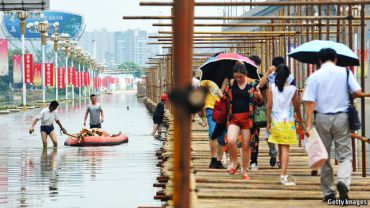
This season has been one of the wettest in China’s recent history, with 150 towns and cities suffering record amounts of rain. The Yangzi basin has been particularly hard hit. In the week to July 6th Wuhan, a giant city downstream from the dam, received 560mm (22 inches) of rain, its biggest ever downpour (residents are pictured on a temporary bridge).

China’s most recent experience of weather like this was in 1998, which was also the last time El Niño, a shift in the weather patterns of the western Pacific, had a big impact on the world’s weather. That summer the Yangzi burst its banks, causing more than 1,300 deaths. So far this year fewer than 200 people have died in the river’s basin.

One big difference is that in 1998 the Three Gorges dam was still under construction (it went into full operation in 2012). By July 24th it had held back about 7.5 billion cubic metres (260 billion cubic feet) of potential floodwater, which would have compounded disasters caused by torrential rain in the middle and lower reaches: some of the heaviest rains have occurred downstream from the dam. It is too soon to declare victory over the floods. The rainy season is only halfway through and more downpours are expected in August. But so far, as a method of flood control, the dam has done more or less what it was supposed to.

That doesn’t necessarily justify the project. One of the most important criticisms of it, by the late Huang Wanli, a hydrologist at Tsinghua University in Beijing, is that so much silt will eventually build up behind the dam that it will have to be taken down, leaving the Yangzi basin worse off than if the barrier had never been built. The region in which the dam stands is also one of the world’s most seismically active. Geologists worry that the weight of water in the sinuous reservoir, 600km (370 miles) from end to end, and the rise and fall of it, is causing more frequent tremors along the fault lines. Even small earthquakes can cause perilous landslides.

Considered purely as a means of flood control, the dam is a mixed blessing. The silt-free water that gushes through it fails to replenish embankments downstream, thus weakening them as flood barriers (several have collapsed this year). Below the dam, the water now runs faster; it has scraped away and lowered the Yangzi’s bed by as much as 11 metres, according to Fan Xiao, a geologist working for Probe International, a Canadian NGO. As a result, nearby wetlands drain into the river, damaging their ability to act as sponges during a flood.In 2000 another academic at Tsinghua, Zhang Guangduo (who had done the environmental feasibility studies for the dam), told the man in charge of building the barrier that “perhaps you know that the flood-control capacity of the Three Gorges Project is smaller than declared by us,” according to leaked documents. Peter Bosshard of International Rivers, an environmental NGO, asks whether it was wise to spend so many billions on one project, rather than strengthen flood-protection measures all along the Yangzi.

That point has been borne out by the many failures of local flood-control measures that have also occurred this year. In July parts of Wuhan’s metro system filled with water. This seems to be the result of bad management or corruption. According to People’s Daily, a party newspaper, only 4 billion yuan ($600m) of the 13 billion yuan allocated to improving drainage in the metro was actually spent. Local media say that one of the people responsible for drainage projects in the city is under arrest for taking huge bribes.

Such problems have been exacerbated by urban expansion. Wuhan used to have more than 100 lakes, but it has lost two-thirds of them to construction sites since 1949. The city’s wetlands have been gobbled up, too. Those that remain are too small to store flood waters. It is a relief that far fewer people have died in floods along the Yangzi this year compared with 1998. But it is no indication of the basin’s broader environmental health.

The Three Gorges dam has a historical parallel. In 1928 a tropical hurricane caused Lake Okeechobee, in central Florida, to flood, drowning 2,500 people in the southern half of the state. Determined that such a thing would never happen again, America’s Army Corps of Engineers over the next few decades drained much of the Everglades, which then covered much of the southern part of the state. No human disaster has recurred but the Everglades is a shadow of its former self and conservationists are battling to save it from destruction. The Yangzi is in danger not only from floods but from its flood controls.

Source: Disgorging | The Economist

29/07/2016

Strike hits Indian banks, but treasury functions normal | Reuters

A nation-wide bank strike in India hit the public transactions like cheque clearances and cash deposits, but the vital treasury operations including a 150 billion rupee ($2.24 billion) government bond auction are unlikely to be affected, traders said.Staffing in treasuries of banks are likely to be less than normal days but officials will ensure that functions like bidding at the auction will run smoothly, three traders at state-run banks said.

“Treasury people have been allowed to enter the head office of the bank, so there is no problem for us in trading or bidding at the auctions,” said a senior trader at a large state-run bank.

However, there could be some issues in some banks settling the previous day’s trades due to thin staffing.

“Settlement will be a problem at back office,” said a senior official with State Bank of India.The RBI was also not too worried about the impact of the strike on treasury operations and settlements of banks.

“There shouldn’t be any problem. Primary dealers are also there to underwrite if needed. But auctions should go through smoothly,” the official said.

An estimated 1 million bank staff are expected to strike work, opposing the government’s proposal to merge SBI‘s associate banks with itself. In addition, unions are against the government’s proposed move to privatise IDBI Bank.

($1 = 66.9800 Indian rupees)

Source: Strike hits Indian banks, but treasury functions normal | Reuters

29/07/2016

Why India Is Spending $1 Billion on Boeing Jets – The Short Answer – WSJ

India is beefing up its maritime patrol and anti-submarine warfare capabilities with an order for four Boeing Co.-made P-8I aircraft.

The order is the latest evidence of booming defense ties between India and the U.S. The South Asian nation’s arms imports from the U.S. in the five years through 2015 were 11 times the amount in the previous five years, according to the Stockholm International Peace Research Institute.

India imported 14% of its weapons from the U.S. in the same period, although its longstanding supplier Russia continued to dominate its defense market with a 70% share, according to the think tank.

India spent how much?

India will pay about $1 billion for the four P-8I planes. That is about half the amount the country spent in 2009 for eight of the aircraft. That order had an option for India to acquire four more jets at the 2009 price, something it is exercising now.

What can the planes do?

The P-8I—a military variant of Boeing 737-800 commercial jetliner—is fitted with state-of-the-art sensors and radars for maritime surveillance and reconnaissance, and to snoop on submarines. It can also be fitted with the Harpoon all-weather anti-ship missiles made by Boeing.

The aircraft–a variant of the U.S. navy’s P-8A Poseidon plane–can also be used for anti-piracy and other intelligence operations. It was deployed in 2014 when India joined the multinational search for the missing Malaysia Airlines Flight 370. It is currently being used in the search for an Indian air force AN-32 aircraft that went missing on Friday over the Bay of Bengal.

Why does India want the jets?

The latest acquisition of the P-8I is a milestone in India’s strategy to replace its aging equipment, much of which was bought from Russia during the Soviet era. The twin-engine jet has a range of about 2,222 kilometers, or more than 1,200 nautical miles, which allows the Indian navy to monitor the country’s vast coastline.

Has this got anything to do with China?

India’s expansion of the P-8I fleet comes as China increases its naval presence in the Indian Ocean, alarming New Delhi.

In recent years, China has been improving its submarine power with a nuclear-powered sub travelling all the way to the Persian Gulf via Sri Lanka. China and India are also locked in a long-running land-border dispute.

The new planes will bolster India’s capabilities to keep an eye on movement on Chinese warships and submarines in the region.

What else is on the shopping list?

India’s government, led by Prime Minister Narendra Modi, has promised to upgrade the country’s military capabilities. But a long-delayed deal to buy 36 Rafale fighter jets from Dassault Aviation S.A. of France is still being negotiated–more than a year after it was announced.

India also has plans to buy howitzers, warships, submarines, as well as to acquire fighter jets.

Source: Why India Is Spending $1 Billion on Boeing Jets – The Short Answer – WSJ

Law of Unintended Consequences

continuously updated blog about China & India

ChiaHou's Book Reviews

continuously updated blog about China & India

What's wrong with the world; and its economy

continuously updated blog about China & India