24/02/2020

Coronavirus: North Korea quarantines foreigners

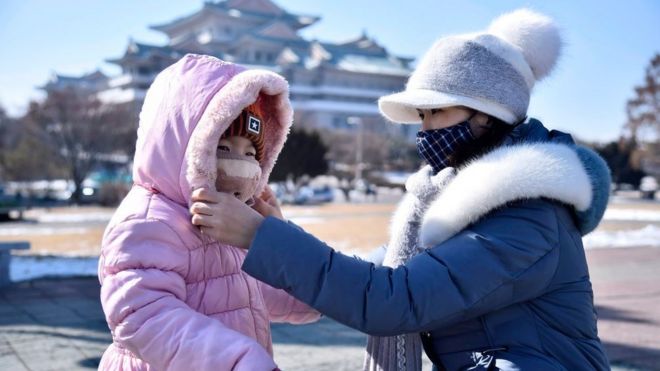
A woman helps her daughter seen wearing a face mask in PyongyangImage copyright GETTY IMAGES
Image caption North Korea is taking precautions to keep the virus out

North Korea has quarantined 380 foreigners in an attempt to stop the coronavirus from breaking out.

The foreigners are mostly diplomats stationed in the capital Pyongyang, state media reported.

About 200 foreigners had already been confined to their compounds for the past 30 days – but as that came to an end, the quarantine has been extended.

North Korea has not reported any cases of Covid-19, but several other countries did so on Monday.

Afghanistan and Dubai said they had detected their first cases, and Kuwait said three people returning from Iran had been infected.

In South Korea, seven people have died with 763 people infected. Around 7,700 troops have been quarantined after 11 military members were infected.

The virus, which emerged in China, has spread to at least 29 countries. Italy has the highest number of coronavirus cases in Europe, with 152.

Around 50,000 people in two northern “hotspot” regions – Veneto and Lombardy – have been put under quarantine for two weeks.

Iran has also confirmed 43 cases of the virus and eight deaths.

In the Chinese city of Wuhan, where the virus emerged, the authorities earlier announced that some non-residents would be allowed to leave if they showed no symptoms of the virus.

However, local officials now say that order was made without authorisation and has been revoked.

The city has been in lockdown since January 23, with authorities cutting off transport links in and out of the city.

More than 2,500 people have died from the virus in mainland China, with some 77,150 cases confirmed cases reported.
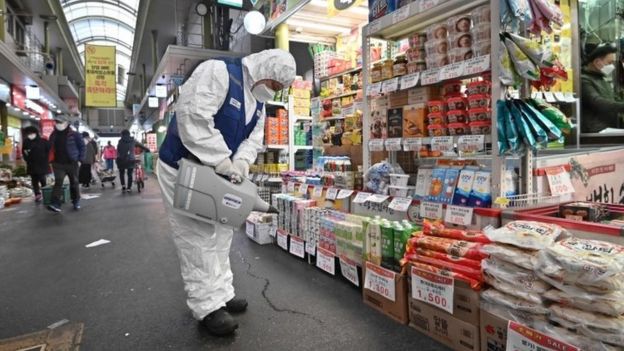
A worker sprays disinfectant to help prevent the spread of the novel coronavirus at a market in SeoulImage copyright AFP
Image caption A worker sprays disinfectant to help prevent the spread of the novel coronavirus at a market in Seoul

What is the situation in North Korea?

North Korea has not confirmed any cases but the country shares a long and often porous border with China. There are concerns that North Korea, which is subject to international sanctions, lacks the health infrastructure to test and treat those infected and that any outbreak could quickly spread unchecked.

At the moment, all foreigners coming into the country must be quarantined for 30 days.

There are relatively few foreigners in North Korea, and only around 200 Westerners, according to one expert.

North Korean authorities have also cancelled the annual Pyongyang marathon, which typically sees people from all over the world participating.

Around 3,000 people in North Pyongan province – a north-western region bordering China – are also now under monitoring for reportedly showing suspected symptoms, said state media.

What about South Korea?
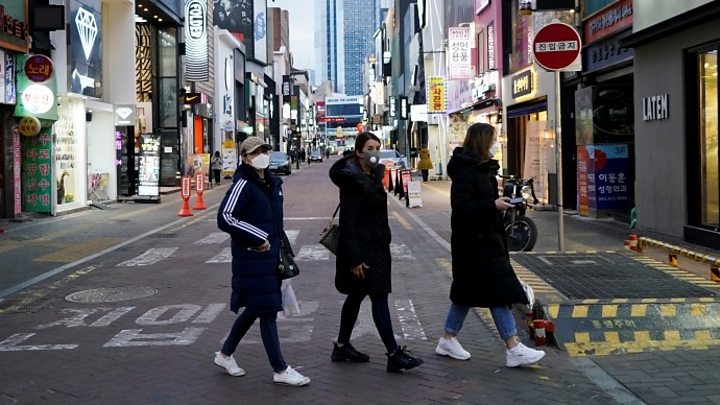
Media caption People in Daegu have voiced concern over the spread of the virus

South Korea has the largest number of confirmed cases outside China, after a huge spike in the past week.

Before last Wednesday, the country had recorded just 31 cases. That number has now jumped to 763.

Eight new cases of the virus have been reported in the army, and one in the navy, air force and marine corps – bringing the number to 11.

But the biggest virus clusters have been linked to a hospital and a religious group near the south-eastern city of Daegu.

A handful of South Korea airlines, including Korean Air Lines – the country’s biggest airline – has suspended flights going to Daegu, which has a population of around 2.5m.

Korean Air says the suspension will last until March 27

What’s happening in Italy?

Italian officials have introduced sweeping measures to control what is now the worst outbreak of the coronavirus in Europe – at least three people have died and more than 150 cases confirmed.

In the regions of Lombardy and Veneto, a lock-down is in place in several small towns. For the next two weeks, 50,000 residents will not be able to leave without special permission.

Even outside the zone, many businesses and schools have suspended activities, and sporting events have been cancelled – including several top-flight football matches.

Officials have yet to find the first carrier of the virus in the country.
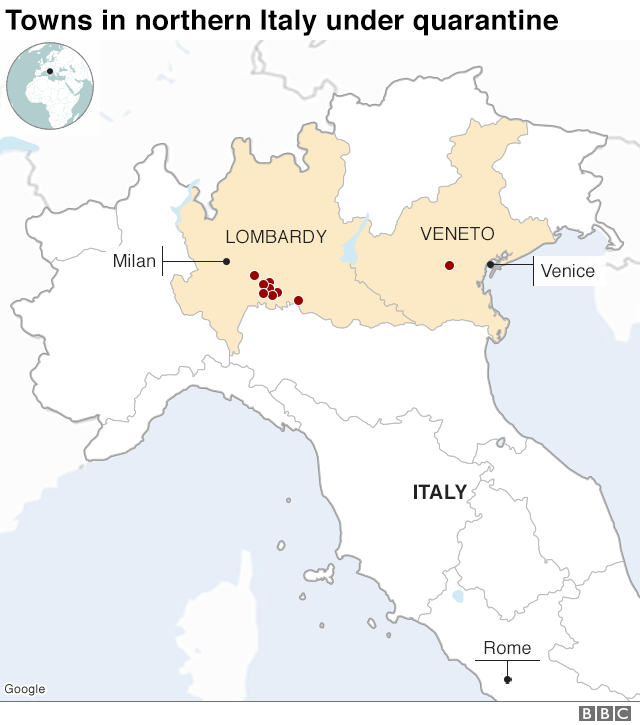
Map of Italy
Presentational white space
Grey line

World edges closer to coronavirus pandemic

Analysis by Fergus Walsh, medical correspondent

The combined situation in South Korea, Iran and Italy points to the early stages of pandemic. This means a global outbreak, with the coronavirus spreading in the community in multiple parts of the world.

In each of these countries we are seeing spread of the virus with no connection to China. The lockdown efforts in Italy mirror those that have happened in China.

The situation in Iran is especially worrying, because the health authorities have reportedly said the virus has spread to multiple cities, and it appears the first case in Lebanon is linked to a traveller from Iran.

If we have a pandemic, it will still be important to limit the speed of spread of the virus.

If countries could hold it somewhat at bay until the end of winter, there is a hope that warmer temperatures will reduce the time the virus can survive in the air, as we see with seasonal flu. But this may not be certain.

Grey line

What’s the latest from Iran?

Iran said on Sunday it had 43 confirmed cases of the virus, most of them in the holy city of Qom. Eight of those infected have died, the highest number of deaths outside China.

Iraq, Pakistan, Armenia and Turkey have closed their borders with Iran, and Afghanistan has suspended air and road travel to and from Iran.

What about China, where the outbreak started?

China’s President Xi Jinping has described the outbreak as the “largest public health emergency” in the country’s recent history.

Speaking on Sunday, he acknowledged “shortcomings” in China’s response and said lessons must be learned.

China reported 409 new infections on Monday, the bulk of which were from Wuhan.

But outside China, cases with no clear link to that country or other confirmed cases continue to rise, prompting concern from the World Health Organization (WHO).

Source: The BBC

24/02/2020

New coronavirus cases rise in Italy, Korea and Iran but fall in China

BEIJING/SEOUL (Reuters) – Italy, South Korea and Iran reported sharp rises in coronavirus infections on Monday, triggering concern from the World Health Organization (WHO), but China relaxed some curbs on movement, including in Beijing, as the rate of new infections there eased.

The virus has put Chinese cities into lockdown, disrupted air traffic to the workshop of the world and blocked global supply chains for everything from cars and car parts to smartphones.

The surge of cases outside mainland China triggered steep falls in global share markets and Wall Street stock futures as investors fled to safe havens. Gold soared to a seven-year high, oil tumbled nearly 4% and the Korean won KRW= fell to its lowest level since August.[MKTS/GLOB]

But U.S. Treasury Secretary Steven Mnuchin cautioned against jumping to conclusions about the impact on the global economy or supply chains, saying it was simply too soon to know.

The World Health Organization (WHO) said it no longer had a process for declaring a pandemic, but that the coronavirus outbreak remained an international emergency.

“We are specially concerned about the rapid increase in cases in … Iran, Italy and the Republic of Korea,” WHO head Tedros Adhanom Ghebreyesus told a news conference in Sweden via video link from Geneva.

South Korea reported 231 new cases, taking its total to 833. Many are in its fourth-largest city, Daegu, which became more isolated with Asiana Airlines (020560.KS) and Korean Air (003490.KS) suspending flights there until next month.

Iran, which announced its first two cases last Wednesday, said it had confirmed 43 cases and eight deaths. Most of the infections were in the Shi’ite Muslim holy city of Qom.

Elsewhere in the Middle East, Bahrain and Iraq reported their first cases and Kuwait reported three cases involving people who had been in Iran.

Saudi Arabia, Kuwait, Iraq, Turkey, Pakistan and Afghanistan imposed restrictions on travel and immigration from Iran. Afghanistan also reported its first case, officials said.

The WHO has been saying for weeks that it dreads the disease reaching countries with weak health systems.

Europe’s biggest outbreak is in Italy, with some 150 infections – compared with just three before Friday – and a fifth death.

‘SEVERE AND COMPLEX’

Scientists around the world are scrambling to analyze the virus, but a vaccine is probably more than a year away.

“Worryingly, it seems that the virus can pass from person to person without symptoms, making it extremely difficult to track, regardless of what health authorities do,” said Simon Clarke, an expert in cellular microbiology at the University of Reading in Britain.

China postponed the annual meeting of its parliament in Beijing.

But there was a measure of relief for the world’s second-largest economy as more than 20 province-level jurisdictions, including Beijing and Shanghai, reported zero new infections, the best showing since the outbreak began.

President Xi Jinping urged businesses to get back to work, though he said the epidemic was still “severe and complex, and prevention and control work is in the most difficult and critical stage”.

Excluding the central Hubei province, center of the outbreak, mainland China reported 11 new cases, the lowest since the national health authority started publishing nationwide daily figures on Jan. 20.

The coronavirus has infected nearly 77,000 people and killed more than 2,500 in China, most in Hubei.

Overall, China reported 409 new cases on the mainland, down from 648 a day earlier, taking the total number of infections to 77,150 cases as of Feb. 23. The death toll rose by 150 to 2,592.

Outside mainland China, the outbreak has spread to about 29 countries and territories, with a death toll of about two dozen, according to a Reuters tally.

Xi said on Sunday the outbreak would have a relatively big, but short-term, impact on the economy and the government would step up policy adjustments to help cushion the blow.

Mnuchin, speaking to Reuters in the Saudi city of Riyadh, said he did not expect the coronavirus to have a material impact on the Phase 1 U.S.-China trade deal.

“Obviously that could change as the situation develops,” he added.

In northern Italy, authorities sealed off the worst-affected towns and banned public gatherings across a wide area, halting the carnival in Venice, where there were two cases.

Austria briefly suspended train services over the Alps from Italy after two travelers coming from Italy showed symptoms of fever.

Both tested negative for the new coronavirus but Austrian Interior Minister Karl Nehammer said a task force would meet on Monday to discuss whether to introduce border controls.

Japan had 773 cases as of late Sunday, mostly on a cruise ship quarantined near Tokyo. A third passenger, a Japanese man in his 80s, died on Sunday.

In South Korea, authorities reported a seventh death and dozens more cases on Monday. Of the new cases, 115 were linked to a church in the city of Daegu.

Drone footage showed what appeared to be hundreds of people queuing in a neat line outside a Daegu supermarket under the winter sunshine to buy face masks. ( tmsnrt.rs/37WP6lA )

Source: Reuters

24/02/2020

‘Namaste Trump’: Modi holds huge rally for Trump’s visit

AHMEDABAD, India (Reuters) – Donald Trump was cheered by more than 100,000 Indians at the opening of the world’s largest cricket stadium on Monday, promising “an incredible trade deal” and “the most feared military equipment on the planet” at his biggest rally abroad.

Indians wore cardboard Trump masks and “Namaste Trump” hats to welcome the U.S. president at the huge new Motera stadium in Prime Minister Narendra Modi’s own political homeland, the western city of Ahmedabad.

Modi, a nationalist who won re-election last year and has shifted his country firmly to the right with policies that his critics decry as authoritarian and ethnically divisive, touts his relationship with Trump as proof of his own global standing.

U.S. officials have described Trump’s visit as a way to counter China’s rise as a superpower.

“You have done a great honour to our country. We will remember you forever, from this day onwards India will always hold a special place in our hearts,” Trump said to thunderous applause.

India is one of the few big countries in world where Trump’s personal approval rating is above 50%. It has built up ties with the United States in recent years as Washington’s relationship has become strained with India’s foe Pakistan.

“As we continue to build our defence cooperation, the United States looks forward to providing India with some of the best and most feared military equipment on the planet,” Trump said.

Trump said the two countries will sign deals on Tuesday to sell military helicopters worth $3 billion and that the United States must become the premier defence partner of India, which relied on Russian equipment during the Cold War. Reuters reported earlier that India has cleared the purchase of 24 helicopters from Lockheed Martin (LMT.N) worth $2.6 billion.

But in a sign of the underlying political tensions in India, violent protests broke out in Delhi – where Trump is due on Tuesday – over a new citizenship law that critics say discriminates against Muslims and is a further attempt to undermine the secular foundations of India’s democracy.

Vehicles were set on fire in the eastern part of Delhi, metal barricades torn down, and thick smoke billowed through the air as thousands of those who are supporting the new law clashed with those opposing it.

In his speech Trump extolled India’s rise as a stable and prosperous democracy as one of the achievements of the century. “You have done it as a tolerant country. And you have done it as a great, free country,” he said.

Trump planned to raise the issue of religious freedoms in India with Modi, an administration official said last week.

VERY BIG DEALS

In Ahmedabad, Modi embraced Trump as he stepped off Air Force One, along with his wife, Melania.

Folk dancers carrying colourful umbrellas danced alongside the red carpet as drummers, trumpeters and other musicians performed at the airport to welcome Trump and the U.S. delegation. Crowds lined the route along his cavalcade, many taking pictures on their phones.

The two sides did not manage to hammer out a trade deal ahead of the visit, with differences remaining over agriculture, medical devices, digital trade and proposed new tariffs. Trump said he was going to discuss economic ties with Modi, describing him as a tough negotiator.

“We will be making very, very major, among the biggest ever made, trade deals. We are in the early stages of discussion for an incredible trade agreement to reduce barriers of investment between the United States and India,” he said.

“And I am optimistic that working together, the prime minister and I can reach a fantastic deal that’s good and even great for both of our countries – except that he is a very tough negotiator.”

Modi, who has built a personal rapport with Trump, is pulling out the stops for the president although prospects for even a limited trade deal during the visit are seen as slim.

“There is so much that we share, shared values and ideals … shared opportunities and challenges, shared hopes and aspirations,” said Modi at the rally.

Trump, who faces his own re-election campaign this year, has frequently praised Modi for his crowd-pulling power.

Last year, Trump held a “Howdy Modi” rally with Modi in Houston, drawing 50,000 people, mainly Indian Americans. At the time, Trump likened Modi to Elvis Presley as a draw for crowds.

Later, Trump and his entourage which includes daughter Ivanka and son-in-law Jared Kushner flew to Agra to see the Taj Mahal at sunset. Children lined the route cheering and waving flags as his convoy drove past.

Trump and Melania posed for pictures at the Taj, the 17th century monument to love. “It’s incredible,” he told reporters.

Source: Reuters

23/02/2020

WHO experts travel to Wuhan for COVID-19 investigation

BEIJING, Feb. 22 (Xinhua) — Some members of the China-World Health Organization (WHO) joint expert team traveled to Wuhan Saturday to investigate the COVID-19 outbreak, the National Health Commission said.

The experts will have discussions with Wuhan’s health authorities and visit medical and health institutions, the commission said.

The joint expert team began its work in China on Feb. 16 and has finished investigation in Beijing, Guangdong Province and Sichuan Province.

Source: Xinhua

23/02/2020

Daily necessity supplies stable in Hubei, rest of China: official

BEIJING, Feb. 22 (Xinhua) — Supply of daily necessities has been stable in China, including the epidemic-hit Hubei Province, despite the ongoing novel coronavirus outbreak that heavily impacted daily life and factory activities, an official with the Ministry of Commerce said Saturday.

With more Chinese returning to work, more than 95 percent of the chain supermarkets and about 90 percent of the large fast-food chains have opened to customers, Wang Bin with the commerce ministry told a press conference.

Meanwhile, around 80 percent of the chain convenience stores and 80 percent of the large wholesale farm produce markets nationwide have resumed operation, along with many farmers’ markets and grocery stores.

In China’s 50 key wholesale farm produce markets, vegetable transaction volume on Friday jumped 26.4 percent from the beginning of the month, he said.

In contrast, other retailers are getting back to service at a slower pace. For instance, only 50 percent of the department stores and shopping malls have so far opened for business, according to Wang.

For Hubei, especially the provincial capital Wuhan where the epidemic first broke out with the largest number of infections, Wang said while the epidemic did cause some difficulties, the local market is generally stable with stocks of grain, meat and vegetables on the rise.

Local authorities in Wuhan have ordered online purchase, group buying and direct delivery services to provide daily necessities to residents kept indoors by the epidemic.

Up to 80 percent of communities in the city’s central districts are covered by group buying services from shops and supermarkets, he said.

To ensure food price stability in the epidemic-hit Hubei, Wang said the commerce ministry has ordered 150 key food producers, including state-owned food group COFCO and major pork producer Shuanghui, to provide over 600,000 tonnes of food to the region.

For the next stage, Wang said the authorities will work on product circulation, farm product sales and further resumption of wholesale markets to both help farmers sell their produce while ensuring daily supplies for residents amid the epidemic.

Source: Xinhua

23/02/2020

Pic story: head nurse on frontline of epidemic fight

CHINA-HUBEI-WUHAN-COVID-19-HEAD NURSE (CN)

Head nurse Sun Chun is seen at an ICU ward of the First Hospital of Wuhan City in Wuhan, central China’s Hubei Province, Feb. 22, 2020. Sun Chun is among the first batch of medical workers dispatched from the First Hospital to the makeshift hospital of Leishenshan (Thunder God Mountain) in Wuhan, the epicenter of the novel coronavirus outbreak. After finishing the work at Leishenshan, she returned to the First Hospital and remained in the frontline of fighting against the virus. By now, she has taken care of some 167 COVID-19 patients with various degrees of symptoms. (Xinhua/Xiao Yijiu)

Source: Xinhua

23/02/2020

Xi sends reply letter to U.S. elementary school students

BEIJING, Feb. 22 (Xinhua) — Chinese President Xi Jinping has written back to a group of U.S. elementary school students, encouraging them to continue their efforts to learn Chinese language and culture and contribute to promoting friendship between the two peoples.

On the eve of the Spring Festival, 50 fourth-grade students from Cascade Elementary School in the U.S. state of Utah wrote New Year cards to Xi in Chinese, telling him about their Chinese language learning and personal hobbies, expressing their love for China and Chinese culture as well as their hope for a chance to visit China, and wishing “Grandpa Xi” a happy New Year.

In his reply letter dated Feb. 15, Xi told the children that like the United States, China is a big country, that the Chinese civilization has a history of more than 5,000 years, and that the Chinese people are as hospitable as the American people.

He added that they can learn more about Chinese history and culture by learning the Chinese language, which is used by more than 1 billion people around the world.

Xi said he is pleased to see those students write and learn Chinese so well, and hopes that they will continue to work hard, make greater progress and become young ambassadors for the friendship between the two peoples.

Established in 1967, the public school is one of the first schools in Utah to offer a Chinese immersion program, which involves more than half of its students. Utah has one-fifth of all Chinese language learners in the United States. The state’s Chinese immersion program began in 2009 and is now available in 76 elementary and secondary schools.

Source: Xinhua

23/02/2020

Coronavirus: Taiwanese workers call time on mainland China over Covid-19 fears

  • An extended Lunar New Year holiday provides people from the self-ruled island with the opportunity to rethink their careers as the death toll from the deadly infection continues to rise
  • Online poll finds 63 per cent of Taiwanese unwilling to return to mainland China over health concerns
Many Taiwanese are opting not to return to their jobs in mainland China because of the coronavirus epidemic. Photo: EPA-EFE

Taiwanese account manager Douglas Liu values his life more than his job, which is why he will be staying at home on Monday rather than going back to work in the mainland China city of Suzhou.

Liu returned to his home in Taipei on January 10 for an extended Lunar New Year

 holiday – and to vote in the island’s presidential election – and planned to go back to work on February 1. But as the coronavirus epidemic worsened, the 45-year-old changed his plans.
“Last week, my company told me I should resume work on February 24, but after I argued in vain over the risk of returning to Suzhou, I tendered my resignation,” he said. “After all, my life is more important.”
Liu works for a firm that manufactures chest freezers for the mainland Chinese market.
“With more than 80 coronavirus infections in Suzhou and little sign of it subsiding, who knows what could happen to me if I return,” he said.
More than 78,700 people have contracted the virus since it was first detected in Wuhan, the capital of central China’s Hubei province, at the end of last year, and close to 2,500 have lost their lives to it.

As of Saturday, about 98 per cent of the infections and 99 per cent of the fatalities were in mainland China, two figures that have prompted many Taiwanese to rethink their employment plans.

According to a survey conducted last week by online recruitment agency 104 Job Bank, 63 per cent of Taiwanese with jobs on the mainland said they would not be returning to work after the extended Lunar New holiday. Before Wuhan was placed under lockdown on January 23 in a bid to contain the coronavirus outbreak, the figure was just 50 per cent.

“The intensification of the outbreak has created panic and insecurity for Taiwanese who work in mainland China and the lockdown of many cities has further discouraged them from returning to their jobs,” said Jason Chin, a senior vice-president at the recruitment agency.

Wuhan has been on lockdown since January 23. Photo: Reuters
Dozens of cities across China have introduced some form of restriction on the movement of residents, and several remain under total lockdown.

Chin said that the containment efforts had made it impossible for many companies to resume normal operations and provided a catalyst for Taiwanese workers to seek employment elsewhere.

“Taiwanese often to change jobs after the Lunar New Year, so the mainland government’s policy of delaying the resumption of regular business activities has given them more time to look for work outside mainland China,” he said.

Shannon Chiu is another Taiwanese who decided to call time on the mainland because of the coronavirus outbreak.

After two years working for an agricultural technology company in Zhengzhou, the capital of central China’s Henan province, she said she already had concerns about the standards of health care there.

“Being sick in Zhengzhou is a nightmare for Taiwanese because of the poor organisation and registration procedures,” she said.

“You either have to wait hours to see a doctor or go hospital-hopping in the hope of getting an appointment somewhere else.”

Chiu said she was still working in Zhengzhou after the outbreak had been reported in Wuhan – about 500km (310 miles) to the south – but no one in the city was wearing a face mask.

“I was lucky because I came back to Taiwan a week before the lockdown and my company allowed me to continue working from Taipei,” she said.

“Although I no longer enjoy the expatriate benefits, I feel a lot safer here because I don’t think I would survive if I was put in a mainland hospital because of Covid-19.”

Source: SCMP

23/02/2020

Korea raises alert to highest level as coronavirus cases jump

SEOUL/SHANGHAI (Reuters) – South Korea raised its disease alert to the highest level on Sunday after a surge in coronavirus infections and two more deaths, while China state media warned the outbreak there had yet to reach a turning point despite some signs of easing.

South Korea’s president said he was putting the country on “red alert” due to the rapid rise in new cases, which are largely being traced back to church services. Health officials reported 169 new infections, bringing the total to 602, having doubled from Friday to Saturday.

The escalation in the alert level allows the government to send extra resources to Daegu city and Cheongdo county, which were designated “special care zones” on Friday.

South Korea’s Yonhap News Agency said it also enables the government to forcibly prevent public activities and order the temporary closure of schools, though the government gave no immediate details on what steps could be taken.

In China, the health commission confirmed 648 new infections – higher than a day earlier – but only 18 were outside of Hubei province, the lowest number outside of the epicenter since authorities started publishing data a month ago and locked down large parts of the country.

But the number of cases continued to climb elsewhere.

Japanese Prime Minister Shinzo Abe instructed government agencies on Sunday to urgently prepare medical provisions and draft a comprehensive plan to curb the spread of the virus, after it reported 27 more cases a day earlier.

The U.S. State Department raised its travel advisory level one notch for South Korea and Japan to Level 2 on a scale of 1 to 4.

Concern about the reach and rapid spread of coronavirus also grew in Europe and the Middle East.

Cases in Italy, Europe’s worst hit country, more than quadrupled to 79 on Saturday, with two deaths.

Iran reported a total of 43 infections, with eight deaths – all since Tuesday – forcing some of its neighbors to announce travel and immigration curbs.

The World Health Organization on Saturday stressed that the number of cases outside of China was still relatively few, but it was worried by the detection of infections without a clear link to China.

The disease has spread to some 26 countries and territories outside China, killing more than a dozen people, according to a Reuters tally. It has been fatal in 2% of reported cases, with the elderly and ill the most vulnerable, according to the WHO.

The potential economic impact of coronavirus was prominent at a meeting of G20 finance ministers in Riyadh, at which the International Monetary Fund chief said China’s 2020 growth would likely be lower at 5.6%, down 0.4 percentage points from its January outlook, with 0.1 percentage points shaved from global growth.

Graphic: Online site for coronavirus news here

Graphic: Tracking the novel coronavirus here

CHURCH CONTAGION

The last time South Korea raised the alert to the highest was 11 years ago during the Influenza A or H1N1 outbreak.

Many of South Korea’s new cases were linked to the Shincheonji Church of Jesus congregation in Daegu after a 61-year-old woman known as “Patient 31” tested positive for the virus last week. The woman had no recent record of overseas travel.

Catholic churches in Daegu and Gwangju have suspended mass and other gatherings, while churches elsewhere saw declines in attendance on Sunday, especially among the elderly.

“If the situation gets worse, I think we’ll need to take more measures. Currently, we’re limiting personal gatherings within the church except for Mass,” said Song Gi-young, 53, wearing a face mask at church.

Heo Young-moo, 88, expressed frustration.

“Devotees shouldn’t go to any risky places … Hasn’t it become so widespread because those people didn’t get checked?”,” he said.

Outside of the church was a sign that said: “All Shincheonji followers are strictly prohibited from entering”.

The foreign ministry said South Koreans aboard a plane to Israel had been denied entry there on Saturday due to concerns about the virus spread.

China said the number of new deaths on Saturday from COVID-19, as the disease caused by the virus is known, was 97, all but one of which were in Hubei.

Eighty-two of those were in the provincial capital Wuhan, where Xinhua news agency said nucleic tests were being carried out on the backlog of cases to try to contain the spread.

In total, China has reported 76,936 cases, and 2,442 deaths. The WHO says the virus is severe or critical in only a fifth of infected patients, and mild in the rest.

Graphic: Reuters graphics on the new coronavirus here

NOT OVER YET

Beijing, Zhejiang, Sichuan had no new infections on Feb. 22 for the first time since the outbreak was detected. There were signs of street life in Shanghai, with some cafes serving take-out food and families wearing masks walking their dogs.

State run television on Sunday urged people to avoid complacency, drawing attention to people gathering in public areas and tourist spots without wearing masks.

Analysts have been closely watching out for any signs of a secondary wave of infections as transport restrictions are eased and many migrant workers return to factories and offices. Business activity in the world’s second-biggest economy is only gradually returning to normal after widespread disruptions.

Japan’s health minister apologized on Saturday after a woman who was allowed to leave the coronavirus-struck Diamond Princess cruise ship tested positive despite having underwent quarantine.

At least 623 cases have been reported on the vessel, the biggest outbreak outside China, involving more than a dozen nationalities.

In Italy, schools and universities were closed and some soccer matches postponed in Lombardy and Veneto, the country’s industrial heartland.

Saudi Arabia, Kuwait, Iraq have travel and immigration curbs on Iran, while Oman on Sunday urged its citizens to steer clear of countries with high infection rates and said arrivals from those nations would be quarantined.

Source: Reuters

23/02/2020

Crossing Divides: What happens when pen pals reunite

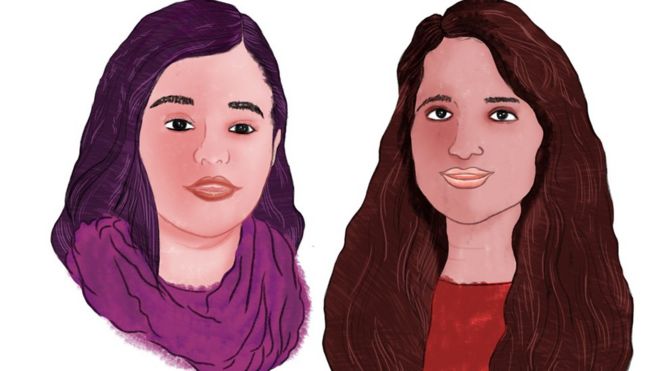
Illustration depicting Duaa and Saumya

Duaa Bhat is a 17-year-old girl in Indian-administered Kashmir, one of the most heavily militarised zones in the world. Two years ago, she became pen pals with Saumya Sagarika, 18, from the country’s capital, Delhi, in a bid to understand the different worlds they were growing up in.

The army has been deployed in Kashmir, India’s only Muslim-majority region, since the rise of an armed rebellion in 1989. As Saumya discovered through her letters, Duaa’s studies were interrupted by strikes and school shutdowns. The problem was often compounded by the Indian government who would deliberately shut down or “snap” internet and social media.

Then, in August last year, the government removed Kashmir’s special status – which provided a degree of autonomy under article 370 of the country’s constitution – and imposed a communication clampdown. Schools were closed, thousands including politicians were placed under detention, and phone lines and internet were blocked.

Five months later, as the government began to ease communication restrictions, Saumya began writing to Duaa again. Here are edited excerpts from their letters.

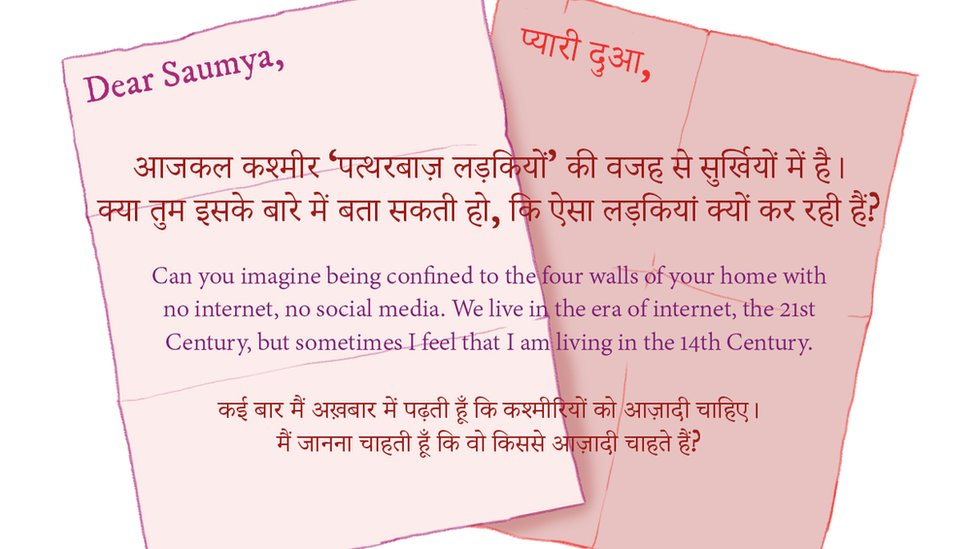
Illustration depicting Duaa and Saumya's letters

Dear Duaa

A warm hello from Delhi. How are you? How is everyone in your family? We didn’t really continue our promise of staying “pen pals” after our last round of letters, but I am very happy to restart our conversation.

A lot must have changed in your life and the circumstances around you in the past two years too. I got to know that Section 370 was removed from Kashmir a few months back and for some time telecommunications were snapped there, and internet is probably still not working.

I am sure the situation must have changed. I hope everyone is safe there?

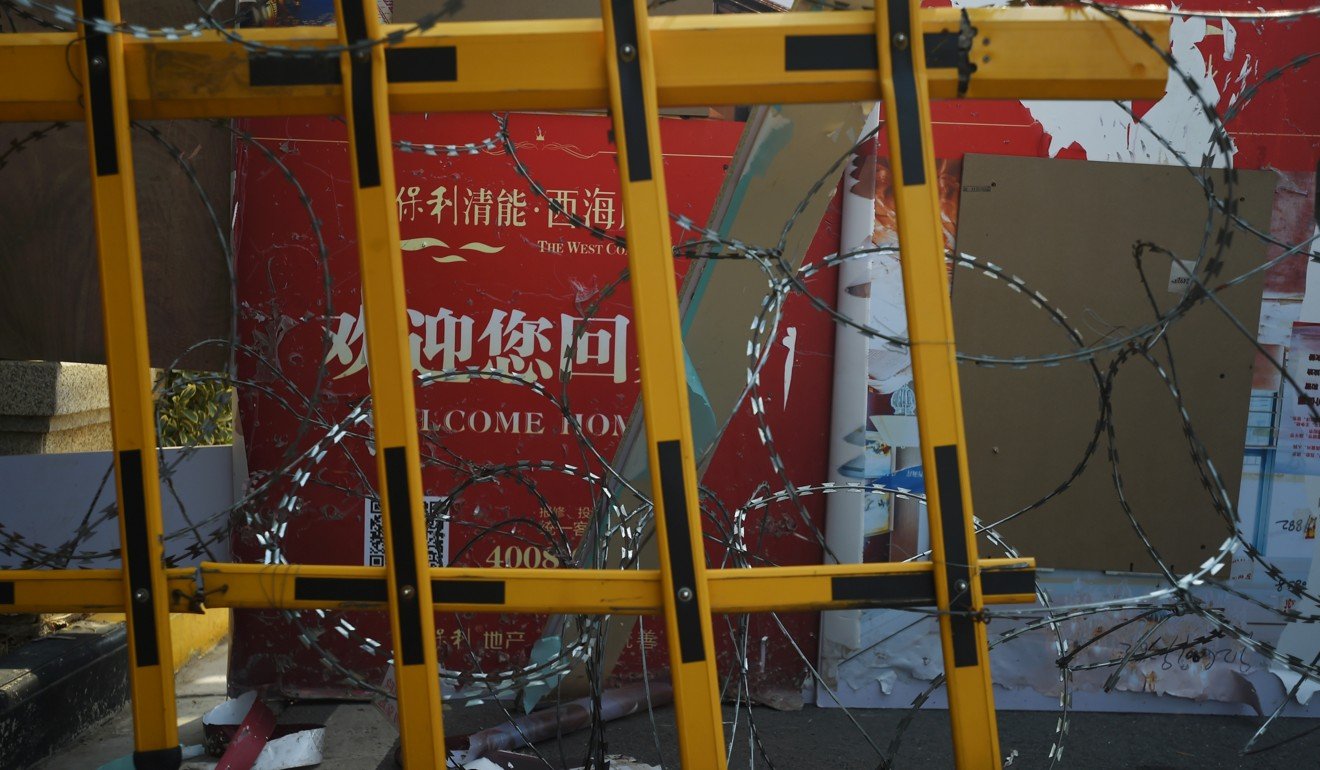
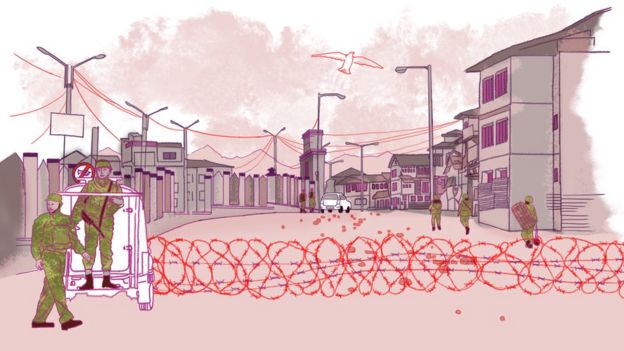
An illustration of a street with barbed wire across it

Dear Saumya

A chilling salaam from Kashmir.

Chilling because it is really, really cold here these days. I am good and, Allhamdullilah, everyone in my family is doing good. We didn’t continue being pen pals because the internet here is down most of the time and staying in touch with anyone outside the valley is a task in itself.

I was really happy to know that you’ve started college and your studies are going well. People like me have suffered the most in the past few months. We used to study ourselves with some help from the magic of the internet. Only the Almighty knows how we’ve completed our syllabus in time for exams.

People here are not happy with the removal of our special status. Personally, I feel depriving people of even talking to their near and dear ones is a violation of human rights.

Saumya, most people, including myself, do not understand the protests in the rest of the country. News channels here do not give us enough information to understand what the CAA (Citizenship Amendment Act) really is. Can you brief me about them?

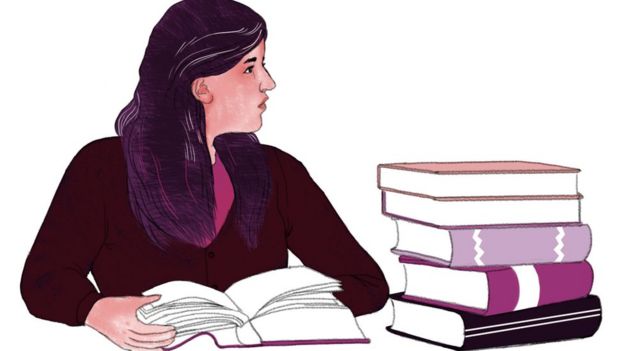
Illustration depicting Duaa with her books

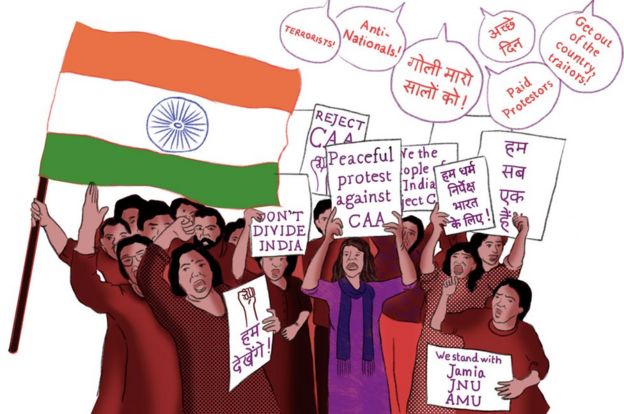
In December, India’s parliament passed the CAA, which offers amnesty to non-Muslim illegal immigrants from the three nearby Muslim-majority countries – Pakistan, Afghanistan and Bangladesh. It sparked massive protests as many considered it discriminatory against Muslims, something the government denies. Saumya, a Hindu, joined the hundreds of mostly Muslim women in a Delhi street protest against the new citizenship laws.

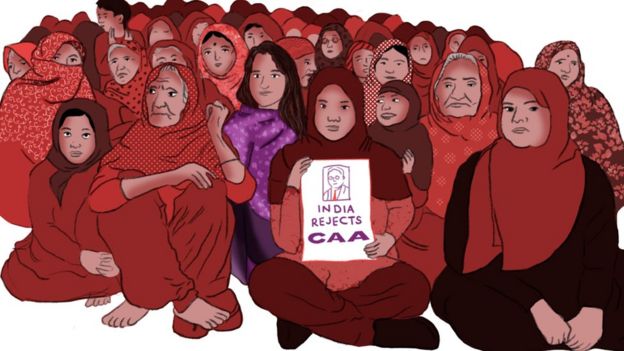
Illustration depicting the Shaheen Bagh protest

Dear Duaa

It is quite cold in Delhi too but the mood is really hot.

A few days back, I went to the protest at Delhi’s Shaheen Bagh. Women have been protesting against this act there for the past 26 days. These women are not university professors or activists but homemakers, women who remain in purdah, who have stepped out on to the streets to protest. They are fighting this battle so their children are able to lead their lives in peace.

After witnessing the enthusiasm among people at Shaheen Bagh, I’ll say people are prepared to fight this battle for our rights.

In your last letter, you wrote that you’d heard slogans like, “They wanted Kashmir to become like India but have made India into Kashmir”, were being chanted in Delhi. You are 100% right.

Since this protest movement started, all of Delhi is feeling like Kashmir. Like internet/phone shutdowns, section 144 (curfew) being imposed, stone-throwing and police lathi-charge (using long batons) during protests. So I can say that today I understand Kashmir and the situation facing people living there quite well.

Illustration depicting the shutdown in Kashmir

Dear Saumya

From what you said about CAA, I feel we are going back in time instead of moving forward. I still can’t believe that even in the 21st Century some people discriminate against others on the basis of caste, religion and, in some parts of society, even gender.

These protests are a proof that people still believe in taking a stand for each other and that humanity is still alive. Unlike other places in India, Kashmir has been really calm about this act. In our hearts we know this act is wrong but these days we Kashmiris couldn’t care less about what’s happening outside the valley. Our voices, our rights have been neglected in the past and are being neglected right now.

A couple of days ago, a Niti Aayog (a government think tank) member VK Saraswat defended the communication ban and he went as far as saying that Kashmiris do nothing but watch “dirty films” online. Even though he apologized later, these remarks cannot be just thrown out of our minds. Do people there really think that way about us? No one is talking about the problems we are facing right now due to the internet ban. Are we really invisible to the rest of the country?

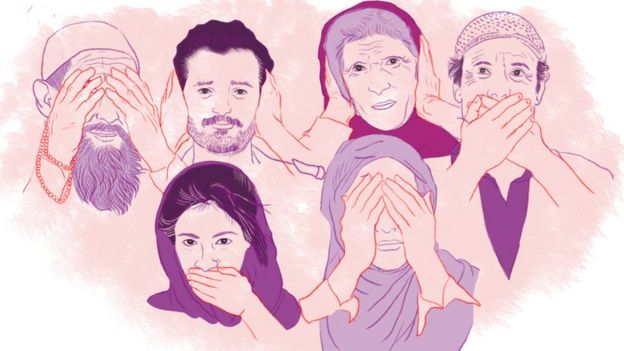
Illustration depicting protests against the new citizenship laws

Religious identities come up repeatedly in Saumya and Duaa’s letters. In 1989-90, at the start of the rebellion, hundreds of thousands of Hindus – referred to as Pandits – were terrorised into leaving by Muslim militants. It tore apart the centuries-old harmony that existed between the two communities.

Dear Duaa

I feel that people here consider Kashmir a precious property of the country and don’t give any importance to its people. Just last week, there was a discussion on the film Shikara on TV. The film is based on Kashmiri Pandits. There has been no discussion of their plight for the past 30 years here. And I don’t think that people will go to watch this film or talk about it even now.

Through our letters I have been able to understand a lot about Kashmir and Muslims, which is different from common perceptions. We have lots of family friends who are Muslim but are unable to discuss such issues with them openly, lest we offend them. This CAA issue motivated me to protest, even though I am a Hindu.

As I have understood Kashmir through your letters, it has removed my apprehensions and made me even more curious about Kashmir and Kashmiris. Earlier I was afraid because of the image created by society and the media. But after our conversations, I am excited to go to Kashmir to understand and experience it myself. Is the Kashmir valley open for people from outside now?

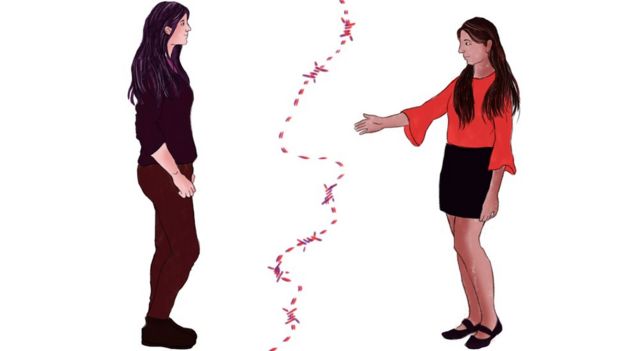
Illustration depicting Duaa and Saumya reaching out across barbed wire

Dear Saumya

I am writing this letter not from Kashmir, but from one of the most holy cities of the world – Mecca, Saudi Arabia. It’s an amazing feeling to watch Muslims from all around the world come to pray here.

I feel glad that you know the truth about Kashmir. The valley is open for tourists now (officially) but for us Kashmiris it was and will always be open for the people outside.

You know there is a place in the Khanyar area of Kashmir, where worshipping places of different religions are located on one hill. At the bottom is a Gurdwara (Sikh temple), in the middle a shrine and at the top a temple. My mother’s maiden home was near that area and they had Pandits as neighbours. In my childhood, my mother used to tell me various stories about the brotherhood between different communities.

Kashmir is a really beautiful place to live and I pray to the Almighty in this holy city of Mecca to make Kashmir a peaceful place again and to restore the brotherhood that was lost. I’m closing this letter with the hope that my dua (wish) comes true and you will come to Kashmir to meet me.

With lots of love

Duaa

Law of Unintended Consequences

continuously updated blog about China & India

ChiaHou's Book Reviews

continuously updated blog about China & India

What's wrong with the world; and its economy

continuously updated blog about China & India