27/12/2019

Exhibition on Confucian culture opens in Beijing

BEIJING, Dec. 27 (Xinhua) — An exhibition featuring Confucian culture kicked off at the National Museum of China Friday.

The exhibition displays more than 700 pieces of cultural relics, documents and artworks related to Confucian culture in four sections to reveal the life and thoughts of Confucius, the development and spread of Confucianism, as well as artworks themed around Confucius.

An educator and philosopher, Confucius (551-479 BC) founded a school of thought, deeply influential on later generations, known as Confucianism. He was also the first to set up private schools in China that enrolled students from different social classes.

The exhibition will last until March 27.

Source: Xinhua

27/12/2019

China launches heaviest satellite to test key technologies

CHINA-HAINAN-LONG MARCH-5-LAUNCH (CN)


Long March-5 Y3 blasts off from Wenchang Space Launch Center in south China’s Hainan Province, Dec. 27, 2019. The rocket, coded as Long March-5 Y3, blasted off from the coastal launch center at 8:45 p.m. (Beijing time), carrying the Shijian-20 technological experiment satellite weighing over eight tonnes, the heaviest and most advanced communications satellite of the country. About 2,220 seconds later, the satellite was sent into its planned orbit. (Xinhua/Yang Guanyu)

by Xinhua writers Quan Xiaoshu, Yu Fei

WENCHANG, Hainan, Dec. 27 (Xinhua) — Aboard the third Long March-5 rocket, China’s largest carrier rocket, Shijian-20, a new technology test and verification satellite, successfully entered its orbit Friday night.

The rocket, coded as Long March-5 Y3, blasted off from the Wenchang Space Launch Center in south China’s Hainan Province at 8:45 p.m. (Beijing time).

Shijian-20, weighing more than eight tonnes, is the country’s heaviest and most advanced communications satellite in geosynchronous orbit, according to its maker, the China Academy of Space Technology (CAST) under the China Aerospace Science and Technology Corporation (CASC).

It will carry out orbit experiments for a series of key technologies, the CAST said in a press release.

It will demonstrate in orbit its heat transfer technology based on cryogenic loop heat pipes, an efficient thermal control device for space applications, to lay the foundation for the development of highly sensitive space probes.

The satellite will test the controllable deformation of shape memory polymers, a type of smart material that can switch between temporary shapes, to pave the way for the development of large variable space structures.

It will also carry out satellite-ground communication tests using Q/V bands, which lie between 33-75 GHz, within the extremely high frequency (EHF) area of the radio spectrum. These frequencies are used mainly for satellite communications.

“The major way to improve the satellite communication capacity is to expand the bandwidth of available frequency bands. If we liken the geostationary orbit to an expressway, which is now the most crowded in space, the use of Q/V bands will help to widen the expressway by four to five times,” said Li Feng, chief designer of the satellite with the CAST.

The test is key to the development of the next generation of high throughput satellites capable of delivering 1Tbps bandwidth for ultrafast speeds, he said.

Shijian-20 has the largest solar wings among all China’s satellites, with the total wingspan 10 meters wider than that of a Boeing 737 aircraft.

The solar wings will unfold twice, the first time after the satellite enters its orbit and the second after it flies around the orbit for about a week. The increase of the solar wing area will supply the satellite with abundant power.

The satellite adopts a hybrid propulsion system. Chemical propulsion is powerful but inefficient, and is used in rapid orbit change or satellite attitude adjustment to send it to the planned orbit as soon as possible. Electric propulsion is more precise and efficient but less powerful, which is suitable for long-term delicate adjustments in orbit.

Electric propulsion is also a preferred technology for future deep space exploration. Missions to explore Mars, Jupiter and asteroids are all too far away from Earth to be fulfilled by chemical propulsion alone, as it is impossible to bring the amount of fuel needed.

Shijian-20 will also test the adaptability of the DFH-5 satellite platform, which may serve the needs of high-capacity satellites for high orbit communications, microwave remote sensing, optical remote sensing, space scientific exploration, in-orbit service and other purposes in the next 20 years.

“With the government’s consistent support for the communications satellite industry in the past decades, we have developed the DFH-3 and DFH-4 satellite platforms, making China one of the few countries in the world that can independently develop large communications satellites and provide in-orbit commercial services,” said Hao Yanyan, product assurance manager of Shijian-20 with the CAST.

So far, there are more than 20 communications satellites based on the DFH-4 platforms running stably in orbit.

To meet the pressing needs of economic development, the research and development of the DFH-5 platform started in 2010.

According to the design, the takeoff weight of a satellite based on the DFH-5 platform can reach eight to nine tonnes, and its payload capacity 1,500 to 1,800 kg. The power for the whole satellite is more than 28 kilowatts, while the power for its payload above 18 kilowatts.

“According to these technical indicators, a satellite based on the DFH-5 platform in orbit can provide services equivalent to that of two or three satellites on the DFH-4 platform,” Hao said.

The new technologies verified by Shijian-20 will further promote the development of new satellites, especially the high throughput communications satellite and high resolution remote sensing satellite, which is of great significance to the progress of China’s space technology, Li said.

Source: Xinhua

27/12/2019

China-Bangladeshi joint venture constructs mega expressway bypassing Dhaka

DHAKA, Dec. 27 (Xinhua) — A Chinese and Bangladeshi joint venture has started construction of a mega expressway bypassing Dhaka.

Sichuan Road and Bridge (group) Co., Ltd won the deal jointly with local Unique Dream Consultant and Shamim Enterprise Limited to construct the 48-km Dhaka Bypass Expressway.

A total of 40 billion taka will be spent for construction of the expressway within the next three years. The expressway will pave the way for vehicles to drive at a speed of 120 kmph.

The construction of the four-lane expressway which is expected to be completed by 2022.

Bangladeshi Road Transport and Bridges Minister Obaidul Quader on Thursday opened the groundbreaking work of the project at Purbachal on the outskirts of Dhaka under the country’s first major public private partnership (PPP) initiative.

Also on Thursday night, a project commencement ceremony was held in Dhaka with participation of senior officials and dignitaries from various sectors.

The expressway, connecting Joydevpur, Debugram, Vulta and Modonpur, will establish an easy link for the industrial belts around Dhaka with the seaport city Chattogram and northeastern Sylhet region bypassing the capital city.

In his speech at the groundbreaking ceremony, Chinese Ambassador to Bangladesh Li Jiming said the Dhaka bypass project will greatly improve the city’s transportation network, ease congestion problems, reduce logistics costs, and bring huge economic and social benefits.

Facility connectivity is the main focus of the China-proposed Belt and Road Initiative, and infrastructure is the key area of cooperation between China and Bangladesh, he said.

In addition to the bypass project, the ambassador said Chinese enterprises have engaged in investment and projects regarding road and bridge, tunnel and other sectors as well, such as the Padma Bridge, the Mujibur Rahman Tunnel under the Karnaphuli River, Payra 1,320-MW thermal power Plant.

“At present, these projects are progressing smoothly. I hope that the Chinese enterprises involved in these projects will make full use of China’s advantages in terms of capital, technology and management, and combine those with Bangladesh’s advantages in human resources, to achieve complementary effects, and smoothly carry out project construction operations,” he said.

Source: Xinhua

23/12/2019

China’s northernmost province facilitates winter travel

HARBIN, Dec. 22 (Xinhua) — Northeast China’s Heilongjiang Province has extended train routes to the country’s northernmost city of Mohe in a move to boost winter travel in the province, according to the local railway operator.

Train K7068/9, which travels 1,348 km between Suihua in the middle of the province and Jiagedaqi in the northwest, has extended its route to reach Mohe from Dec. 20 to Feb. 17 next year, said China Railway Harbin Group Co., Ltd.

The group also added carriages to three train sets that travel to Mohe to increase transport capacity.

The temperature in Mohe this winter dropped to as low as minus 40 degrees Celsius, but many tourists still come, especially for its Arctic Village, which features a spectacular snow landscape, igloos and a starry sky.

Mohe has an annual ice and snow period of up to eight months. The city has developed a variety of winter tourism programs including the Arctic Plaza of China, an ice sculpture garden, ice and snow amusement park, and ice maze.

Source: Xinhua

23/12/2019

Chinese vice premier stresses pork supply for upcoming holidays

CHINA-BEIJING-HU CHUNHUA-PORK SUPPLY-MEETING (CN)

Chinese Vice Premier Hu Chunhua speaks at a meeting on restoring hog production, in Beijing, capital of China, Dec. 21, 2019. (Xinhua/Rao Aimin)

BEIJING, Dec. 22 (Xinhua) — China will take multiple measures to meet pork consumption demand in the upcoming New Year and Spring Festival holidays and strive to keep pork prices stable, according to a recent meeting on restoring hog production.

When addressing the meeting, Vice Premier Hu Chunhua said pork consumption would grow intensively during the first quarter and efforts must be made to prevent short supply.

He stressed the need to encourage hog producers to expand hog production, saying that more reserved pork and substitutes such as beef, mutton and poultry meat should be released to the market.

In the meantime, market supervision must be tightened to prevent hoarding, profiteering and price rigging.

Contingency plans need to be made to cope with adverse weather which might make it more difficult to increase pork supply, he said.

Social relief and aid shall be activated to help those who are financially challenged.

“To keep hog prices stable and secure pork supply, the most fundamental way is to restore hog production,” he said, urging local authorities to take effective measures to meet the goals.

Source: Xinhua

23/12/2019

China Focus: Bonuses from CIIE continue to unfold

SHANGHAI/NANCHANG, Dec. 22 (Xinhua) — One month after the second China International Import Expo (CIIE), the jeweled shoes designed by Jimmy Choo Yeang Keat OBE that attracted attention at the expo have entered the brand’s first jewelry shoe concept store in the world on the Bund in Shanghai.

“At the CIIE, we made a lot of friends and received many invitations to open a brick-and-mortar store. But we decided to open the first store in Shanghai as this is where east meets west,” said Reggie Hung, chief designer of the luxury brand Genavant.

The CIIE not only helps foreign exhibitors better understand the Chinese market but is also changing people’s buying habits. After the second CIIE, over 8,000 kinds of imported commodities from more than 80 countries and regions are on display at the Hongqiao Import Commodities Exhibition and Trading Center.

“With more frequent customers, our sales volume and customer flow have doubled. Our next step is to promote the platform to other cities in the Yangtze River Delta region and speed up the entry of imported goods into residents’ homes,” said Zhu Yinghua, with Shanghai Hongqiao Central Business District Administrative Committee.

A total of 71.13 billion U.S. dollars worth of tentative deals were reached for one-year purchases of goods and services at the second CIIE, up 23 percent year on year. As the second CIIE concluded last month, more overseas companies are now benefitting from China’s large market.

At a production base in Jiangxi-Shanghai Economic and Technological Development Zone in east China’s Jiangxi Province, two workshops and seven production lines are carrying out premix production of feed additives in an orderly way.

Methionine on the feed production line was from France’s Adisseo Group, yeast from France’s Lesaffre Group, and lysine from CJ Group of the Republic of Korea, said Zhou Wenqin, general manager of Jiangxi Zhengbang Biotechnology Co., Ltd., adding that the materials on the production line were the results of purchases at the CIIE.

Established 20 years ago, Zheng Bang Group is a leading enterprise in animal husbandry and plant protection. It is expected that the group will achieve a total output value of 88 billion yuan in 2019 and a target of 100 billion yuan in 2020.

“The CIIE enables enterprises to communicate with each other face to face, which is so much more convenient than phone calls or emails,” said Huang Guoqiang, manager of the group’s purchasing department, who participated in the CIIE as a domestic purchaser for two consecutive years.

The enterprise signed a 50-million-dollar purchase contract with Adisseo Group at the first CIIE, and expanded contracts with France’s Lesaffre Group and ROK’s CJ Group at the second CIIE, with the purchase of 70 million dollars of new programs.

“The CIIE has become an important platform for inland provinces such as Jiangxi to further open up and improve their economic development quality,” said Liang Yonghong, deputy head of the foreign trade development bureau of the province’s commerce department, adding that the introduction of high-end equipment, high-quality products and services will enhance the development level of their local economy.

The CIIE not only provides a platform for companies to seek the great potential of the Chinese market but also helps them better understand the needs of Chinese consumers.

“We have already signed up for the third CIIE,” said Tetsuro Homma, CEO of China & Northeast Asia Company, Panasonic Corporation, adding that the company is pleased with the turnouts of the CIIE.

To further strengthen business in China, this April, Panasonic established the China & Northeast Asia Company in Beijing.

“It’s clear that we would not be able to respond to the rapid changes in the Chinese market if we only rely on the operational judgment made in Japan. Local business is run locally. The decisions, from development to production and sales in the Chinese market, are all made in China,” Homma said.

The huge business opportunities in the Chinese market have not only attracted companies such as Panasonic to increase its investment in China but has also allowed them to launch star products in the Chinese market.

Panasonic launched an OLED TV at the CIIE, which looked like a piece of transparent glass but could actually be turned into a TV. “This represents our confidence and optimism in the Chinese market,” Homma said.

Source: Xinhua

23/12/2019

China presses for nuclear talks in last days till North Korea’s deadline for US

  • Summit between Chinese, South Korean and Japanese leaders could yield results for future of Korean peninsula, analyst says
North Korea has promised an unwelcome “Christmas present” if the US does not show the “right attitude” for talks. Photo: KCNA
Chinese President Xi Jinping has again stressed the need for tensions on the Korean peninsula to be resolved through dialogue, as the deadline looms in North Korea’s threat to give the United States an unwelcome “Christmas gift”
.

With just over a week to go until Pyongyang’s year-end deadline for Washington to change what it says a policy of hostility, Xi held separate talks with South Korean President Moon Jae-in and Japanese Prime Minister Shinzo Abe in Beijing on Monday.

Moon and Abe will also join Chinese Premier Li Keqiang for a trilateral summit in Chengdu, Sichuan province, on Tuesday.

The first trilateral leadership talks took place in 2008, but were not held in 2013 and 2014, or in 2016 and 2017.

Xi said China and South Korea “both insist on maintaining peace and stability on the peninsula, and advocate solving problems through dialogue and consultation”, state news agency Xinhua reported on Monday.
“China supports South Korea in continuing to improve its relationship with

North Korea,

and injecting impetus for the Korean peninsula peace talks,” the report said.

Moon said the suspension of talks between the US and North Korea and heightened tensions along the peninsula “are not beneficial to both our countries and North Korea”, according to South Korean news agency Yonhap.

Moon also said that China had played an “important role” in efforts for the denuclearise the peninsula, the report said.

North Korea has signalled impatience over the stalled talks with the US, and the fading hopes for an end to Washington’s economic sanctions.

In April, North Korean leader Kim Jong-un said that he would “wait” until the end of the year to decide whether the US had the “right attitude” to allow a resumption of negotiations, but no signs of further talks have emerged.

Then earlier this month Pyongyang warned that Washington would receive a “Christmas gift”, and US actions would determine whether the present would be good or bad.

In an apparent sign of frustration with the US, North Korean news agency KCNA reported on Sunday that Kim held a meeting of the Workers’ Party of Korea to “bolster the overall armed forces of the country” to deal with the “the fast-changing situation”.

The US imposed crippling sanctions on North Korea’s economy in 2017, though many countries, including China, South Korea and Japan, have also tightened measures against the North.

South Korea and Japan both scaled back people-to-people links in 2016, China banned coal exports to the North in 2017. Earlier this year, Trump thanked China and Russia for maintaining sanctions against Pyongyang.

As diplomats make last-ditch attempts to stop renewed confrontation, US special envoy for North Korea Stephen Biegun shuttled around the region last week, meeting senior officials in China, South Korea and Japan. Biegun urged North Korea to return to negotiations, and said the US “does not have a deadline” for talks.

China and Russia also proposed last week that the United Nations Security Council 

lift some sanctions

, saying it was necessary to break the deadlock.

Xi’s meeting with Moon also comes as Beijing tries to mend ties with Seoul to prevent neighbouring nations from getting closer to Washington.
Relations between China and South Korea deteriorated in 2017 after Seoul deployed a US-led missile defence system known as THAAD, which Beijing deemed as a security threat to its own territory.
On Monday, both Xi and Moon said in their meeting that they looked forward to improving relations between their countries.
“We have been friends and partners that have continued close cooperation,” Xi said. “We have a wide range of common understandings in various fields, including on further developing bilateral relations, facilitating regional peace, stability and prosperity, and defending multilateralism and a free trade system.”
Sun Xingjie, a North Korea specialist at Jilin University, said the US signal was “very clear” in Beigun’s comments.
“They still want to continue discussions,” he said.
Sun also said the talks in Chengdu on Tuesday would likely play an important role in the future of resolving problems on the Korean peninsula.
“After returning to the platform these last couple years, I believe this will become an important, normalised place for discussions. Whatever problems they run into, the platform should continue to move forward,” Sun said.
Source: SCMP
23/12/2019

Tesco Christmas card factory in China denies ‘forced labour’

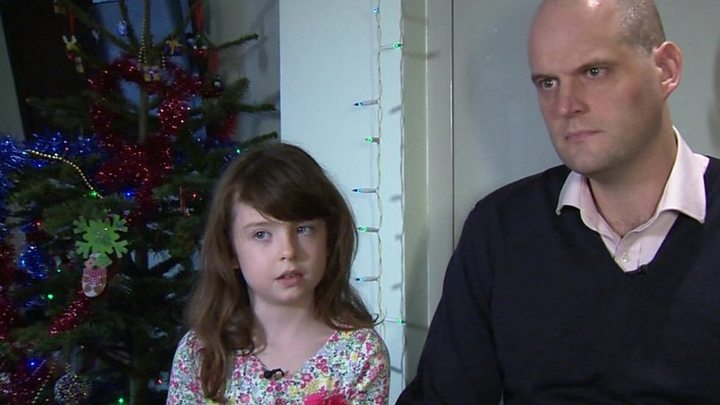
The card opened by Florence Widdicombe
Image caption The pack of cards cost £1.50 from Tesco

A factory in China has denied it used forced labour after a six-year-old girl found a message from workers inside a Tesco charity Christmas card.

The card supplier, Zhejiang Yunguang Printing, told China’s Global Times it had “never done such a thing”.

Tesco halted production at the factory on Sunday over the message, allegedly written by prisoners claiming they were “forced to work against our will”.

The Chinese foreign ministry said the allegation was “a farce”.

Speaking to the nationalist newspaper Global Times on Monday, a spokesman for the card supplier said: “We only became aware of this when some foreign media contacted us. We have never done such a thing.

“Why did they include our company’s name?”

The message – first reported by the Sunday Times – was found by Florence Widdicombe, who was writing cards to her school friends. She found that one of them – featuring a kitten with a Santa hat – had already been written in.

In block capitals, it said: “We are foreign prisoners in Shanghai Qingpu prison China. Forced to work against our will. Please help us and notify human rights organisation.”

The message in the card asked whoever found the message to contact Peter Humphrey, a British journalist who was himself imprisoned there four years ago.

Chinese foreign ministry spokesman Geng Shuang told reporters on Monday the allegation was “a farce” created by Mr Humphrey.

“Shanghai’s Qingpu prison has no such foreign prisoners undergoing forced labour,” Mr Shuang said.

Zhejiang Yunguang Printing’s factory manager, Shu Yunjia, told the BBC it had not outsourced any of its work to the Qingpu prison.

Media caption Florence Widdicombe was writing the cards last Sunday when she discovered the message

Florence, from Tooting in south London, said she was writing her “sixth or eighth card” when she saw “somebody had already written in it”.

“It made me feel shocked,” she said, adding that when it was explained to her what the message meant she felt “sad”.

Tesco added that it would de-list Zhejiang Yunguang if it was found to have used prison labour.

A Tesco spokeswoman said: “We were shocked by these allegations and immediately halted production at the factory where these cards are produced and launched an investigation.”

The supermarket said it has a “comprehensive auditing system” to ensure suppliers are not exploiting forced labour.

The factory in question was checked only last month and no evidence of it breaking the ban on prison labour was found, it said.

Sales of charity Christmas cards at the company’s supermarkets raise £300,000 a year for the British Heart Foundation, Cancer Research UK and Diabetes UK.

Tesco has not received any other complaints from customers about messages inside Christmas cards.

‘Very bleak life’

The message in the card urged the recipient to contact Peter Humphrey, who was formerly imprisoned at Qingpu on what he described as “bogus charges that were never heard in court”.

After the Widdicombe family sent him a message via Linkedin, Mr Humphrey said he then contacted ex-prisoners who confirmed inmates had been forced to work.

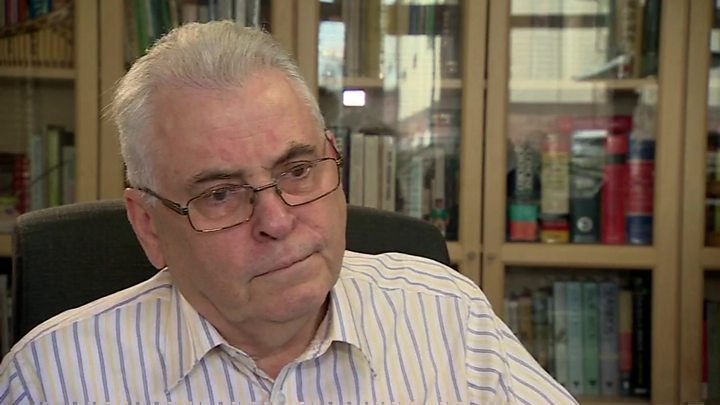
Media caption Peter Humphrey: “I think I know who it was but I will never disclose the name”

Mr Humphrey told the BBC that the cell block of foreign prisoners has about 250 people in it, who are living a “very bleak daily life” with 12 prisoners per cell.

He added that when he was in there, manufacturing labour work was voluntary – to earn money to buy soap or toothpaste – but that work has now become compulsory.

Mr Humphrey told the BBC: “I spent two years in captivity in Shanghai between 2013 and 2015 and my final nine months of captivity was in this very prison in this very cell block where this message has come from.

“So this was written by some of my cellmates from that period who are still there serving sentences.

“I’m pretty sure this was written as a collective message. Obviously one single hand produced this capital letters’ handwriting and I think I know who it was, but I will never disclose that name.”

It is not the first time that prisoners in China have reportedly smuggled out messages in products they have been forced to make for Western markets.

In 2012, Julie Keith from Portland, Oregon, discovered an account of torture and persecution by a prisoner who said he was forced to manufacture the Halloween decorations she had purchased.

And in 2014, Karen Wisinska from Co Fermanagh in Northern Ireland, found a note on a pair of Primark trousers reading: “Our job inside the prison is to produce fashion clothes for export. We work 15 hours per day and the food we eat wouldn’t even be given to dogs or pigs.”

Under the UN’s guidance for human rights and prisons, prisoners “should not be subordinated merely to making a profit either for the prison authorities or for a private contractor”.

The standard minimum rules for the treatment of prisoners state: “Prison labour must not be of an afflictive nature.”


Source: The BBC

23/12/2019

Exclusive: Tesla to take new $1.4 billion loan from Chinese banks for Shanghai factory: sources

BEIJING/SHANGHAI (Reuters) – U.S. electric vehicle maker Tesla Inc (TSLA.O) and a group of China banks have agreed a new 10 billion yuan (1.08 billion pounds), five-year loan facility for the automaker’s Shanghai car plant, three sources familiar with the matter said, part of which will be used to roll over an existing loan.

China Construction Bank (0939.HK) (601939.SS) (CCB), Agricultural Bank of China (1288.HK) (601288.SS) (AgBank), Industrial and Commercial Bank of China (601398.SS) (1398.HK) (ICBC) and Shanghai Pudong Development Bank (600000.SS) (SPDB) are among the banks which have agreed to give Tesla the financial support, one source with direct knowledge said.

The Chinese banks earlier this year already offered Tesla a 12-month facility of up to 3.5 billion yuan, which is due to be repaid on March 4, 2020, according to a filing the automaker made to the U.S. Securities and Exchange Commission.

That new loan will be partially used to roll over the previous 3.5 billion yuan debt, according to the first source. The second source said the rest will be used on the factory and Tesla’s China operations.

The new loan’s interest rate will be pegged at 90% of China’s one-year benchmark interest rate, the same as the 3.5 billion yuan loan, the first source said. This is a rate that China banks offer to their best clients.

Tesla, CCB, AgBank, ICBC and SPDB did not immediately respond to Reuters’ requests for comment.

Tesla broke ground on the factory in January and has started producing vehicles from its Shanghai plant. It aims to build at least 1,000 Model 3 cars a week by the end of this year.

The factory, which is Tesla’s first car manufacturing site outside the United States, is the centerpiece of its ambitions to boost sales in the world’s biggest auto market and avoid higher import tariffs imposed on U.S.-made cars.

The Shanghai government has also thrown its support behind the Tesla project, which would be China’s first wholly foreign-owned car plant and a reflection of the government’s broader shift to open up its car market.

($1 = 7.0119 Chinese yuan)

Source: Reuters

22/12/2019

Economic Watch: Smart economy fledging in China as AI empowers industries, individuals

BEIJING, Dec. 21 (Xinhua) — Ask the silver-haired residents of the elderly care community Yinheyuan in central Beijing what they know about artificial intelligence (AI), and they will probably throw the question to the smart speakers within their reach.

These smart speakers, capable of interacting with users with voice-recognition technologies, are also part of the answer. Via voice command, senior residents can control lights, TVs and other home appliances, order food or ask for help.

AI is no longer a technical term used exclusively by professionals in China. Both young and old are enjoying the benefits of the growing smart economy.

After personal computers (PC), PC internet and mobile internet, the growth focus of China’s digital economy is shifting to smart technologies like AI, said Baidu Chairman and CEO Robin Li at the World Internet Conference in October.

In the smart economy era, Li predicted a declining reliance on cellphones and a rising popularity of other smart devices. AI chips, cloud computing services, among others, would become the new digital infrastructure, while innovative businesses will flourish as transport, health, education and other sectors go smart.

Wearable devices, smart home appliances, autonomous driving and smart cities are among the fastest-growing fields in the smart economy.

China is the largest smart speaker market in the world, accounting for 36 percent of global shipments in the third quarter of 2019, according to global market firm Strategy Analytics. It found in a July and August survey that 63 percent of Chinese people without a smart speaker planned to buy one within the following year. Another 22 percent planned to make a purchase later on.

Chinese firms are stepping up investment in 5G, AI and the Internet of Things to gain a foothold in the emerging field. By end-June, China had over 1,200 AI-related enterprises, according to the Ministry of Industry and Information Technology.

Baidu launched its autonomous driving open platform ApollBo in 2017 to coordinate cross-sector efforts in this field. It has launched several L4 autonomous driving vehicles in partnership with leading automobile companies, and a fleet of Apollo-powered robotaxis are now taking test runs in central China’s Changsha.

Nurturing a smart economy is also on the government agenda. China has passed a guideline to boost the integration of AI and the real economy this year, and plans to build some 20 national AI innovative development pilot zones by 2023.

The country’s AI sector is forecast to be worth more than 160 billion yuan (about 22.83 billion U.S. dollars) in 2020, spurring related sectors to exceed 1 trillion yuan, said Lin Nianxiu, deputy director with the National Development and Reform Commission, citing industrial data.

Lin said China would focus on 100 firms dedicated to AI technologies and relevant applications, improve the industrial ecosystem, facilitate the deep integration of AI and the real economy, and intensify its international collaboration on AI technology, standards, industries, laws and regulations and ethics.

Source: Xinhua

Law of Unintended Consequences

continuously updated blog about China & India

ChiaHou's Book Reviews

continuously updated blog about China & India

What's wrong with the world; and its economy

continuously updated blog about China & India