11/11/2019

Cyclone Bulbul kills 13 across India and Bangladesh

Cyclone Bulbul has ripped through coastal areas of Bangladesh and India, killing at least 13 people while more than two million others were forced to spend a night in storm shelters.

The storm packed winds of up to 120km/h (75 mph), injuring dozens and destroying thousands of homes.

Five of the six who lost their lives in Bangladesh were hit by falling trees.

Officials say that further casualties were avoided because people were evacuated in time.

Authorities say the storm is now weakening.

What damage did Cyclone Bulbul cause?

Seven people were killed in the Indian state of West Bengal, the state’s minister for disaster management told reporters.

Hindu pilgrims walk back from the dock after a ferry service to Sagar Island was suspended due to the approaching Cyclone Bulbul in Kakdwip in West Bengal stateImage copyright AFP
Image caption West Bengal is one of the worst hit areas in India

The five victims hit by trees in Bangladesh included a 52-year old woman who died when a tree dropped onto her house.

A 60-year-old fisherman also lost his life after ignoring evacuation warnings.

There are increasing concerns after two fishing boats carrying more than 30 men failed to return, an official in Bangladesh’s Bhola district said.

Around 1,200 tourists, most of them Bangladeshi, were stuck on St Martin’s Island, part of Cox’s Bazar district, an official told the Reuters news agency.

“All of them will be rescued,” he said.

Services at many sea ports and airports in the region were also suspended – including the busy Kolkata airport.

Bangladesh’s two biggest ports, Mongla and Chittagong, were closed and flights into Chittagong airport were stopped.

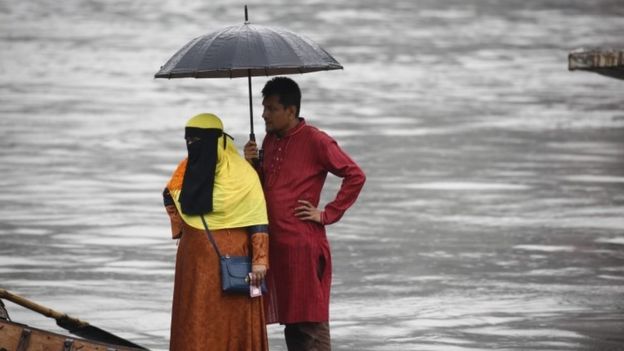
Bangladeshi passengers use an umbrella as they cross the Buriganga River by boat during a rainy day in Dhaka, BangladeshImage copyright EPA
Image caption Storms have battered areas of Bangladesh

Bangladesh’s low-lying coast is often hit by deadly cyclones, but the country has successfully reduced the number of casualties in recent years.

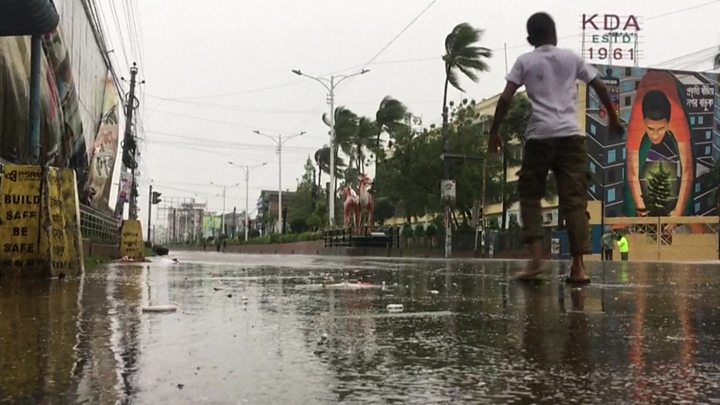
Media caption People in Khulna, Bangladesh, seek shelter from the storm

Source: The BBC

11/11/2019

With Indian court ruling, Modi’s Hindu agenda barrels forward

AYODHYA/MUMBAI (Reuters) – Just six months after sweeping to re-election, Indian Prime Minister Narendra Modi has delivered on two major promises of his party’s Hindu agenda, electrifying his base but sowing unease among liberals and the nation’s large Muslim minority

The latest boost for Modi came on Saturday, when the Supreme Court handed Hindu groups control of a contested site where a 16th-century mosque was razed over two decades ago, paving the way for the construction of a temple there that has long been an election promise of the ruling Bharatiya Janata Party (BJP).

That followed New Delhi’s move in August to strip Muslim-majority Jammu and Kashmir of its special status as a state in what Modi’s government said was a bid to integrate the restive region with the rest of predominantly-Hindu India.

Now, the BJP may move towards delivering on its third traditional plank: Creating a uniform civil code that does away with the independence of religious communities on certain issues.

“After just a few months of Modi 2.0, they’ve accomplished two out of three (main cultural objectives). It’s quite possible that they will accomplish all three by next year,” said Milan Vaishnav, a senior fellow at the Carnegie Endowment for International Peace in Washington D.C.

“It’s striking that the government has moved with a clarity of purpose on its social agenda that’s completely absent when it comes to economic matters,” added Vaishnav in reference to the slowing of the country’s once red-hot economic growth.

Many Muslims have watched with a mix of fear and resignation as the BJP has morphed into the officially secular country’s near-undisputed political force.

The controversial site in the northern state of Uttar Pradesh has been one of the most explosive issues in the nation of 1.3 billion, where Muslims constitute about 14% of the population.

In its verdict on Saturday, the Supreme Court called the mosque’s demolition illegal but handed the plot of land to Hindus, who believe the site is the birthplace of Lord Ram, a much venerated god-king. The court directed that another plot in Ayodhya be provided to a Muslim group that contested the case.
In over a dozen interviews, Muslim community leaders, businessmen, and students said they respected the verdict but it exacerbated their sense of alienation.
“Why did the court then give a ruling which is completely one-sided? Was the court under pressure? We don’t know. We can’t trust anyone now. No door is open for us,” said local Muslim community leader Azam Quadri during evening prayers in Ayodhya.

“BEST TO BE NUMB”

While Modi himself has said the court verdict should not be seen as a “win or loss” for anyone, many Muslims Reuters spoke to expressed resignation after the ruling.

Some were bitter that a probe into the demolition has inconclusively dragged on for three decades and that many of the politicians accused of conspiring to take down the mosque are prominent BJP members. Those people have said the demolition was spontaneous and not planned.

“I feel humiliated by the Supreme Court verdict,” said one affluent Mumbai-based Muslim businessman, who declined to give his name. “Others don’t care. They have become numb. It’s best to be numb in Modi’s India.”

Some people believe that Hindu nationalists, galvanized by the Ayodhya triumph, could turn their attention to two other Uttar Pradesh mosques they believe Mughal conquerors built over the remains of Hindu temples centuries ago.

“This (verdict) seems to generate incentives for Hindus to take down mosques and resettle,” said Neelanjan Sircar, an assistant professor at Ashoka University near New Delhi.

Another likely move is the uniform civil code.

New Delhi has already taken steps toward creating such a code, with the BJP-led parliament in July outlawing the centuries-old right of a Muslim man to instantly divorce his wife. While many activists thought the Muslim custom was wrong, some Muslim groups said Modi was targeting them while turning a blind eye to discrimination in Hindu society.

For a factbox on the BJP’s plans, please see:

Despite the focus on social issues, political analysts predict the government and the BJP will have to shift attention quickly to a sagging economy and surging unemployment or risk losing popular support.

India, long touted as the world’s fastest-growing large economy, has seen economic expansion wither to six-year lows.

Two college students – one Hindu, one Muslim – in Uttar Pradesh’s capital Lucknow separately said after the court verdict that they hoped the government would now focus on economic issues.

“This case has gone on for so long… Now that it’s done with altogether, maybe more economic issues can come forward”, said Rajat Mishra, a business student.

“Attention can now move beyond topics of religion,” said medical student Irfan, 22, who declined to give his surname.

Source: Reuters

08/11/2019

Xi Focus: Xi’s trip to Greece, Brazil to advance bilateral ties, BRICS cooperation

BEIJING, Nov. 7 (Xinhua) — Chinese President Xi Jinping’s upcoming visit to Greece and Brazil is expected to intensify China’s relations with the two countries and enhance BRICS cooperation, officials said here Thursday.

At the invitation of Greek President Prokopis Pavlopoulos, Xi will pay a state visit to Greece from Nov. 10 to 12, said Vice Foreign Minister Qin Gang.

This will be the first visit to the European country by a Chinese president after an interval of 11 years, which will exert a historic influence of China-Greece ties and push forward China-Europe relations and Belt and Road cooperation, Qin said.

He noted that China and Greece, both with old civilizations, are trustworthy and helpful friends respecting and supporting each other on core interests and major concerns.

Greece is among the first European Union (EU) countries to sign an intergovernmental cooperation document with China to jointly construct the Belt and Road, Qin said, adding that Greek prime ministers attended the first and second Belt and Road Forum on International Cooperation in Beijing.

The two sides have conducted fruitful cooperation on the principle of mutual benefit and win-win cooperation and witnessed increased bilateral trade and investment, Qin said.

“The Piraeus Port project, a flagship project for the Belt and Road cooperation, has made important contributions to the local economic and social development of Greece and played an important role in advancing connectivity in various regions around the globe,” said the vice foreign minister.

Speaking of people-to-people and cultural exchanges, Qin said peoples of the two countries respect each other and advocate openness and inclusiveness in their close interactions.

“Both China and Greece hold that different civilizations should respect each other and facilitate experience sharing, mutual learning and conversation among civilizations,” he said.

China and Greece are new friends of the “17 +1” cooperation. In April this year, Greece became a full member of the China-Central and Eastern European Countries Cooperation Mechanism, adding new opportunities to the development of this mechanism, which is also conducive to developing China-EU relations and China-EU connectivity, Qin said.

Greek Prime Minister Kyriakos Mitsotakis led a delegation to the ongoing second China International Import Expo (CIIE). Xi met with him, and the two leaders visited the Greek pavilion, Qin said.

According to Qin, in Greece, Xi is scheduled to hold talks respectively with Pavlopoulos and Mitsotakis, in a bid to consolidate political mutual trust and traditional friendship between the two countries, intensify pragmatic cooperation in trade, investment, infrastructure and other fields, uphold multilateralism and free trade and build an open world economy.

Besides, Qin noted that the Chinese and Greek leaders will conduct cultural exchanges and advocate dialogues among civilizations.

The two sides will issue a joint statement on strengthening the comprehensive strategic partnership, draw up a blueprint for the development of bilateral ties, sign intergovernmental cooperation documents on investment and education, and ink commercial agreements in such fields as ports, finance, and energy.

Greece, in the West, and China, in the East, are heirs of ancient civilizations. Noting that both China and Greece are faced with the mission of rejuvenation and prosperity, Qin said the two countries can enlighten the world to deal with various problems and challenges.

Xi’s upcoming visit to Greece shows respect and appreciation of the ancient Chinese civilization to the ancient Greek civilization, as well as the expectation of jointly building a community with a shared future for humanity, Qin said.

It is believed the visit will elevate the level of bilateral cooperation in an all-round way and inject new impetus to the development of China-EU relations with fruitful results, Qin stressed.

According to Vice Foreign Minister Ma Zhaoxu, at the invitation of Brazilian President Jair Messias Bolsonaro, Xi will attend the 11th BRICS summit in Brasilia, the capital of Brazil, from Nov. 13 to 14.

BRICS is the acronym for an emerging-market bloc that groups Brazil, Russia, India, China and South Africa.

Xi is scheduled to attend the closing ceremony of the BRICS business forum, closed and public meetings of the BRICS leaders’ meeting and the BRICS leaders’ dialogue with the BRICS Business Council and the New Development Bank. The leaders’ declaration is expected to be released, Ma said.

Xi will hold talks with Bolsonaro, sign cooperation documents in various fields, and hold bilateral meetings with leaders of other participating countries to exchange views on ties and BRICS cooperation, Ma said.

As the world is undergoing changes rarely seen in a century and confronted with unprecedented opportunities and challenges, BRICS countries have drawn ever-growing attention worldwide, Ma said, stressing that China appreciates the efforts made by Brazil in its preparation and stands ready to jointly prompt the meeting to achieve fruitful results.

He voiced expectations of the Chinese side.

“The Chinese side hopes that BRICS countries will further enhance political mutual trust, boost mutually beneficial cooperation and forge a more comprehensive, closer and broader partnership,” Ma said.

As for safeguarding multilateralism and strengthening global governance, Ma voiced China’s determination to make joint efforts with other BRICS countries to safeguard the rules-based multilateral trade system, the international order based on international law, and the international system with the UN at the core.

This aims to promote a more equitable, open, transparent and inclusive global governance system and safeguard common interests and development space of emerging markets and developing countries, Ma said.

“China believes the five BRICS countries should follow the trend of the new industrial revolution and facilitate economic transformation and upgrading,” Ma noted.

As an important outcome of last year’s Johannesburg meeting, the BRICS partnership for a new industrial revolution has progressed well in the past year, he said, adding that China is willing to work with concerned parties to accelerate the development of the partnership and tap more potential for cooperation projects, so as to propel high-quality development of the five countries.

“China looks forward to more cooperation on economy, trade, finance, political security and people-to-people exchanges, with projects meeting the development needs of the five countries and serving the interests of their peoples,” he said.

The Chinese side believes that with concerted efforts of all parties and under the political guidance of the five countries’ leaders, the 11th BRICS Summit will be a full success, Ma said, stressing that the BRICS countries will continue to contribute to world peace and development and the building of a community with a shared future for humanity.

Source: Xinhua

08/11/2019

Jackie Chan cancels Vietnam charity visit after South China Sea backlash

  • Chan is accused of supporting Beijing’s so-called nine-dash line, which is its historical justification for its territorial claims in the resource-rich sea
  • Vietnam, Malaysia, the Philippines, Taiwan and Brunei all have competing claims in the waterway that overlap with China’s
Film star Jackie Chan. Photo: Reuters
Martial arts film star Jackie Chan’s planned visit to Vietnam for a charity has been cancelled following an online backlash related to Beijing’s expansive claims in the disputed South China Sea.
The Hong Kong-born actor was set to visit Hanoi on November 10 to support Operation Smile, a charity that gives free surgery to children with facial disfigurements.
Jackie Chan says he wants to make films in Saudi Arabia
But the plans were scrapped after thousands of angry Facebook users flooded the charity’s official page when his visit was announced last week.
Some of their comments claimed Chan had spoken in support of China’s so-called nine-dash line – its historical justification for its territorial claims in the resource-rich sea.
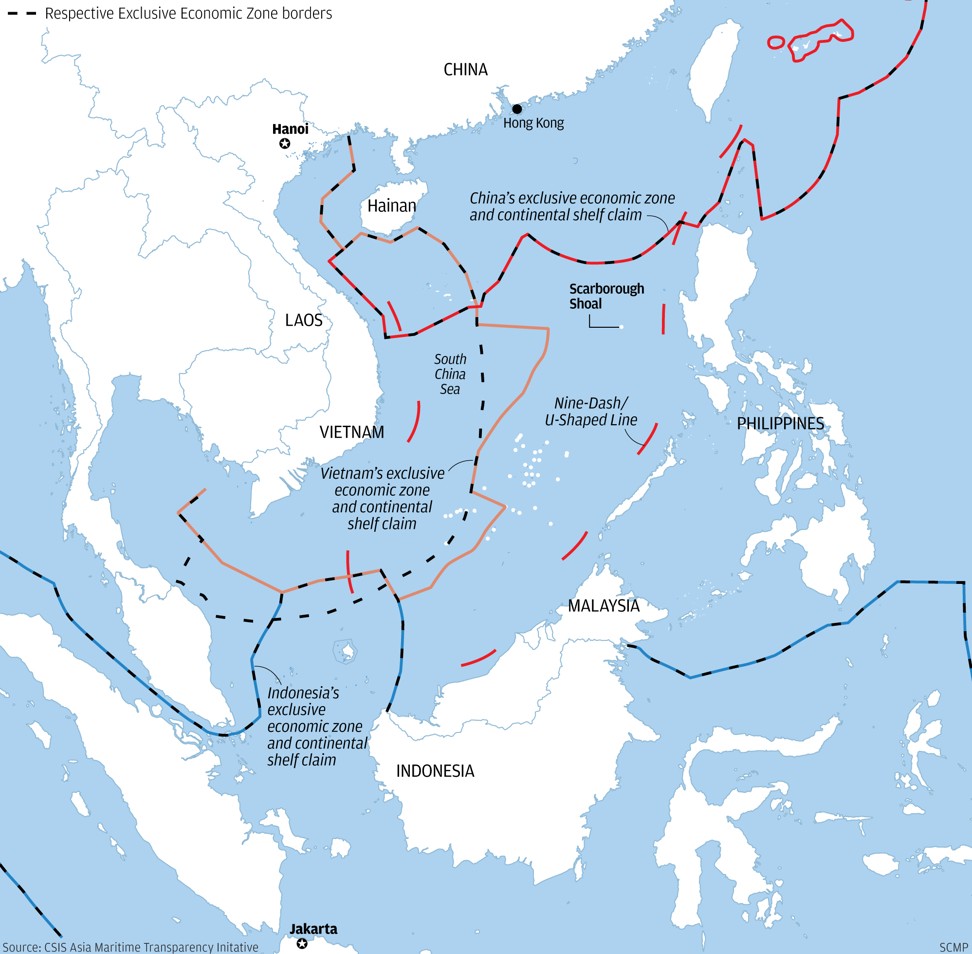
A map showing claimant countries’ exclusive economic zones in the South China Sea.

However, Chan has not explicitly expressed public support for the controversial maritime assertion.

Vietnam, Malaysia, the Philippines, Taiwan and Brunei all have competing claims in the waterway that overlap with China’s – long a source of tension in the region.

Issuing a mea culpa on Friday for failing “to predict the reaction” of the Vietnamese public, the charity asserted that their work is “non-political”.

“We are very sorry … Operation Smile will not organise any activities with [Chan’s] involvement” in Vietnam, they said.

A Chinese coastguard ship sails by a Vietnamese vessel off the coast of Vietnam in 2014. Photo: Reuters

Vietnam is one of Beijing’s most vocal critics over the flashpoint South China Sea issue.

The foreign ministry on Thursday repeated its usual proclamation on the sea, citing the country’s “full legal basis and true evidence to affirm Vietnam’s sovereignty”, deputy spokesperson Ngo Toan Thang said.

Chan has in the past been accused of siding with China over Hong Kong’s democracy protests after calling the unrest in his hometown “sad and depressing”.

The comment sparked ire in Hong Kong but was warmly received by many in China where he has a massive fan base.

Abominable has been criticised for a scene showing the nine-dash line. Photo: DreamWorks
Earlier this month Hanoi pulled the DreamWorks film Abominable from theatres over a scene featuring a map showing the nine-dash line.
Beijing claims most the South China Sea through the vague delineation, which is based on maps from the 1940s as the then-Republic of China snapped up islands from Japanese control.
Abominable is not being shown in Malaysia either

after its distributor refused to cut the offending scene, while the Philippines also filed complaints.

The US this week accused Beijing of intimidating smaller countries in the South China Sea, a key global fishing route.
China has built military installations and man-made islands in the area, and for several weeks earlier this year sent a survey ship to waters claimed by Vietnam.
Source: SCMP
07/11/2019

China’s top political advisor to visit Egypt, Oman, Laos

BEIJING, Nov. 7 (Xinhua) — China’s top political advisor Wang Yang will pay official visits to Egypt, Oman and Laos, Foreign Ministry spokesperson Geng Shuang announced here Thursday.

Invited by Speaker Ali Abdel-Aal of the Egyptian Parliament and Chairman Yahya bin Mahfoudh Al Manthri of State Council of Oman, Wang Yang, chairman of the National Committee of the Chinese People’s Political Consultative Conference (CPPCC), will pay official visits to Egypt and Oman from Nov. 10 to 16, Geng said.

Invited by member of the Political Bureau of the LPRP Central Committee and President of the Lao Front for National Construction Saysomphone Phomvihane, Wang, also a member of the Standing Committee of the Political Bureau of the Communist Party of China (CPC) Central Committee, will pay an official visit to Laos from Nov. 16 to 19, Geng added.

Source: Xinhua

07/11/2019

Chinese top legislator meets Czech parliament speaker

CHINA-BEIJING-LI ZHANSHU-CZECH PARLIAMENT SPEAKER-MEETING (CN)

Li Zhanshu, chairman of the Standing Committee of the National People’s Congress (NPC), meets with Speaker of the Czech Chamber of Deputies Radek Vondracek in Beijing, capital of China, Nov. 7, 2019. (Xinhua/Ding Haitao)

BEIJING, Nov. 7 (Xinhua) — Chinese top legislator Li Zhanshu met with Speaker of the Chamber of Deputies Radek Vondracek in Beijing on Thursday.

Li, chairman of the Standing Committee of the National People’s Congress (NPC), said China and the Czech Republic have traditionally enjoyed friendly ties, and China’s further opening-up will bring greater opportunities for cooperation between the two countries.

Li called on China and the Czech Republic to uphold mutual respect, mutual trust and mutual benefit to push the strategic partnership between the two countries to new heights.

The NPC stands ready to work with the parliament of the Czech Republic, he said.

Vondracek said the Czech Republic is willing to seize the important opportunity provided by China’s development and further opening-up, enhance high-level exchanges, promote practical cooperation and explore the Chinese market. The Czech Republic will continue to uphold the one-China principle, he said.

Source: Xinhua

07/11/2019

The cheap sensor detecting landslides in India

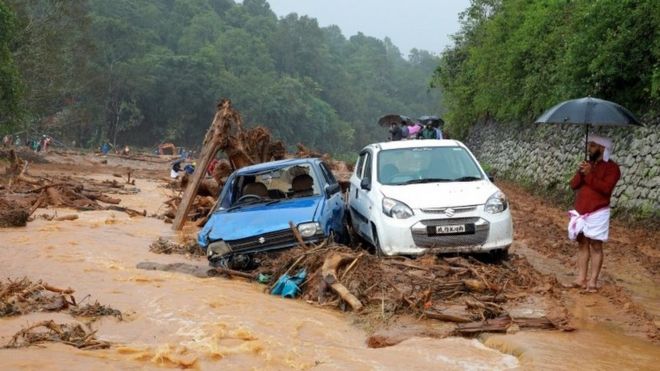
A man stands next to damaged cars after a landslide caused by torrential monsoon rains at Puthumala near Meppadi, Wayanad district, in the southern state of Kerala, India, August 14, 2019Image copyright REUTERS
Image caption Landslides are common in India after heavy rains

Landslides are common in rural and mountainous areas of India, especially after heavy rain. Scientists now say they have developed a low-cost technology for detecting them, using a motion sensor commonly found in smartphones.

The device is currently being trialled in more than 20 locations in the Himalayan state of Himachal Pradesh, where landslides kill dozens of people every year.

Scientists say they are hopeful that it will help drastically reduce the deaths and damage caused by these natural disasters.

An accelerometer is a type of motion sensor which measures changes in velocity. In smartphones, this is what allows people to use compass and maps applications and even flip their screens horizontally or vertically.

But now scientists from the Indian Institute of Technology (IIT) in Himachal Pradesh’s Mandi district have found that with some modifications, it can be used as a low-cost early warning system for landslides.

They told BBC Click’s Shubham Kishore that it will cost an estimated 20,000 rupees (£218; $282) to manufacture – a fraction of the cost of existing technologies.

Authorities say the frequency of landslides in Himachal Pradesh is due to its mountainous terrain and the instability of the Himalayas, which is a relatively young mountain range.

However, excessive rain, rampant deforestation, and unauthorised construction has exacerbated the problem.

RENUKA DO SARKAImage copyright IIT MANDI
Image caption One of the devices being fitted

The Environmental Information (ENVIS) centre for the Ministry of Environment and Forest said in a report that casualties from landslides were also growing because “the increase of road connectivity and number of vehicles plying on these roads in the state, means the number of road accidents and loss of precious human lives is increasing day by day”.

This is because landslides frequently wash away roads and destroy homes – many of which are built with materials like clay mud or unburned bricks.

Early warning

Dr Varun Dutt, a computer engineer, with his colleague, Dr KV Uday, a civil engineer, are leading efforts to develop the technology. These researchers say they are using the motion sensor to measure soil movements.

“When we embed it in the soil, the accelerometer will move when the soil moves. Essentially soil moves if some force acts on it.

“What the sensor does is allow us to record the extent of that movement. It throws up a range of data that then allows us to track small displacements in soil which causes landslides,” Dr Dutt told the BBC’s Ayeshea Perera.

He explained that a series of small soil movements could help provide an early warning to a larger disaster in the making. Due to the early warnings from small movements, detecting a landslide is easier than trying to detect an earthquake, which is more instantaneous with a very small warning corridor.

The device measures all these movements, and when it detects a significant displacement of earth which could result in a landslide, it emits loud noises and sends text messages to officials so that they can evacuate and stop vehicular movement to and around the area.

Heavy machinery removes debris as rescue personnel search for survivors and bodies of victims after a landslide along a highway at KotrupiImage copyright AFP
Image caption The new device helps to detect landslides

The device has already seen some success.

In Kutropi, in the state’s Mandi district, the device was able to successfully alert officials about an impending landslide. Police were able to turn away vehicles from a road that was later completely washed away.

Dr Uday told the BBC that they have managed to alert officials after using the device that a hill in the state’s Deode region needed to be monitored carefully as the soil movements indicated that the hill was at risk of sliding.

Dr Dutt says that state officials – who often have to deal with the tragic consequences of landslides – are excited about the technology.

“We were invited to present it at a workshop by the state government in partnership with the National Disaster Management Authority (NDMA) earlier this year.

“We showcased the technology and we got a lot of requests to commercialise it. So now we are in the process of marketing it and setting it up,” he said.

Predictive technology

The device has also won an innovation award from the government.

At present, the device has managed to demonstrate enough of a lead time to allow officials to warn residents and motorists shortly before a potential landslide.

But Dr Dutt and Dr Uday want the technology to be more predictive than reactive.

So the team has begun using Artificial Intelligence (AI) and machine learning on the sets of data thrown up by the device, and are hoping that it can develop algorithms that will enable them to predict landslides 24 hours or even a week in advance.

These algorithms are currently being refined, and scientists are hoping to test them more accurately in the field by the 2020 monsoon.

“We are excited but we want it to be accurate. There should be fewer false alarms.

“The good part is that policymakers understand that this is experimental work and it will improve as more data gets collected. If it all goes to plan, it will be very useful,” Dr Dutt said.

Source: The BBC

06/11/2019

French President Emmanuel Macron tells Chinese leader Xi Jinping talks are needed to calm Hong Kong situation

  • French leader calls for restraint and says he raised the topic ‘on several occasions’ during his visit
  • Two sides find common ground on need to defend free trade and fight climate change as Donald Trump starts process of pulling US out of Paris Climate Agreement
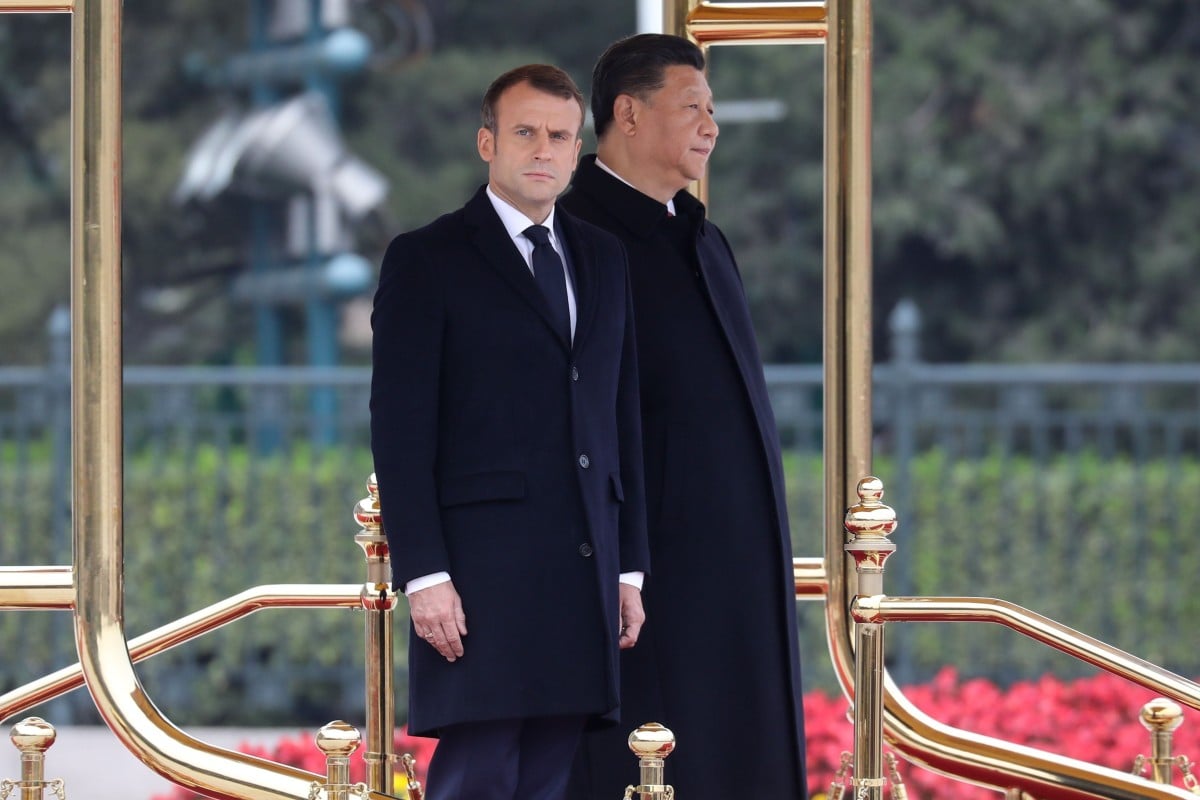
Xi Jinping and Emmanuel Macron at a welcome ceremony ahead of their talks in Beijing on Wednesday. Photo: AFP

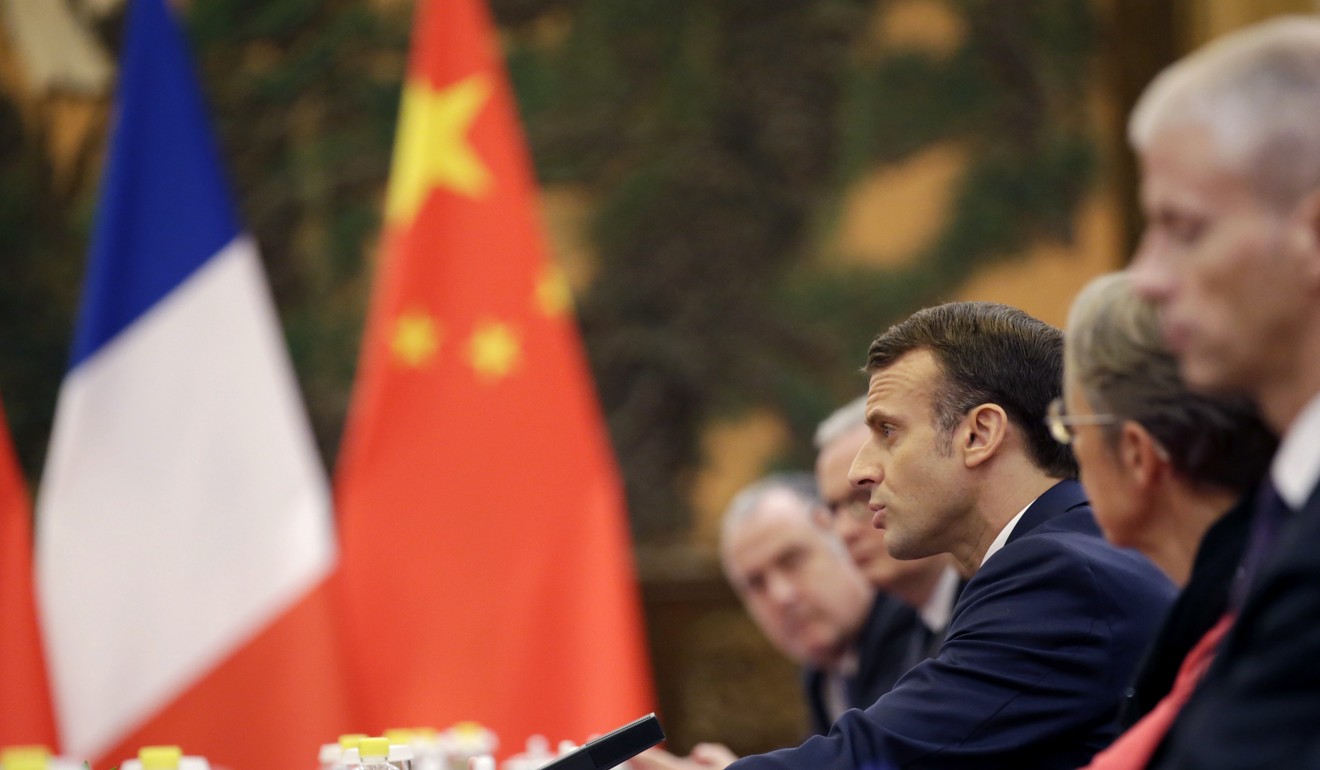
French President Emmanuel Macron said he raised human rights and the Hong Kong situation during his talks with his Chinese counterpart Xi Jinping on Wednesday.

Macron’s visit to China concluded with pledges to work together on climate change, but the French leader also said he also called for a de-escalation of the situation in the city through dialogue after months of protests.

Macron, who had promised to raise “taboo” topics during the visit, told a press conference: “I obviously raised this with President Xi Jinping on several occasions.

“We have repeatedly called on the parties involved to [engage in] dialogue, to show restraint, to de-escalate.”

The discussion followed Xi’s meeting with Hong Kong’s embattled Chief Executive Carrie Lam Cheng Yuet-ngor in Shanghai on Monday, where he expressed “high trust” in her and “fully affirmed” support for her response to the unrest that has gripped the city since June.

Earlier the French and Chinese leaders had restated their commitment to protect free trade and pledged their continued support for the Paris Agreement as the United States begins the process of formally withdrawing from the global climate deal.

Macron expressed “regret” over “some countries’ negative attitude” towards environmental protection and the fight against climate change and pledged to work with China to halt the loss of biodiversity.

The French president’s office also released a statement on Wednesday that reaffirmed France and China’s joint support for the “irreversible” Paris Agreement.

Macron points to common ground with China on tariffs and climate action

With the European Union, China and Russia backing the pact, he added, “the isolated choice of one or another is not enough to change the course of the world. It only leads to marginalisation.”

The two countries also agreed to work together to develop joint nuclear power projects and signed a series of contracts worth US$15 billion.

The deals covered aeronautics, energy and agriculture, including approval for 20 French companies to export poultry, beef and pork to China.

An additional action plan released after the talks said French utility giant EDF and China General Nuclear Power should be encouraged to cooperate on projects in China or third countries, citing the joint efforts by the two companies to build nuclear reactors at the Hinkley Point C station in Britain as an example.

The two sides also committed to signing a contract for the construction of a nuclear fuel recycling plant in China, which would involve French energy giant Orano, by January 31.

Xi took what appeared to be a veiled swipe at the United States, which is still embroiled in a protracted trade war and other confrontations with Beijing.

“We advocate for mutual respect and equal treatment, and are opposed to the law of the jungle and acts of intimidation,” Xi said.

“We advocate for openness, inclusion and for mutually beneficial cooperation, and are opposed to protectionism and a zero-sum game.”

Macron said China and the European Union should work in partnership as the world became more unstable, calling on the two sides to further open up market access.

“We call again for trade multilateralism to respond to distortions that have appeared in the global economy, which have led to a profound rise in inequalities and imbalances that explain the surge of challenges to the international systems,” he said.

“China and Europe also share the same views that the trade war only leads to loss.”

Macron kicks off China visit with deal to protect wine and cheese from counterfeiting

Chinese state news agency Xinhua said the two countries agreed to work together to push forward with plans to assemble Airbus’s A350 model in China.

Meanwhile, Beijing Gas Group and French utility firm Engie will collaborate on a liquefied natural gas terminal and storage in the northern city of Tianjin, while France’s Total will set up a joint venture with China’s Shenergy Group to distribute liquid nitrogen gas by truck in the Yangtze River Delta.

The two countries also agreed to reach an agreement by the end of January 2020 on the cost and location of a nuclear fuel reprocessing facility to be built by Orano, formerly known as Areva.

Wu Libo a professor and director of the Centre for Energy Economics and Strategies Studies at Fudan University, said there was “great potential” for further cooperation between the two countries on nuclear energy.

“France has many useful experiences in the operation and management of nuclear power plants and its plants have long-term safe and stable operation records,” she said.

The two sides agreed to work together on joint nuclear power projects. Photo: AP

Jiang Kejun, a senior researcher at the Energy Research Institute of China’s National Development and Reform Commission, said China’s cooperation with France would add credibility to potential third-country projects.

“China has advanced third-generation technology but it’s still a new member in the nuclear power market, while France has developed nuclear energy for a long time, and its EPR reactors – a technology designed and developed in France – are in business operation,” he said.

Jiang said possible markets for the joint projects included Argentina and India, while some Middle Eastern states – such as Saudi Arabia and Qatar – had expressed interest in nuclear energy.

China’s ambassador hits out at Macron’s team for backing ‘hypocritical’ EU stance on Hong Kong

Tong Jiadong, professor of international trade at Nankai University, said that the deals between the two sides helped show that France and China could work together to counteract US unilateralism.

“Objectively speaking, this will form, or at least imply, an opposition to US unilateralism,” Tong said. “China hopes the cooperation between these two countries produces demonstrable effects for other EU member states.”

Ding Chun, a professor of European Studies at Fudan University, said he did not think the EU wanted to “choose a side” between the US and China.

But Ding continued: “If we are talking about free trade and multilateralism, there’s no doubt that the EU and China share a common view and can balance Donald Trump’s unilateralism.”

Source: SCMP

05/11/2019

Xi Focus: Xi meets HKSAR chief executive

(CIIE)CHINA-SHANGHAI-XI JINPING-CARRIE LAM-MEETING (CN)

Chinese President Xi Jinping meets with Chief Executive of Hong Kong Special Administrative Region (HKSAR) Carrie Lam, who is here for the second China International Import Expo (CIIE), in Shanghai, east China, Nov. 4, 2019. (Xinhua/Ju Peng)

SHANGHAI, Nov. 4 (Xinhua) — President Xi Jinping on Monday met with Chief Executive of Hong Kong Special Administrative Region (HKSAR) Carrie Lam, who is in Shanghai for the second China International Import Expo.

After hearing Lam’s report on the recent situation in Hong Kong, Xi said the disturbances in Hong Kong have lasted five months. Lam has led the SAR government to fully discharge its duties, strive to stabilize the situation and improve the social atmosphere, and has done a lot of hard work, he said.

Xi voiced the central government’s high degree of trust in Lam and full acknowledgement of the work of her and her governance team.

Ending violence and chaos and restoring order remain the most important task for Hong Kong at present, he noted.

Xi demanded unswerving efforts to stop and punish violent activities in accordance with the law to safeguard the well-being of the general public in Hong Kong.

Meanwhile, effective efforts should be made in work including having dialogue with all sectors of the society and improving people’s livelihood, Xi said.

Xi expressed his hope that people from all walks of life in Hong Kong fully and faithfully implement the principle of “one country, two systems” and the HKSAR Basic Law, and make concerted efforts to safeguard Hong Kong’s prosperity and stability.

Source: Xinhua

05/11/2019

Chinese pilot banned from flying after passenger cockpit photo

Photo taken from microblogging site WeiboImage copyright WEIBO/SCREENSHOT
Image caption The female passenger is seen here with her fingers in a V pose, also known as the peace sign

A Chinese pilot has been banned from flying after a photo went viral showing a female passenger in the cockpit.

The photo was taken in January on an Air Guilin flight from Guilin city to Yangzhou city, state media said, but was widely shared this week – causing the airline to take action.

It shows a woman posing in the cockpit with refreshments laid out next to her.

Air Guilin said in a statement the pilot had violated air safety regulations.

‘Thanks to the captain’

The incident took place on 4 January on flight GT1011 from Guilin city to Yangzhou city, according to state media outlet The Global Times.

But it was brought to the airline’s attention on Sunday after screenshots of the alleged passenger’s post started being shared widely on micro-blogging site Weibo.

The post showed the woman making a V sign with her fingers – a popular pose in China – with the photo captioned: “Thanks to the captain. So happy.”

The woman is rumoured to be a flight attendant in training at a Guilin university, according to news site Chinese News Service.

Air Guilin did not specify if the photo was taken mid-flight, but Chinese pilots and analysts said the photo appears to have been taken during the flight.

The pilot, who was not named, has been banned from flying for life, though it is unclear if he was fired from all roles by the airline.

Air Guilin said in a statement that he had “violated [regulations] by allowing irrelevant personnel into the cockpit”.

According to the Civil Aviation Administration of China, passengers are not allowed to enter the cockpit without special approval or under “necessary” circumstances.

Other staff members involved in the incident have also been “suspended indefinitely” while further investigations are held.

“Passengers’ safety is always Air Guilin’s priority. We take a zero-tolerance approach against any inappropriate and unprofessional behaviour that might risk the aviation safety,” the Chinese carrier said.

Last year, Chinese carrier Donghai Airlines suspended a pilot for six months and revoked his qualifications as a flight instructor after he allowed his wife to go inside the cockpit.

Source: The BBC

Law of Unintended Consequences

continuously updated blog about China & India

ChiaHou's Book Reviews

continuously updated blog about China & India

What's wrong with the world; and its economy

continuously updated blog about China & India