

For two days in row, Chinese swimmer Fu Yuanhui clambered out of the Olympic pool in Rio clueless about her breakthrough performances: breaking personal records and clinching a bronze medal.
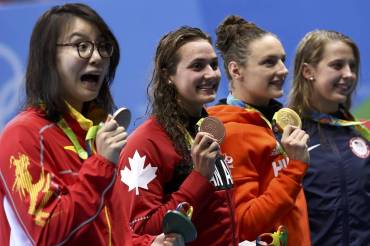
Each time a poolside reporter had to break the news to the bubbly 20-year-old, whose vivacious epiphanies on live television have broken the Chinese internet.“I was so fast! I’m really pleased!” Ms. Fu exclaimed Monday after learning that she swam the 100-meter backstroke semifinal in 58.95 seconds, a new personal best. “I’ve already… expended my primordial powers!”
After Tuesday’s final, when told that she trailed the silver medalist by just 0.01 second, Ms. Fu replied, “Maybe it’s because my arms are too short.”
Her gleeful candor made her an overnight online sensation. Fans feted her as “Primordial Girl” in online memes and viral videos spoofing her exuberant expressions. Her Weibo microblog following swelled more than sixfold to 3.8 million users.
China has a new sports star, and never mind that she didn’t finish first. In a country long obsessed with winning gold medals, Ms. Fu’s newfound fame seemed to signal shifting social perceptions about the meaning of sport.
“‘Primordial Girl’ and the netizens who appreciate her have taught all of us a lesson: sport is about the struggle and, especially, enjoyment, but most definitely not about spinning gold,” the Communist Party’s flagship newspaper, People’s Daily, said in a Tuesday commentary.
“The warm support from netizens,” according to the newspaper, “shows that public attitudes toward competitive sport and the Olympics have sublimated to a higher level.
”Ms. Fu’s fans, for their part, credited her “authentic” demeanor, which contrasted with the mild mien typical of Chinese Olympians. “We love your happy optimism and strong personality,” a Weibo user wrote on Ms. Fu’s microblog. “That’s what makes a true athlete.
”Winning used to be everything for China’s Olympians, virtually all of whom came through a grueling state-run sports regime that fetishized success. Athletes who strike gold can expect fame and fortune, while those who disappoint often suffer neglect or even ignominy.
Liu Xiang, a hurdler who became the first Chinese man to win an Olympic gold in athletics at the 2004 Athens Games, saw public adulation turn into anguish and anger at the Beijing Games four years later, when an injury forced him to withdraw just before running his first race.E
China nonetheless crowned a grandly staged Beijing Olympics by topping the gold-medal tally for the first time, with 51 in all. Their gold haul dropped to a second-place 38 at the 2012 Games in London, and some Chinese pundits expect a further slip in Rio, to between 30 and 36.
State media, for its part, has tried to manage public expectations about China’s ebbing gold rush.
“As we mature in mentality, learn how to appreciate competition, and become able to calmly applaud our rivals, we’d showcase the confidence and tolerance of a great country,” state broadcaster China Central Television said Sunday in a Weibo post after a goldless first day.
“We still need our first gold medal to boost morale, but what we really need is to challenge ourselves, surpass ourselves,” CCTV said. By Tuesday Chinese athletes had racked up eight golds, alongside three silvers and six bronzes.The message seems to be filtering through, with many Chinese fans appearing more tolerant of athletes who underperformed.
Among the beneficiaries was Ning Zetao, a swimmer who won widespread popularity at last year’s world championships with his boyish good looks—and a 100-meter freestyle gold.
After crashing out of the same event in Rio at the semifinal stage on Tuesday, the 23-year-old appeared philosophical about his failure.
“I’ve done my best,” he told a CCTV reporter.
His comments found a receptive audience among his Weibo fandom. “This is Ning Zetao’s first time participating in the Olympics,” one user wrote. “Don’t give him too much pressure!”


 CHINDIA ALERT: You'll be living in their world, very soon