Posts tagged ‘Adidas’

03/10/2016

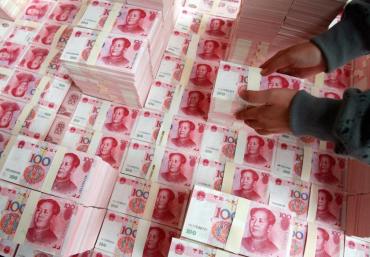
China’s Yuan Just Joined An Elite Club Of IMF Reserve Currencies

China’s yuan joins the International Monetary Fund’s basket of reserve currencies on Saturday in a milestone for the government’s campaign for recognition as a global economic power.

The yuan joins the U.S. dollar, the euro, the yen and British pound in the IMF’s special drawing rights (SDR) basket, which determines currencies that countries can receive as part of IMF loans. It marks the first time a new currency has been added since the euro was launched in 1999.The IMF is adding the yuan, also known as the renminbi, or “people’s money”, on the same day that the Communist Party celebrates the founding of the People’s Republic of China in 1949.

“The inclusion into the SDR is a milestone in the internationalization of the renminbi, and is an affirmation of the success of China’s economic development and results of the reform and opening up of the financial sector,” the People’s Bank of China said in a statement.

China will use this opportunity to further deepen economic reforms and open up the sector to promote global growth, the central bank added.

The IMF announced last year that it would add the yuan to the basket, so actual inclusion is not expected to impact financial markets. But it puts Beijing’s often opaque economic and foreign exchange policy in the international spotlight as some central banks add yuan assets to their official reserves.

Critics argue that the move is largely symbolic and the yuan does not fully meet IMF reserve currency criteria of being freely usable, or widely used to settle trade or widely traded in financial markets. U.S. Republican presidential nominee Donald Trump has said he will formally label China a currency manipulator if he wins November’s election.

China stunned investors by devaluing the currency last year and the yuan has since weakened to near six-year lows, adding to worries about already feeble global growth.

Some China watchers also fear that Beijing’s commitment to further market opening and financial sector reforms will fade after its diplomatic success, despite repeated reassurances from Beijing it will continue with the process.

U.S. Treasury Secretary Jack Lew said on Thursday the yuan was “quite a ways” from true global reserve currency status. The new IMF status recognizes the “enormous” change in China in the last 10 years that had made the yuan more open, but Beijing still had work to do to make its currency and its economy more market-driven, he said. “Being part of the SDR basket at the IMF is quite a ways away from being a global reserve currency,” he said.

Capital Economics said inclusion of the currency in the IMF’s SDR basket will have minimal impact on foreign demand for yuan assets, so “offers little support” for the currency.“

If anything, the risk is that official intervention to keep the renminbi stable ahead of its inclusion will subsequently be paired back, allowing for renewed deprecation,” it said in a research note.

The IMF on Friday fixed the relative amounts of the five currencies in the basket for five years, based on their average exchange rates over the past three months.

Source: China’s Yuan Just Joined An Elite Club Of IMF Reserve Currencies

05/09/2014

Alibaba’s Taobao, Tmall Transform Shopping in China’s Small Cities – Businessweek

Li Yuxin remembers when she had to travel from Zhangjiekou, her northern Chinese home town, to visit her half-sister in Beijing so she could buy the right clothes. Sure, Zhangjiekou has large shopping malls full of cheap t-shirts and baggy jackets, but not stores where the aspiring fashionista could purchase accessories from such foreign luxury brands as Prada (1913:HK) or even popular Western sportswear made by Nike (NKE) and Adidas (ADS:GR).

Checking deliveries from online marketplaces Tmall and Taobao at an express delivery company in Beijing

But since she started ordering clothes from Taobao and Tmall—websites owned by Alibaba Group—her options and her wardrobe have dramatically expanded. “Maybe I spend too much money now, but I have to catch up with Li Zhu,” her half-sister who lives in China’s capital, she says.

E-commerce has quickly changed the face of shopping and consumer marketing in China. Mirroring the rise of Amazon (AMZN) in the U.S., the ascendance of Alibaba in China has greatly accelerated this trend and turned China into the world’s second-largest e-commerce market.

via Alibaba’s Taobao, Tmall Transform Shopping in China’s Small Cities – Businessweek.

18/06/2014

At the World Cup, It’s Made in China, Sold in Brazil – China Real Time Report – WSJ

From the official Adidas ball to armadillo figurines, China may not have made the World Cup this year, but its factories are keeping soccer fans supplied. As Chao Deng and Jenny W. Hsu report:

Made in China, sold in Brazil. So it goes for many a product going to fans across the world.

The country is manufacturing a long list of World Cup memorabilia—from figurines of the armadillo that serves as the games’ official mascot to wigs, flags and caps. And who could forget the (Chinese-made) vuvuzelas that cropped up when South Africa hosted the last cup? This year, the country is stocking fans with an alternative instrument, the percussive Brazilian caxirolas.

While there is no official tally of how much of the sales profits China will keep, margins could be thinning given the rise in domestic labor costs. Many global sportswear brands outsourced their production to Taiwan in the late 1980s, before the Chinese labor market opened up in 1990s, says Mr. Poon. But now, as wages rise in both China and in neighboring Southeast Asian countries, competition between factories is “not only about who’s the cheapest but who’s most efficient” in production.

“The term ‘Made in China’ is slowly becoming the definition of high-quality, even though it wasn’t the case in the past,” said Simon Lee, president of Wagon Group, the Taiwanese-owned Chinese company that is responsible for 80% of the officially licensed souvenirs for this year’s World Cup.

via At the World Cup, It’s Made in China, Sold in Brazil – China Real Time Report – WSJ.

15/04/2014

Massive China shoe factory strike rolls on as offer falls flat | Reuters

Thousands of workers at a giant Chinese shoe factory shrugged off an offer for improved social benefits on Tuesday, prolonging one of the largest strikes in China in recent years amid signs of increased labor activism as the economy slows.

Yue Yuen Industrial Holdings

Yue Yuen Industrial Holdings (Photo credit: Wikipedia)

The industrial unrest at Yue Yuen Industrial (Holdings), now stretching to around ten days and sparking sporadic scuffles with police, has centered on issues including unpaid social insurance, improper labor contracts and low wages. Workers have demanded improved social insurance payments, a pay rise and more equitable contracts.

“The factory has been tricking us for 10 years,” said a female worker inside a giant industrial campus in Gaobu town run by Yue Yuen in the southern factory hub of Dongguan in the Pearl River Delta. “The Gaobu government, labor bureau, social security bureau and the company were all tricking us together.”

A spokesman for Yue Yuen said the firm, which makes shoes for the likes of Nike, Adidas, Reebok, Asics and Converse with a market capitalization of some $5.59 billion, had agreed to an improved “social benefit plan” on Monday, while stressing the business impact had been “mild” so far.

“Basically, the terms that we announced yesterday was after a very thorough internal analysis and calculation and considering all the factors including the affordability from the factory perspective,” the spokesman told Reuters by phone.

via Massive China shoe factory strike rolls on as offer falls flat | Reuters.

Enhanced by Zemanta
29/07/2012

* Tailored in China, for Team World

China Daily: “The record number of Olympic teams clad in clothes bearing Chinese innovations brings a “made-in-China” to “created-in-China” paradigm shift to the London Games. Erik Nilsson, Wu Ying, Cecily Liu, Wang Zhenghua and Tiffany Tan report.

While much ado has been made about the fact that Team USA‘s uniforms for the London Olympics are made in China, less attention has been given to the record number of foreign teams’ uniforms not only manufactured, but also designed, by domestic companies.

Leading the pack is home-grown label Peak, which sponsors seven countries that will participate in 20 events in London, a major backer at the Games after Nike and Adidas. Because the design process takes months – it may take up to a year until manufacturing is complete – Peak had to turn away 10 countries that approached it for the 2012 Games.

Next up is Li-Ning, named after and founded by the Chinese Olympic champion, which sponsors teams from eight countries and more than 600 individual athletes from 17 countries across the five continents – one for every Olympic ring.

Other companies with foreign clients include Adivon, Qiaodan, Erke, 361 and Xtep. A far greater number of domestic companies manufacture uniforms, apparel and merchandise developed at home and abroad.

“The phenomenon indicates domestic sportswear companies are rapidly growing and earning a say on the international stage,” says Jian Jie, senior sponsorship products manager of Li-Ning’s sports resources products department.

“It also shows that brand influence becomes increasingly important in the sportswear field and ‘made in China’ is gradually transforming to ‘created in China’. The alliance between a domestic brand and an international brand can internationalize Chinese brands and generate greater access to the partner’s market.

“The alliance during the Olympics can also increase the exposure of the domestic brand, promote its brand value and further its recognition at home and abroad. Through cooperation with the foreign brands, domestic brands can also improve.””

via Tailored in China, for Team World[1].

Law of Unintended Consequences

continuously updated blog about China & India

ChiaHou's Book Reviews

continuously updated blog about China & India

What's wrong with the world; and its economy

continuously updated blog about China & India