Posts tagged ‘Ahmedabad’

05/10/2016

Why are millions of Indians marching in silence? – BBC News

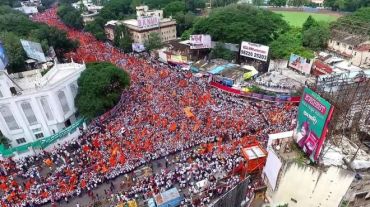
It is a unique protest: the silent marchers have no leaders; and they include the peasant and the professional. Women lead many of the marches; and politicians are not allowed to seize them. It is a sound of silence, says a commentator, that India can ill afford to ignore.

The protesters belong to the Maratha caste, one of India’s proudest – the warrior king Shivaji was one of them. Mostly farmers, they comprise more than a third of one of the population of Maharashtra, a relatively prosperous state, which is home, on one hand to Bollywood, thriving factories and farms and on the other, malnourished children and neglected tribespeople living in abject poverty.

Huge protests

The rape of a teenage Maratha girl allegedly by three low caste Dalit men triggered the silent marches in July. Then the protests expanded to include a demand for quotas in college seats and government jobs and a review of a 27-year-old federal law that protects Dalits and tribespeople from caste-related atrocities.

What is India’s caste system?

Why India’s farm communities are angryAfter more than 20 such rallies, the silent marchers – who call themselves the Maratha Revolutionary Silent Rallies – are expected to gather in the western Indian state capital, Mumbai, at the end of October. More than 10 million people are expected to participate in what could turn out to be one of largest protests in India in recent memory.

The upper-caste, largely land-owning Marathas have a handful of grumbles.

For one, they have turned their ire on the Dalits and tribespeople, alleging that the law to protect them has become a pretext to target the upper caste community, and lodge false cases against them. (The victims also get state compensation for as many as 47 offences against them.)

Image copyright VAISHALI GALIM

But this may not be an entirely truthful claim. Although dalits and tribespeople – India’s wretched of the earth – comprise 19% of Maharashtra’s population, but only 1% of the police complaints were filed by them last year, according to one report. Also the federal law was applicable in less than 40% of the complaints.

Social unrest

Clearly this disingenuous grievance masks a longer-standing demand: caste quotas in government jobs and seats in educational institutions. India’s Supreme Court has put a 50% cap on caste quotas, a limit that has already been reached in Maharashtra. Any concessions to the Marathas will mean that they will have to be officially labelled backward or less-privileged and the quotas will have to come at the expense of those for the less privileged castes. This could potentially trigger off bloody caste wars in the state.

The silent marchers of Maharashtra point to a host of structural infirmities afflicting India, which, if not resolved in time, could stoke widespread social unrest.

Growing inequity and decades of flagrant cronyism has meant that power and wealth continue to belong to a few.

The majority of colleges, cooperative banks and sugar factories in Maharashtra, for example, are owned by a clutch of politicians. According to one estimate, 3,000 families own more than 70% of all the farms in the state. The majority of the state’s 18 chief ministers have been Marathas. Half of its lawmakers belong to the community as well.
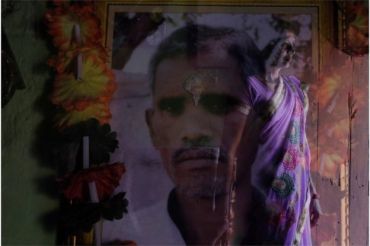
Image copyright MANSI THAPLIYAL Maratha farmers have taken their lives after they failed to repay debts

But caste and class don’t often coalesce in India, and the Marathas, like other upper caste communities have mixed fortunes: they are the educated elite and the rich farmers, but they are also the struggling small and landless farmers and farm workers. More than a third of Marathas are landless, according to one estimate.

It is the “lower and middle-rung Marathas who feel isolated, neglected, marginalised in the job market and denied opportunities in higher education,” in a fast-changing country, as commentator Kumar Ketkar points out in this perceptive essay on the ongoing protests.

The silent marches also shine a spotlight on its looming farm crisis as farmer incomes plummet due to expensive feedstuff, fertiliser, labour and erratic crop prices.

Frustration

Plot sizes have also shrunk, making farming unrewarding. Most of India’s farms are rain fed, and irregular weather changes are playing havoc with crops as rivers are drying up, and drought is common. Farmers are often left to fend for themselves and have no skills for jobs in India’s services-based economy. Aspiration is turning into frustration.

The Maratha protests also point to how India is veering towards what sociologist Andre Beteille called a “populist democracy” where social and political life are influenced by group identities and loyalties. “Problems arise when the loyalties of kinship and community are allowed to distort and override the demands of constitutional government,” wrote Professor Beteille.

Image copyright MANSI THAPLIYAL Farming is becoming an unrewarding profession

Many believe India’s quotas for seats and jobs are in a sordid mess of its own making.

It is indisputable that affirmative action is essential for communities like dalits and tribespeople who have been historically wronged. But extending it to other castes recklessly can distort matters.

How much burden of quotas can a state bear without being weakened irreparably? India needs jobs – and fast – and skills training if it has to avoid the social unrest that could blight a developing nation. Otherwise, the marchers of Maharashtra may not remain silent for long.

Source: Why are millions of Indians marching in silence? – BBC News

12/05/2015

Indian rail projects outweigh rivalry before Modi visit to China | Reuters

Beijing has been pushing India to accelerate work on a multi-billion dollar rail link from New Delhi to Chennai ahead of Prime Minister Narendra Modi‘s visit to China this week, as the Asian giants put economic ties before regional rivalries.

China, which is conducting a feasibility study into a $36 billion bullet train project from the capital in the north to Chennai in the south, has asked for work to begin on a pilot project covering part of the route, officials said.

The two sides have also agreed to speed up implementation of a shorter high-speed rail corridor from Chennai to Bengaluru, as China seeks to cash in on Modi’s vision of modernizing a creaking train system that 25 million people use daily.

Indian Railways Logo

Indian Railways Logo (Photo credit: Wikipedia)


Such cooperation could help ease tensions between the neighbors caused by a Himalayan border dispute and Chinese naval forays into the Indian Ocean as well as India’s strategic tie-ups with Japan and the United States.

Modi and Chinese President Xi Jinping are expected to address the border issue, a major irritant that overshadowed Xi’s visit to New Delhi last year and has proved impossible to resolve despite 13 years of negotiations.

But progress on the economic front is more likely, officials said, as China eyes a greater share of India’s $2 trillion economy. Thanks in part to a statistical revision, India is now the world’s fastest growing major economy, outstripping China.

Modi, who arrives in China on Thursday, appears happy to encourage such investment, despite reservations among India’s powerful security community which has not forgotten a brief border war the countries fought in 1962.

“Modi is abandoning the old approach to China,” said C. Raja Mohan, an influential Indian foreign policy analyst.

“He has recognized that India can’t construct a serious business relationship with China, the world’s second largest economy and a major exporter of capital, by giving the security establishment a veto over economic policy,” he added.

$10 BILLION IN DEALS

China’s ambassador to India, Le Yucheng, told CNN-IBN television that deals worth $10 billion were expected to be signed during Modi’s three-day visit.

He urged the Indian government to focus on cutting red tape to ease investment flows, the channel said in a press release.

During Xi’s visit to India last year, China announced $20 billion in investments over five years, including setting up two industrial parks.

Since then progress has been slow, in part because of the difficulties Modi has had in getting political approval for easier land acquisition laws.

Only a fifth of the necessary land has been acquired for a $5 billion industrial park in the western city of Pune that the two sides announced last year, said a Chinese official.

In Modi’s home state of Gujarat, only 28 percent of the land has been purchased for a proposed $1.8 billion Chinese-built industrial park in Vadodara.

That is not likely to blunt China’s appetite for investments in India, according to experts.

“China’s attitude toward this investment is extremely positive,” said Ma Jiali, executive deputy director of the China Reform Forum’s Centre for Strategic Studies and an India expert.

via Indian rail projects outweigh rivalry before Modi visit to China | Reuters.

18/09/2014

Trade, investment hopes as China’s Xi visits India – Businessweek

Chinese President Xi Jinping landed in the Indian prime minister‘s home state of Gujarat on Wednesday for a three-day visit expected to focus on India’s need to improve worn out infrastructure and reduce its trade deficit.

Xi was greeted on the tarmac by state officials carrying fringed umbrellas to guard him from the sun in Gujarat’s main financial city of Ahmedabad.

Prime Minister Narendra Modi is expected to court Chinese business and seek investment to upgrade creaky infrastructure, banking on China’s track record at building highways, railways, and industrial zones. India is also eager to address the imbalance in their annual trade, which now totals around $65 billion but is skewed toward imports of Chinese electrical equipment and parts.

Modi and the Gujarat government are staging a lavish welcome for Xi, with billboards across Ahmedabad showing a smiling Modi and Xi. A banquet dinner was being held Wednesday night on the banks of the Sabarmati River in Ahmedabad. Modi was also celebrating his 64th birthday.

Xi has been equally effusive in expressing excitement for the visit.

China-India relations have become one of the most dynamic and promising bilateral relations in the 21st century,” Xi wrote in an article published Wednesday in The Hindu newspaper.

via Trade, investment hopes as China’s Xi visits India – Businessweek.

29/08/2012

* India riots: Court convicts 32 over Gujarat killings

BBC News: “A court in India has convicted 32 people for involvement in the 2002 religious riots in Gujarat state.

Rioting in Gujarat in 2002

The court acquitted 29 others in the case known as the Naroda Patiya massacre.

Among those convicted were former minister Maya Kodnani and Babu Bajrangi, a former leader of the militant Hindu group Bajrang Dal.

A total of 95 people were killed in the rioting on 28 February in the Naroda Patiya area of Ahmedabad city.

Most of the convicted, including Ms Kodnani and Mr Bajrangi, were found guilty of murder and criminal conspiracy, reports said.

The trial began in August 2009 and charges were framed against 62 people. One of the accused died during the trial.

Ms Kodnani was the junior minister for women and child development in the Gujarat government when she was arrested in connection with the incident in 2009.

More than 1,000 people, mostly Muslims, were killed when riots erupted after 60 Hindu pilgrims died in a train fire in 2002.

It was one of India’s worst outbreaks of religious violence in recent years.”

via BBC News – India riots: Court convicts 32 over Gujarat killings.

See also: Indian ethnic – religious tensions

Law of Unintended Consequences

continuously updated blog about China & India

ChiaHou's Book Reviews

continuously updated blog about China & India

What's wrong with the world; and its economy

continuously updated blog about China & India