Posts tagged ‘Aircraft carrier’

23/01/2017

China’s first aircraft-carrier bares its teeth | The Economist

FOR Admiral Wu Shengli, the commander of China’s navy since 2006, it must have been a sweet swansong to mark his imminent retirement. In November China announced that its first and only aircraft-carrier, the Liaoning, was combat ready.

On December 24th its navy duly dispatched an impressive-looking carrier battle-group with three escorting destroyers, a couple of frigates, a corvette and a refuelling ship. It sailed from the northern port of Qingdao down through the Miyako Strait, past Taiwan and into the South China Sea.

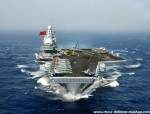
Three weeks later the Liaoning (pictured) was back in port having sailed home via the Taiwan Strait, thus completing a loop around the island. The point was not lost on the Taiwanese, who scrambled fighter jets and sent naval ships to monitor the group’s progress. The Chinese ships showed off their firepower, with Shenyang J-15 fighters staging a series of take-off and landing drills. That everything went smoothly was evidence of the navy’s transformation under Admiral Wu (his career perhaps destined by his forename, which means victory). He had meticulously prepared for this moment, which came just four years after the carrier, acquired as a partially built hulk from Ukraine in 1998, formally entered naval service.

China’s deployment of an aircraft-carrier is not a military game-changer. But it is a conspicuous symbol of the country’s ambitions as a maritime and global power. The Liaoning has been a crucial building block for the navy in its evolution from a coastal defence force into what is now a modern navy that China uses to assert its (contested) maritime claims in the East and South China Seas. Within the next 25 years China expects its navy to become a powerful blue-water fleet that can guard China’s sea lanes of communication against any aggressor, push the US Navy beyond the “second island chain” far out into the Pacific (see map) and protect the country’s far-flung commercial interests.

Scary, perhaps, but also easy to sink

To that end, probably around 2004, China made up its mind that it must have aircraft-carriers. A second, indigenously designed one, based on the Liaoning but with the latest radar and space for more aircraft, is nearing completion at the northern port of Dalian. Many analysts believe that a third such vessel, larger and more complex, is under construction in Shanghai. Andrew Erickson of the US Naval War College says Admiral Wu adopted a “crawl, walk, run” approach to developing a carrier capability, recognising the difficulties involved. Carrier operations are inherently dangerous—America lost 8,500 aircrew in the 40 years to 1988 on its way to reaching what Mr Erickson calls its current “gold standard” of carrier expertise.


Commissioning the Liaoning was a good way to start. Much modified and fettled by the Chinese, the ship is based on the Soviet Kuznetsov-class design. It is big, with a displacement of about 60,000 tons, but nowhere near the size of America’s super-carriers such as the USS Ronald Reagan, which is based in Japan. That Nimitz-class ship displaces around 100,000 tons.

In other ways, too, the Liaoning pales in comparison with America’s 10 Nimitz-class carriers. They can carry more than 55 fixed-wing aircraft. The Liaoning can only handle 24 J-15s (based on the Russian Sukhoi SU-33) and a handful of helicopters. Unlike the American carriers, it lacks a catapult to propel aircraft from its deck. Instead it relies on a “ski-jump” prow to provide extra lift. As a result, the J-15s have to carry a lighter load of weapons and fuel. Heavier, slower airborne early-warning and anti-submarine aircraft cannot take off from the Liaoning at all. That limits the type of missions the ship can perform and makes the vessel vulnerable when operating beyond the range of shore-based aircraft. The Liaoning also depends on a notoriously unreliable Soviet-era design for its steam turbines, which cuts its range and speed compared with the nuclear-powered Nimitz-class carriers.

The US Office of Naval Intelligence has dismissed the Liaoning’s ability to project naval power over a long distance. But the ship does have military value. It can provide air-protection for China’s fleet, and would be a major asset in disaster-relief or evacuation missions. Peter Singer of the New America Foundation, a think-tank, says that a Liaoning-led battle group would also seem pretty formidable to neighbours, such as Vietnam or the Philippines, should China feel like bullying them.

But the main value of the Liaoning is the experience that it is giving the navy in the complex choreography of carrier operations. Those skills will help in the eventual deployment of indigenously designed carriers. The Chinese have been training with catapult-launch systems on land. This has fuelled speculation that the carrier thought

Source: China’s first aircraft-carrier bares its teeth | The Economist
10/02/2016

U.S. and India consider joint patrols in South China Sea – U.S. official | Reuters

The United States and India have held talks about conducting joint naval patrols that a U.S. defence official said could include the disputed South China Sea, a move that would likely anger Beijing, which claims most of the waterway.

An Indian Navy personnel gestures on the deck of the newly built INS Kochi, a guided missile destroyer, during a media tour at the naval dockyard in Mumbai, India September 28, 2015. REUTERS/Shailesh Andrade/Files

Washington wants its regional allies and other Asian nations to take a more united stance against China over the South China Sea, where tensions have spiked in the wake of Beijing’s construction of seven man-made islands in the Spratly archipelago.

India and the United States have ramped up military ties in recent years, holding naval exercises in the Indian Ocean that last year involved the Japanese navy.

But the Indian navy has never carried out joint patrols with another country and a naval spokesman told Reuters there was no change in the government’s policy of only joining an international military effort under the United Nations flag.

He pointed to India’s refusal to be part of anti-piracy missions involving dozens of countries in the Gulf of Aden and instead carrying out its own operations there since 2008.

The U.S. defence official said the two sides had discussed joint patrols, adding that both were hopeful of launching them within the year. The patrols would likely be in the Indian Ocean where the Indian navy is a major player as well as the South China Sea, the official told Reuters in New Delhi on condition of anonymity.

The official gave no details on the scale of the proposed patrols.

There was no immediate comment from China, which is on a week-long holiday for Chinese New Year.

China accused Washington this month of seeking maritime hegemony in the name of freedom of navigation after a U.S. Navy destroyer sailed within 12 nautical miles of a disputed island in the Paracel chain of the South China Sea in late January.

The U.S. Navy conducted a similar exercise in October near one of China’s artificial islands in the Spratlys.

Source: Exclusive: U.S. and India consider joint patrols in South China Sea – U.S. official | Reuters

31/12/2015

It’s official: China building second aircraft carrier as concern mounts over claims to South China Sea | South China Morning Post

China on Thursday confirmed it is building a second aircraft carrier, as its neighbours worry about Beijing’s new assertiveness to claims in the South China Sea.

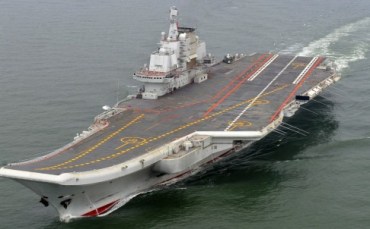
Chinese aircraft carrier Liaoning cruises for a test on the sea. Photo: AP

Defence Ministry spokesman Yang Yujun said the carrier had been designed in China and was being built in the port of Dalian in Liaoning province. The construction drew on experiences from the country’s first aircraft carrier, the Liaoning, bought from Ukraine in 1998 and refitted in China.

Source: It’s official: China building second aircraft carrier as concern mounts over claims to South China Sea | South China Morning Post

24/10/2013

China has technology to build VTOL J-20 stealth fighter jet

A few days ago, a dual-hull aircraft carrier, today a VTOL fighter. Are these for real or ‘western’ paranoia?

See also: https://chindia-alert.org/2013/10/20/china-developing-180000-ton-double-hull-aircraft-carrier/

20/10/2013

China developing 180,000-ton double-hull aircraft carrier

If successful, first in the world.

27/08/2013

Is China Building an “Aircraft Carrier in Disguise?”

If true, another step towards military confrontation.

The Diplomat: “Earlier this month a series of pictures posted on Chinese military forums appeared to show that China was building its first indigenous aircraft carrier, prompting much speculation and commentary including from The Diplomat.

China

Now some claim that this narrative might have been mistaken.

According to Japan’s Kyodo News, Kanwa Information Center, a private Canadian think tank, has published a report that claims that the pictures do not show an aircraft carrier. Instead, the Kanwa report—which is based on Ukraine military sources— says the vessel under construction is China’s first amphibious assault ship capable of carrying hovercraft and helicopters.

In other words, if the report is accurate, China is building a Landing Helicopter Assault (LHA)-like ship not completely unlike the Izumo-class helicopter destroyer Japan launched earlier this month, which Chinese analysts referred to as an “aircraft carrier in disguise.”

Kanwa says the vessel is being built at a shipyard on Shanghai’s Changxing Island and could be commissioned as early as 2015. It will reportedly displace 35,000 tons, roughly double what China’s three existing Type 071 amphibious assault ships, which displace between 17,000-20,000 tons, according to Sino-Defense. The same source says the Type 071 ships were built by Shanghai-based Hudong-Zhonghua Shipyard. The location of Changxing Island, suggests that Jiangnan Shipyard is constructing the new vessel.

Japan’s Izumo-class helicopter destroyer reportedly displaces between 20,000-25,000-tons.

China’s new LHA will carry four hovercraft and up to 20 helicopters, according to Kyodo News, which cited the Kanawa report.

There’s reason to think the Kanwa report is accurate. Indeed, last November a Chinese admiral told CCTV, China’s official broadcaster, that the PLAN was building a 40,000-ton amphibious assault ship similar to the U.S. Navy’s LHA.”

via Is China Building an “Aircraft Carrier in Disguise?” | Flashpoints | The Diplomat.

See also: https://chindia-alert.org/2013/08/21/china-japan-and-indias-asian-arms-race/

10/10/2012

* Russia further delays delivery of Admiral Gorshkov to India

It would seem a mini-arms race is on between India and China.  Although India already has two aircraft carriers, one is being retired and the other undergoing a five-month refit.  Fortunately, there is no known marine based territorial dispute between India and China, Curiously, India has been getting its carriers from Russia’s obsolete fleet and China from Ukraine’s retired fleet!

Times of India: “Russia delayed delivery of a trouble-plagued aircraft carrier for at least a year on Friday, a blow to India’s efforts to quickly build up naval strength as increasingly assertive Asian rival China expands its maritime reach.

INS Vikramaditya is anchored at Sevmash factory in northern city of Severodvinsk

Originally built as the Admiral Gorshkov in the Soviet Union, the $2.3 billion aircraft carrier is being reconditioned and was due to be ready this year, but problems with the ship’s boilers have pushed the delivery date back several times.

“We believe the handover of the ship will take place in the fourth quarter of 2013,” Russian defence minister Anatoly Serdyukov said at a joint news conference with his Indian counterpart in New Delhi.

Defence minister AK Antony said he had conveyed “serious concern” at the delays to Serdyukov.

The bilateral meeting precedes a visit by Russian President Putin to New Delhi on November 1.

The ship is to be renamed as Vikramaditya and the success of the order is seen as an important test of defence ties between Russia, the world’s second-largest arms exporter, and its biggest customer.

India, a big buyer of Soviet Union weaponry, still relies on Russia for 60 percent of its arms purchases, but has diversified its suppliers in recent years. Israel is now the No. 2 seller, and countries like the United States and France also increasing their presence.

“I myself expressed serious concern about the delay,” Antony said, adding that the issue had been raised several times. He said he was putting pressure on both sides to finish work on the biolers as soon as possible, but said he had not discussed penalising Russia so far.

India is closely watching the Chinese navy’s newly assertive stance in the South China Sea and in a dispute with Japan over contested islands that have raised tensions in East Asia this year.

India bought its first, British-built aircraft carrier in the 1960s, which was decommissioned in 1997. Another ex-British carrier, the INS Viraat, is in operation but is reaching the end of its useful service.”

via Russia further delays delivery of Admiral Gorshkov to India – The Times of India.

29/09/2012

Suddenly, China’s aircraft carriers will increase by 100%!

29/08/2012

* China’s aircraft carrier: in name only

Reuters: “When Japanese activists scrambled ashore on a disputed island chain in the East China Sea this month, one of China’s most hawkish military commentators proposed an uncharacteristically mild response.

A half-built Chinese-owned aircraft carrier Varyag, which is to be converted into a floating casino in China, is towed and escorted by a flotilla of tugboats and pilot ships past the Leandros Tower built in 419 B.C. on the Bosphorus Straits in Istanbul November 1, 2001. REUTERS-Fatih Saribas-Files

Retired Major General Luo Yuan suggested naming China’s new aircraft carrier Diaoyu, after the Diaoyu islands in the East China Sea. It would demonstrate China’s sovereignty over the islands known as the Senkakus in Japanese, he said.

For a notable hardliner, it was one of the least bellicose reactions he has advocated throughout a series of territorial rows that have soured China’s ties with its neighbors in recent months.

More typical was General Luo’s warning in April that the Chinese navy would “strike hard” if provoked during a dispute with the Philippines over Scarborough Shoal in the South China Sea.

One possible reason for General Luo’s restraint, military analysts say, is he knows it could be towards the end of the decade before China can actually deploy the new carrier to the disputed islands or any other trouble spot.

Despite public anticipation in China that the carrier — a refitted, Soviet-era vessel bought from Ukraine — will soon become the flagship of a powerful navy, defense experts say it lacks the strike aircraft, weapons, electronics, training and logistical support it needs to become a fighting warship.

“There is considerable uncertainty involved, but it could take anything from three to five years,” said Carlo Kopp, the Melbourne, Australia based co-founder of Air Power Australia, an independent military think tank.”

via Analysis: China’s aircraft carrier: in name only | Reuters.

See also: China’s military presence

23/05/2012

* Taiwan spies increase in carrier threat

Hong Kong Standard: “Taiwan’s intelligence chief said Beijing plans to build two aircraft carriers to go with the first one in its fleet, a refitted former Soviet carrier currently undergoing sea trials.

“Indeed, the Chinese communists have decided to build two aircraft carriers on their own,” Tsai Teh-sheng, head of the National Security Bureau, told lawmakers. Construction is expected to start next year and in 2015, with the warships, which would be conventionally powered, to be delivered in 2020 and 2022. Tsai said Beijing has conducted six sea trials of its first carrier since the middle of last year, and that Taiwan expects it to go into service before the end of this year. Initially it may simply be used for training purposes but it can be sent for battles when necessary in the future,” he said. The ship’s sea trials have sparked international concern about the mainlands widening naval reach amid growing regional tensions over maritime disputes and a US campaign to assert itself as a Pacific power.”

via Taiwan spies increase in carrier threat – The Standard.

Law of Unintended Consequences

continuously updated blog about China & India

ChiaHou's Book Reviews

continuously updated blog about China & India

What's wrong with the world; and its economy

continuously updated blog about China & India