Posts tagged ‘American middle class’

29/11/2016

Nissan Revs Up Connected Car Plans in India – India Real Time – WSJ

Nissan Motor Co. said Tuesday that it planned to accelerate the penetration of internet-connected vehicles by offering a connection device to existing customers in Japan and India starting next year.

Nissan has been among the most aggressive car makers in putting connection technology in lower-priced vehicles. Now, it is expanding the offering to owners of older models.

The device will allow car owners to get live updates on maintenance needs, make service appointments and order parts ahead of time. Nissan said it planned to bring the device to other countries eventually and install it in 30% of the 40 million Nissan vehicles on the road globally today.

The device contains a Global Positioning System tracker and can transmit information about the vehicle’s health to Nissan through mobile networks. The goal is to give customers a taste of connected-car services that will become available on new cars, Nissan said.

“In the coming years, customers will see sophisticated applications of software and hardware that will keep them connected with work, with friends and family. It will allow them to control their vehicles from their phones in their pockets,” said Kent O’Hara, who runs Nissan’s after-sales division.

Source: Nissan Revs Up Connected Car Plans in India – India Real Time – WSJ

24/05/2016

China’s Middle Class Vents Over Growing List of Grievances – China Real Time Report – WSJ

The death here of a 29-year-old man in police custody—a new father and graduate of a prestigious Chinese university—has exposed growing anxieties in the country’s growing middle class, already shaken by a decelerating economy and a disparate series of high-profile incidents threatening their sense of stability.

As WSJ’s Te-Ping Chen reports:

Other wide-ranging targets of recent social-media attention include a violent string of attacks on doctors by embittered patients and their families, a demand that apartment owners in eastern China pay extra to secure the land on which their apartments were already built, confusing changes in college-entrance standards, and fatal chemical explosions wiping out homes.

Such disruptions have come as reminders that rising incomes or better education don’t automatically shield China’s expanding middle-class ranks from danger, whether physical or economic, in a society where the law can be arbitrarily enforced and justice is sometimes brutal.

“There’s a gap between expectation and reality,” said He Yunfeng, who heads Shanghai Normal University’s Institute of Knowledge and Value Sciences. “These kinds of incidents concentrated together have created a kind of panic.” Some critics have begun joking that the Chinese term for middle class— zhongchanjieji—would be better depicted by the term zhongcanjieji, or the “tragic middle class.”

Source: China’s Middle Class Vents Over Growing List of Grievances – China Real Time Report – WSJ

21/12/2015

Panda power | The Economist

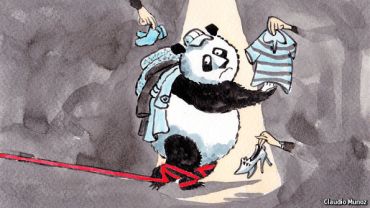
THE feeding frenzy for the pandas comes at nightfall. People furtively approach them, pouring bags of old clothes down their gullets.

By day, the trucks arrive to clean the bears out, leaving them empty for the next big meal. The pandas are plastic. They are large, bear-shaped receptacles, designed to entice people to donate their unwanted garments to those in need.

First deployed in 2012, there are now hundreds around Shanghai, often placed by entrances to apartment buildings. They swallowed about a million items of clothing last year. The procession of donors feeding trousers to pandas is impressive. But they usually do so under cover of darkness. Charitable giving is not yet a middle-class habit. Many people still feel awkward about it, despite their growing prosperity. China’s GDP per person is about one-seventh of America’s.

But in 2014 Chinese gave 104 billion yuan ($16 billion) to charity, about one-hundredth of what Americans donated per person (see chart). This is partly a legacy of attitudes formed during Mao’s rule, when the party liked to present itself as the source of all succour for the poor (to suggest otherwise was deemed counter-revolutionary). Even until more recent years the party was reluctant to encourage charities, worried that they might show up its failings.

The middle classes have worries too—that giving large amounts to charity may draw unwanted attention to their wealth. They do not want to fuel the envy of the have-nots or encourage tax collectors to pay them closer attention.

The top 100 philanthropists in China gave $3.2 billion last year, according to Hurun Report, a wealth-research firm based in Shanghai. That was less than the amount given by the top three in America.

In 2008 when a powerful earthquake hit the south-western province of Sichuan—the deadliest in China in more than 30 years—it seemed that one positive outcome would be a boom in charitable giving. Volunteers poured into the devastated region and donations filled the coffers of aid organisations. Problems soon arose, however. Embarrassed that private relief efforts were proving more effective than official ones, the government reined in citizen-led organisations.

Source: Panda power | The Economist

Law of Unintended Consequences

continuously updated blog about China & India

ChiaHou's Book Reviews

continuously updated blog about China & India

What's wrong with the world; and its economy

continuously updated blog about China & India