Posts tagged ‘ASEAN’

24/02/2013

* Railway linking China, ASEAN becomes operational

New Orient Express slowly taking shape.

Xinhua: “A railway that links southwest China’s Yunnan Province with the Association of Southeast Asian Nations (ASEAN) countries became operational on Saturday after seven years of construction, local railway authorities said.

The railway between Yuxi and Mengzi is part of the eastern line of the planned Pan-Asia Railway network.

The 141-km railway has a designed maximum speed of 120 km per hour. It passes through 35 tunnels and crosses 61 bridges, which together account for 54.95 percent of the eastern line’s total length.

The eastern line also consists of Kunming-Yuxi Railway, which had been in operation, and the Mengzi-Hekou Railway that is under construction and scheduled to be operational end of next year.

Upon the full completion of the eastern line, it will further open up China’s southwest, improve transportation and boost economic development along the line, experts said.

The Pan-Asia Railway network also consists of central and western lines and is an international railway project that will bring China closer with southeast Asia.”

via Railway linking China, ASEAN becomes operational – Xinhua | English.news.cn.

see also: 

11/01/2013

New Asean secretary general vows quick negotiations on South China Sea

Bangkok Post: “The Association of Southeast Asian Nations (Asean) is seeking early talks with China to discuss a code of conduct to manage tensions over the disputed South China Sea, the bloc’s new chief said Wednesday.

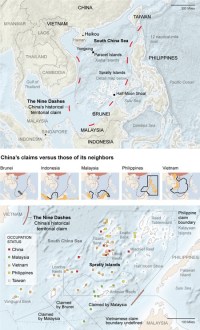
China claims most of the sea, including a vital shipping lane and resource-rich areas. The Philippines, Malaysia, Vietnam and Brunei have overlapping claims in the area, as does Taiwan.

“Asean should speed up efforts towards an early start of negotiations with China with a view to achieving an early conclusion of a code of conduct on the South China Sea,” Asean Secretary-General Le Luong Minh said.

Newly inaugurated Asean Secretary-General Le Luong Minh of Vietnam, left, shakes hands with outgoing former Surin Pitsuwan during the office handover ceremony. (Reuters photo)

The Vietnamese diplomat was speaking in Jakarta after officially assuming the post of Asean secretary, replacing Surin Pitsuwan of Thailand.

In 2011, Asean and China agreed on a non-binding set of guidelines to allow dialogue and cooperation during talks on the Indonesian resort island of Bali.

A binding code of conduct is aimed at reducing the chance of conflict among the claimants.

Mr Minh also vowed to push Asean to move ahead in launching the Asean Economic Community in 2015.

“Despite the many challenges, I fully believe that Asean will emerge triumphant.

“The Asean Secretariat will continue to play active roles in supporting and coordinating with member states to help facilitate and drive the establishment of the Asean Community,” Mr Minh said.

“The next five years will be exciting and critical ones. We in the secretariat are prepared to work closely with Asean member states to ensure we are able to deliver our major commitments and objectives,” he said.”

via New Asean secretary general vows quick negotiations on South China Sea | Bangkok Post: news.

20/12/2012

* Amid China tensions, Southeast Asia looks to India

ASEAN nations turning to India to counter-balance China’s aggressive position on territorial disputes.

Reuters: “Southeast Asian leaders are expected to lay out a vision for closer cooperation with India on security and the economy at a high-level gathering in New Delhi at a time of tension with China in the potentially oil- and gas-rich South China Sea.

ASEANIndian flagThe meeting is a ceremonial summit to mark 20 years of cooperation with India and will not include detailed negotiations on regional issues, India’s Foreign Minister Salman Khurshid told Reuters.

But ministry officials said the leaders would also produce a statement which is expected to reiterate a commitment to freedom of navigation, a hot issue because of territorial conflicts in the South China Sea.

Some ASEAN countries contest claims by China in the waters, making it the biggest potential flashpoint in the region. The United States has called for calm, but some are also looking to India, the other regional heavyweight, to get involved.

“They want India to play a larger role. Those concerns are only increasing given the uncertain situation that is emerging,” said C. Raja Mohan, a strategic affairs expert at the Observer Research Foundation think-tank.

For India, improved relations with Southeast Asia will give it entry into one of the fastest-growing economic regions in the world and a source of raw materials needed for its own growth.

Poor there are poor transport links between India and the nations to its southeast, and constraints like India’s tiny diplomatic corps – similar in size to New Zealand’s – mean India trails China in relations with the region.

Trade between India and the 10-member ASEAN was up to $80 billion last year compared with $47 billion in 2008. An agreement on free trade in services and investment could be signed at the New Delhi meeting.

But India’s role in the region is dwarfed by that of China, which enjoyed trade worth a record $363 billion with ASEAN countries in 2011 in an already established free trade area.

“What we need is far greater connectivity,” Khurshid said in an interview with Reuters, mentioning roads, railways and flights as areas needing work. He described a 10-year plan to double the number of diplomats to reflect India’s global ambitions.”

via Amid China tensions, Southeast Asia looks to India | Reuters.

24/11/2012

* The end of the “ASEAN way”

Extracted from Al Jazeera Blogs: “The long-time journalists in this region have joked that it didn’t really matter if they missed out on covering ASEAN summits as nothing ever really happened at them anyway.: ”

The ten-member regional organisation composed of Brunei, Cambodia, Indonesia, Laos, Malaysia, Myanmar, The Philippines, Thailand, Singapore, and Vietnam was seen as a bit of a toothless mouse … ineffective, irrelevant, and a trifle useless.

All pomp and ceremony at the best of times – with very little substance. It’s been termed a “loose grouping” with nothing legally binding it together.

The one pronouncement from ASEAN with any kind of general recall was its members’ agreement of “non-interference” in each other’s affairs – which meant that for the most part, there were no condemnations of, or sanctions against, or even reactions to alleged human rights violations amongst them from anyone in the group.

It was the “ASEAN way” to be non-confrontational, put on a united front… and pretty much sweep things under the carpet. Which is likely why most thought the group a “lame” body.

Everything hinged on members’ consensus… and for many years, the only underlying consensus appeared to be making sure everyone played nice, and kept the house clean and presentable at all times. There was to be no “rocking the boat”, as it were.

But if one thing is clear after this series of recently concluded summits in Phnom Penh (ASEAN + Australia, China, India, Japan, New Zealand, Russia, South Korea, and the US) it’s that ASEAN is changing.

But it’s precisely because Cambodia, a nation with deep ties to China, tried to “stifle” that issue that things didn’t quite go as it had planned.

The Philippines, one of the countries embroiled in an increasingly tense dispute with China over overlapping maritime claims, spoke out in public contradiction of Cambodia’s statement that ASEAN members had “agreed” to not “internationalise” the territorial disputes.

“There was no consensus,” Philippine President Benigno Aquino said after the Cambodian leader finished his declaration. And that was only the beginning.

Possibly emboldened by the presence of Obama, (and the seven other non-ASEAN leaders), Aquino took the opportunity to basically “internationalise” the matter by speaking about the need for a “multi-lateral” resolution.

One that involves all those with a stake in the disputed areas’ maintaining its freedom of navigation and over-flight, including the US. A position several other countries agreed with.

And just like that, the subject that wasn’t supposed to be discussed hijacked the discussions. Much of this happened behind closed doors, but there was no way it was going to remain there… whether ASEAN liked it or not.

Cambodian Prime Minister Hun Sen delivered his usual stage-managed, loquacious statement in an attempt to conclude the summits on a “positive” and “graceful” note… but he refused to answer questions (of which there were many!) ostensibly because he was tired and feeling “emotional” about the passing of Cambodia’s former king last month.

But never mind Hun Sen’s neat summary. The media rush, (referred to by one journalist as similar to a dangerous bar-room brawl), to get to the Chinese and Philippine delegates as they exited and looked to make side-line statements taking pot-shots at each other (without directly pointing fingers of course), said more about the region’s state of affairs than can be tidied up and swept under the carpet.

This time around, ASEAN may have found itself with little other choice than to do something more substantial.

via The end of the “ASEAN way” – Al Jazeera Blogs.

23/11/2012

* Southeast Asian Nations Announce Trade Bloc to Rival U.S. Effort

It is not clear to me what motivates ASEAN nations to try and forma trading bloc that includes China, while Obama had initiated a similar pact to exclude China.  If may be a way of mollifying the strong stance ASEAN had taken regarding the South China Sea disputes. A ‘quid pro quo’ as it were.

NY Times: “Ten Southeast Asian nations said Tuesday that they would begin negotiating a sweeping trade pact that would include China and five of the region’s other major trading partners, but not the United States.

The proposal for the new trade bloc, to be known as the Regional Comprehensive Economic Partnership, is enthusiastically embraced by China. The founding members, who belong to the Association of Southeast Asian Nations, said at the close of the association’s summit meeting here that the bloc would cover nearly half of the world’s population, starting in 2015.

The new grouping is seen as a rival to a trade initiative of the Obama administration, the 11-nation Trans-Pacific Partnership, which includes many of the same countries but excludes China.”

via Southeast Asian Nations Announce Trade Bloc to Rival U.S. Effort – NYTimes.com.

22/11/2012

* China might be moving to ASEAN agreement on S China Seas= dispute

If China does agree to ASEAN multi-lateral agreement on South China Sea dispute, it will probably be the first time. It much prefers to do bilateral deals; conforming tot the old principle of ‘divide and conquer’.

See also:

18/11/2012

* Southeast Asia calls for talks with China on sea dispute

S E Asia may be joining hands to call China to the discussion table; but China really dislikes being pressured and much prefers one-to-one dialogue and bi-lateral agreements.

Reuters: “Southeast Asian nations displayed a rare show of unity on Sunday against China’s sweeping maritime claims, calling for the first formal talks with Beijing over a sea dispute that has raised tensions and exposed deep divisions in the region.

(L - R)Singapore Prime Minister Lee Hsien Loong, Thailand Prime Minister Yingluck Shinawatra, Vietnam Prime Minister Nguyen Tan Dung, Cambodia Prime Minister Hun Sen and the Sultan of Brunei Hassanal Bolkiah hold hands during the opening ceremony of the 21st ASEAN (Association of Southeast Asian Nations) and East Asia summits in Phnom Penh November 18, 2012. REUTERS-Samrang Pring

As Chinese Premier Wen Jiabao arrived in Cambodia for meetings with Southeast Asian leaders, the 10-member Association of Southeast Asian Nations (ASEAN) appeared determined to avoid a repeat of an embarrassing breakdown of talks in July over competing claims in the mineral-rich South China Sea, its biggest security challenge.

Cambodia’s Prime Minister Hun Sen will tell Wen that ASEAN wants to begin talks on a binding Code of Conduct, aimed at reducing the chance of naval flashpoints, as soon as possible, ASEAN Secretary General Surin Pitsuwan told reporters.

“Prime Minister Hun Sen himself will be discussing with the PM of China tonight and delivering this consensus on the ASEAN side,” Surin said.

“They would like to see the commencement of the discussion as soon as possible because this is an issue of interest, concern and worry of the international community.”

China’s assertive claims in the South China Sea have sown deep divisions within the bloc at a time when military spending in the region is surging and the United States refocuses attention on Asia – a “pivot” that President Barack Obama will reinforce on his visit to the summit on Monday in Cambodia’s capital, Phnom Penh.

Chinese ally Cambodia has used its powers as ASEAN chair this year to restrict discussion of the issue, in line with Beijing’s view that the disputes should be discussed on a bilateral basis. China has said it is willing to discuss the Code of Conduct when the “time is right.”

Diplomats said the Philippines, a close U.S. ally, had invited fellow Southeast Asian claimant states Vietnam, Brunei, and Malaysia to separate talks in Manila to be held later this year or early next year.

“We are trying to make that happen, hopefully in Manila,” Philippine Foreign Secretary Albert del Rosario told reporters.

The other members of ASEAN include Cambodia, Laos, Myanmar, Thailand, Singapore and Indonesia, none of which have claims on the South China Sea.

One Philippine diplomat said the meeting was aimed at resolving issues among the claimant states, such as overlapping economic zones. He voiced frustration with China for delaying the start of talks with ASEAN over the Code of Conduct.

“ASEAN has done its part,” the diplomat said. “Now it is up to China to also come up with its own because when we formally sit down we will present our position to them. In fact we have already written it.””

via Southeast Asia calls for talks with China on sea dispute | Reuters.

See also: 


18/10/2012

* Feuds in the Pacific over islands: it’s not simply a case of China against everyone else

Unfortunately for China, its recent military posturing has obscured the fact that territorial claims in the South China Sea is not only between China and its neighbours but endemic.

WorldTimes: “When it comes to feuds in the Pacific over islands and what lies beneath, it’s not simply a case of China against everyone else. Depending on the dispute, it’s also South Korea vs. Japan, Japan vs. Taiwan, Taiwan vs. Vietnam, Vietnam vs. Cambodia and numerous other permutations — for many of the same reasons supposedly behind China’s actions. Resource grab. Patriotic posturing. Historical baggage (mostly to do with Japan’s brutal occupation of most of East Asia before and through World War II). Referring to the South China Sea, former ASEAN secretary general Rodolfo Severino, who now heads Singapore’s Institute of Southeast Asian Studies, wrote recently that “all claimants feel their footholds are essential to what they consider their national interests … This clash of national interests … makes it most difficult even to appear to be making compromises on national integrity or maritime regimes and, thus, almost impossible to resolve [the] disputes.””

Read more: http://world.time.com/2012/08/19/why-asias-maritime-disputes-are-not-just-about-china/#ixzz29dhhV78F

21/09/2012

* China’s Xi seeks to reassure Southeast Asia on sea dispute

Reuters: “China’s leader-in-waiting Xi Jinping sought to reassure Southeast Asian leaders on Friday that his country wanted only peaceful relations with them, following months of growing tensions over the strategically located South China Sea.

China's Vice President Xi Jinping listens to U.S. Secretary of Defense Leon Panetta (not pictured) in a meeting at the Great Hall of the People in Beijing, September 19, 2012. REUTERS/Larry Downing

Speaking at the opening of a trade fair in southern China for Association of Southeast Asian Nations (ASEAN) members, Vice President Xi said China’s own prosperity could only be guaranteed by having good relations with its neighbors.

“The more progress China makes in development and the closer its links with the region and the world, the more important it is for the country to have a stable regional environment and a peaceful international environment,” Xi said.

“Having gone through numerous vicissitudes in modern times, we are deeply aware of the importance of development and how valuable peace is,” he added, according to state media.

Beijing’s assertion of sovereignty over a vast stretch of the South China Sea has set it directly against Vietnam and the Philippines, while Brunei, Taiwan and Malaysia also lay claim to other parts of the region, making it Asia’s biggest potential military troublespot.

At stake are potentially massive offshore oil reserves. The seas also lie on key shipping lanes.

Vietnam Prime Minister Nguyen Tan Dung is one of the ASEAN leaders attending the trade fair, held in the city of Nanning.

Xi said China – currently also involved in a dispute with Japan over a group of uninhabited islets in the East China Sea -wanted the peaceful resolution for its diplomatic arguments.”

via China’s Xi seeks to reassure Southeast Asia on sea dispute | Reuters.

See also: https://chindia-alert.org/political-factors/geopolitics-chinese/

12/08/2012

* Beijing Reasserts Its Claims in South China Sea

NY Times: “China does not want to control all of the South China Sea, says Wu Shicun, the president of a government-sponsored research institute here devoted to that strategic waterway, whose seabed is believed to be rich in oil and natural gas. It wants only 80 percent.

Mr. Wu is a silver-haired politician with a taste for European oil paintings and fine furniture. He is also an effective, aggressive advocate for Beijing’s longstanding claim over much of the South China Sea in an increasingly fractious dispute with several other countries in the region that is drawing the United States deeper into the conflict.

China recently established a larger army garrison and expanded the size of an ostensible legislature to govern a speck of land, known as Yongxing Island, more than 200 miles southeast of Hainan. The goal of that move, Mr. Wu said, is to allow Beijing to “exercise sovereignty over all land features inside the South China Sea,” including more than 40 islands “now occupied illegally” by Vietnam, the Philippines and Malaysia.

In the past several weeks, China has steadily increased its pressure, sending patrols with bigger ships and issuing persistent warnings in government-controlled newspapers for Washington to stop supporting its Asian friends against China.

The leadership in Beijing appears to have fastened on to the South China Sea as a way of showing its domestic audience that China is now a regional power, able to get its way in an area it has long considered rightfully its own. Some analysts view the stepped-up actions as a diversion from the coming once-a-decade leadership transition, letting the government show strength at a potentially vulnerable moment.

The Obama administration, alarmed at Beijing’s push, contends that the disputes should be settled by negotiation, and that as one of the most important trade corridors in the world, the South China Sea must enjoy freedom of navigation. The State Department, in an unusually strong statement issued this month intended to warn China that it should moderate its behavior, said that Washington believed the claims should be settled “without coercion, without intimidation, without threats and without the use of force.”

Washington was reacting to what it saw as a continuing campaign on the South China Sea after Beijing prevented the Association of Southeast Asian Nations, at its summit meeting in Cambodia in July, from releasing a communiqué outlining a common approach to the South China Sea.

The dispute keeps escalating. On July 31, the 85th anniversary of the founding of the People’s Liberation Army, the Chinese Defense Ministry heralded the occasion by announcing “a regular combat-readiness patrol system” for the waters in the sea under China’s jurisdiction.

The government then said it had launched its newest patrol vessel: a 5,400-ton ship. It was specifically designed to maintain “marine sovereignty,” said People’s Daily, the Communist Party’s leading newspaper.””

via Beijing Reasserts Its Claims in South China Sea – NYTimes.com.

Law of Unintended Consequences

continuously updated blog about China & India

ChiaHou's Book Reviews

continuously updated blog about China & India

What's wrong with the world; and its economy

continuously updated blog about China & India