Posts tagged ‘Assam’

16/06/2016

Why an Indian Hindu Group Wants a Ministry of Cows – India Real Time – WSJ

Cows have long held a sacred place in India’s society, revered as holy by the country’s predominantly Hindu population. If one group gets its way they might soon have a government department devoted to their interests too.

The cow-protection unit of the right-wing Hindu group Vishva Hindu Parishad (World Hindu Council) is urging Prime Minister Narendra Modi to form a dedicated ministry for the preservation and protection of cows.

“Gou mata (mother cow) is the symbol of life, soul of our culture. She is not being given enough importance,” an official at the Bharatiya Govansh Rakshan Samvardhan Parishad (Indian Cattle Protection and Promotion Council), who didn’t wish to be named, said.

He said the “whole idea is to save the cows from getting killed.” Rearing cows will also increase milk production in the country, he added.

Slaughter of bovines has long been a fraught issue in India, but a renewed push to protect the animals came after a Hindu mob killed a Muslim man in the town of Dadri, 31 miles from New Delhi last September over rumors that he butchered a cow. The murder unleashed a wave of violence and sparked a debate over religious intolerance in the country.

There is no central law on cattle slaughter in India, though various states have introduced their own rules since Mr. Modi took power. A number of states have also tightened restrictions on the consumption of beef.

Minority groups, including around 170 million Muslims, have expressed concern over the clampdown.

The official from the Indian Cattle Protection and Promotion Council said members of his organization plan to meet ministers and members of Mr. Modi’s ruling Bharatiya Janata Party to ask them to take up the issue of a separate cow ministry in the upcoming monsoon session of Parliament, which begins in July.

“Our goal is to restore cows of bharatiya (Hindu) breed back to the country’s economy,” he added.Despite the various bans, India is the world’s largest exporter of beef, according to the U.S. Department of Agriculture. India exported 2.4 million tons of beef last year, compared with 2 million tons by Brazil. India alone accounts for nearly 24% of global beef exports.

India has also ranked first among the world’s milk-producing nations since 1998, according to India’s department of animal husbandry, dairying and fisheries. Milk production in India during the period has gone up from 17 million tons in 1950 to 146.3 million tons till last year, it said.

Source: Why an Indian Hindu Group Wants a Ministry of Cows – India Real Time – WSJ
25/07/2015

Should Britain Pay Reparations to India? Shashi Tharoor Says Yes, Narendra Modi Praises Him, What Do You Think? – India Real Time – WSJ

Should Britain pay reparations to its former colonies, including India? An articulation of why the former holder of empire should make amends, or at least say sorry, for two centuries of colonial rule, has sent a video of Indian law maker Shashi Tharoor viral and opened up a debate in India.

In a 15 minute speech given during a debate at the Oxford Union in the U.K., telegenic and floppy-haired Mr. Tharoor, who is a former foreign minister and a onetime under-secretary-general at the United Nations, argued that “Britain’s rise for 200 years was financed by its depredations in India.”

Speaking in favor of the motion, the opposition Congress party politician said that India’s share of the world economy when the British arrived was 23% but by the time they left it had slipped to 4% because “India had been governed for the benefit of Britain. Britain’s rise for 200 years was financed by its depredations in India.”

“In fact, Britain’s industrial revolution was actually premised upon the de-industrialization of India,” he added.

The YouTube clip of the Congress politician’s oration has been watched more than 1.5 million times since it was uploaded last week, making it one of the most-viewed clips from the Oxford Union, a prestigious debate chamber at the University of Oxford.

A video of Jack Gleeson, an actor explaining to the chamber why he left the Game of Thrones, has over two million views as does one of Sepp Blatter, the FIFA president, impersonating Portuguese soccer player Cristiano Ronaldo.

Others to have appeared at in the red-walled debate chamber in the recent past include Google’s Executive Chairman Eric Schmidt, former U.S. Senator John Edwards, former Australian Prime Minister Kevin Rudd and onetime South African President F.W. De Klerk.

Indian social media lit up with praise for Mr. Tharoor’s eloquence and ability to take on the British establishment: Opposing speakers in the debate included Sir Richard Ottaway, a politician with the United Kingdom’s right-wing Conservative party.

Indian Prime Minister Narendra Modi, who belongs to Congress’s rival the Bharatiya Janata Party, praised Mr. Tharoor for the speech.

via Should Britain Pay Reparations to India? Shashi Tharoor Says Yes, Narendra Modi Praises Him, What Do You Think? – India Real Time – WSJ.

22/02/2015

Modi bets on GM crops for second green revolution | Reuters

On a fenced plot not far from Prime Minister Narendra Modi‘s home, a field of mustard is in full yellow bloom, representing his government’s reversal of an effective ban on field trials of genetically modified (GM) food crops.

A scientist points to a patch of genetically modified (GM) rapeseed crop under trial in New Delhi February 13, 2015. REUTERS-Anindito Mukherjee

The GM mustard planted in the half-acre field in the grounds of the Indian Agricultural Research Institute in New Delhi is in the final stage of trials before the variety is allowed to be sold commercially, and that could come within two years, scientists associated with the project say.

India placed a moratorium on GM aubergine in 2010 fearing the effect on food safety and biodiversity. Field trials of other GM crops were not formally halted, but the regulatory system was brought to a deadlock.

But allowing GM crops is critical to Modi’s goal of boosting dismal farm productivity in India, where urbanisation is devouring arable land and population growth will mean there are 1.5 billion mouths to feed by 2030 – more even than China.

via Modi bets on GM crops for second green revolution | Reuters.

05/09/2014

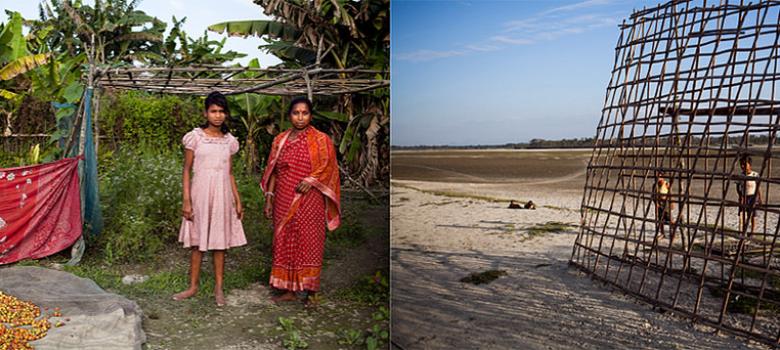
In Assam, villagers struggle to protect their land from the roaring Brahmaputra

Descending from the plateaus of Tibet and flowing through China, India and Bangladesh, the Brahmaputra is one of India’s mightiest rivers, its width running up to 10 kilometers at some places. On its 3,000-kilometer journey, the Brahmaputra provides a livelihood to thousands of communities living on its banks. They depend on it for food, water and farming. In 1950, however, the great earthquake in Assam altered the topography of the river valley and the people of Assam have since been struggling with intense droughts and floods.

Since the earthquake, Assam has witnessed severe cases of river erosion. According to official records, 36 villages, 10 schools, six tea gardens and hundreds of humans and animas have been washed away. The situation has been exacerbated by increasing deforestation and erratic climate changes.

In 2012, floods in Assam displaced over a million people and affected close to 4,500 villages. Today, these villagers from Tinsukia district in Upper Assam are struggling to protect their land and livelihoods from the eroding banks and the rising waters of the mighty Brahmaputra.

via Scroll.in – News. Politics. Culture..

22/05/2014

India scales up military forces on disputed China border – CSMonitor.com

Very interesting: Pakistan is invited to Modi’s inauguration, but China is not; and more troops along Chinese border but not  along border with Pakistan!

“India is raising a new mountain strike corps of nearly 90,000 soldiers to strengthen its defense along its disputed border with China in the high reaches of the Himalayas.

Chinese troops hold a banner which reads: "You've crossed the border, please go back" in Ladakh, India. India is raising a new mountain strike corps consisting of some 90,000 soldiers to strengthen its defence along its disputed but largely uninhabited border with China in the high reaches of the Himalayas. Photo taken Sunday, May 5, 2013.

China will be a top foreign policy challenge for Narendra Modi, the incoming prime minister who won a landslide victory last week. Business ties between India and China are booming. But despite rounds of talks, the two countries have yet to resolve their decades-old dispute over the 2,000-mile border between the two countries. It remains one of the most militarized borders in the world.

The strike corps will have its own mountain artillery, combat engineers, anti-aircraft guns, and radio equipment. Over 35,000 soldiers have already been raised in new infantry units in India’s northeastern state of Assam. The entire corps will be fully raised over the next five years with 90,274 troops at a cost of $10.6 billion. The proposal to raise a new strike corps was recommended last year by India’s China Study Group, a government body that considers all strategic issues related to China.

The strike corps signals a new assertiveness in New Delhi and will provide an additional defense capability to India, which for a long time focused on the land borders with Pakistan. While the decision predated Mr. Modi, he is likely to further strengthen India’s military modernization which is one of his party’s top agenda items.

“China has made frequent border transgressions into Indian border,” says retired Lieutenant General Prakash Katoch, who formerly commanded the Indian Army‘s Special Forces wing. “The new prime minister has to ensure that our borders are well protected. It cannot be business as usual.”

He predicts that as both countries are growing and keen to increase their influence, China and India will increasingly step on each other’s areas of interest and importance.”

via India scales up military forces on disputed China border – CSMonitor.com.

Enhanced by Zemanta
21/03/2014

BBC News – Megadams: Battle on the Brahmaputra

China and India have their eye on the energy potential of the vast Brahmaputra river. Will a new wave of “megadams” bring power to the people – or put millions at risk? The BBC World Service environment reporter Navin Singh Khadka reports from Assam, India.

map

On the banks of the Brahmaputra it is hard to get a sense of where the river starts and ends. It begins far away as a Tibetan mountain stream. On the floodplains of Assam, though, its waters spread as far as the eye can see, merging with the horizon and the sky.

From here it continues through north-eastern India into Bangladesh, where it joins with the Ganges to form a mighty river delta.

For centuries the Brahmaputra has nourished the land, and fed and watered the people on its banks.

Today, though, India and China’s growing economies mean the river is increasingly seen as a source of energy. Both countries are planning major dams on long stretches of the river.

In Assam the plans are being greeted with scepticism and some fear.

The fear is that dams upstream could give China great power over their lives. And many in Assam worry whether China has honourable intentions.

Brahmaputra voices: What next for their river?

Brahmaputra stories: The businessman, the activist, the expert and the official

After a landslide in China in 2000, the river was blocked for several days, unknown to those downstream.

When the water forced its way past the blockage Assam faced an oncoming torrent. There was no advance warning. There are concerns this could happen more frequently.

Some also believe that China may divert water to its parched north – as it has done with other southern rivers.

India’s central government says China has given them assurances about the new Tibetan dams.

“Our foreign ministry has checked with China and we have been told that the flow will not be affected, and we will make sure that the people’s lives are not affected by the dams,” Paban Singh Ghatowar, minister for the development of north-eastern India, told the BBC.

By engaging in a race to dam the Brahmaputra as quickly as possible, China and India will cause cumulative environmental impacts beyond the limits of the river’s ecosystem”

Peter Bosshard

International Rivers Network

Do massive dams ever make sense?

Beijing says the dams it is building on the Tibetan stretch of the river will ease power shortages for people in that region.

“All new projects will go through scientific planning and feasibility studies and the impact to both upstream and downstream will be fully considered,” China’s foreign ministry told the BBC.

It said three new dams at Dagu, Jiacha, and Jeixu were small-scale projects: “They will not affect flood control or the ecological environment of downstream areas,” the foreign ministry said.

Despite the statements, there is no official water-sharing deal between India and China – just an agreement to share monsoon flood data.

via BBC News – Megadams: Battle on the Brahmaputra.

Enhanced by Zemanta
13/02/2014

Labor Issues Prompt Inquiry into Tata’s Tea – India Real Time – WSJ

Nearly a year after human-rights groups complained about working and living conditions on tea plantations run by Amalgamated Plantations Private Ltd., the World Bank has ordered an inquiry.

APPL, a joint venture of Tata Global Beverages Ltd.500800.BY -1.67% and the International Finance Corp., the private-sector lending arm of the bank, employs around 30,000 people on 20 plantations in the northeastern state of Assam.

Tata Global Beverages owns the Tetley Tea brand.

Rights groups, including People’s Action for Development and Nazdeek, told the bank’s Compliance Advisor Ombudsman that the plantations weren’t adhering to Indian laws.

Many tea workers earn less than $2 a day and it “is impossible to properly feed themselves and their family with this amount of money,” the complaint said. “As a result, many workers suffer from malnutrition.”

Ashoke Bordoloi, chief financial officer of APPL said, “We look after our workers and are compliant with the law.” He said the company would extend “full cooperation” to World Bank auditors.

In 2009, Tata Global Beverages received an investment of $8 million from the IFC to address issues concerning workplace and community health and safety.

But civil rights groups allege that the money hasn’t been used.

“Facilities like living quarters, safe drinking water and toilet facilities and proper education for them, have not yet been provided by the management,” Barnabas Kindo, social activist working with PAJHRA, a group working for improving living conditions of tribal people in the northeast told India Real Time Wednesday.

via Labor Issues Prompt Inquiry into Tata’s Tea – India Real Time – WSJ.

Enhanced by Zemanta
04/11/2013

Seven killed in rebel attack in India’s Assam state – BBC News

At least seven people have been killed in an attack by suspected militants in India\’s north-eastern state of Assam, police said.

map

Rebels belonging to the Garo National Liberation Army opened fire on migrant workers who were playing cards late on Sunday in Goalpara district.

Nine workers were also injured in the attack, police said.

Assam has been plagued by ethnic clashes and separatist violence in recent years.

Goalpara has witnessed violence between the Rabha and Garo tribes.

Reports say that Sunday night\’s violence happened after Garo militants from neighbouring Meghalaya state fired at a group of Hindi-speaking migrant workers who were playing cards and gambling to celebrate Diwali, the festival of lights.

\”These militants in army dress came and fired indiscriminately… after the attack, they retreated to Meghalaya,\” AP Raut, a senior Assam police official, told the NDTV news channel.

Correspondents say many tribespeople resent the presence of outsiders, who they believe are taking their jobs and marrying local women.

via BBC News – Seven killed in rebel attack in India’s Assam state.

21/07/2013

How poverty wages for tea pickers fuel India’s trade in child slavery

The Observer: “When the trafficker came knocking on the door of Elaina Kujar’s hut on a tea plantation at the north-eastern end of Assam, she had just got back from school. Elaina was 14 and wanted to be a nurse. Instead, she was about to lose four years of her life as a child slave.

Saphira Khatun, whose daughter Minu Begum was trafficked to Delhi at the age of 12

She sits on a low chair inside the hut, playing with her long dark hair as she recalls how her owner would sit next to her watching porn in the living room of his Delhi house, while she waited to sleep on the floor. “Then he raped me,” she says, looking down at her hands, then out of the door. Outside, the monsoon rain is falling on the tin roof and against the mud-rendered bamboo strip walls, on which her parents have pinned a church calendar bearing the slogan The Lord is Good to All.

Elaina was in that Delhi house for one reason: her parents, who picked the world-famous Assam tea on an estate in Lakhimpur district, were paid so little they could not afford to keep her. There are thousands like her, taken to Delhi from the tea plantations in the north-east Indian state by a trafficker, sold to an agent for as little as £45, sold on again to an employer for up to £650, then kept as slaves, raped, abused. It is a 21st-century slave trade. There are thought to be 100,000 girls as young as 12 under lock and key in Delhi alone: others are sold on to the Middle East and some are even thought to have reached the UK.

Every tea plantation pays the same wages. Every leaf of every box of Assam tea sold by Tetley and Lipton and Twinings and the supermarket own brands – Asda, Waitrose, Tesco, Sainsbury’s and the rest – is picked by workers who earn a basic 12p an hour.

If it says Fairtrade on the box, or certified by the Rainforest Alliance or the Ethical Tea Partnership, it makes no difference: the worker received the same basic cash payment – 89 rupees (£1) a day, a little over half the legal wage for an unskilled worker in Assam of 158.54 rupees. To place that in context, a worker receives about 2p in cash for picking enough tea to fill a box of 80 tea bags, which then sells for upwards of £2 in the UK. The companies say they know the wages are low, and they are trying to make things better, but their hands are tied by the growers. The growers, who set the wages by collective bargaining, say it is all they can afford.

But there is a price for keeping wages so low, and it is paid by the workers who cannot afford to keep their daughters. When the traffickers come knocking, offering to take the girls away, promising good wages and an exciting new life, they find it hard to say no. “He said he would change our lives,” says Elaina, now 20. “The tea garden was closed when he came and my parents were not working, so my father wanted to send me.”

The trafficker had promised excitement and glamour: instead she started work every day at 4am and worked until midnight, and though he promised to give her 1,500 rupees a month, she was never paid. He kept her as a prisoner, unable to leave the house or contact her family.

“His wife was suspicious about what was happening. I told her he had raped me but he denied it and told me to shut up my mouth,” she says. “After that, I was always crying, but he kept me locked in the house. I was afraid. I had no money and he threatened that I would end up in a brothel.”

She was saved only when he sent her to a new owner who, on learning her story, sent her home.”

via How poverty wages for tea pickers fuel India’s trade in child slavery | World news | The Observer.

21/01/2013

* Women voters in India want to stand up and be counted

It’s about time!

Reuters: “Several years ago, a dinner-table conversation about state elections in Himachal Pradesh veered towards a candidate who gave away pressure cookers to woo women voters. Of course, bribing voters is illegal, but I remember wondering whether all I wanted as a woman was a pressure cooker.

The Delhi rape case and the molestation of a young girl in Guwahati in Assam last year have underscored the place that women often occupy in Indian society. These incidents have made me wonder to what extent our country’s political parties will focus on gender inequality as they look forward to the 2014 general elections. How will they vie for the women’s vote?

Until now, political parties and their largely male leadership focussed on the ‘aam aadmi’, or the common man, a phrase which subsumes women. Politicians and other public figures don’t make much hay of gender inequality and many of the attitudes toward women that hurt a large portion of our society — and when they do, they’re often lacking. The best attitude that politicians often apply to women is a patronising one. Instead of focusing on women’s empowerment through education and awareness, politicians distribute saris, cookers and sanitary napkins.

There is some attempt to change that. The Congress party’s weekend “Chintan Shivir“, or brainstorming session, in Jaipur put a special focus on women.

“Discrimination against the girl child and atrocities against women are a blot on our collective conscience,” party chief Sonia Gandhi said while opening the gathering. “Gender issues are fundamental and should be of concern to all of us.””

via India Insight.

Law of Unintended Consequences

continuously updated blog about China & India

ChiaHou's Book Reviews

continuously updated blog about China & India

What's wrong with the world; and its economy

continuously updated blog about China & India