Posts tagged ‘Atlantic Ocean’

29/07/2016

Disgorging | The Economist

OUTSIDE China, the monster Three Gorges dam across the Yangzi river is one of the most reviled engineering projects ever built. It is blamed for fouling the environment and causing great suffering among the 1.2m people who were relocated to make way for its reservoir. Inside China, officials insist that the dam is an “unsung hero” (in the recent words of the Yangzi’s chief of flood control). But controversy over the project occasionally flares. Amid the country’s worst flooding in years, it is doing so again.
The Communist Party took enormous pride in the completion of the Three Gorges dam a decade ago; officials said it would play a vital role in taming a river which, when it flooded, often claimed hundreds or thousands of lives. Recently, however, censors have permitted a few ripples of complaint to disturb the glassy surface of state-run media. Online critics have asked whether the dam has failed to protect cities from flooding or whether it has caused earthquakes—and have not had their posts deleted. Granting permission to complain may seem surprising. But officials have reason to feel confident. The much-denounced dam seems to be passing its first big test as a flood barrier.

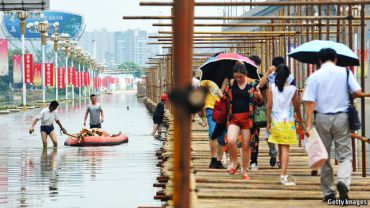
This season has been one of the wettest in China’s recent history, with 150 towns and cities suffering record amounts of rain. The Yangzi basin has been particularly hard hit. In the week to July 6th Wuhan, a giant city downstream from the dam, received 560mm (22 inches) of rain, its biggest ever downpour (residents are pictured on a temporary bridge).

China’s most recent experience of weather like this was in 1998, which was also the last time El Niño, a shift in the weather patterns of the western Pacific, had a big impact on the world’s weather. That summer the Yangzi burst its banks, causing more than 1,300 deaths. So far this year fewer than 200 people have died in the river’s basin.

One big difference is that in 1998 the Three Gorges dam was still under construction (it went into full operation in 2012). By July 24th it had held back about 7.5 billion cubic metres (260 billion cubic feet) of potential floodwater, which would have compounded disasters caused by torrential rain in the middle and lower reaches: some of the heaviest rains have occurred downstream from the dam. It is too soon to declare victory over the floods. The rainy season is only halfway through and more downpours are expected in August. But so far, as a method of flood control, the dam has done more or less what it was supposed to.

That doesn’t necessarily justify the project. One of the most important criticisms of it, by the late Huang Wanli, a hydrologist at Tsinghua University in Beijing, is that so much silt will eventually build up behind the dam that it will have to be taken down, leaving the Yangzi basin worse off than if the barrier had never been built. The region in which the dam stands is also one of the world’s most seismically active. Geologists worry that the weight of water in the sinuous reservoir, 600km (370 miles) from end to end, and the rise and fall of it, is causing more frequent tremors along the fault lines. Even small earthquakes can cause perilous landslides.

Considered purely as a means of flood control, the dam is a mixed blessing. The silt-free water that gushes through it fails to replenish embankments downstream, thus weakening them as flood barriers (several have collapsed this year). Below the dam, the water now runs faster; it has scraped away and lowered the Yangzi’s bed by as much as 11 metres, according to Fan Xiao, a geologist working for Probe International, a Canadian NGO. As a result, nearby wetlands drain into the river, damaging their ability to act as sponges during a flood.In 2000 another academic at Tsinghua, Zhang Guangduo (who had done the environmental feasibility studies for the dam), told the man in charge of building the barrier that “perhaps you know that the flood-control capacity of the Three Gorges Project is smaller than declared by us,” according to leaked documents. Peter Bosshard of International Rivers, an environmental NGO, asks whether it was wise to spend so many billions on one project, rather than strengthen flood-protection measures all along the Yangzi.

That point has been borne out by the many failures of local flood-control measures that have also occurred this year. In July parts of Wuhan’s metro system filled with water. This seems to be the result of bad management or corruption. According to People’s Daily, a party newspaper, only 4 billion yuan ($600m) of the 13 billion yuan allocated to improving drainage in the metro was actually spent. Local media say that one of the people responsible for drainage projects in the city is under arrest for taking huge bribes.

Such problems have been exacerbated by urban expansion. Wuhan used to have more than 100 lakes, but it has lost two-thirds of them to construction sites since 1949. The city’s wetlands have been gobbled up, too. Those that remain are too small to store flood waters. It is a relief that far fewer people have died in floods along the Yangzi this year compared with 1998. But it is no indication of the basin’s broader environmental health.

The Three Gorges dam has a historical parallel. In 1928 a tropical hurricane caused Lake Okeechobee, in central Florida, to flood, drowning 2,500 people in the southern half of the state. Determined that such a thing would never happen again, America’s Army Corps of Engineers over the next few decades drained much of the Everglades, which then covered much of the southern part of the state. No human disaster has recurred but the Everglades is a shadow of its former self and conservationists are battling to save it from destruction. The Yangzi is in danger not only from floods but from its flood controls.

Source: Disgorging | The Economist

07/06/2016

Indian solar power | The Economist

NARENDRA MODI, India’s prime minister, visits America for three days this week for talks with Barack Obama. Climate commitments may be one of many topics discussed. Six months ago 187 countries agreed to cut pollution through pledges for the UN climate talks in Paris. The deal adopted there was stronger than many expected, but much remains to be done. Even if countries manage to do all they offered, global warming will likely be held to around 3.5°C above pre-industrial temperatures. Conversely, the Paris deal aims overall to ensure warming does not exceed 2°C.

Unlike America and China, the world’s two largest polluters, India did not pledge a future reduction in aggregate emissions. It offered instead to reduce the intensity of its emissions—the amount of pollution per unit of economic output—by around a third by 2030 as measured against 2005 levels. Its greenest promise was to install 175GW of renewable power by 2022 (most of it solar). This is an enormous undertaking. In 2014, for example, the world’s entire installed solar capacity was 181GW.

The Modi government says the plans are “ambitious but achievable”. The country’s total installed solar power capacity now comes to 5.8GW; to meet its targets it will need to speed up from adding around 4GW a year to adding more than 15GW instead.

Mr Modi believes solar power is the “ultimate solution to India’s energy problem”. Of 250m households in India, 56m do not have access to electricity. The majority are in rural areas where off-grid solar installations, suitable for single homes or small clusters of buildings, could prove particularly helpful.

India’s solar programme is a good way to assess how seriously countries are taking the Paris agreement—particularly given India’s huge population and increasing economic heft. Mr Modi’s moves will illuminate the state of climate diplomacy.

Source: Daily chart: Indian solar power | The Economist

02/03/2016

A look back at the 25 goals of 2015|Government|chinadaily.com.cn

Amazing achievement.  How many countries declare goals in such clear numerical form and then exceed 23, meet 1, and fail on only 1 out of 25!

A look back at the 25 goals of 2015

1 Revitalize more than 212.4 billion yuan in central finance fund stock. Fulfillment: 237 billion yuan revitalized.

2 Investment within central budget increased to 477.6 billion yuan. Fulfillment: Investment of 521.1 billion yuan.

3 Railway investment to exceed 800 billion yuan. Fulfillment: Investment of 823.8 billion yuan was completed.

4 Utilize more than 8,000 km of newly built rail. Fulfillment: Newly built rail of 9,531 km was put into use.

5 Start construction of 27 major hydro projects. Fulfillment: Construction of 28 initiated.

6 Cancel all non-administrative approvals. Fulfillment: 453 items were cancelled or adjusted.

7 Cut items limiting foreign investment by half. Fulfillment: 41 of 79 items were deleted.

8 Keep grain yields above 550 million tons and increase deep-plough land by 13.33 million hectares. Fulfillment: Grain yields reached 621 million tons, Deep-plough land increased by 13.648 million hectares.

9 Construct or reconstruct 200,000 km of highways in rural areas. Fulfillment: Rural areas saw 251,000 km of newly constructed or reconstructed highways.

10 Build bridges to replace sliding-chairs to cross remote mountainous areas in the West. Fulfillment: All 288 projects have started construction.

11 Ensure that the more than 200,000 people in the country with no access to electricity get access. Fulfillment: 238,000 got access to electricity.

12 Provide safe drinking water to 60 million rural people. Fulfillment: 64.336 million rural people got access.

13 Eliminate all the 1.162 million heavy-emission vehicles with yellow stickers put into operation before the end of 2005. Fulfillment: 1.26 million such vehicles were eliminated.

14 Reduce energy use and carbon dioxide emissions by 3.1 percent or more. Fulfillment: Energy use was reduced by 5.6 percent, while carbon dioxide emissions were cut by 6.6 percent.

15 Cut chemical oxygen demand emissions by 2 percent, ammonia emissions by 2 percent, sulfur dioxide emissions by 3 percent and nitrogen oxide emissions by 5 percent. Fulfillment: Chemical oxygen demand emissions were cut by 3.1 percent, ammonia emissions by 3.6 percent, sulfur dioxide emissions by 5.8 percent and nitrogen oxide emissions by 10.9 percent.

16 Return 667,000 hectares of farmland to forest and grassland. Fulfillment: 667,000 hectares of farmland were returned.

17 Plant 6 million hectares of forests. Fulfillment: 6.3245 million hectares were planted.

18 Build 7.4 million units in government-subsidized housing projects, renovate 5.8 million units in shanty-towns and 4.32 million dilapidated houses in rural areas. Fulfillment: 7.83 million units in government-subsidized housing projects were built, 6.01 million units were renovated in shanty-towns and 4.68 million dilapidated houses in rural areas.

19 Create more than 10 million jobs in urban areas. Fulfillment: 13.12 million jobs were created in urban areas.

20 Raise standard of financial assistance for basic medical insurance of urban residents to 380 yuan per person per year. Fulfillment: Average standard has been raised to 446 yuan.

21 Raise standard of financial assistance for the new rural cooperative medical system to 380 yuan per person per year. Raise standard of financial assistance for per capita funding for basic public health services to 40 yuan. Carry out pilot projects for public hospital reform in 100 cities at and above prefecture level. Fulfillment: Standard of financial assistance for the new rural cooperative medical system was raised to 390. 24 yuan per person per year. Standard of financial assistance for per capita funding for basic public health services reached 42 yuan. Pilot projects for public hospital reform were carried out in 100 cities at and above prefecture level.

22 The registered urban unemployment rate should not exceed 4.5 percent. Fulfillment: Registered urban unemployment rate was 4.05 percent

23 Cut the rural poor population by at least 10 million. Fulfilled.

24 Employment opportunities for 7.49 million college graduates. Fulfillment: The employment situation was the same as the previous year.

25 Increase imports and exports by 6 percent. Failed to meet the goal: Import and export volumes in 2015 were $3.95864 trillion, down 8 percent. Exports decreased by 2.9 percent, still making China the best performer in major economies. China is still the world’s biggest trading power and export power.

Source: A look back at the 25 goals of 2015|Government|chinadaily.com.cn

14/02/2015

China a Top Source of Ocean Trash: Report – China Real Time Report – WSJ

Marine biologists and ocean activists have grown alarmed about the seaborne plastic that fouls shorelines and clogs currents from the Arctic to the South Pacific. But the actual amount and source of it hasn’t been known because consumer habits and pollution-control practices vary so widely world-wide.


Embed from Getty Images

In a new accounting of global garbage, researchers in the U.S. and Australia led by Jenna Jambeck, an environmental engineer at the University of Georgia, calculated the share that each of 192 countries could have contributed to plastic waste in the oceans. Their study is based on consumer data and waste-management information covering coastal populations around the world. The U.S. ranked 20th by the researchers’ estimates, deemed responsible for just under 1% of the mismanaged plastic waste.

Unchecked, the amount of plastic waste fouling the seas may double by 2025, reaching levels “equal to 10 bags full of plastic per foot of coastline,” Dr. Jambeck said.

According to the researchers, the coastal population of China generated 8.82 million metric tons of mismanaged plastic waste in 2010, about 27.7% of the world total. Of that, between 1.32 million and 3.53 million metric tons ended up as marine debris.

via China a Top Source of Ocean Trash: Report – China Real Time Report – WSJ.

Law of Unintended Consequences

continuously updated blog about China & India

ChiaHou's Book Reviews

continuously updated blog about China & India

What's wrong with the world; and its economy

continuously updated blog about China & India