Posts tagged ‘Balochistan’

26/08/2016

The Economist explains: Why Kashmir is erupting again | The Economist

TODAY marks the 48th consecutive day of protests in Jammu & Kashmir, India’s only Muslim-majority state. Young Kashmiri men have been on the streets calling for independence from India and throwing stones at security forces. Indian security forces have responded with tear gas and shotguns that fire small-bore pellets instead of buckshot.
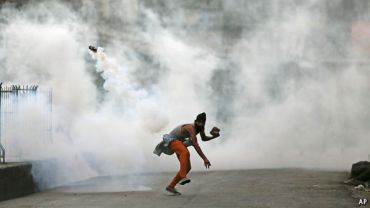
A strict curfew has also been imposed across the Kashmir valley, which includes Srinagar, the region’s largest city. So far, 66 civilians and two police officers have been killed in the violence. Why are Kashmiris protesting?

The region has been disputed since the partition of India and Pakistan in 1947. Both sides claim the territory and have fought three wars over it. Kashmir has been living under India’s Armed Forces (Special Powers) Act, which gives special powers to the army, since the eruption in 1990 of an armed insurgency that was covertly supported by Pakistan. Some 40,000 people have been killed since. Even in the relatively peaceful past decade, unrest has flared up, most notably in the summers of 2008 and 2010. The current protests started on July 9th after Indian security forces killed Burhan Wani, a young and charismatic Islamist militant. Resentment had been building for months. Kashmiris worried when Narendra Modi’s Hindu-nationalist Bharatiya Janata Party (BJP) came to power in 2014 that his national government would make life difficult for Muslims. At state elections later that year, the local Peoples Democratic Party formed a coalition with the BJP, leaving them feeling betrayed. Wani’s killing has mobilised a generation that had grown up under what it sees as an illegitimate Indian occupation.

The result has been a seven-week cycle of violent protests and retaliatory action by the police and paramilitary forces. Their supposedly non-lethal pellets have blinded dozens and injured hundreds. Shops and businesses have remained closed since the protests started, either under curfew orders or because of calls for strikes from separatist leaders. Many Kashmiris have not left their homes for weeks. Few expect the situation to improve any time soon, despite soothing words this week from Mr Modi and a visit to the region by India’s home minister.An obstacle to any lasting solution is India’s insistence on seeing Kashmir through the prism of its rivalry with Pakistan. The Indian government’s immediate reaction to this summer’s unrest was to accuse its neighbour of meddling. In fact, Wani was a home-grown insurgent; the young men on the streets are locals. Unemployment is widespread and economic opportunities are few. The state was also promised special status, guaranteeing autonomy, in India’s constitution. And many Kashmiris now want more: a survey in 2010 by Chatham House, a think-tank, found overwhelming support for independence. Kashmiris are at best ambivalent about their attachment to India. Until the government recognises their demands, the anger is unlikely to dissipate.

Source: The Economist explains: Why Kashmir is erupting again | The Economist

16/08/2016

Indian Prime Minister Narendra Modi’s Independence Day Speech in 10 Quotes – India Real Time – WSJ

Indian Prime Minister Narendra Modi on Monday made the annual Independence Day speech at Delhi’s Red Fort.

With the end of his colorful turban blowing in the wind, he outlined his government’s achievements and took a swipe at Pakistan.

Here are 10 quotes from the 90-minute speech, based on the official translation from Mr. Modi’s office:

On India’s progress:   “India is not 70 years old but this journey is 70 years long.

”On governance:   “Now turning self governance to good governance is the resolve of 1.25 billion countrymen.”

On India’s problems:   “If India has thousands of problems, it also has 1.25 billion brains that have the ability to resolve them.

”On economic growth:   “As far as GDP growth rate is concerned, we have left behind even the big economies of the world.”

On the goods-and-services tax:   “The GST regime is to become a powerful tool to strengthen the economy.

”On toilets:   “More than 20 million toilets have been constructed in our villages. Over 70,000 villages have been free from open defecation.

”On stalled projects:   “Blocking projects, delaying them and wasting money amounts to criminal negligence.

”On inflation:   “I will not allow the poor man’s dish to become costlier.”

On Pakistan and the Kashmir region:   “The way the people of Balochistan, Gilgit and Pakistan-occupied Kashmir praised me, has enhanced the prestige of my 1.25 billion countrymen.”

On caste and minority divisions:    “Serve all people without discrimination. Do not disregard anyone for his age or caste, Respect all.”

Source: Indian Prime Minister Narendra Modi’s Independence Day Speech in 10 Quotes – India Real Time – WSJ

06/07/2015

Rivals Pakistan, India to start process of joining China security bloc | Reuters

Nuclear-armed rivals Pakistan and India will start the process of joining a security bloc led by China and Russia at a summit in Russia later this week, a senior Chinese diplomat said on Monday, the first time the grouping has expanded since it was set up in 2001.

Photo

The Shanghai Cooperation Organisation (SCO) groups China, Russia and the former Soviet republics of Tajikistan, Uzbekistan, Kazakhstan and Kyrgyzstan, while India, Pakistan, Iran, Afghanistan and Mongolia are observers.

“As the influence of the SCO’s development has expanded, more and more countries in the region have brought up joining the SCO,” Chinese Vice Foreign Minister Cheng Guoping told a news briefing.”India and Pakistan’s admission to the SCO will play an important role in the SCO’s development. It will play a constructive role in pushing for the improvement of their bilateral relations.”

India and Pakistan have fought three wars since 1947, two of them over the divided Muslim-majority region of Kashmir which they both claim in full but rule in part. Pakistan also believes India is supporting separatists in resource-rich Baluchistan province, as well as militants fighting the state.

India applied to join the regional security grouping last year and SCO foreign ministers gave a positive recommendation when they met in June. “We await further developments,” said Sujata Mehta, a senior foreign ministry official.

Prime Minister Narendra Modi will be in Moscow for a summit of the BRICS group of emerging markets and both he and his Pakistani counterpart, Nawaz Sharif, will attend a special SCO “outreach” session as part of the gathering.

Pakistan’s application is being considered, said foreign ministry spokesman Qazi Khalilullah. “We hope they will support us for full membership,” he added.

The grouping was originally formed to fight threats posed by radical Islam and drug trafficking from neighboring Afghanistan.

Cheng said the summit, to be attended by Chinese President Xi Jinping, would also discuss security in Afghanistan.

Beijing says separatist groups in the far western region of Xinjiang, home to the Muslim Uighur minority, seek to form their own state, called East Turkestan, and have links with militants in Central Asia, as well as Pakistan and Afghanistan.

China says Uighur militants, operating as the East Turkestan Islamic Movement (ETIM), have also been working with Islamic State.

“It can be said that ETIM certainly has links with the Islamic State, and has participated in relevant terrorist activities. China is paying close attention to this, and will have security cooperation with relevant countries,” Cheng said.

via Rivals Pakistan, India to start process of joining China security bloc | Reuters.

Law of Unintended Consequences

continuously updated blog about China & India

ChiaHou's Book Reviews

continuously updated blog about China & India

What's wrong with the world; and its economy

continuously updated blog about China & India