Chindia Alert: You’ll be Living in their World Very Soon
aims to alert you to the threats and opportunities that China and India present. China and India require serious attention; case of ‘hidden dragon and crouching tiger’.
Without this attention, governments, businesses and, indeed, individuals may find themselves at a great disadvantage sooner rather than later.
The POSTs (front webpages) are mainly 'cuttings' from reliable sources, updated continuously.
The PAGEs (see Tabs, above) attempt to make the information more meaningful by putting some structure to the information we have researched and assembled since 2006.
As vote tallies came in late Tuesday night, it was Wednesday morning in China and inside the U.S. Embassy in Beijing, many Chinese watchers were celebrating the increasingly likely prospect of a Donald Trump win.
The event, intended to give Chinese locals the opportunity to experience a U.S. election, featured a mock vote and the opportunity for locals to pose with large cut-out photos of Mr. Trump and Democratic candidate Hillary Clinton, as well as remarks from U.S. Ambassador Max Baucus.
As he stood and watched the results roll in on a large overhead screen, Tian Junwu, a professor at the Beihang University School of Foreign Languages, said he was rooting for Mr. Trump’s victory.
“I’m a man. I don’t like a woman to be too strong,” said Mr. Tian. “She is too overbearing, like my wife. I think Trump is funny.”
Though the Republican candidate has threatened to slap a 45% tariff on Chinese goods, Mr. Tian said such a prospect wasn’t too alarming. “We [Chinese people] know now that candidates say one thing when they are running, but becoming a president is a different thing.”
Zhong Shaoliang, the Beijing representative of the industry group World Steel Association, said that the candidates seemed similar to him, but that he preferred Mr. Trump because he seemed more authentic. “He’s more American that way,” he said.
Still, he said that if he was American himself, he would see some perhaps worrying aspects at the prospect of a Trump win. “Hillary would be better for overall harmony. Trump will likely continue to further divide America up.”
As Florida was called for Mr. Trump, a pair of second-year college students studying English at the Beijing Language and Culture University said they were pleased.
“Clinton gives me kind of a sinister feeling, I’m kind of scared of her,” said Xu Xiayan, 19, who said she and her friends were paying more attention to the election this year, mostly for its entertainment value. “She’s good at pretending. Like when Trump is saying things and making her angry, she still maintains a slight smile.” Her friend agreed.Kang Xiaoguang, a professor at Renmin University’s China Institute for Philosophy and Social Innovation, said many of his friends were also cheering for Mr. Trump. “He’s saying things that people in America in their hearts might really feel — like about immigrants, about Muslims — but don’t dare say.” And from a foreign-policy perspective, he said, he thought Mr. Trump would be more likely to pull back on a global stage, including in places such as the South China Sea. “That way, China won’t have so much pressure on it,” he said.
“Also, some people feel the U.S. makes too much trouble for China, so if there’s a person making trouble in the U.S., they think Trump becoming president is a good thing,” he added.
Given the chance, he said, he might have cast his ballot for Mrs. Clinton, who he sees as steadier and easier to predict. A recent Pew survey found that Chinese respondents have a poor image of both presidential candidates, but viewed Mrs. Clinton slightly more favorably than her opponent.
Still, no matter what he does in office, Mr. Kang said he didn’t think that Trump’s impact would necessarily be too great. “America is a very mature system,” he said. It won’t be easily rocked by one person.”
China launched its longest manned space mission on Monday, sending two astronauts into orbit to spend a month aboard a space laboratory that is part of a broader plan to have a permanent manned space station in service around 2022.
The Shenzhou 11 blasted off on a Long March rocket at 7:30 am (2330 GMT) from the remote launch site in Jiuquan, in the Gobi desert, in images carried live on state television.
The astronauts will dock with the Tiangong 2 space laboratory, or “Heavenly Palace 2”, which was sent into space last month. It will be the longest stay in space by Chinese astronauts, state media reported.
Early on Monday, Fan Changlong, a vice chairman of China’s powerful Central Military Commission, met astronauts Jing Haipeng and Chen Dong and wished them well, state news agency Xinhua reported.
“You are going to travel in space to pursue the space dream of the Chinese nation,” Fan said.”With all the scientific and rigorous training, discreet preparation, and rich experience accumulated from previous missions, you will accomplish the glorious and tough task… We wish you success and look forward to your triumphant return.”
Shenzhou 11 is the third space voyage for Jing, who will command the mission and celebrate his 50th birthday in orbit.
In a manned space mission in 2013, three Chinese astronauts spent 15 days in orbit and docked with a space laboratory, the Tiangong 1.Advancing China’s space program is a priority for Beijing, with President Xi Jinping calling for the country to establish itself as a space power.
China insists its space program is for peaceful purposes.
Shenzhou 11, whose name translates as “Divine Vessel”, will also carry three experiments designed by Hong Kong middle school students and selected in a science competition, including one that will take silk worms into space.
The U.S. Defense Department has highlighted China’s increasing space capabilities, saying it was pursuing activities aimed at preventing other nations using space-based assets in a crisis.
China has been working to develop its space program for military, commercial and scientific purposes, but is still playing catch-up to established space powers the United States and Russia.
China’s Jade Rabbit moon rover landed on the moon in late 2013 to great national fanfare, but soon suffered severe technical difficulties.
The rover and the Chang’e 3 probe that carried it there were the first “soft landing” on the moon since 1976. Both the United States and the Soviet Union had accomplished the feat earlier.
China will launch a “core module” for its first space station some time around 2018, a senior official said in April, part of a plan for a permanent manned space station in service around 2022.
In 2011, we tried our hand at predicting the ways in which, in the decade to come, Chinese consumers would change their preferences and behaviors.
This article takes stock of those predictions.
Why check in now? One reason is we’re about halfway to 2020. Another is a comprehensive new McKinsey survey, which follows nearly ten years of previous research that includes interviews with more than 60,000 people in upward of 60 cities in China. Along the way, we’ve bolstered our own team’s data on consumer preferences and behavior with a number of complementary analyses and models, including McKinsey’s macroeconomic and demographic studies of Chinese urbanization and income development. We’ve also interviewed academics to draw out the major trends shaping the course of the Chinese economy, such as its rapidly aging population, the growing independence of women in society, and the postponement of critical life milestones, such as marrying and having children.
We’ve done it all with the abiding belief that companies getting ahead of the trends can build their brands and offerings to fit a rapidly evolving set of consumer needs in China. Deeper and more nuanced understanding of Chinese consumers can help reveal fresh opportunities—for new entrants and incumbents alike—and signal those areas where established players may need to be more wary.
Looking back nearly five years on, it is plain that Chinese consumers are evolving along many, though not all, of the lines we’d predicted. While geographic differences persist, Chinese consumers are, on the whole, more individualistic, more willing to pay for nonnecessities and discretionary items, more brand loyal, and more willing to trade up to more expensive purchases—even as their hallmark pragmatism endures.
Evolving geographic differences
Much of the research we described five years ago highlighted the vast differences we found among consumers in China’s various cities and regions. Just as it was then, generalizing about Chinese consumers continues to be almost as difficult (and maybe as foolish) as it is to generalize about European consumers.
We predicted these differences would remain—and even grow more significant, especially in the consumption patterns and tastes that relate to discretionary items. To help companies better tailor their go-to-market approach, we grouped most cities in China into clusters based on their similarities, including their geographic proximity and the transportation infrastructure that connects them.
As the economic structure in each of the 22 biggest city clusters has evolved—and as each of them has been affected differently by the recent slowdown of China’s economy—significant differences, for instance, in consumer confidence, do indeed persist between these clusters.
For instance, some 70 percent of consumers in the Fuzhou–Xiamen city cluster, which lies on the coast across from Taiwan, said in our latest report that they are confident their income will significantly increase over the next five years. In that same report, the Byland–Shandong city cluster, which lies on the coast between Beijing and Shanghai, was comparatively pessimistic, with only 33 percent of its consumers expressing such confidence.
Furthermore, when our latest survey compared the consumers in the Shanghai area to those around Beijing and Hangzhou, certain spending attitudes also showed marked differences. For example, brand loyalty increased much faster in Shanghai (24 percent increase in three years versus just 7 percent in Beijing and 9 percent in Hangzhou), as did the willingness to pay for better or healthier products.
Despite geographic differences, there are broad similarities among Chinese consumers. These mirror the general trends economists have found among consumers around the world as economies develop. The general tendency is for consumers, as they earn more, to spend a lower percentage of their income on food, a little more on healthcare, and even more on travel and transportation, as well as on recreational activities. It was no great stretch then, in our report five years ago, to predict a significant shift in consumption from necessities and seminecessities into discretionary categories.
Sure enough, our new survey shows Chinese consumers following the anticipated pattern. When we asked how they plan to increase spending as their income increases, dramatically fewer consumers said they will increase it on food (46 percent in the latest survey, compared to the 76 percent who said they would do so three years earlier).
Responses trended slightly up for healthcare products (from 16 percent to 17 percent), and increased for travel (from 14 percent to 23 percent) and leisure (from 17 percent to 25 percent).
Aspirational trading up
In our previous predictions, we also argued that as the income of Chinese consumers grew, they would aspire to improve their quality of life by not only spending more on discretionary items, but also by shifting their spending to more expensive items in the same categories.
In necessity categories such as food, for example, we predicted consumers would be willing to spend more for healthier versions of the same products—for instance, that olive oil would grow much faster than less healthy (and less expensive) oils. In semi-necessity categories like apparel, we predicted people would buy more special-occasion and premium brands. We anticipated that the strongest beneficiaries of these changes would be in the more discretionary and aspirational categories, such as skincare and automotive. So what has happened so far?
Premium categories have really accelerated. Comparing cosmetics purchases between 2011 and 2015, 44 percent of consumers have traded up their purchases, compared with 4 percent who traded down. Even for rice, 25 percent of consumers traded up versus 3 percent who traded down. Automotive was not included in our survey, but sales data from the Traffic Management Bureau of the Ministry of Public Security in China suggest significant trading up. In 2011, 51 percent of the renminbi spent on cars by Chinese consumers were for autos cheaper than 100,000 RMB. These sales accounted for only 43 percent of the market. Cars selling for 100,000 to 250,000 RMB grew twice as fast with a compound annual growth rate (CAGR) of 19 percent versus 9 percent. And cars with price tags between 250,000 and 400,000 RMB grew the fastest of all, with 23 percent CAGR.
Emerging senior market
In 2011, we observed a big generational difference between consumers in their late 50s and early 60s, who were very conservative spenders, and all of the age cohorts younger than them.
We predicted that by 2020, as the needs of consumers over the age of 55 changed along with their economic confidence, their spending habits would follow suit, making this age group worth pursuing by consumer-product companies. If anything, we underestimated the speed and force with which this trend would unfold.
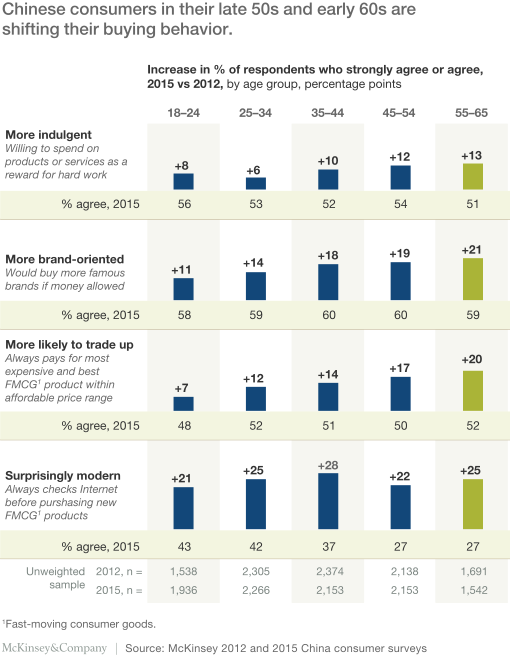
By 2015, the 55–65 age group had started to shift even faster than the rest of the population. For example, 52 percent of the people in this age group showed a preference for premium products, compared to just 32 percent in 2012. They leaped from being the most conservative age group to the one most likely to trade up. Similarly, the preference for famous brand names among these older buyers jumped by more than 20 percent, fully closing the previous difference among cohorts. As Exhibit 1 shows, these older consumers don’t shy away from indulgences, and they have grown more likely to use the Internet to research their purchases, even if they still do so less often than younger consumers.
Exhibit 1
That said, the upper age group has remained more pragmatic and cost conscious than any other age group, as we discuss in the following section.
The still-pragmatic consumer
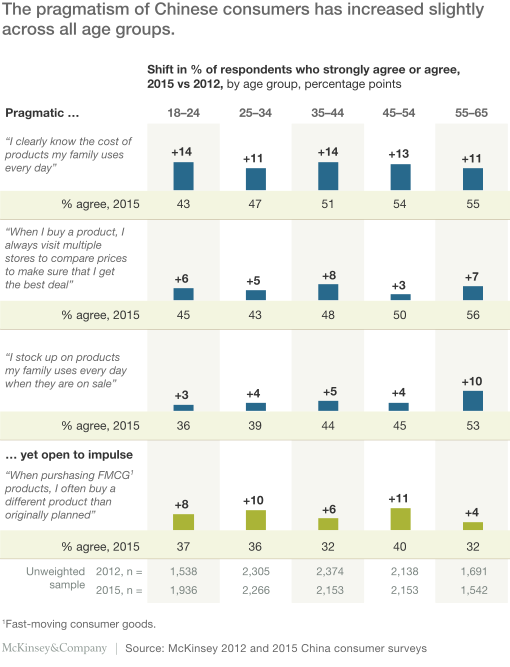
Back in 2011, even as we were predicting changes in the behavior and preferences of Chinese consumers, we also saw ways in which their essential pragmatism would likely stay the same. For instance, we anticipated that impulse buying would remain lower than in other countries and that value for money would continue to be an important consideration when choosing products and services. Interestingly, Chinese consumers across all age groups have, in some ways, become even more pragmatic. They’re now even more likely to compare prices across multiple stores, to be more price aware, and to stock up on promotions. That said, they’re now willing to buy more often on impulse (Exhibit 2).
Exhibit 2
The individual consumer
We also predicted that as Chinese consumers aspire to a better life and trade up their purchases, they would become more discerning and gradually more individualistic. This would lead, for example, to a shift toward more healthy choices, more user-friendly products, and products and brands that better fit their personality. This could be a big opportunity for niche brands—and a threat to the mass-market brands that had won big in previous years by using scale and ubiquitous availability, supported by the trust gained by heavy advertising.
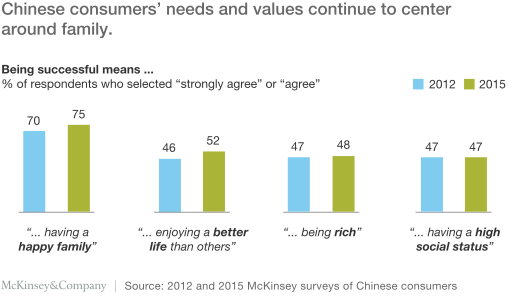
Our latest research certainly shows a decrease in consumption in categories deemed less healthy and a willingness to spend significantly more on health and more environmentally conscious categories. It also shows consumers are more likely to spend more to indulge themselves and more likely to try new technology. While their consumption choices have become more individualistic, though, it is important to note that family values continue to be at the top of their priorities (Exhibit 3).
Exhibit 3
One area our predictions missed, however, was by anticipating that consumers, as they became more individualistic in their choices, might focus less on basic product reliability and safety. Perhaps in part because of a number of more recent food scandals, however, consumers seemed more concerned with these issues in 2015 than they were before.
The increasingly loyal consumer
When our team first started researching Chinese consumers, nearly ten years ago, many of us were surprised by their fickle attitude toward brands. Fewer than half of consumers tended to stick with their favorite brands, compared, for example, with almost three quarters of US consumers.
As we debated this tendency while making our predictions, we wondered if, in the clash between pragmatism and individualism, brand loyalty would stay low, increase, or even decline. Ultimately, we decided it would increase as the emotional benefits of brands became more important to consumers and as increased choice and availability of branded products (online and off) would allow consumers to optimize for price and convenience without changing choices too often.
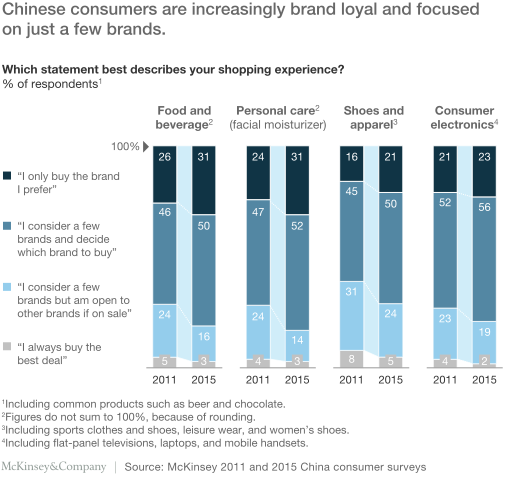
Our recent research confirmed the changes we anticipated. Consumers are now significantly less likely to buy a brand that is not already among their favorites, continuing the upward trend we observed in 2011 (Exhibit 4).
Exhibit 4
The modern shopper
Our 2011 predictions were bullish on e-commerce, predicting that Chinese consumers would adapt their channel choices even faster than has occurred in developed markets.
We estimated that by 2020, online consumer-electronics purchases would jump to 40 percent, from about 10 percent. More mainstream categories would rise to 15 percent, and some categories, such as groceries (now below 1 percent), could reach about 10 percent. These changes are occurring even as the enduring pragmatism and diligence of the Chinese consumer continue to be in place. Our latest research shows that consumers of all age groups are much more likely to collect information online, even on fast-moving consumer goods, than they were just three years ago.
In 2015, online food and beverages sales (excluding fresh) reached 7.2 percent: reaching our predicted 10 percent in five years looks very likely. The online share of consumer-electronic purchases, meanwhile, has reached a whopping 39 percent in 2015, and it now looks possible that by 2020 it will be about 50 percent of overall sales.
Looking from today’s perspective at our 2011 predictions, it is impressive to see the evolution of Chinese consumers—even as their most characteristic traits endure. Certainly, we’ll check in on their progress as we get ever closer to the year 2020. Making predictions may be difficult, especially about the future—as US Baseball Hall of Famer Yogi Berra famously observed. But they can still provide valuable foresight for executives.
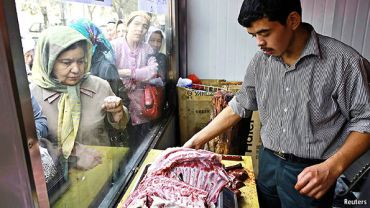
CHINA’S cities abound with restaurants and food stalls catering to Muslims as well as to the many other Chinese who relish the distinctive cuisines for which the country’s Muslims are renowned.
So popular are kebabs cooked by Muslim Uighurs on the streets of Beijing that the city banned outdoor grills in 2014 in order to reduce smoke, which officials said was exacerbating the capital’s notorious smog (the air today is hardly less noxious).
Often such food is claimed to be qing zhen, meaning “pure and true”, or halal, prepared according to traditional Islamic regulations. But who can tell? Last year angry Muslims besieged a halal bakery in Xining, the capital of Qinghai province, after pork sausages were found in the shop’s delivery van. There have been several scandals in recent years involving rat meat or pork being sold as lamb. These have spread Muslim mistrust of domestically produced halal products.
In response, some local governments have introduced regulations requiring food purporting to be halal to be just that (though not going into detail of what halal means, such as the slaughter of animals with a knife by a Muslim). Earlier this year, however, the national legislature suspended its work on a bill that would apply such stipulations countrywide.
There is much demand for one. Local rules are often poorly enforced. Advocates of a national law say a lack of unified standards is hampering exports to Muslim countries. According to Wang Guoliang of the Islamic Association of China, the country’s halal food industry makes up a negligible 0.1% of the global market.
The government began drafting a national halal law in 2002. But Muslim communities in China have varying definitions of the term. Work on the bill was slow. Each year, during the legislature’s annual session in March, Muslim delegates called for faster progress. But there were opponents, too. Some scholars argued that the government should not regulate on matters relating to religious faith. Others said that by giving in to the Muslims’ demands, China would encourage them to press for more concessions and ultimately form their own enclaves run by sharia.
Such views may have given pause to China’s leaders. In April, at a high-level meeting on religious affairs, President Xi Jinping said religion should be prevented from interfering with the law. That month Wang Zhengwei, a Muslim official who had been pushing for halal legislation, was removed from his post as the head of the State Ethnic Affairs Commission.
Also in April, the Communist Party chief of Ningxia urged officials to “sharpen [their] vigilance” against the use of halal labels on products such as toilet paper, toothpaste and cosmetics. And the government of Qinghai province ordered the inspection of Muslim-only toilets and hospital rooms, as well as shops catering to Muslims, to make sure that halal symbols were being used only on food. Xinjiang, the far-western region that is home to the Uighurs, recently introduced an anti-terrorism law threatening punishment of those who “overextend” halal rules. Officials clearly worry that those who do so might be the same sort of people who embrace jihad.
Ismael An, a Muslim writer, says this is overreacting. “Supporters of the halal law are not the so-called extremists, because real extremists don’t make demands through legislation,” he says. On the internet, however, a small but vocal group of Islamophobes has been calling for a boycott of halal-certified products. They say the price of such goods factors in payments to Islamic groups that grant the certificates—they do not want to give the religion even indirect support. Ironically, it is the non-Muslim love of Muslim food that will ensure the campaign will not succeed.
While India may be known for its oppressive pollution, poverty and bureaucracy, it’s a better place to be sent to work than China or even the United States according to a recent survey.
An HSBC report that tried to break down what it’s like to be an expatriate in different countries this week surprisingly ranked India ahead of the world’s two biggest economies.
In its HSBC Expat Explorer 2016 report based on an online survey of 27,000 expats this year, the bank ranked India 26th out of 45 countries. While that is on the bottom half of the rankings, the U.S. did worse at 30th as did China at 34th.
How is that possible?
One factor was the Indian economy. Even though it is decades behind China and the U.S. it is still the fastest growing major economy in the world right now. That means globe-trotting executives and entrepreneurs don’t feel like they have been relegated to the backwaters when they work in India.
“More than half (51%) of expats in India believe the country is a good place for them to progress their career, compared with 42% across Asia-Pacific,” said the report, which ranked India 10th for “entrepreneurship,” better than China which got the 16th rank. India was also rated by expats as “a good place to start a business,” about 7% more than China in the region.
“Expats in India are also able to save more, with 44% saying that living there has accelerated their progress towards making longterm savings and investments, compared with 39% across the region,” said the report.
More important for the rankings this year though was family and friends.
The expats who responded to the HSBC survey gave India much higher marks in terms of ease of integrating with the locals as well as cost of raising children.
Of course the report also showed how India continues to underperform in many areas including quality of life and safety.India’s overall ranking slipped this year. Last year it was 17th out of 39 countries just below the U.S. but still better than China.
“The slight drop in India’s ranking is due to a range of factors, for example, expat parents in India have reported that the country is more expensive to bring up a child than last year,” said the bank when asked about India’s lower ranking this year.
Why did India, China and the U.S. perform worse than last year? That’s because they faced new competition from 6 other countries which were not a part of last year’s survey, including Norway and Austria which were ranked 6th and 7th in 2016.
On the top of the rankings this year was Singapore, New Zealand and Canada.
What a contrast! See pair of articles – this on on China, the other on India, both from WSJ.
Recent stability in the Chinese economy masks deep-seated problems that threaten to rattle global markets in advance of a leadership change next year, according to a survey.
Ignoring these risks is shortsighted, said authors of the China Beige Book International, a quarterly survey that tracks the world’s second-largest economy.Data from the group’s third-quarter survey of 3,100 Chinese firms and 160 bankers point to some potential problems. New growth engines intended to shift the economy away from investment toward consumption-led growth are increasingly wobbly as corporate cash flow is squeezed and Beijing doubles down on traditional engines to stabilize output, the China Beige Book says.
“I’d find it earth-shatteringly surprising if we don’t have a significant problem between now and China’s leadership change” in the fall of 2017 when the 19th Party Congress convenes, said Leland Miller, China Beige Book’s president. “This is not a stable economy. It’s one that twists and turns and happens to end up at the same spot. There are real problems below the surface.”
Growth in China’s service industry, a cornerstone of its planned transition to a new and more sustainable economic model, weakened during the third quarter as financial services, private healthcare, telecommunications, media and other subsectors flagged, the group’s data showed. In retail, the apparel, luxury goods and food sectors slowed, it said, as online retailers continued to cannibalize brick-and-mortar sales.
Despite Beijing’s pledge to reduce excess Industrial capacity and pare debt, China remains heavily dependent on government spending to power traditional debt-fueled growth engines, the group said. Much of the economic momentum during the third quarter came from infrastructure, manufacturing, commodities and real estate and many of these sectors are in danger of losing momentum, it said.
While property sales remained strong in major cities, cash flow in the sector tightened and borrowing increased, a sign that investors should “think about getting off this train sooner rather than later,” the China Beige Book said.
“Deteriorating corporate finances and a rebalancing reversal seem a high price to pay for a quarter’s worth of stability,” the group added.
Economic and monetary authorities didn’t respond to requests for comment.
China roiled global markets last year when stocks plunged and Beijing intervened to prop them up. A few months later, it introduced a new currency system in which the yuan fell against the dollar, fueling concern that this would launch a destabilizing round of currency depreciations among rival trading nations. State spending and easy money policies since then have settled investor nerves.
China is expected to report third-quarter economic growth of around 6.7% next month, the level it posted in both the first and second quarters. Gauges such as industrial production and fixed-asset investment have been surprisingly robust over the past month.The trigger for another potential market jolt in the next few quarters could be the release of particularly weak Chinese service or retail data coinciding with a Federal Reserve interest rate rise or another global event, Mr. Miller said. “Right now, the markets are lulled to sleep,” he said. “People become used to the stable China narrative until they start looking more closely into the data.”
A report released Tuesday by the International Monetary Fund said China can reduce the negative impact on the global economy of its shift to slower but more sustainable growth by ending its use of targets to artificially prop up growth and by communicating its intentions clearly.
Other economists say they expect the Chinese economy to remain relative stable through the once-in-five-year leadership change, which is expected to be in October or November of 2017, as long as Beijing continues stimulating the economy enough to avoid a drop in growth. “I don’t think there’s going to be a crisis next year,” said Julian Evans-Pritchard, an economist with Capital Economics Pte. “But they often take their foot off the pedal too much, then tend to panic again and put it back on, creating a lag.”
The Bank for International Settlements warned last week that mounting leverage raises the risk of a financial crisis in China. The nation’s total debt, led by rising corporate obligations, is on target to reach 253% of gross domestic product by the end of 2016, a doubling over the past eight years, according to credit ratings agency Fitch Ratings Inc.
Third quarter China Beige Book data also pointed to areas of strength. The job market remains strong. The manufacturing outlook improved with new domestic and international factory orders picking up and deflationary pressure on industry ebbing.“It was not a disaster of a quarter,” Mr. Miller said. “But it’s a lot more negative than people think.”
The two nuclear-armed neighbours have been moving to gradually ease long-existing tensions between them.
Leaders of Asia’s two giants pledged last year to cool a festering border dispute, which dates back to a brief border war in 1962, though the disagreement remains unresolved.
Meeting on the sidelines of the G20 summit in the eastern Chinese city of Hangzhou, Xi said relations had maintained a steady, healthy momentum, and should continue to increase mutual understanding and trust.
“We ought to respect and give consideration to each other’s concerns, and use constructive methods to appropriately handle questions on which there are disputes,” Xi said, in comments carried by China’s Foreign Ministry.
“China is willing to work hard with India the maintain the hard-won good position of Sino-India relations,” Xi added.
China’s Defence Ministry said last month that it hoped India could put more efforts into regional peace and stability rather than the opposite, in response to Indian plans to put advanced cruise missiles along the disputed border with China.
Indian military officials say the plan is to equip regiments deployed on the China border with the BrahMos missile, made by an Indo-Russian joint venture, as part of ongoing efforts to build up military and civilian infrastructure capabilities there.
China lays claim to more than 90,000 sq km (35,000 sq miles) ruled by New Delhi in the eastern sector of the Himalayas. India says China occupies 38,000 sq km (14,600 sq miles) of its territory on the Aksai Chin plateau in the west.
India is also suspicious of China’s support for its arch-rival, Pakistan.Modi arrived in China from Vietnam, which is involved in its own dispute with China over the South China Sea, where he offered Vietnam a credit line of half a billion dollars for defence cooperation.Modi’s government has ordered BrahMos Aerospace, which produces the BrahMos missiles, to accelerate sales to a list of five countries topped by Vietnam, according to a government note viewed by Reuters and previously unreported.
China and the United States are set to jointly announce their ratification of a landmark climate change pact before the G20 summit early next month, the South China Morning Post has learned.
Senior climate officials from both countries worked late into the night in Beijing on Tuesday to finalise details, and a bilateral announcement is likely to be made on September 2, according to sources familiar with the issue.
President Xi Jinping will meet his US counterpart Barack Obama for the G20 summit in Hangzhou, Zhejiang province, two days later on September 4.
How China, the ‘world’s largest polluter’, is taking on climate change
“There are still some uncertainties from the US side due to the complicated US system in ratifying such a treaty, but the announcement is still quite likely to be ready by Sept 2,” said a source, who declined to be named.
If both sides announce the ratification on the day, it would be the last major joint statement between the two leaders before Obama leaves office.
China and the US account for about 38 per cent of global greenhouse gas emissions, according to the World Resources Institute.
By ratifying the Paris Agreement on climate change, Beijing and Washington could generate momentum for the accord to come into effect as a binding international treaty.
The pact agreed by representatives from 195 countries in Paris last December aims to keep the increase in the global average temperature to well below 2 degrees Celsius on pre-industrial levels.
Countries began the ratification process on April 22, Earth Day, and by Tuesday, 23 nations had joined, but they account for just 1 per cent of emissions.
China and the US create a new climate for international collaboration on the environment
The treaty will enter into force only after 55 countries representing at least 55 per cent of emissions ratify or join the deal in other ways.
China had said earlier it would ratify the accord before the G20 summit in September.
In June, the US said it would “work towards” approving the deal before end of the year, with the White House keen to seal a key part of Obama’s environmental protection legacy before he leaves office in January.
US law allows the nation to join international agreements in a number of ways, including through the authority of the president.
With China and US joining, some civil society trackers say they are confident the deal could hit the 55 per cent threshold before the end of the year.
On Wednesday, investors managing more than US$13 trillion of assets urged leaders of the Group of Twenty major economies to ratify the deal before the end of December.
The 130 investors also called for the G20 to double global investment in clean energy, develop carbon pricing and phase out fossil fuel subsidies.
How a little-known chapter in Sino-US cooperation may have helped save the planet
“Governments must ratify the Paris agreement swiftly and have a responsibility to implement policies that drive better disclosure of climate risk, curb fossil fuel subsidies and put in place strong pricing signals sufficient to catalyse the significant private sector investment in low carbon solutions,” said Stephanie Pfeifer, chief executive at Institutional Investors Group on Climate Change.
Ratification is expected to play out differently in the US compared with China.
While China has “few uncertainties” at home for passing the deal, it could cause controversy within the US, according to Liu Shuang, an officer with Energy Foundation’s low-carbon development programme.But the Obama administration’s commitment to international frameworks suggests the accord would be passed in a way that would make it difficult for his successors to undo, civil society trackers said.
‘I may do something else’: Donald Trump’s threat to renegotiate UN climate deal greeted with widespread dismay
The two countries started extensive cooperation at the leadership level in 2014. In a joint declaration that year, China promised its emissions would peak before 2030, while the US promised to cut emission by at least 26 per cent. That deal is widely regarded as paving the way for the Paris Agreement.
The country could create sustainable economic conditions in five ways, such as promoting acceptable living standards, improving the urban infrastructure, and unlocking the potential of women.
Twenty-five years ago, India embarked on a journey of economic liberalization, opening its doors to globalization and market forces. We, and the rest of the world, have watched as the investment and trade regime introduced in 1991 raised economic growth, increased consumer choice, and reduced poverty significantly.
Now, as uncertainties cloud the global economic picture, the International Monetary Fund has projected that India’s GDP will grow by 7.4 percent for 2016–17, making it the world’s fastest-growing large economy. India also compares favorably with other emerging markets in growth potential. (Exhibit 1).
The country offers an attractive long-term future powered largely by a consuming class that’s expected to more than triple, to 89 million households, by 2025.Exhibit 1
Liberalization has created new opportunities. The challenge for policy makers is to manage growth so that it creates the basis for sustainable economic performance. Although much work has been done, India’s transformation into a global economic force has yet to fully benefit all its citizens. There’s a massive unmet need for basic services, such as water and sanitation, energy, and health care, for example, while red tape makes it hard to do business. The government has begun to address many of these challenges, and the pace of change could accelerate in coming years as some initiatives gain scale.
From our vantage point, India has an exciting future. In the new McKinsey Global Institute report India’s ascent: Five opportunities for growth and transformation, we look at game-changing opportunities for the country’s economy and the implications for domestic businesses, multinational companies, and the government. The five areas we focus on by no means provide a comprehensive assessment of India’s prospects, but we believe they are among the most significant trends. Foreign and Indian businesses would do well to recognize these opportunities and reflect on how to exploit them.
1. From poverty to empowerment:
Acceptable living standards for allThe trickle-down effect of economic liberalization has lifted millions of Indians from indigence in the past two decades. The official poverty rate declined from 45 percent of the population in 1994 to 22 percent in 2012, but this statistic defines only the most dismal situations. By our broader measure of minimum acceptable living standards—spanning nutrition, water, sanitation, energy, housing, education, and healthcare—we find that 56 percent of Indians lacked the basics in 2012.
The country will need to address these gaps to achieve its potential. The task is certainly within India’s capacity, but policy makers will have to promote an agenda emphasizing job creation, growth-oriented investment, farm-sector productivity, and innovative social programs that help the people who actually need them. The private sector has a substantial role to play both in creating and providing effective basic services.
2. Sustainable urbanization:
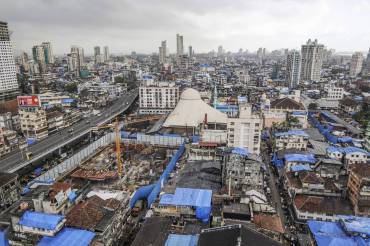
Building India’s growth enginesBy 2025, MGI estimates, India will have 69 cities with a population of more than one million each. Economic growth will center on them, and the biggest infrastructure building will take place there. The output of Indian cities will come to resemble that of cities in middle-income nations (Exhibit 2).
In 2030, for example, Mumbai’s economy, a mammoth market of $245 billion in consumption, will be bigger than Malaysia’s today. The next four cities by market size will each have annual consumption of $80 billion to $175 billion by 2030.Exhibit 2To achieve sustainable growth, these cities will have to become more livable places, offering clean air and water, reliable utilities, and extensive green spaces. India’s urban transformation represents a huge opportunity for domestic and international businesses that can provide capital, technology, and planning know-how, as well as the goods and services urban consumers demand.
3. Manufacturing for India, in India
Although India’s manufacturing sector has lagged behind China’s, there will be substantial opportunities to invest in value-creating businesses and to create jobs. India’s appeal to potential investors will be more than just its low-cost labor: manufacturers there are building competitive businesses to tap into the large and growing local market. Further reforms and public infrastructure investments could make it easier for all types of manufacturing businesses—foreign and Indian alike—to achieve scale and efficiency.
4. Riding the digital wave:
Harnessing technology for India’s growthTwelve powerful technologies will benefit India, helping to raise productivity, improving efficiency across major sectors of the economy, and radically altering the provision of services such as education and healthcare. These technologies could add $550 billion to $1 trillion a year of economic value in 2025, according to our analysis, potentially creating millions of well-paying, productive jobs (including positions for people with moderate levels of formal education) and helping millions of Indians to enjoy a decent standard of living.
5. Unlocking the potential of Indian women: If not now, when?
Our research suggests that women now contribute only 17 percent of India’s GDP and make up just 24 percent of the workforce, compared with 40 percent globally. In the coming decade, they will represent one of the largest potential economic forces in the country. If it matched the progress toward gender parity of the region’s fastest-improving country, we estimate that it could add $700 billion to its GDP in 2025. Movement toward closing the gender gap in education and in financial and digital inclusion has begun, but there is scope for further progress.
Public-sector efforts to address the five areas are under way. The government is attempting to improve the investment climate and accelerate job creation—India’s ranking on the World Economic Forum’s Global Competitiveness Report climbed to 55 in 2015–16, from 71 a year earlier. Officials are moving to make the government more efficient, using technology that can leapfrog traditional bottlenecks of a weak infrastructure. One billion Indian citizens, for example, are now registered under Aadhaar, the world’s largest digital-identity program and a potent platform for delivering benefits directly to the poor.
Realizing India’s promise will require national, state, and local leaders to adopt new approaches to governance and the provision of services. To meet the people’s aspirations, these officials will also need new capabilities. The requirements include private sector–style procurement and supply-chain expertise, deep technical skills for planning portfolios of infrastructure investments, and strong project-management capabilities to ensure that large capital projects finish on time and on budget. Training will be needed to help staff members use digital technologies to automate and reengineer processes, manage big data and advanced analytics, and improve interactions among citizens through digitized touchpoints, online-access platforms, portals, and messaging and payment platforms. The government could acquire these capabilities by adopting quality-oriented procurement policies and taking advantage of secondments from the private sector. For businesses, India represents a sizable market but will require a granular strategy and a locally focused operating model.
No single report can capture all the changes taking place in the country, but we have tried here to identify the most significant trends. Foreign and Indian businesses should consider how their strategies will be influenced by them. Policy makers should focus on helping all stakeholders to capitalize on them. By any measure, the challenge is daunting, but success could give a historic boost to India’s economy.
Poland is in talks with potential investors from China over selling a stake in the state airline LOT [LOT.UL], Deputy Prime Minister Mateusz Morawiecki said on Wednesday.
Poland’s euroskeptic, conservative government has been looking to tighten its relations with China since coming to power last year. The two countries pledged deeper co-operation during the visit of China’s leader Xi Jinping to Warsaw in June.”LOT is our national carrier, which we are trying to save no matter the cost. It is deeply in debt,” Morawiecki told state news agency PAP on Wednesday, adding that without a national carrier Poland would become a more peripheral country.
LOT, one of the world’s oldest airlines, has for years struggled to compete against low-cost competitors like Ryanair (RYA.I) and bigger rivals. The state-owned airline was saved from bankruptcy in 2012 thanks to public aid of more than 500 million zlotys ($130 million).
“The previous government has already granted public support for LOT, we cannot grant another and we are looking for an investor,” Morawiecki said.
“According to EU law a carrier from outside the EU cannot take over more than 49 percent of a carrier from the EU, hence we are in talks with potential investors, among others, from China,” he said.Morawiecki also said that usually it is a very long road to finalize such a transaction.
Earlier on Wednesday, a Polish local newspaper reported that Chinese carrier Air China (601111.SS) is interested in buying a 49-percent stake in LOT with a delegation from the Chinese firm expected to arrive in Warsaw over the coming days.
However, a LOT spokesman said he had no knowledge of any plans for a capital tie-up between LOT and Air China.
“I have no knowledge regarding any planned capital co-operation between LOT and Air China,” Adrian Kubicki, LOT spokesman said. “We have commercial co-operation with Air China, which we want to develop, regarding the Warsaw-Beijing route.”
Air China was not immediately available for comment.






 Liberalization has created new opportunities. The challenge for policy makers is to manage growth so that it creates the basis for sustainable economic performance. Although much work has been done, India’s transformation into a global economic force has yet to fully benefit all its citizens. There’s a massive unmet need for basic services, such as water and sanitation, energy, and health care, for example, while red tape makes it hard to do business. The government has begun to address many of these challenges, and the pace of change could accelerate in coming years as some initiatives gain scale.
 In 2030, for example, Mumbai’s economy, a mammoth market of $245 billion in consumption, will be bigger than Malaysia’s today. The next four cities by market size will each have annual consumption of $80 billion to $175 billion by 2030.Exhibit 2To achieve sustainable growth, these cities will have to become more livable places, offering clean air and water, reliable utilities, and extensive green spaces. India’s urban transformation represents a huge opportunity for domestic and international businesses that can provide capital, technology, and planning know-how, as well as the goods and services urban consumers demand.
 CHINDIA ALERT: You'll be living in their world, very soon