Posts tagged ‘Barack Obama’

02/08/2016

Why Experts Say a Donald Trump Presidency Could Benefit India – India Real Time – WSJ

A Donald Trump presidency could help India, according to a panel of India’s top strategic thinkers.

The businessman and television personality, known for his pledge to shake up the global status quo and “make America great again,” could help Indian business by squashing free-trade deals that disadvantage the South Asian nation and while also opening up a larger role for India’s military, speakers at a Brookings India event in Delhi said Monday.

Mr. Trump’s plan to make Asian allies pick up more of the slack for defense spending in the region would “open up a huge amount of space for India” in global affairs, said C. Raja Mohan, director of Carnegie India.

Meanwhile, Mr. Trump’s opposition to the Trans Pacific Partnership would also be a bonus for India, which never signed the deal, said Brookings India’s Harsh V. Singh. Mr. Trump says such deals disadvantage U.S. workers. Many Indian companies “would breathe a sigh of relief” if the trade deal, which favors signatories like Vietnam and Malaysia over India, was squashed, Mr. Singh said.

Mr. Trump has already sent jitters through the Asian security community by saying: “Many countries are not paying their fair share,” for U.S. military protection. By contrast his opponent Hillary Clinton, is seen as someone who would most likely leave relationships unchanged with major allies.

For India, which has no U.S. military bases on its soil, the prospect of life with a diminished American presence in east Asia and the Middle East would mean a sharpening of divisions in the region, but also allow it to expand its influence and invent a new global role for itself, said Mr. Mohan.

The changes could be as large as those that accompanied the withdrawal of the British military from the region post World War II, a shift that saw the birth of modern India in 1947, he said.

Still, if Mr. Trump wins office, he will likely withdraw U.S. support and investment for Indian renewable energy, the Hindustan Times’ Foreign Editor Pramit Pal Chaudhuri said. Protectionist policies could be “a disaster” for the global economy, triggering a spate of trade wars, Mr. Chaudhuri said.

Source: Why Experts Say a Donald Trump Presidency Could Benefit India – India Real Time – WSJ

25/07/2016

Ways India Has Changed Since Liberalization 25 Years Ago – WSJ

Twenty-five years ago this week, India unshackled private industry and embraced foreign investment, ending four decades of socialist self-reliance and making a major bid to reclaim its place as an economic power.

The finance minister at the time, Manmohan Singh, had a keen sense of the moment’s place in history. Presenting the budget before Parliament on July 24, 1991, he framed the new economic policies as a means of eliminating “the scourge of poverty, ignorance and disease,” and of realizing the full potential of the Indian people. In the famous closing flourish of his speech, he invoked Victor Hugo: “No power on Earth can stop an idea whose time has come.”

But even Mr. Singh, who later served a decade as the country’s prime minister, could not have foreseen all the changes that this set of ideas would bring about.

1 Economic Liftoff

By every measure, India has grown more economically prosperous. National output last year was nearly five times what it was in 1991. Indians sell more to the world, and enjoy more of the outside world’s products and services, know-how and technology. A country that was once a byword for famine is today one of the planet’s biggest exporters of rice, cotton and other agricultural products.Not all sections of Indian society have risen as much as others: The country is still home to more of the world’s poorest people than any other nation. And much of the growth has been in the informal economy, where companies don’t pay taxes or have access to large-scale finance, and where workers don’t receive benefits or protection from unfair treatment. That suggests the deterrents to doing business above-board, such as government regulations and enforcement, are still too many.ANUPAM

2 People Power

Indians are living longer, and fewer are dying at or shortly after birth. More are literate, more receive schooling and more go to college. Still, the nation badly lags its neighbors on many of these human indicators. Women fare worse than men. And despite recent government sanitation campaigns, more people in India have cellphones than have access to decent toilets, according to the United Nations.

3 Consumer Explosion

In 1991, Indians had two television channels to choose from, and both of them were produced by Doordarshan, the state broadcaster. In much else, too, from sweets to cosmetics to butter, autarky meant the choices for the average consumer were very limited. Today’s riot of options makes pre-liberalization India seem, as the writer Mukul Kesavan wrote recently, like “another country.

4 Car Crazy

It isn’t quite true that Indians had only one car available to them, the Hindustan Motors Ltd. Ambassador, before 1991. But their options have certainly multiplied since then. Almost every major international maker has tried to enter the market; not all have succeeded. The industry in India churned out nearly 24 million vehicles in the year that ended in March.

5 A Flailing State

Over the last quarter-century, as India’s economy has grown more complex, it has arguably loped ahead of the government’s capacity to manage it and provide essential services. That’s why the Harvard economist Lant Pritchett in 2009 called India a “flailing state”: The top institutions of government are sound, but they don’t deliver reliably on the ground.Public health facilities are understaffed and underfunded. Schoolteachers don’t show up for their own classes. Unlike in 1991, “India’s problem is not what the state does wrong now,” says Manish Sabharwal, chairman of TeamLease Services Ltd., a Bangalore-based staffing company. “It is what the state does not do.”

Source: Ways India Has Changed Since Liberalization 25 Years Ago – WSJ

16/06/2016

Disney’s China fairytale begins with $5.5 billion park opening | Reuters

Walt Disney Co has opened the gates to its first theme park in China, prompting a rush from thousands of gathered Mickey Mouse enthusiasts to be the first to storm Treasure Cove, ride the Roaring Rapids or visit Disney’s tallest castle.

Disney’s largest overseas investment at $5.5 billion, the park is a bet on China’s middle class and booming domestic tourism. The U.S. firm hopes it will offset an otherwise lackluster international theme park business, better known for cash-burning sites such as Euro Disney.

“This is one of the proudest and most exciting moments in the history of the Walt Disney Company,” chief executive Bob Iger said at the official ribbon cutting ceremony on Thursday, where he was flanked by Chinese government officials.

Iger and Chinese Vice Premier Wang Yang read out letters of support from Barack Obama and President Xi Jinping.

Not everything has gone quite to plan though.The opening gala – meant to be a bonanza of fireworks, live music and dance – was rained off on Wednesday night, while at Disney’s park in Orlando, Florida, a young boy was grabbed by an alligator and killed.

Disney, though, sees China as its biggest opportunity since Walt Disney bought land in Florida in the 1960s for what is now Walt Disney World – the world’s most-visited theme park.

With that in mind, Main Street has been replaced by Mickey Avenue to reduce the feel of Americana while attractions include the Chinese-style Wandering Moon tea house, a Chinese Zodiac-themed garden and a Tarzan musical featuring Chinese acrobats.

Disney estimates 330 million people within a three-hour radius of Shanghai will be able to afford to come to the park: that includes Zhao Qiong, 36, who was one of the first visitors inside the park on Thursday with her 4-year-old daughter.”Since she was young, my little girl has always loved Disney princesses, so I wanted to bring her to the park to fulfill her dream,” she told Reuters.

Source: Disney’s China fairytale begins with $5.5 billion park opening | Reuters

16/06/2016

U.S., India and Japan Begin to Shape a New Order on Asia’s High Seas – India Real Time – WSJ

From the waters of the Philippine Sea this week emerged a partial outline of Washington’s vision for a new Asian maritime-security order that unites democratic powers to contend with a more-assertive and well-armed China.

A U.S. Navy aircraft-carrier strike group along with warships from India and Japan jointly practiced anti-submarine warfare and air-defense and search-and-rescue drills in one of the largest and most complex exercises held by the three countries.

The maneuvers were being tracked by a Chinese surveillance vessel, a U.S. Navy officer aboard the carrier USS John C. Stennis said on Wednesday. Last week, China’s Foreign Ministry spokesman Hong Lei said Beijing hoped the training “will be conducive to regional peace, security and stability.

”Washington and Tokyo have long cooperated closely on defense. And the U.S. has been working to deepen strategic ties with India and to encourage New Delhi to play a more active role, not just in the Indian Ocean but also in the Pacific, as China’s rise shifts the regional balance of power.

Americans are looking for those who can share the burden,” said C. Raja Mohan, director of the Carnegie Endowment for International Peace’s India center. A strengthened three-way partnership among the U.S., Japan and India is “an important strategic shift.”

Source: U.S., India and Japan Begin to Shape a New Order on Asia’s High Seas – India Real Time – WSJ

08/06/2016

In boost to Paris climate pact, India says it aims to join this year | Reuters

India has agreed to work toward joining the Paris Agreement on climate change this year, India and the United States said on Tuesday, giving a jolt of momentum to the international fight to curb global warming.

At a time of heightened tensions in Asia over China’s assertive pursuit of territory, the two countries also pledged to expand military cooperation and outlined principles for cooperation on cyber issues.

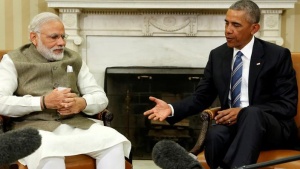
President Barack Obama welcomed Indian Prime Minister Narendra Modi to the White House for their seventh meeting since Modi took office in 2014, underscoring the warm relationship between the leaders and the world’s two largest democracies. Modi is to address the U.S. Congress on Wednesday.

“We discussed how we can, as quickly as possible, bring the Paris Agreement into force,” Obama told reporters. Climate change is a legacy issue for the U.S. president who leaves office in January.

India’s potential entrance into the agreement this year would help accelerate its enactment, perhaps years ahead of schedule. India is the world’s third-largest greenhouse gas emitter after China and the United States.

The two countries also welcomed preparations that could lead to the building of six nuclear reactors in India by U.S.-based Westinghouse, in what would be the culmination of some 10 years of work to resolve civil-nuclear issues.

The joint statement said India and the U.S. Export-Import Bank were working to complete a financing package for the project and that the Nuclear Power Corporation of India and Westinghouse had confirmed engineering and site design work would begin immediately.It said Westinghouse and the Nuclear Power Corporation of India would work toward finalizing the contract by June 2017 – a year later than Westinghouse’s chief executive, Daniel Roderick, said he hoped for in an interview with Reuters in late March.

Modi told an event organized by the U.S. India Business Council that relations between India and the United States were “closer than ever.” He said the planned reactor purchases would mark new era in nuclear and scientific cooperation.Modi’s address to a joint session of Congress will be a significant personal step. Although this has become a tradition for Indian prime ministers, he was once banned from the United States over massacres of Muslims.

More than 1,000 people, mostly Muslims, were killed in sectarian riots in Gujarat in 2002 when Modi had just become the state’s chief minister. Modi has denied any wrongdoing, and India’s Supreme Court in 2010 ruled there was no case.In the joint statement, the United States said it now recognized India as a “Major Defense Partner” and would work on technology sharing “to a level commensurate with that of its closest allies and partners.

“The text of a logistics agreement, which will allow the countries’ militaries to use each other’s land, air and naval bases, would be signed soon, a U.S. official said.

Tensions between the United States and Pakistan as well as regional concerns about China have served as a backdrop to increased security cooperation.Senator John McCain, chairman of the U.S. Senate Armed Services Committee, said the address to Congress was “entirely appropriate” given the new partnership.”

There’s no doubt there are significant tensions and challenges in the region, which argues for closer coordination between our militaries,” he said.While Modi is generally popular with U.S. lawmakers, they criticize what they see as lingering unfriendliness to U.S. firms and a stifling bureaucracy, in spite of Modi’s pro-business image. They also question New Delhi’s record on human rights.Modi got a boost on Tuesday when Amazon Inc AMZN.O Chief Executive Jeff Bezos said his company would invest an additional $3 billion in India, boosting its committed investment in the country to over $5 billion.

Source: In boost to Paris climate pact, India says it aims to join this year | Reuters

08/06/2016

U.S. Firm to Build Six Nuclear Reactors in India – India Real Time – WSJ

The U.S. and India agreed to move ahead with the construction of six nuclear reactors in India by an American company, the first such move since the countries signed a landmark civil nuclear deal in 2008.

The breakthrough capped a wide-ranging White House meeting on Tuesday between President Barack Obama and Indian Prime Minister Narendra Modi, who are seeking closer cooperation as Washington wants to boost New Delhi’s role in counterbalancing China.

The meeting, which included lunch at the White House, will be followed on Wednesday by a speech by Mr. Modi to Congress, wrapping up the Indian leader’s fourth visit to the U.S. as part of an increasingly close relationship that has been sought by both governments.

The warming Indian relationship is backed by the lure of accelerating growth in that country, signs of improvement in the business climate, shared democratic values and some overlapping strategic goals.

By contrast, recent U.S. interactions with China, a far bigger Asian economy and U.S. trading partner whose growth appears to be slowing down, have been marked by strains and warnings over economic and security issues.

Source: U.S. Firm to Build Six Nuclear Reactors in India – India Real Time – WSJ

07/06/2016

Indian solar power | The Economist

NARENDRA MODI, India’s prime minister, visits America for three days this week for talks with Barack Obama. Climate commitments may be one of many topics discussed. Six months ago 187 countries agreed to cut pollution through pledges for the UN climate talks in Paris. The deal adopted there was stronger than many expected, but much remains to be done. Even if countries manage to do all they offered, global warming will likely be held to around 3.5°C above pre-industrial temperatures. Conversely, the Paris deal aims overall to ensure warming does not exceed 2°C.

Unlike America and China, the world’s two largest polluters, India did not pledge a future reduction in aggregate emissions. It offered instead to reduce the intensity of its emissions—the amount of pollution per unit of economic output—by around a third by 2030 as measured against 2005 levels. Its greenest promise was to install 175GW of renewable power by 2022 (most of it solar). This is an enormous undertaking. In 2014, for example, the world’s entire installed solar capacity was 181GW.

The Modi government says the plans are “ambitious but achievable”. The country’s total installed solar power capacity now comes to 5.8GW; to meet its targets it will need to speed up from adding around 4GW a year to adding more than 15GW instead.

Mr Modi believes solar power is the “ultimate solution to India’s energy problem”. Of 250m households in India, 56m do not have access to electricity. The majority are in rural areas where off-grid solar installations, suitable for single homes or small clusters of buildings, could prove particularly helpful.

India’s solar programme is a good way to assess how seriously countries are taking the Paris agreement—particularly given India’s huge population and increasing economic heft. Mr Modi’s moves will illuminate the state of climate diplomacy.

Source: Daily chart: Indian solar power | The Economist

24/05/2016

China’s Middle Class Vents Over Growing List of Grievances – China Real Time Report – WSJ

The death here of a 29-year-old man in police custody—a new father and graduate of a prestigious Chinese university—has exposed growing anxieties in the country’s growing middle class, already shaken by a decelerating economy and a disparate series of high-profile incidents threatening their sense of stability.

As WSJ’s Te-Ping Chen reports:

Other wide-ranging targets of recent social-media attention include a violent string of attacks on doctors by embittered patients and their families, a demand that apartment owners in eastern China pay extra to secure the land on which their apartments were already built, confusing changes in college-entrance standards, and fatal chemical explosions wiping out homes.

Such disruptions have come as reminders that rising incomes or better education don’t automatically shield China’s expanding middle-class ranks from danger, whether physical or economic, in a society where the law can be arbitrarily enforced and justice is sometimes brutal.

“There’s a gap between expectation and reality,” said He Yunfeng, who heads Shanghai Normal University’s Institute of Knowledge and Value Sciences. “These kinds of incidents concentrated together have created a kind of panic.” Some critics have begun joking that the Chinese term for middle class— zhongchanjieji—would be better depicted by the term zhongcanjieji, or the “tragic middle class.”

Source: China’s Middle Class Vents Over Growing List of Grievances – China Real Time Report – WSJ

01/04/2016

Beware the cult of Xi | The Economist

Xi Jinping is stronger than his predecessors. His power is damaging the country

“IF OUR party can’t even handle food-safety issues properly, and keeps on mishandling them, then people will ask whether we are fit to keep ruling China.” So Xi Jinping warned officials in 2013, a year after he became the country’s leader. It was a remarkable statement for the chief of a Communist Party that has always claimed to have the backing of “the people”. It suggested that Mr Xi understood how grievances about official incompetence and corruption risked boiling over. Mr Xi rounded up tens of thousands of erring officials, waging a war on corruption of an intensity not seen since the party came to power in 1949. Many thought he was right to do so.

Today, however, China is enduring its biggest public-health scandal in years. Tens of millions of dollars-worth of black-market, out-of-date and improperly stored vaccines have been sold to government health centres, which have in turn been making money by selling them to patients.

Mr Xi’s anti-graft war has often made little difference to ordinary people. Their life—and health—is still blighted by corruption. In recent days there have also been signs of discontent with Mr Xi among the elite: official media complaining openly about reporting restrictions, a prominent businessman attacking him on his microblog, a senior editor resigning in disgust.

Mr Xi has acquired more power than any Chinese leader since Mao Zedong. It was supposed to let him get things done. What is going wrong?

Credibility gap

In fairness, Mr Xi was bound to meet with hostility. Many officials are angry because he has ripped up the compact by which they have operated and which said that they could line their pockets, so long as corruption was not flagrant and they did their job well. But Mr Xi has also found that the pursuit of power is all-consuming: it does not leave room for much else. In three and a half years in charge, he has accumulated titles at an astonishing pace. He is not only party leader, head of state and commander-in-chief, but is also running reform, the security services and the economy. In effect, the party’s hallowed notion of “collective” leadership (see article) has been jettisoned.

Mr Xi is, one analyst says, “Chairman of Everything”. At the same time, he has flouted the party’s ban on personality cults, introduced in 1982 to prevent another episode of Maoist madness. Official media are filled with fawning over “Uncle Xi” and his wife, Peng Liyuan, a folk-singer whom flatterers call “Mama Peng”. A video, released in March, of a dance called “Uncle Xi in love with Mama Peng” has already been viewed over 300,000 times. There have been rumours recently that Mr Xi feels some of this has been going a bit far. Some of the most toadying videos, such as “The east is red again” (comparing Mr Xi to Mao), have been scrubbed from the internet. Many would take that as a sign that the personality cult is little more than harmless fun.

Mr Xi is no Mao, whose tyrannical nature and love of adulation were so great that he blithely led the country into the frenzy and violence of the Cultural Revolution. Although some older Chinese squirm at a style of politics so reminiscent of days long past, there is no suggestion that China is on the brink of another such horror.

More …

No liberal, Xi

More …

Source: Beware the cult of Xi | The Economist

05/03/2016

China Sets Economic Growth Target of 6.5% to 7% for 2016 – China Real Time Report – WSJ

China has set an economic growth target of between 6.5% and 7% for 2016 and an average of at least 6.5% over the next five years, goals that acknowledge slowing momentum in the world’s second-largest economy but which still could be difficult to reach.

As WSJ’s Mark Magnier reports:

By adopting a range for the first time in two decades, China has given itself more flexibility in a system where hitting goals set far in advance, regardless of conditions on the ground, remains politically important.

The targets released here on Saturday at the opening of the National People’s Congress, China’s annual parliament, weren’t a surprise given that senior officials from President Xi Jinping on down had flagged them in recent months.

But they underscore that the government continues to prioritize stability, as output in the world’s second-largest economy downshifts faster than expected.

Last year, China’s economy grew 6.9%, its slowest pace in 25 years, compared with the 2015 target of about 7%. This year could bring a new quarter-century low, as traditional growth engines continue to lose traction.

Source: China Sets Economic Growth Target of 6.5% to 7% for 2016 – China Real Time Report – WSJ

Law of Unintended Consequences

continuously updated blog about China & India

ChiaHou's Book Reviews

continuously updated blog about China & India

What's wrong with the world; and its economy

continuously updated blog about China & India