Posts tagged ‘Barack Obama’

21/02/2016

Xi takes nuclear option in bid to rule for life | The Sunday Times

Very worrying, if true.

CHINA is moving towards one-man rule as the state media step up demands for personal loyalty to President Xi Jinping, a departure from the Communist party’s collective leadership of recent decades.

Xi Jinping appears to be building a personality cult around him as Mao did

Last week the party’s flagship newspaper issued a call for Xi to have the power to “remake the political landscape of China”. The article, supposedly written by one of a literary group, was put out on a social media account run by the People’s Daily. It said all communists must be loyal to Xi and “line up with the leadership”.

The campaign to enshrine Xi as the infallible “core” of authority is worrying many inside the political elite and coincides with China exerting its military muscle and possibly preparing to change its nuclear weapons strategy.

The People’s Liberation Army (PLA) has just stationed surface-to-air missiles on a disputed island in the South China Sea. The Chinese expansion comes as Barack Obama rallies Asian nations to support free navigation in the strategic waterway. The prospect of one man dominating the party, the state and the army in China could be the most challenging test in the next American president’s in-tray.

Xi’s grand plans include a total reorganisation of the Chinese military command structure that has included an internal debate about its nuclear weapons. Xi recently formed a dedicated PLA rocket force to control the nuclear ballistic missile arsenal. A report for the Union of Concerned Scientists, a US-based group, says China may be considering placing its nuclear forces on alert, which means that, like America and Britain, its weapons would be ready to fire on command.

That would be a shift of position for a nation that affirms it will not be the first to use nuclear weapons in any conflict. China has already started an ambitious programme to upgrade its older missiles with multiple warheads like those of other nuclear powers.

Rising military budgets show that despite the slower Chinese economy and big flows of capital out of the country, Xi is seizing any initiative to turn nationalism to his advantage. A source who grew up in the party’s privileged residential compounds in Beijing said the moves harked back to an earlier era: “There is a fear among the families, the long-time party members for generations, that this guy wants to make himself into another Chairman Mao and rule for life.”

It is clear that, like Mao, Xi, 62, is using articles and essays in the state media, often penned by pseudonymous authors or published in the provinces, to intimidate his enemies and promote himself.

Last week a social media platform controlled by the Beijing Daily, the voice of the capital’s municipal committee, launched a striking attack on a party faction opposed to Xi, the Communist Youth League. Officials connected to the league were “ambitious aristocrats whose self-serving attitude did no good to the party and led to scandals”, it sneered.

Targeting the league — whose members include the prime minister, Li Keqiang, and the former president, Hu Jintao — is a signal that Xi has broken with the consensus set after the unrest of 1989 that the party’s factions do not attack one another in public. In the past, a league connection meant a fast-track to promotion for young high-flyers. Now it seems to be a liability.

A study by the Central Commission for Discipline Inspection — the party watchdog unleashed by Xi against rivals accused of corruption — has criticised the “mentality” of league members. The commission’s propaganda publication, the China Discipline Inspection Paper, warned against “those who form their own circles inside the party” and referred to fallen officials as “gangs”.

This Mao-era language singled out the “petroleum gang” under the purged security chief, Zhou Yongkang, whose cronies dominated the Chinese oil industry, and the “secretary gang” around Ling Jihua, a close aide to Hu and a former league stalwart. Ling is already under arrest on corruption and bribery charges.

Defining people as members of “gangs” or “cliques” is a classic tactic of communist infighting and a prelude to destroying them.

Chilled by the signals from the top, half the provincial party chiefs in the country this month pledged allegiance to Xi as “the core”.

The term represents a significant change from the language used about Xi’s predecessors, Hu and Jiang Zemin, who were referred to as being only “at the core” of a collective leadership. The last strongman in China, Deng Xiaoping, exercised his power behind the scenes and scorned a cult of personality.”

Source: Xi takes nuclear option in bid to rule for life | The Sunday Times
20/02/2016

Leaders of Nepal and India mend fences after friction | Reuters

The leaders of Nepal and India have overcome mutual misgivings, India’s foreign secretary said on Saturday, after talks to ease tensions over Nepal’s recently-adopted constitution.

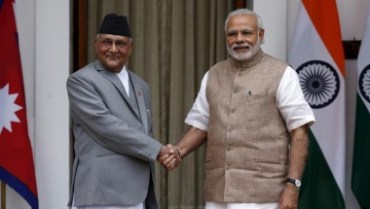
Nepal's Prime Minister Khadga Prasad Sharma Oli (L) shakes hands with his Indian counterpart Narendra Modi during a photo opportunity ahead of their meeting at Hyderabad House in New Delhi, India, February 20, 2016. REUTERS/Adnan Abidi

Prime Minister K.P. Oli visited New Delhi for talks with his Indian counterpart Narendra Modi after a months-long freeze in relations triggered by the grievances of plains dwellers in southern Nepal who have close historical ties to India.

Nepal, which moved from absolute to constitutional monarchy in 1990, made changes to its constitution to ensure greater participation of the Madhesi community in parliament.

But community leaders said the amendments failed to address their central fear that provincial borders would be redrawn in a way that would divide them.

“Our prime minister appreciated the progress made towards consolidation of constitutional democracy in Nepal,” Indian Foreign Secretary Subrahmanyan Jaishankar told a news briefing.

Source: Leaders of Nepal and India mend fences after friction | Reuters

16/02/2016

First train from China to Iran stimulates Silk Road revival – Xinhua | English.news.cn

First cargo train from China to Iran arrived in Tehran on Monday, indicating a milestone in reviving the “Silk Road,” which has opened a new chapter of win-win cooperation between China and Iran.

English: the Silk Road in Central Asia

English: the Silk Road in Central Asia (Photo credit: Wikipedia)

silk road

The train, also referred to as Silk Road train, has passed through Kazakhstan and Turkmenistan to Iran, travelling a distance of 10,399 kilometers. It had left Yiwu city in east China’s Zhejiang Province on January 28.

This train was carrying dozens of cargo containers, according to the deputy of Iran’s Road and Urbanism Minister, Mohsen Pour-Aqaei, who made a welcome speech after the arrival of the cargo train at Tehran Train Station on Monday.

As known to all, ancient Silk Road trade route had served as an important bridge for East-West trade and brought a close link between the Chinese and Persian civilizations.

The “Belt and Road” initiative was raised by Chinese President Xi Jinping in 2013, which refers to the New Silk Road Economic Belt, linking China with Europe through Central and Western Asia, and the 21st Century Maritime Silk Road, connecting China with Southeast Asian countries, Africa and Europe.

“To revive the Silk Road Economic Belt, the launch of the train is an important move, since about 700 kilometers of trip has been done per day,” said Pour-Aqaei, who was present at the welcome ceremony of the train in Tehran’s Railway Station.

“Compared to the sea voyage of the cargo ships from China’s Shanghai city to Iran’s Bandar Abbas port city, the travel time of the train was 30 days shorter,” he said.

Pour-Aqaei, also the Managing Director of Iran’s Railway Company, added that according to the plan, there would be one such a trip from China to Iran every month.

The travel of cargo train from China to Iran is part of a Chinese initiative to revive the ancient Silk Road used by the traders to commute between Europe and East Asia.

Tehran will not be the final destination of these kinds of trains from China, the Iranian deputy minister said, adding that in the future, the train will reach Europe.

This will benefit Iran as the transit course for the cargo trains from the east Asia to Europe, he said.

Chinese ambassador to Iran Pang Sen told Xinhua that as one of the cooperation projects after Chinese President Xi Jinping’s state visit to Iran, the cargo train is playing a important role to promote construction of the “Belt and Road” initiative.

Meanwhile, the railway line from Yiwu to Tehran provides the two countries an express and efficient cargo trade transportation method, Pang said, adding that the countries along the railway line will furthur upgrade rail technology with the aim to make its transportation ability faster and better.

Source: First train from China to Iran stimulates Silk Road revival – Xinhua | English.news.cn

08/02/2016

Gong Xi Fa Cai! What to expect in China’s Year of the Monkey – SCMP

The Year of the Monkey is expected to be another turbulent year for the world’s second largest economy. Here, SCMP reporters gaze into their crystal balls for what might lie ahead.

An installation celebrates the Year of the Monkey at Ditan Park in Beijing. Photo: EPA

POLITICS: Political jockeying and more crackdowns

The Communist Party will be focused on preparations for a new leadership team, to be unveiled at the 19th Party Congress next year. Apart from President Xi Jinping (習近平) and Premier Li Keqiang (李克強), the rest of the Politburo Standing Committee will have reached retirement age. The new appointments will be keenly observed for clues as to who Xi intends to succeed him.

Two of Xi’s signature campaigns – the drives against corruption and in favour of frugality in public life – are likely to continue to reshape the nation.

– Cary Huang

DIPLOMACY: Conflicts and tensions to escalate

Following Xi’s maiden presidential visit to the Middle East, Beijing is expected to increase its role as a broker in the region’s conflicts. Beijing has already hosted representatives from Syria and Afghanistan for talks. But other than calling for dialogue, China’s options are limited, partly because it does not want to be seen as interfering in the internal affairs of other nations.

With the Beijing-led Asian Infrastructure Investment Bank having just started operations, China is expected to boost its economic diplomacy by funding infrastructure projects overseas.

Tensions in the South China Sea are also expected to rise, as China is likely to continue building structures in the disputed waters. How the United States and China handle the issue – especially the Pentagon’s deployment of warships within 12 nautical miles of Chinese-controlled islands – will be the biggest concern.

– Teddy Ng

DEFENCE: Band(s) of Brothers?

The top priority of the military will be to rebuild morale and its integrity following its restructuring into five theatre commands. Xi set the tone this month by visiting Jinggangshan, the cradle of the communist revolution in China. The Eastern Theatre Command’s land force quickly followed his lead and visited Gutian in Fujian (福建) province, where the Red Army pledged obedience to the party in 1929, and saluted the party flag. Other commands are expected to make similar displays of fidelity.

It will be a bumpy road: the old ways of managing operations, carrying out orders through personal connections and using favoured contractors, has been upended. Xi wants to turn the PLA into a fighting force that meets international standards, with all the efficiencies and accountability that entails.

– Minnie Chan

ECONOMY: Pandora’s Box to open?

There’s actually little disagreement between billionaire investor George Soros and Beijing decision-makers over China’s economic prospects in 2016 – both agree growth will be lower in 2016 than that of 2015. Where they disagree is on how much and how quickly.

One thing is for sure, China will never admit an economic “hard-landing”, though investors may find plenty of evidence for one – from factory closures to rising unemployment and financial strains.

– Zhou Xin

UNEMPLOYMENT: What’s the real picture?

Of all of China’s official economic indicators, the registered urban jobless rate is possibly the least reliable. The rate, released quarterly, has barely ever moved from 4.1 per cent in recent years, regardless of the economic cycle. Another jobless rate compiled by the statistics agency, which is increasingly being cited by the premier, claims a level of about 5 per cent.

Neither of these official rates are likely to change much throughout 2016.

– Zhou Xin

A-shares: Beware the bear!

The mainland’s stock market, after witnessing a sharp fall at the beginning of 2016, is expected to continue a bear run in the Year of Monkey amid a crisis of confidence.

A depreciating yuan, the imminent launch of the new initial public offering (IPO) mechanism and a bleak outlook for corporate earnings are set to exacerbate weak sentiment with millions of retail investors suffering paper losses following a market rout last year.

Local investors are increasingly betting on a further downturn in the A-share market.

Corporate earnings are likely to stay flat in 2016 despite Beijing’s increased efforts to navigate a transition to a consumer-led growth.

– Daniel Ren

Consumption: Bittersweet for retailers

Online stores are continuing to take business from their brick-and-mortar counterparts.

While overall consumption growth is expected to further slow in 2016, bringing problems for both sectors, shopping malls and big stores face their own particular woes.

Hypermarkets could see custom slow, but business at smaller formats such as mini-marts and convenience stores should remain stable.

People will continue to spend more on tourism, leisure, food and health-related products.

Domestic brands will continue to gain ground on foreign ones.

Women will continue to take a greater role in driving spending. Consulting firm Mintel found more than half of Chinese mothers control the family budget and that women are more willing to try new products and experiences than men.

– Mandy Zuo

E-commerce: Click, click, click to buy, buy, buy

The personal computer era is over. Mobile-commerce, which enables people to buy everything from anywhere via the internet, is dominating the online sector and this trend shows no sign of stopping.

Retail on WeChat, the most popular social media platform, is expected to grow steadily. The mobile platform is also becoming an important tool of advertising and communication for businesses.

Online to offline (O2O) business will continue to boom as mainlanders show growing interest and loyalty in professional home services such as home cleaning and massage.

With growing demand from mainland consumers for prime goods overseas, fiercer competition is expected in cross-border business. Internet giants, entrepreneurs and small businesses will flock to the sector, which the Ministry of Commerce projects will grow an average 30 per cent in the next few years.

– Mandy Zuo

P2P lending: More closures, collapses and runaway owners

The long-awaited regulations reining in peer-to-peer lending are expected to bring an industry shakeup that will knock out a significant number of players.

Industry data showed the number of P2P lending platforms dropped a second consecutive month to 2,566 at the end of January from 2,595 in December.

The draft rules, released by the China Banking Regulatory Commission at the end of 2015, define P2P lending platforms as internet financing intermediaries and forbid them from selling wealth management and other financial products that attract investors with promises of high returns.

– Kwong Man-ki

Tourism: Slowdown, what slowdown?

Despite the economic slowdown, the depreciation of the yuan and turmoil in the stock markets, Chinese tourists passed a milestone last year – making a record 120 million outbound trips and spending US$104.5 billion to make China the world’s leading source of tourists.

The boom is expected to continue this year, thanks to a relaxation in visa policies in more countries as well as a strong yuan against the euro and yen.

– Laura Zhou

Childbirth: More buns in the oven

The Year of the Monkey is traditionally regarded an auspicious year for giving birth, so it will prove popular with people planning families. Some of those may have delayed their plans from the Year of the Goat, which is decidedly inauspicious.

More of the newborns are likely to be second children, as parents seek to benefit from the new policy allowing all couples to have two children.

– Zhuang Pinghui

URBANISATION: Millions to relocate

Urbanisation will maintain its pace with millions relocating, most of them rural residents.

They will continue to move to cities near rivers, railway lines and coastlines and more of them will be migrating with spouses and children.

The policy of issuing residence permits to migrants and granting urban household registrations to rural residents are helping them to access public services and integrate in urban life.

– Zhuang Pinghui

ENVIRONMENT: More smoggy days?

As the new five-year plan period (2016-2020) begins, cities will need to set targets on how to improve water and air quality. But whether much can be done to reduce smog problems – especially in heavily polluted city clusters near Beijing and Shanghai – depends largely on how determined local governments are to slash overcapacity in heavy industries.

At the end of 2015, Beijing’s persistent smog pushed the city authorities to pledge better management of small-scale coal burning. If other cities follow suit, the move could impact China’s environmental footprint.

– Li Jing

http://www.scmp.com/news/china/policies-politics/article/1910019/kung-hei-fat-choy-what-expect-chinas-year-monkey

24/01/2016

Well-wishing | The Economist

SINCE he took over as China’s leader in 2012, Xi Jinping has been a busy globetrotter. Last year he visited more countries than Barack Obama, America’s president (14 against 11).

Heedless of whether his hosts are powerful, puny or pariahs, he has flown everywhere from America to the Maldives and Zimbabwe. Mr Xi wants to project China’s rising power—and his role in promoting that—to foreign and domestic audiences. But until this week, he had not set a presidential foot in the Middle East.

The trip, under way as The Economist went to press, began in Saudi Arabia (whose king, Salman bin Abdul Aziz, is pictured with Mr Xi). He then visited Egypt and was due to finish his tour in Iran. No Chinese president had toured the region since 2009. China’s leaders had worried about getting embroiled in the region’s intractable disputes. But China has a big stake in the Middle East. It is the world’s largest oil importer and gets more than half of its crude from the region (see chart). Mr Xi’s much ballyhooed “new Silk Route”, aimed at linking China and Europe with the help of Chinese-funded infrastructure, runs across the Middle East. Chinese companies are already building expressways and harbours there. In this section Divorce: a love story Well-wishing Reprints Related topics Middle East Politics Government and politics World politics Asia-Pacific politics

The timing of Mr Xi’s tour is tricky. Tensions between Saudi Arabia and Iran are particularly high after Saudi Arabia executed a Shia cleric earlier this month and angry Iranians responded by storming the Saudi embassy in Tehran. But the lifting of Western sanctions on Iran on January 16th (see article) allowed Mr Xi to display even-handedness by visiting both countries, without upsetting Western powers. Mr Xi, like his predecessors, likes to present China as a non-interfering champion of peace. (Xinhua, China’s state-run news agency, said this week that the West’s “meddling hands” were “more of a mortal poison than of a magic potion” in the Middle East.) But Mr Xi is not keen to play a central role as peacemaker. China’s first “Arab Policy Paper”, released on January 13th, is a vague, waffly document. It talks of “building a new type of international relations”, but is devoid of new ideas.

Zhang Ming, a vice-foreign minister, said this week that economic development was the “ultimate way out” of conflict in the region. By expanding its trade and investment links with the Middle East, China hopes discontent and conflict there will gradually dissipate. In addition to crushing dissent, it is trying a similar approach in Xinjiang, a province in western China with a large Muslim population—so far without success.

In the long run, China may find it hard to avoid taking sides. To some extent it has already done so in Syria: it talks to representatives from both the Syrian government and the opposition, but by vetoing UN resolutions on intervention it tilts, in effect, in the government’s favour. The presence of a growing number of Chinese citizens in the Middle East may challenge China’s non-interventionist approach. After a Chinese national was executed by Islamic State in November, China promised to strengthen protection of its citizens abroad. Its new rules of Middle Eastern diplomacy could end up resembling familiar Western meddling

Source: Well-wishing | The Economist

22/01/2016

Chinese president offers remedies for Mideast predicaments, aid to Arab development – Xinhua | English.news.cn

Out-of-the box thinking.  Hope other major powers start to subscribe to this point of view. The current ones  of taking sides and partisan fighting isn’t working.

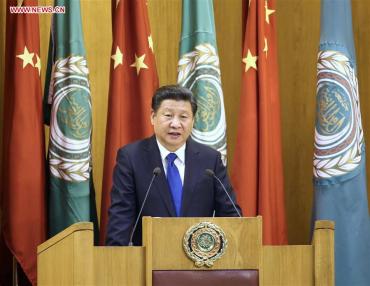
“Visiting Chinese President Xi Jinping on Thursday prescribed his remedies to restore peace in the Middle East and promote development in the Arab world.

EGYPT-CAIRO-CHINA-XI JINPING-VISIT

While delivering a speech at the headquarters of the Arab League, Xi described the Middle East region, which in many’s eyes is almost an equivalent to wars and tumult, as a “land of abundance.”

PATH TO PEACE

The Chinese leader concluded in the remarks that dialogues and development are the key factors that can help bring peace and stability back in this part of the world.

He said use of force offers no solution to problems, neither will zero-sum mentality bring enduring peace, adding that for the success of talks, there is need for utmost patience and flexibility.

Speaking of the Syrian crisis, he said there will be no winner out of a conflict, and to address the hot-spots, what is the most urgent, is to bring about cease-fire and start political talks.

Xi also believed that turmoil in the Middle East stems from the lack of development, while the ultimate solution will depend on development, saying that only when young people are able to live a fulfilled life with dignity can hope prevail in their heart. Only then will they voluntarily reject violence, extremist ideologies and terrorism.

Mahmoud Allam, former Egyptian ambassador to China, admitted that many of the deep-rooted problems the Arab world is grappling with have been the result of failures to achieve a successful development model, saying development is no doubt the most viable path of mobilizing people toward achieving their common interests and overcoming disagreements.

TANGIBLE HELP

Also in his speech, the Chinese president introduced a host of fresh moves including loans, financial aid and common investment fund to help improve livelihood, fight terrorism and promote development in the Arab world.

The Chinese government has decided to pledge 50 million RMB (7.53 million U.S. dollars) to help improve the lives of the Palestinians and 230 million RMB (about 35 million dollars) for Syria, Jordan, Lebanon, Libya and Yemen as humanitarian assistance, said Xi.

Beijing also wants to promote the industrialization in the Middle East. To achieve that end, China is going to hand out a number of loan programs, including a 15-billion exclusive loan, a 10-billion business lending, and 10 billion concessional loans so as to facilitate production capacity cooperation between China and the regional countries, according to the president.

Meanwhile, China also prepares to work with the United Arab Emirates and Qatar to set up a common investment fund worth 20 billion dollars that focuses on traditional sources of energy in the Middle East, infrastructure, and high-end manufacturing.

Xi also offered in his speech 300 million dollars for law enforcement cooperation, police training so as to help build up the abilities of the regional countries to maintain stability.China also planned to provide 1,000 training opportunities for young Arab leaders, and strengthen exchanges among their think tanks, experts and scholars.

CHINA’S DOS AND DON’TS IN MIDEAST

The Chinese leader also said his country will neither look for proxies nor try to fill any “vacuum” in the Middle East, adding that Beijing has no intention of building any sphere of influence in the region.

“Instead of looking for a proxy in the Middle East, we promote peace talks; instead of seeking any sphere of influence, we call on all parties to join the circle of friends for the Belt and Road Initiative; instead of attempting to fill the ‘vacuum’, we build a cooperative partnership network for win-win outcomes,” he said.

Meanwhile, Xi promised that China will not link terrorism with any specific ethnic group or religion, as doing so will only create ethnic and religious tensions, adding that there should be no double standards in battling terrorism.

Also, he said the Middle East is the meeting place of ancient human civilizations and home to diverse and splendid cultures. China will continue to unswervingly support Middle East and Arab states in preserving their ethnic and cultural traditions, and oppose all forms of discrimination and prejudice against specific ethnic group and religion.”

Source: Chinese president offers remedies for Mideast predicaments, aid to Arab development – Xinhua | English.news.cn

08/01/2016

Three political questions looming over China’s leadership in 2016 – WSJ China Real Time

From: http://blogs.wsj.com/chinarealtime/2016/01/08/three-political-questions-looming-over-chinas-leadership-in-2016/?mod=djemChinaRTR_h

Last year saw more attention to Chinese President Xi Jinping as China’s paramount leader, including what many observers have seen as a cult of personality. The economy may eclipse politics as a concern for Beijing in 2016, but in China the two are always closely intertwined. Here are the three major political questions that will loom over the Xi leadership in the months to come.

  1. Is it time for thelong-running anticorruption campaignto shift its focus?

In laying out a vision for his anti-corruption drive in 2013, Xi Jinping vowed to go after both high-ranking “tigers” and low-level “flies.” So far the campaign has been fueled by the takedowns of a procession of big cats – but there are signs that a change is in the offing.

There’s upside to an increased focus on local cadres and others at the insect level. For one, it would send a signal to doubters that the anti-graft campaign is genuine, not just a way to purge Xi’s political enemies. It would also help Xi score points with regular citizens and reform-minded officials outraged at the pervasiveness of corruption in China.

But there’s also a political risk. Already, the current crusade has compelled many officials to hunker down and sit on their hands to avoid attracting attention – a phenomenon that has slowed policymaking. Likewise, many developers remain wary of starting new projects that might aid an ailing economy because they’re still not sure what’s permissible in the new environment.

Broadening the anti-graft campaign could handcuff policymaking even further, because cadres will spend time looking over their shoulders, and entrepreneurs, wondering about political support, will wait until the dust settles before embarking on new commercial initiatives.

  1. What sort of politics does China want to practice?

Xi Jinping and Chinese Premier Li Keqiang agree on a great deal, but they have distinctive notions about how to build a better China.

Xi believes that China’s political future rests on a reassertion of the party’s rule, preventing potential challenges from social groups, and convincing citizens and cadres alike that the government stands for something more than just nationalism — that socialism is still relevant but needs to be recast in ways that appeal to society.

Li appears to see his political mission differently. In his eyes, ideological renovation is far less crucial to the country than administrative restructuring and being a more efficient and approachable government. It’s innovation, not rectification, Li argues, that will secure the Party’s legitimacy. From experimenting with new ways to measure China’s actual economic performance to making bureaucratic requirements easier for citizens to meet, Li has created a profile for himself that challenges the prevailing political course being set by Xi.

While Xi wants more control over society, Li argues for less oversight and regulation in China’s economy and bureaucracy–making it easier for businesses to start up and succeed as a way of preventing social pressure from becoming a political threat.

Thus far, the policy divide between Xi and Li hasn’t resulted in political warfare. But some lower-level cadres are increasingly perplexed about which template to follow: They’ve been quietly pressing for clarification about whether they should be focusing on being better Communists, or on building a more efficient and responsive government. It’s not clear how they can accomplish both, especially when they’re under the anticorruption microscope.

The economy could catalyze conflict here. If slower growth turns into a tailspin, Li and his allies will surely press to have their agenda for change adopted more widely, and argue that the current strategy of “politics before economics” championed by Xi isn’t working. Xi and his comrades won’t concede the political high-ground they currently occupy without a fight.

Xi and Li have been doing a fine job of sharing responsibility up to now, but the divide in their approaches is getting wider, and the challenges China faces will very likely compel one model to be adopted at the expense of the other.

  1. What happens if resistance to Xi’s reforms becomes active political opposition?

Xi’s efforts to centralize party control over the economy and society have been ruthless. Even the hint of organized opposition to party policies has brought out the truncheon swingers, with censorship or jail awaiting those who propose an alternative political path for China.

Observers who see Xi’s main opposition as coming from the Chinese street are looking down a now-empty avenue. They should be paying attention to disquiet within the ranks of officialdom.

The boldness and breadth of Xi’s reforms have led some in the party ranks to wonder privately about—and even openly question—whether his handling of China’s challenges has always been correct. For example, there are some who contend that the anticorruption campaign has placed too much power in the hands of discipline inspectors and unnecessarily disrupted the status quo (in Chinese).

Some of that scrutiny concerns Xi’s efforts to reinsert the Party more fully into economic and social life, a move that risks stoking discontent in a populace that has grown used to a certain level of leeway in recent decades. There are also those within the political apparatus who see Xi’s recent restructuring of China’s military as courageous but more aimed at quelling dissent from the armed forces than rejuvenating strategy and doctrine. Even Xi himself has noted in a recently released collection of internal speeches (in Chinese) that not everything he has been doing has been met with universal acclaim within the Communist party. Murmurs of discord have reached a level in recent months where a number of officials have been punished for “improper discussion” of Party policies.

Thus far, the angst, anxiety and antagonism within the government to Xi’s reforms remain unorganized. That’s because no one has proposed an alternative strategy for dealing with the nation’s many challenges that would unify the disaffected to act against Beijing. Social activists have little political support from above; annoyed cadres are afraid that any move to form a coalition could plunge the country into civil unrest.

Xi and his allies have been as determined as they’ve been daring in following their own reform path—and their success in getting their way politically has been remarkable thus far. The most pressing question for this new year is whether what has worked thus far will continue to do so—or whether the disaffected in China start believing that their leadership may have begun to run out of answers.


10/12/2015

China to introduce tough emissions controls for ships | Reuters

China will introduce tough controls on ship emissions at three key port areas from January to reduce sulfur dioxide which results in acid rain, causing respiratory difficulties and sometimes premature death, said the Ministry of Transport.

Shipping containers are seen on a ship docked at a port in Rizhao, Shandong province, China, December 6, 2015. REUTERS/Stringer

If strictly implemented the move would force oil suppliers to increase the supply of cleaner marine fuel, industry experts said. The ministry gave no details on how the new emissions rules would be enforced or penalties for non-compliance.

The new rules will apply to merchant ships navigating or anchoring in the waters of Pearl River Delta, Yangtze River Delta and the Bohai Bay rim, with a goal to cut sulfur dioxide by 65 percent by 2020 from the 2015 level, according to a document issued by the Ministry of Transport.

Similar emissions control areas exist in the North Sea and the north American coast.

Ships berthed at ports within the three Chinese emissions control zones will start using bunker fuel with a maximum sulfur dioxide (SO2) content of 0.5 percent from January 2016, the ministry said.

Hong Kong made it mandatory in July for merchant ships to switch to fuel with a SO2 content of 0.5 percent from high sulfur fuel. Neighboring Shenzhen port launched a voluntary fuel switching scheme in July this year that is expected to cost 200 million yuan ($31.07 million) in subsidies over three years.

Enforcement of the new emission measures will initially be up to individual ports, but the controls will be toughened in 2017 to cover all key ports in the three control areas.

They will be tightened further from the start of 2019, when ships entering control zones, not just berthed or anchored, will have to use 0.5 percent SO2 bunker fuel or below. Fishing, sports and military vessels will be exempt, said the ministry.

Oil consultancy ICIS estimated that majority of fuel use in China’s shipping sector is currently using fuel with 1-2 percent SO2 content.

The International Maritime Organization (IMO), a U.N. body which regulates merchant shipping, plans to introduce a global cap on ship emissions in either 2020 or 2025.

The IMO will carry out a review in 2018 that will include an assessment of the availability of low-sulfur fuel that will be used to decide the actual implementation date.

Source: China to introduce tough emissions controls for ships | Reuters

04/12/2015

China’s Tech Industry Is as Male-Dominated as Silicon Valley – China Real Time Report – WSJ

When Chinese President Xi Jinping met with top U.S. and Chinese technology executives in Seattle two months ago, they posed for a now-famous group photo. But one thing was missing: women from China.

As WSJ’s Li Yuan writes in her “China Circuit” column: This defies the conventional wisdom in China that compared with Silicon Valley, China’s tech industry has less of a gender-inequality problem. True, women accounted for nine out of 30 Alibaba partners when it went public in 2014. Both Alibaba and Baidu’s chief financial officers are women. Some of China’s most prominent venture capitalists are women, too.

But the group photo attests to what is really happening behind the success stories: China’s tech industry is as male-dominated as that of Silicon Valley. And unlike the debate and discussions taking place in Silicon Valley about gender inequality, China’s tech industry has yet to acknowledge the problem. With the​tech sector becoming the brightest spot in a sluggish economy, women risk losing out in the competition for the best-paying jobs and the best opportunities to start their own businesses.

Source: China’s Tech Industry Is as Male-Dominated as Silicon Valley – China Real Time Report – WSJ

30/11/2015

Smog chokes Chinese, Indian capitals as climate talks begin | Reuters

The capitals of the world’s two most populous nations, China and India, were blanketed in hazardous, choking smog on Monday as climate change talks began in Paris, where leaders of both countries are among the participants.

China’s capital Beijing maintained an “orange” pollution alert, the second-highest level, on Monday, closing highways, halting or suspending construction and prompting a warning to residents to stay indoors.

The choking pollution was caused by the “unfavourable” weather, the Ministry of Environmental Protection said on Sunday. Emissions in northern China soar over winter as urban heating systems are switched on and low wind speeds have meant that polluted air has not been dispersed.

In New Delhi, the U.S. embassy’s monitoring station recorded an air quality index of 372, which puts air pollution levels well into “hazardous” territory. A thick smog blanketed the city and visibility was down to about 200 yards (metres).

Air quality in the city of 16 million is usually bad in winter, when coal fires are lit by the poor to ward off the cold. Traffic fumes, too, are trapped over the city by a temperature inversion and the lack of wind.

However, the government has not raised any alarm over the current air quality and no advisories have been issued to the public. Thirty thousand runners took part in a half marathon at the weekend, when pollution levels were just as high.

In Beijing, a city of 22.5 million, the air quality index in some parts of the city soared to 500, its highest possible level. At levels higher than 300, residents are encouraged to remain indoors, according to government guidelines.

The hazardous air underscores the challenge facing the government as it battles pollution caused by the coal-burning power industry and will raise questions about its ability to clean up its economy at the talks in Paris.

Chinese President Xi Jinping and Indian Prime Minister Narendra Modi are both in Paris and both were scheduled to meet U.S. President Barack Obama on Monday to give momentum to the two-week negotiations.

Source: Smog chokes Chinese, Indian capitals as climate talks begin | Reuters

Law of Unintended Consequences

continuously updated blog about China & India

ChiaHou's Book Reviews

continuously updated blog about China & India

What's wrong with the world; and its economy

continuously updated blog about China & India