Posts tagged ‘BBC’

30/11/2016

India prisons: Why security needs to be improved – BBC News

Two major jailbreaks in a month have shone a spotlight on security in India’s overcrowded and under-staffed prisons. BBC Hindi’s Vineet Khare reports.
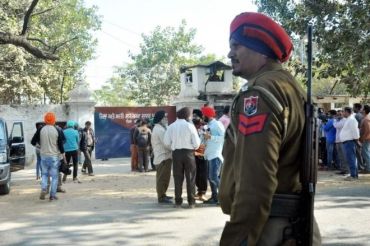
On Sunday, five armed men in the northern state of Punjab attacked the high-security Nabha prison and freed six inmates. One of the escapees, a Sikh separatist leader, was recaptured on Monday.

It was a brazen attack. Assailants dressed in police uniforms arrived “on the pretext of depositing a prisoner” but began firing indiscriminately as soon as the prison gate was opened. They escaped with the inmates in a convoy of vehicles.

“This is what happens when there is diversion of jail staff to non-jail work and infrastructure is creaking,” said retired police officer Prakash Singh.

Prison break: Four unusual ways Indians have escaped jail

A bad seven days for Indian justice

More than 180 prisoners have escaped in more than 40 jailbreaks over the past two years, latest government figures say

Last year, two inmates escaped from the high-profile Tihar jail in the capital Delhi by digging a tunnel under a wall.

Last month, eight prisoners escaped from a high-security jail in the city of Bhopal in central Madhya Pradesh state. The inmates, members of an outlawed Islamist group, were killed outside Bhopal after they resisted arrest, police said.

Eight prisoners escaped from this prison in Bhopal last month

The men used bed sheets to scale the walls of the prison before escaping the high-security Bhopal Central Prison, police said.

The police version was questioned when unverified videos of the killing of the men surfaced from the outlawed Students Islamic Movement of India. The matter is being investigated.

India’s prisons are notoriously overcrowded and under-resourced.

Some 1,400 prisons house nearly 420,000 inmates against a capacity of 366,7810, according to India’s National Crime Records Bureau.

More than a third of positions for prison guards and officers are lying vacant. Nearly half of the staff positions in Tihar are vacant.

Inmates ‘do everything’

It is estimated that more than two-thirds of the prisoners in Indian jails are on trial, contributing significantly to overcrowding.The Bhopal jailbreak, described as an act of coldblooded murder by the inmates’ lawyer, served again to highlight what was wrong with India’s prisons.

The prison houses more than 3,000 inmates against a capacity of 1,400.

Madhya Pradesh also has a history of jailbreaks:In 2011, nine prisoners spiked the tea of six guards of the state’s Dabra prison and ran away

In 2013, five captives broke through the washroom window of the dilapidated Khandwa prison and escaped

Retired jail officials say no one is paying attention to a system that is crying out loud for support.

“Our jails are collapsing,” retired jail official GK Agarwal told me in Bhopal, showing me a number of handwritten official correspondences to officials, in which he had pleaded for reforms.

Two years ago, in a missive to top officials, Mr Agarwal had predicted a “big accident” at Bhopal jail owing to its “structure, vulnerable points, imprudent security and staff’s deplorable situation”.

But Mr Agarwal said nothing had moved.

Lawyer Dr Siddhartha Gupta, who spent two days in the jail on a minor charge of “disturbing peace outside the court” told me: “The presence of guards inside is next to nothing.”

It’s the inmates who do everything. From cooking to office jobs to counting inmates, everything is done by them.

“Under pressure to act, Madhya Pradesh’s new head of prisons, Sanjay Choudhary, is promising “speedy modernisation”.

“We are enhancing security, increasing manpower and creating a high-security zone,” he said.

Source: India prisons: Why security needs to be improved – BBC News
30/09/2016

Glass loos with a view open in China – BBC News

Whatever will the Chinese think of next?

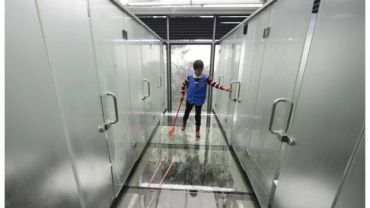
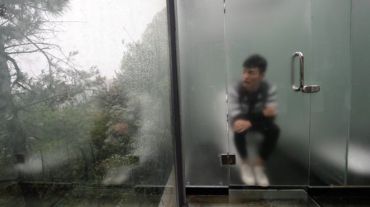
China’s recent obsession with glass tourist attractions has gone round the U-bend with the opening of some see-through treetop public toilets.

The loos, near Shiyan Lake in southern Hunan province, have fabulous views of both the forest below and other people using the facilities.

Cubicle walls, even those between the men’s and women’s sections, are only separated by lightly frosted glass.

But state media said few visitors dared use the loos on their opening day.

Image copyrightBARCROFT IMAGESImage caption

Shy users of the urinals may take comfort from the privacy barriers between them, though not in the fact they are made of glass

Despite a boom in the construction of glass bridges and walkways in scenic locations in China in recent years – in some cases so popular they had to be closed – these are thought to be the first entirely glass public bathrooms in the country.

However, it not the first time those busting to go have been exposed a little more than they might like by the enthusiasm for glass.

There were reports recently of some male toilets in a university dorm in Hunan which included one very public cubicle.

Image copyrightBARCROFTImage captionUnusually, a head for heights is a requirement for a job as a cleaner there

Image copyrightBARCROFTImage caption Awkward: cubicle walls are only lightly-frosted, even between the men’s and women’s sections

News of the wide-view WCs at Shiyan Lake sparked a range of reactions online.Responding to a Facebook post about it by state television channel CCTV, Ejike Nnadi summed up the feelings of many: “Hell no.”

Others were more taken by the idea. “You’ll be surprised by what you can tolerate when you really, really need to go,” said one post.

Another nodded towards another modern use for restrooms: “I’d be in there ’til my battery hit zero if there was signal in there!”

Image copyrightBARCROFTImage captionThe well-lit lavs are built on a steep hillside

Tina Chen took a dimmer view of all such projects though. “(It) is not about being shy, just again someone had extra money to waste.”

Image copyrightGETTY IMAGESImage caption Unusual glass structures have provided popular photo ops for tourists across China

Awkward or not, it is hoped that these bathrooms for the brave will encourage tourists to visit the countryside around Changsha city and admire the spectacular autumn colours of its forests.

Source: Glass loos with a view open in China – BBC News

15/09/2016

Censors clamp down on China’s ‘Traingate’ – BBC News

In Britain the leader of the Labour Party, Jeremy Corbyn became embroiled in a very public argument with a rail company about whether or not he was able to get a seat on one of its trains – a controversy that quickly acquired the nickname ‘Traingate’.

Now China is experiencing its own Traingate moment, but in this case the official whose behaviour has come under scrutiny seems to be getting help to minimise discussion of his actions.

Chinese government censors are reportedly censoring mentions of Pan Changjie, the Deputy Commander of the People’s Armed Police Force, who it is claimed used his rank to secure first class seats on a high-speed train.

It’s alleged that Pan compounded the offence by refusing to let a passenger sit in her reserved seat during a journey from Tangshan to Dandong. To make matter worse, Communist Party officials are not allowed to travel first class, and so the incident has enraged some online users.

Anjing_BerBer says Pan refused to get out of her reserved seat

However, most posts that mention Pan appear to have been swiftly taken offline.

The allegations surfaced when a woman with the social media handle ‘Anjing_BerBer’ blogged about her experiences of travelling on the same train as Pan and his colleagues on 6 September.

The woman said she had bought a first class reserved seat. But she described how, when she boarded the train, she found Pan in her seat, surrounded by a group of officials. She asked him to move, but said that he refused, and said warningly, “We’re from the Beijing Armed Police.”

She took her phone out to film him but describes how she was “blocked and threatened by black-clad Special Police“. However, she managed to take a picture of Pan and some of his colleagues playing cards on the train, while she was forced to stand for most of the journey.

The woman’s post with the photo was removed from the social media platform Weibo, a fact she noted in a later post. “My published article was ‘automatically’ deleted. How strange! There might be someone who has a guilty conscience,” she wrote.

“My published article was ‘automatically’ deleted. How strange! There might be someone who has a guilty conscience.”

No media in mainland China have mentioned the alleged incident and a search of Pan’s name on leading search engine Baid brings up news reports only from as recently as August.

Posts on Weibo that mention Pan have been quickly taken offline by government censors. According to censorship-monitoring website Free Weibo, “Pan Changjie” is currently one of the top 10 censored search terms.

Source: Censors clamp down on China’s ‘Traingate’ – BBC News

01/07/2014

BBC News – English explodes in India – and it’s not just Hinglish

Anyone who travels beyond Delhi and Mumbai to India’s provincial cities will notice English words cropping up increasingly in Hindi conversation. While some of these terms fell out of use in the UK decades ago, others are familiar, but used in bold new ways.

Indian sigh: Spirtual Walk

Picture the scene. I’m chatting to a young man named Yuvraj Singh. He’s a college student in the Indian city of Dehra Dun. We’re talking in Hindi. But every so often there’s an English word. It’s Hindi, Hindi, Hindi, and then suddenly an English word or phrase is dropped in: “job”, “love story” or “adjust”.

What should we make of this? It’s not that Hindi lacks equivalent words. He could have said the Hindi “kaam” instead of “job”. Why mention the English words? And what’s Yuvraj speaking? Is it Hindi, English, an amalgam “Hinglish“, or something else?

In 1886 Henry Yule and Arthur Burnell published Hobson-Jobson, a guide to words from Indian languages that had passed into English.

You can search through it for references to the origins of words such as “shampoo” and “bungalow”. But now many Indian citizens are using English words in the course of talking Hindi – or Tamil, or Bengali etcetera.

Continue reading the main story

Find out more

Listen to From Our Own Correspondent for insight and analysis from BBC journalists, correspondents and writers from around the world

Broadcast on Radio 4 on Thursdays and Saturdays at 11:30 BST and BBC World Service

Listen to the programme

Download the programme

Sometimes you hear English swear words where you would least expect them.

There are some good reasons for the explosion of English words. They are sometimes badges of honour in a society intent on becoming modern. Even if you don’t speak English fluently, you might be able to use the odd word to impress your neighbour.

I was travelling on a train out of Delhi once and a young girl dropped her ice cream on the carriage floor. Her mother turned round and reminded her of what she evidently thought was an appropriate English word: “Say ‘shit!’ Say ‘shit’!” she said strictly. You won’t hear that on the 08:15 to Paddington.

via BBC News – English explodes in India – and it’s not just Hinglish.

07/03/2014

BBC News – Chaori Solar in landmark Chinese bond default

Solar panel maker Shanghai Chaori Solar Energy Science & Technology has defaulted on interest payments owed on its bond, say media reports quoting the firm.

Solar panels

It is the first Chinese firm ever to default on its onshore corporate bonds.

On Tuesday, the firm warned it would be unable to make a 89.8 million yuan ($14.6m; £8.7m) interest payment on a one billion yuan bond issued in 2012.

The default is seen as a test case for the Chinese government.

Investors have assumed in the past that the Chinese government would bail out any Chinese corporation in danger of defaulting.

The move to allow Chaori to default signals a new stance.

“There’s never been a corporate bond default, [so] investors have been conditioned that there is no such thing as risk in China,” Leland Miller, president of research firm China Beige Book, told the BBC.

“The Chinese leadership is trying to break down this misunderstanding that everything is backstopped.”

Chaori Solar said it planned to pay 4 million yuan ($654,000) of the interest payment due on the billion yuan bond, which was taken out two years ago.

via BBC News – Chaori Solar in landmark Chinese bond default.

Enhanced by Zemanta
Law of Unintended Consequences

continuously updated blog about China & India

ChiaHou's Book Reviews

continuously updated blog about China & India

What's wrong with the world; and its economy

continuously updated blog about China & India