Posts tagged ‘Beijing’

22/06/2016

China’s newest space rocket, Long March 7, ready for blast-off | South China Morning Post

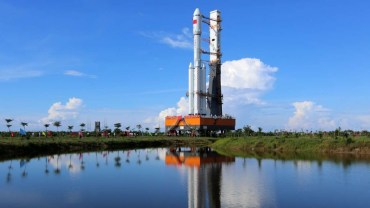
China’s latest Long March rocket arrived on the launch pad on Wednesday morning three days before it is due for blast-off on the maiden launch of both the rocket and the launch site.

At 8am on Wednesday the 600-tonnes Long March 7 rocket began a three-hour rail journey of several kilometres from the assembly complex to the launch site at Wenchang Satellite Launch Centre, China Central Television reported.

The Long March 7 will use new liquid fuel, which is environmentally friendly and costs only a fraction of the fuel used by its predecessor, LM-2.It will be carrying a test model of China’s next-generation manned spacecraft, together with several small satellites.

China’s second space lab to go into orbit this year as part of permanent manned space station by 2022

The rocket’s role in future will be to send up cargo ships to the Chinese space station.

If the weather turns bad on Saturday – which is not uncommon at the nation’s southernmost launch site on the tropical Hainan Island – the launch window will be able to remain open until Wednesday.

This launch will be different from others carried out by China because the public will be able to watch what happens in person on the mainland for the first time.

Eight designated “best spot” viewing areas covering 40 hectares around the launch site, including public parks and a private hotel beach, can accommodate about 25,000 spectators.

“This launch will open a new chapter in the history of Chinese space exploration,” a space scientist involved in the development of the new Long March rockets told the South China Morning Post.

“The blast of flames, rise of vapour, the chest-pounding noise and the trembling of the ground under people’s feet … it will be a life-changing experience for many people [watching],” the scientist said.

Source: China’s newest space rocket, Long March 7, ready for blast-off | South China Morning Post

18/06/2016

The great crawl | The Economist

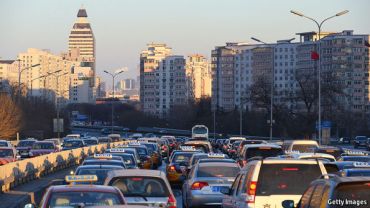
LATE last month a black-and-white photograph of a professor from Beijing Jiaotong University spread on social media. His image was edged by a black frame, like those displayed at funerals in China, and trimmed with white flowers of mourning. Though Mao Baohua is still very much alive, he had angered netizens enough to depict him as dead. His crime? To suggest that Beijing should follow the likes of London and Stockholm, by charging drivers 20-50 yuan ($3-7.50) to enter the capital’s busiest areas in the hope of easing traffic flow in the gridlocked city.

Most Chinese urbanites see buying a vehicle as a rite of passage: a symbol of wealth, status and autonomy, as it once was in America. Hence their outrage at any restraint on driving. Since car ownership is more concentrated among middle- and high-income earners in China than it is in richer countries, any attack on driving is, in effect, essentially aimed at the middle class, a group the Communist Party is keen to keep on side. That makes it hard to push through changes its members dislike.

Since 2009 officials in Beijing and the southern city of Guangzhou have repeatedly aired the idea of introducing congestion charges. Netizens have fought back, accusing their governments of being lazy, brutal and greedy. Many also gripe that the policy would be “unfair” because the fee would have less impact on the super-rich. Complaints about the inequality of congestion charging echo those made in London and other cities before they launched such schemes. But the party, nervous of being accused of straying from socialism, is particularly sensitive to accusations that it is favouring the wealthiest.

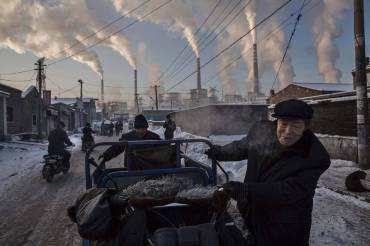
Because of such objections, city governments have not pushed their proposals very hard. But that is now changing in Beijing, where officials face a dilemma. Traffic jams in the city and appalling air pollution—30% of which comes from vehicle fumes, by official reckoning—may end up causing as much popular resentment as any surcharge. The local government is trying to work out how close it is to this tipping point. It is conducting surveys to “pressure test” how people would react to a congestion fee, says Yuan Yue of Horizon, China’s biggest polling company (the results will not be made public). It is likely that a concrete plan for a congestion charge will be announced soon. Beijing’s environmental and transport departments (not usual partners) are collaborating on a draft. State media have recently published a flurry of articles about this, not all in favour.

Public opinion is not the only challenge a congestion scheme faces. The urban planners who conceived Beijing’s layout, and that of other Chinese cities, never imagined that so many people would want to drive. The capital now has 3.6m privately owned cars: the number per 1,000 people in Beijing has increased an astonishing 21-fold since 2000, according to our sister company, the Economist Intelligence Unit (see chart).

On most days large tracts of the capital are now bumper to bumper amid a cacophony of car horns. Beijingers have the longest average commute of any city in China, according to data collected by Baidu, a Chinese search engine. The problem is not confined to Beijing. The capital has higher vehicle ownership than any other Chinese city, but car use is rising rapidly across the country. Many second- and third-tier cities are already clogged.

Beijing’s congestion scheme would be the first outside the rich world, where a handful of cities now charge drivers to enter a designated area. (Singapore has a different form of road pricing, with tolls on individual arterial roads.) Such measures have been credited with reductions in downtown car-use, improved traffic flow and greater use of public transport. They have also cut pollution, including emissions of the tiny PM2.5 particles that are particularly dangerous to health and abundant in Beijing’s air.

Transport planners reckon a congestion zone would have similar effects in Beijing, and complement existing attempts to restrict car use. In 2008, after Beijing staged the Olympic games, the city launched the current system whereby each car is banned from the urban core one workday per week, depending on the last digit of its licence plate. Beijing is now one of 11 Chinese cities with similar restrictions.

But some drivers choose to pay the 100 yuan fine, which is far higher than the congestion charge that Beijing is now mulling (around the sums suggested by Professor Mao). People also drive without plates, or buy second cars, to bypass the rules. In 2011 the capital introduced a lottery for obtaining new licence plates (six other cities do this). In Beijing the scheme has slowed the increase in car ownership, but not enough to cut congestion; some residents use vehicles registered elsewhere. Also in 2011 the capital raised parking fees, hoping to deter drivers. But people often park on pavements and traffic islands instead, usually with impunity.

Source: The great crawl | The Economist

18/06/2016

Study Finds China’s Ecosystems Have Become Healthier – China Real Time Report – WSJ

China’s skies may be toxic, and its rivers fetid and prone to sudden infestations of pig carcasses. But according to a new study, the country’s environmental battle has also been making quiet, measurable progress.

The paper, a collaboration between U.S. and Chinese researchers published in this week’s issue of Science, found that China’s ecosystems have become healthier and more resilient against such disasters as sandstorms and flooding. The authors partly credit what they describe as the world’s largest government-backed effort to restore natural habitats such as forests and grasslands, totaling some $150 billion in spending since 2000.

“In a more and more turbulent world, with climate change unfolding, it’s really crucial to measure these kinds of things,” says Gretchen Daily, a Stanford biology professor and a senior author on the paper.

The study didn’t examine air, water or soil quality, all deeply entrenched problems for the country.

Beijing’s investments in promoting better ecosystem protection were triggered after a spate of disasters in the 1990s. In particular, authors note, two decades after China started to liberalize its economy, rampant deforestation and soil erosion triggered devastating floods along the Yangtze River in 1998, killing thousands and causing some $36 billion in property damage.

The government subsequently embarked on an effort to try to forestall such environmental catastrophes. According to the study, in the decade following, carbon sequestration went up 23%, soil retention went up 13% and flood mitigation by 13%, with sandstorm prevention up by 6%.

The paper also involved authors from the Chinese Academy of Sciences and the University of Minnesota, among other institutions. Data was collected by remote sensing and a team of some 3,000 scientists across China, said Ms. Daily, who praised the “big-data” approach to tracking the quality of China’s ecosystems.

“The whole world is waking up to the need to invest in natural capital as the basis for green growth,” she said.

Reforestation was one particular bright spot, she said. Under the country’s founding father, Mao Zedong, China razed acres of forests to fuel steel-smelting furnaces. To reverse the trend–and combat creeping desertification in the country’s north — the country embarked on a project in 1978 to build a “Great Green Wall” of trees. Today, authorities say that 22% of the country is covered by forest, up 1.3 percentage points compared with 2008.

The authors note that the study has limits. While China has reported improving levels of air quality in the past year, urban residents still choke under regular “airpocalypses.” The majority of Chinese cities endure levels of smog that exceed both Chinese and World Health Organization health standards.

“You can plant trees till the end of time,” says Ms. Daily. “But they’ll never be enough to clean up the air.”

Source: Study Finds China’s Ecosystems Have Become Healthier – China Real Time Report – WSJ

16/06/2016

Reaping what they sow: Shaolin monks harvest wheat as a form of Zen practise | South China Morning Post

Monks at Shaolin Temple in Henan province have been harvesting wheat as a method to practice Buddhism, the China News Agency reported on Thursday.

The 1,400-year-old temple, famed as the birthplace of Chan (Zen) Buddhism and martial arts traditions, operates a farm of of about 70 hectares where they grow wheat, corn, vegetables and herbs.

During the wheat reaping season in June, groups of monks cut the crops, thrash the grain, bag it and carry it to the barn.

Farming is also a kind of self-cultivation,” said Shi Yanzi, the monk in charge of the farm. “We farm with the spirit of Zen, and plough and sow in our own mind too.

”Shaolin’s millennium-long tradition of farming was interrupted in the past decades, but was resumed by head abbot Shi Yongxin in recent years.

Shi believes producing food in the temple’s fields can also ensure food safety.

The Shaolin temple farm also opens to tourists to experience harvesting fresh vegetables or fruit.

Source: Reaping what they sow: Shaolin monks harvest wheat as a form of Zen practise | South China Morning Post

27/05/2016

What Can Be Learned From China’s Monetary Past – China Real Time Report – WSJ

China’s decline as a great power in the 19th century wasn’t the fault of imperialism and opium. It was bad monetary policy, after all.

English: Qing emperor Jiaqing

English: Qing emperor Jiaqing (Photo credit: Wikipedia)

So says Werner Burger, a numismatic historian and Sinologist who has published a detailed history of money in the Qing Dynasty, entitled “Ch’ing Cash.” Mr. Burger has spent his professional life tracking down details of nearly every coin minted in China over three centuries. After three decades of making official requests, it wasn’t until 1996 that Beijing granted him access to the previous century’s imperial mint reports, the modern equivalent to central bank money supply statistics.

His conclusion: The Jiaqing Emperor, By letting the fakes infiltrate the economy, the Jiaqing emperor and his successors allowed the effective exchange rate for standard brass Chinese coins to swell from the official rate of 1000 per unit of silver to as high as 2500. Soldiers wages were effectively halved, giving them little incentive to fight the various battles against Western colonizers.

Mr. Burger refutes the notion that China’s trade with the United Kingdom, which for a time involved China sending silver to the U.K. in exchange for opium, was responsible for the debasement. He said the amount of silver sent abroad didn’t affect the exchange rate, noting a mid-century period of three decades when China actually experienced silver inflows.

Amid such currency instability, “all attempts at economic reforms and progress were bound to fail. China had no chance to catch up with the rest of the world and so lost a whole century to corruption and greedy officials,” says Mr. Burger.

For investors who want to learn from China’s past mistakes, the two volume history will cost a pretty penny: $800.

Source: What Can Be Learned From China’s Monetary Past – China Real Time Report – WSJ

27/05/2016

Foxconn replaces ‘60,000 factory workers with robots’ – BBC News

If manufacturers like Foxconn and high street companies like McDonald’s and, no doubt soon, offices too start replacing humans with robots, where will it all end? Where will all the ‘surplus’ people find jobs and pay.  And, eventually, who will be able to afford the iPhones, the hamburgers and so forth?  Won’t it be self-defeating in the long run for the employers with no customers or, at best, not enough customers to keep all the robots occupied and earning their keep.

“One factory has “reduced employee strength from 110,000 to 50,000 thanks to the introduction of robots”, a government official told the South China Morning Post.

Xu Yulian, head of publicity for the Kunshan region, added: “More companies are likely to follow suit.”

China is investing heavily in a robot workforce.

In a statement to the BBC, Foxconn Technology Group confirmed that it was automating “many of the manufacturing tasks associated with our operations” but denied that it meant long-term job losses.

“We are applying robotics engineering and other innovative manufacturing technologies to replace repetitive tasks previously done by employees, and through training, also enable our employees to focus on higher value-added elements in the manufacturing process, such as research and development, process control and quality control.

“We will continue to harness automation and manpower in our manufacturing operations, and we expect to maintain our significant workforce in China.”

Since September 2014, 505 factories across Dongguan, in the Guangdong province, have invested 4.2bn yuan (£430m) in robots, aiming to replace thousands of workers.

Kunshan, Jiangsu province, is a manufacturing hub for the electronics industry.

Economists have issued dire warnings about how automation will affect the job market, with one report, from consultants Deloitte in partnership with Oxford University, suggesting that 35% of jobs were at risk over the next 20 years.

Former McDonald’s chief executive Ed Rensi recently told the US’s Fox Business programme a minimum-wage increase to $15 an hour would make companies consider robot workers.

“It’s cheaper to buy a $35,000 robotic arm than it is to hire an employee who is inefficient, making $15 an hour bagging French fries,” he said.”

Source: Foxconn replaces ‘60,000 factory workers with robots’ – BBC News

26/04/2016

As China’s Economy Slows, Unrest Among Veterans Rises – China Real Time Report – WSJ

Over lunch in a Beijing backstreet, four Chinese veterans raised glasses to toast their reunion with fiery “baijiu” liquor.

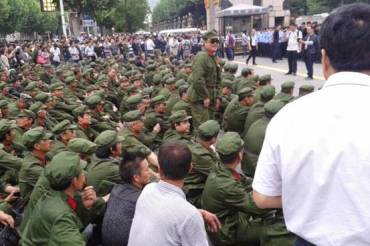
PLA veterans stage a sit-down protest outside government offices in Hubei province on May 4, 2015.

They’d not drunk together since they were in the same army unit, fighting skirmishes with Vietnamese forces in the aftermath of a 1979 border war.

Now in their 50s, they’d come here shortly before an annual parliament meeting in March to fight a different kind of battle – to demand the welfare support that they say was promised to them, and millions of other veterans, on leaving the armed forces years ago.

The four veterans, all from the southern province of Hunan, are an example of the problem facing President Xi Jinping as he prepares to lay off 300,000 out of 2.3 million troops in the biggest restructuring of the People’s Liberation Army, or PLA, since the 1950s.

China already has at least six million PLA veterans on state welfare, thousands of whom have staged well-organized protests in recent years over what they see as insufficient government support. Traditionally the government has offered subsidies to former soldiers and reserved slots for them at state-run companies, though many veterans say officials don’t follow through or that the perks aren’t enough to make ends meet.

Now, with an economic slowdown threatening to cause millions of state sector layoffs, prominent military figures have warned that veterans’ protests could escalate if the government can’t provide jobs or sufficient welfare support for the 300,000 being laid off.

One of the largest veterans’ protests was in June last year when several thousand, mostly veterans of China’s war with Vietnam, wearing uniforms and medals, protested outside offices of the Central Military Commission, which commands the armed forces and is headed by Mr. Xi.

A month earlier, there was another big veterans’ protest outside a Beijing courthouse. Smaller demonstrations occur frequently in other cities, according to experts who monitor them.

Many other veterans have tried to sue the government or lodge formal petitions, as the four in the restaurant did. Before lunch, they said, they’d submitted one at a nearby building that houses the petitions office of the Central Military Commission.

Officials there took the petition and scanned their identity cards, but gave them neither a receipt nor a reply, they said. “They just told us to go back where we came from,” said one of the four, a 54-year-old former worker in a coal-washing plant. “We got the feeling it was useless to go there.”

Source: As China’s Economy Slows, Unrest Among Veterans Rises – China Real Time Report – WSJ

26/04/2016

China Bans Some New Coal Power Plants – China Real Time Report – WSJ

China Bans Some New Coal Power Plants A coal-fired power plant in Shanxi, China. Beijing has announced a ban on new coal plants in areas with surplus power supply.

Beijing has announced a ban on new coal plants in areas with surplus power supply.

China’s government is banning construction of new coal-fired power plants in areas with surplus power supply, a move that could weigh on already-struggling coal markets. As WSJ’s Brian Spegele reports:

The new measures outlined Monday by China’s top economic planner, the National Development and Reform Commission, underscore the central government’s deep concern with overcapacity across China’s economy, a result of weakening industrial demand as growth slows.

Beijing has previously said it aimed to curb thermal power overcapacity; analysts said the fact that it now came from an official NDRC communiqué was the clearest signal yet that it won’t tolerate new coal capacity in regions that already have excess supply.

Weaker demand for coal inside China could ultimately lead to higher exports, which would exacerbate the huge supplies of coal sloshing around global markets. The higher supplies could drive down global benchmark prices and hit the bottom lines of major U.S. and international coal producers.

The global commodities downturn has proven particularly tough on global coal companies. St. Louis-based Peabody Energy Corp. and Arch Coal Inc. are among the large U.S. miners to file for chapter 11 bankruptcy protections in recent months. The U.S. sector has shed 31,000 jobs since 2009.

Source: China Bans Some New Coal Power Plants – China Real Time Report – WSJ

01/04/2016

Beware the cult of Xi | The Economist

Xi Jinping is stronger than his predecessors. His power is damaging the country

“IF OUR party can’t even handle food-safety issues properly, and keeps on mishandling them, then people will ask whether we are fit to keep ruling China.” So Xi Jinping warned officials in 2013, a year after he became the country’s leader. It was a remarkable statement for the chief of a Communist Party that has always claimed to have the backing of “the people”. It suggested that Mr Xi understood how grievances about official incompetence and corruption risked boiling over. Mr Xi rounded up tens of thousands of erring officials, waging a war on corruption of an intensity not seen since the party came to power in 1949. Many thought he was right to do so.

Today, however, China is enduring its biggest public-health scandal in years. Tens of millions of dollars-worth of black-market, out-of-date and improperly stored vaccines have been sold to government health centres, which have in turn been making money by selling them to patients.

Mr Xi’s anti-graft war has often made little difference to ordinary people. Their life—and health—is still blighted by corruption. In recent days there have also been signs of discontent with Mr Xi among the elite: official media complaining openly about reporting restrictions, a prominent businessman attacking him on his microblog, a senior editor resigning in disgust.

Mr Xi has acquired more power than any Chinese leader since Mao Zedong. It was supposed to let him get things done. What is going wrong?

Credibility gap

In fairness, Mr Xi was bound to meet with hostility. Many officials are angry because he has ripped up the compact by which they have operated and which said that they could line their pockets, so long as corruption was not flagrant and they did their job well. But Mr Xi has also found that the pursuit of power is all-consuming: it does not leave room for much else. In three and a half years in charge, he has accumulated titles at an astonishing pace. He is not only party leader, head of state and commander-in-chief, but is also running reform, the security services and the economy. In effect, the party’s hallowed notion of “collective” leadership (see article) has been jettisoned.

Mr Xi is, one analyst says, “Chairman of Everything”. At the same time, he has flouted the party’s ban on personality cults, introduced in 1982 to prevent another episode of Maoist madness. Official media are filled with fawning over “Uncle Xi” and his wife, Peng Liyuan, a folk-singer whom flatterers call “Mama Peng”. A video, released in March, of a dance called “Uncle Xi in love with Mama Peng” has already been viewed over 300,000 times. There have been rumours recently that Mr Xi feels some of this has been going a bit far. Some of the most toadying videos, such as “The east is red again” (comparing Mr Xi to Mao), have been scrubbed from the internet. Many would take that as a sign that the personality cult is little more than harmless fun.

Mr Xi is no Mao, whose tyrannical nature and love of adulation were so great that he blithely led the country into the frenzy and violence of the Cultural Revolution. Although some older Chinese squirm at a style of politics so reminiscent of days long past, there is no suggestion that China is on the brink of another such horror.

More …

No liberal, Xi

More …

Source: Beware the cult of Xi | The Economist

18/03/2016

Deep in a pit | The Economist

COMMUNIST Party give us back our money”, “We want to live, we need to eat!” Such were the slogans daubed on banners that were displayed on March 12th during a protest by thousands of coal miners in the dingy streets of Shuangyashan, a city in Heilongjiang province near the border with Russia.

The demonstrators gathered outside the headquarters of Longmay, the largest mining company in the north-east and Heilongjiang’s biggest state-owned enterprise (SOE). They demanded wages which they said they had not received for at least two months. Some protesters blocked railway lines; others scuffled with police wearing riot gear. Internet censors deleted pictures of the unrest (such as the one shown) as they spread across social media.

The protest was one of the biggest by workers at an SOE for many years. It was an indication of the problems that China’s government will probably face as it seeks to cut excess capacity among SOEs like Longmay and reduce their enormous losses. In February the labour minister, Yin Weimin, said that 1.3m coal workers and 500,000 steel workers could lose their jobs over the next five years.

Other estimates say 3m-5m people may be thrown out of work in these industries as well as in aluminium production and glassmaking. That is far fewer than the tens of millions who lost their jobs during SOE restructuring in the late 1990s. But the economies of some cities, including Shuangyashan, are driven by a handful of large SOEs. In these, downsizing will be traumatic and possibly turbulent.

Labour unrest is rising everywhere as economic growth slows (see chart). Many firms, like Longmay, are reacting to financial distress by paying wages late or not at all. According to China Labour Bulletin, a Hong Kong-based NGO, there were 2,700 strikes last year, twice the number in 2014. In the two months leading up to China’s lunar new-year holiday in early February, there were over 1,000 strikes and protests, 90% of them related to the non-payment of wages. Three days after the protest in Shuangyashan, an almost equally large one began at Tonghua Steel in neighbouring Jilin province, also over wage arrears.

In Shuangyashan (its name, meaning Double Duck Mountains, refers to the shape of two nearby peaks), the authorities have tried to soothe the protesters by giving them overdue pay. Some mine workers say they have now begun receiving their salaries for January, and that they have been assured their pay packets for February will be coming soon. But the government remains nervous of further unrest. On March 15th police were still ubiquitous, on the streets of Shuangyashan as well as outside a nearby mine. In the city centre, a row of women who said the men in their families all worked in mines sat holding placards offering their services as cleaners or house painters. “We have no money to eat. What do they expect us to do?” said one woman angrily before being told by police to stop talking. A man who identified himself as a government official followed your correspondent everywhere.

The protests in Shuangyashan were particularly embarrassing for the party, occurring as they did during the 12-day annual session of China’s parliament, the National People’s Congress (NPC), which ended on March 16th. Every year during the NPC session, officials try even more strenuously than usual to prevent street unrest, lest it tarnish the image of political unity and national prosperity that they want the NPC to project (see article). Party bosses in Heilongjiang will get their knuckles rapped by leaders in Beijing for failing to anticipate this outbreak, which followed months of grumbling among Longmay’s workers about lay-offs and overdue pay. In September, the company said it would shed 100,000 of its 240,000 staff.

Source: Deep in a pit | The Economist

Law of Unintended Consequences

continuously updated blog about China & India

ChiaHou's Book Reviews

continuously updated blog about China & India

What's wrong with the world; and its economy

continuously updated blog about China & India