Posts tagged ‘Beijing’

12/09/2015

China’s top graft-buster breaks taboo by discussing Communist Party’s ‘legitimacy’ | South China Morning Post

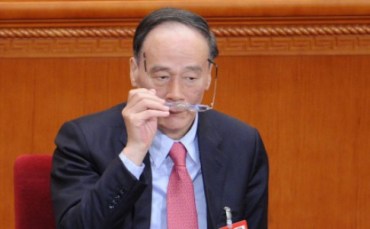
Open discussion by top graft-buster Wang Qishan about the legitimacy of the ruling Communist Party – a topic long deemed unquestionable – has raised the eyebrows of some commentators. Graft-buster Wang Qishan has raised some eyebrows with his comments on the Communist Party's 'legitimacy'. Photo: AFP

“The legitimacy of the Communist Party of China derives from history, and depends on whether it is supported by the will of the people; it is the people’s choice,” Wang said when meeting some 60 overseas attendants of the Party and World Dialogue 2015 in Beijing on Wednesday. ADVERTISING Analysts said the aberration was a step forward but some disagreed with Wang’s interpretation of “legitimacy”.

Zhang Lifan, a Beijing-based commentator, said Wang’s remarks reflected a shift of attitude in the party as a result of intensified social conflicts and increasing pressure from an underperforming economy.

“In the past, the issue was not allowed to be discussed, because the [party] thinks [its rule] is justified unquestionably. As the old saying goes, ‘political power grows out of the barrel of a gun’. They fought their way into the ruling position, instead of being elected into it,” Zhang said. [The Communist Party’s] legitimacy was maintained by relying on economic growth, but now economic growth is facing problemsZHANG LIFAN, COMMENTATOR

“Its legitimacy was maintained by relying on economic growth, but now economic growth is facing problems. In the past people thought [the party] could continue governing and did not have strong opposition to it because they still had money in their pocket. Now the size of their pockets have shrunk,” he said.

Zhang Ming , a political scientist with Renmin University, applauded Wang’s courage, but disagreed with his use of “legitimacy”. “You can’t talk about legitimacy merely from a historical perspective. How to let the people express their approval or disapproval [of the government]? The ballots are the most obvious way,” he said.

Steve Tsang, a senior fellow at the China Policy Institute of the University of Nottingham, said the “legitimacy” Wang mentioned did not mean democratic accountability.

“The will of the people, in China’s political reality, is collected and reorganised into something in line with what the party wants,” he said.

“Then [it] uses the powerful propaganda machinery to ensure the people embrace the newly reformulated views as their own.”

Source: China’s top graft-buster breaks taboo by discussing Communist Party’s ‘legitimacy’ | South China Morning Post

08/09/2015

From ‘Made in China’ to ‘Innovate in China’ – International Finance Magazine

In the West, people often opine that Chinese are not innovators but just copiers who can make a product at a cheaper rate. If somebody mentions inventions, like gunpowder and printing press which were invented by the Chinese, the argument often ends up with ‘they have not really followed through with their innovations and have since then made little progress in this department’.

From ‘Made in China’ to ‘Innovate in China’But the Chinese are ready to transform themselves from the factory of the world to the generator of innovation. Companies like Alibaba Group and Xiaomi among others are making a mark in the world.

“I understand that the China market is characterised by some significant weaknesses when compared to a highly mature Silicon Valley, but the investment power and determination of the Chinese government, along with its appetite to transition away from ‘Made in China’ to ‘Innovated in China’ leaves no doubt in my mind that China will become a leader when it comes to building ecosystems for growth of startups and other innovative organisations,” says Lars Lin Villebaek, co-founder of GrowthEnabler.com, a platform for startups. He has 10 years of personal entrepreneurship experience in China.

Last year, China gave birth to a massive 1.9 million new businesses (across all sectors) and saw some record breaking IPOs in the global market.

And unlike the US, which has Silicon Valley and the area around Boston which are known for their startup ecosystems, China has several dozen ‘Silicon Valleys’. “Most of these are in the embryonic stage. Silicon Valley has a long history of success while the Chinese ones are new. The oldest — Zhongquancun in Beijing district — dates back to the ’80s,” says Zhang Chia Hou, China & India analyst and a board member of GrowthEnabler.com and author of http://www.chindia-alert.org.

According to Wan Gang, China’s minister of science and technology, the district last year birthed 49 startups daily. As of March 2015, 129 high-tech zones had been approved by the State Council. These are designated areas in different cities where entrepreneurs are supported by different policies and benefits, such as fast Internet connections, government assistance in funding, and access to talented and educated human resources from nearby universities.

“Zhongquancun is also home to several universities like the prestigious Tsinghua University which churns out PhDs and computer scientists by the thousands. So there is no shortage of people who understand technology and the investment tap is flowing quite readily,” says Erik Roth, an entrepreneur, lecturer, serial innovator and lead for McKinsey & Company’s Global Innovation & Growth Practice.

Apart from Zhongquancun, Shanghai and Chengdu are also home to several startups.

According to Villebaek, there are several other factors which will help China achieve the ‘startup capital of the world’ status. There is ample access to funding even for high-risk projects. As long as projects replicate proven business models and products, the financing is usually done very quickly.

Additionally, successful companies like Alibaba, Tencent and Baidu have taken upon themselves to nurture the startup system in the country.

Says Alibaba Group spokeswoman: “Our founders started Alibaba Group to champion small businesses, in the belief that the Internet would level the playing field by enabling smallenterprises to leverage innovation and technology to grow and compete more effectively in the domestic and global economies. Alibaba supports innovative entrepreneurs who are able to create products and services that benefit the end user and society as a whole.”

Also, some Chinese are going for international exposure. “Most of the emerging class of entrepreneurs and venture capitalists, including Alibaba’s founder Jack Ma, studied at leading US universities, and worked for great corporations and investment firms. Most Chinese who can afford it (foreign education) decide to have an experience abroad,” says Christoph Tutsch, founder and CEO of ONPEX, a company which provides white-label cloud-based payment technology.

Tutsch adds that China is going in the right direction and people are educating themselves to achieve their goals. “They are trying to think out of the box for solutions that will help the local problems. Even now, they are many successful tech companies in China that no one has heard of because they are kept in the local market, which is good for self-improvement. In the next few years, we will start hearing of more Alibabas who venture West,” says Tutsch.

Where they need to improve

Historically, the Chinese do not have a culture of risk taking. “In a long time, I have not noticed any disruptive business model from China,” remarks Roth. The educational system in the country will have to focus on research and offer education in entrepreneurship to address the needs of entrepreneurs.

“The young in general are following the old path of secure jobs in government or established industry. But with 1.3 billion people, there are enough youngsters interested in innovation and entrepreneurship for them to be a real force,” says Zhang.

Source: From ‘Made in China’ to ‘Innovate in China’-International Finance Magazine

05/09/2015

What if the China Panic Is All Wrong? – China Real Time Report – WSJ

China’s stock-market routs and economic deceleration are widely cited as the major trigger for the latest round of global market volatility. But what if the dominant narrative about China—that the world’s No. 2 economy is on the verge of falling off a cliff—is wrong?

It would mean the global market turmoil hitting equities, commodities and currencies is an overreaction. “We may have seen overshooting,” said Hung Tran, executive managing director of global capital markets at the Institute of International Finance, an industry group representing around 500 of the world’s largest banks, funds and other financial institutions. Even the head of the International Monetary Fund indicated as much earlier this week.

One of the chief problems is that it’s difficult to gauge China’s black-box economy. The country’s true growth is a guessing game given a number of statistical factors. That’s why growth forecasts show a range spanning several percentage points. Lombard Street Research, for example, estimates the economy will only expand by 3.7% this year, nearly half Beijing’s official growth forecast. Even if China’s economy is healthier than many now fear, uncertainty is oxygen for market volatility.

More clarity from Beijing about growth prospects and crisis-management plans would likely prove fruitful. That’s why the U.S. plans to press Chinese officials for greater details on their policy plans at a meeting of finance ministers and central bankers from the Group of 20 largest economies late this week. Here are some of the arguments that might moderate market fears:

• China’s stock market valuation is a bad indicator of Chinese growth. “Investors should not get carried away by the collapse of the Shanghai Composite Index,” warns Melanie Debono from Capital Economics in note to clients, “not least because its performance often bears little relation to that of the economy, primarily due to wild swings in its valuation.” The market run-up in advance of the selloff was out of step with reality, says Nick Lardy, a China expert at the Peterson Institute for International Economics. That’s why he says there’s likely more to come in the Chinese market correction. Even after the rout, “The market was still trading at 39 times earnings. Give me a break, it’s still too high.”

• The devaluation of the renminbi likely isn’t Beijing scrambling to save the economy through competitive devaluation. Beijing’s depreciation was likely more about addressing a key concern for the International Monetary Fund as it considers whether to include the Chinese yuan in its basket of currencies that comprise its lending reserves than it was about reviving economic growth by juicing exports. On Aug. 11, Beijing changed the way it values the yuan, allowing markets to play a greater role in the exchange rate. Market pressure has long been for depreciation, so allowing the currency to be more market-determined would, in the near-term, naturally see the yuan move lower. Against a basket of global currencies, the yuan has appreciated over the last year by nearly 15%, accounting for inflation. That’s despite Beijing intervening for months to prevent the yuan from losing value. “So the fact that the yuan came down 3% to 4% is not going to make much difference,” said Ted Truman, a former top international finance official at the U.S. Treasury and the Federal Reserve.

GDP growth may not be nearly as bad as suspected. Economists such as Clare Howarth at Oxford Economics say that beyond official industrial production figures, data on car and cell phones sales are jacking up the risk that China’s growth stalls. But “critics are really overlooking the fact that the growth model has changed in China,” Lardy says. “The service sector is now the driver of growth. So the fact that industrial growth has slowed down quite a bit does not mean, as it would have meant 10 years ago, that the economy is falling off a cliff.” Based on electricity consumption, “I just don’t see any signs that the Chinese economy is experiencing a hard landing,” says Torsten Sløk, Deutsche Bank’s chief international economist. Joe Hockey, treasurer for an economy that is intimately tied to China, Australia, says market reactions have been overblown. “We’re confident about our understanding of the Chinese economy and we see over time huge opportunities for growth,” Mr. Hockey told the Journal.

• Rather than regressing to policies of old, China’s government has actually been showing signs of moving ahead with market reforms.

Source: What if the China Panic Is All Wrong? – China Real Time Report – WSJ

03/09/2015

China military parade commemorates WW2 victory over Japan – BBC News

China has held a lavish parade in Beijing to mark the defeat of Japan in World War Two, showcasing its military might on an unprecedented scale. President Xi Jinping in his opening speech paid tribute to “the Chinese people who unwaveringly fought hard and defeated aggression” from Japan. He also said the People’s Liberation Army would be reduced by 300,000 personnel, but gave no timeframe.

Soldiers of China's People's Liberation Army (PLA) march at the beginning of the military parade marking the 70th anniversary of the end of World War Two, in Beijing, China, 3 September 2015

China’s growing military power is being keenly watched amid regional tensions. China has several territorial disputes with neighbours in the South China Sea, as well as with Japan in the East China Sea. Ahead of the parade, the US said five Chinese ships had been spotted in the Bering Sea off Alaska for the first time. China’s People’s Liberation Army (PLA) is the world’s largest military, with 2.3 million members. China also has the second biggest defence budget after the US.

Source: China military parade commemorates WW2 victory over Japan – BBC News

15/08/2015

China Eastern to buy 15 Airbus jets for $3.6 billion | Reuters

China Eastern (600115.SS)(0670.HK), the country’s No.2 airline by market value, plans to acquire 15 Airbus (AIR.PA) jets for about $3.6 billion to meet booming demand for air travel.

The logo of Airbus Group, Europe's largest aerospace group, is pictured in front of the company headquarters building in Ottobrunn, near Munich February 26, 2014. REUTERS/Michaela Rehle

Airbus is scheduled to deliver seven A330s in 2017 and a further eight in 2018, China Eastern Airlines Corp (CEA.N) said in a statement to the Shanghai stock exchange.

“The company is purchasing 15 Airbus A330 planes to help to replace older planes that will retire over the next few years. It will also help to meet rising passenger demand for mid and long routes,” China Eastern said.

China will be the world’s largest air passenger market by 2034, according to the International Air Transport Association, attracting interest from foreign airlines.

Delta Air Lines Inc (DAL.N) is poised to become the first U.S. carrier to own part of a Chinese peer, announcing plans last month to buy a 3.55 percent stake in China Eastern for $450 million and gaining an “observer” seat on its board.

In a separate statement on Friday, China Eastern reported first-half net profit up sharply to 3.56 billion yuan ($557 million) from only 15 million yuan a year earlier, citing lower fuel prices and strong travel demand.

via China Eastern to buy 15 Airbus jets for $3.6 billion | Reuters.

11/08/2015

China Shakes Markets with Yuan Move – China Real Time Report – WSJ

China devalued the yuan by nearly 2% on Tuesday in a surprise move that shook markets around the world and appeared to be a response to sharply weaker exports and plummeting factory prices in a softening economy. The central bank described its action as a new way of setting the daily parity or reference rate – a rate it sets for the currency against the dollar –  to better reflect market rates.  (The markets get a chance to trade the currency around that rate, but not by much. The yuan can go up or down only 2% from that crucial central rate.)

So far this year, the parity rate has hardly budged against the dollar even though the latter has been rising steadily against other currencies. That has made China’s exports more expensive in many markets just as the world’s second largest economy is slowing.  The People’s Bank of China says it will now pay more attention to the market levels when it sets its parity rate. It also called the move a “one-time fix.”

Economists are hotly debating the significance of the move, in part because it seems to be speaking to many different audiences. It will help the struggling export sector, which has stalled amid weak global demand. Exports in July, for example, sank more than 8% and they were down nearly 1% for the first seven months of the year.

At the same time, it was essential for the People’s Bank of China not to alarm domestic and foreign investors to avoid triggering a wave of capital outflows. Investors tend to dump a weakening currency and move their assets into other currencies. Thus, the PBOC said the move was a one-time reform effort to bring the yuan more in line with the markets.

Finally, the central bank may also have had the International Monetary Fund in its sights. The yuan is up for possible inclusion in international agency’s Special Drawing Rights, a basket of currencies that serves as a global reserve. Too big a move might have damaged Beijing’s case that the yuan is a suitable candidate for addition to that basket of currencies, analysts said.

via Economists React: China Shakes Markets with Yuan Move – China Real Time Report – WSJ.

07/08/2015

China’s Unsinkable Aircraft Carriers – China Real Time Report – WSJ

What should the U.S. do about China’s increased assertiveness in the South China Sea? As the Brookings Institution’s Michael O’Hanlon writes:

Beijing claims almost the whole sea—land formations, seabeds and open waters alike—and of late has been literally creating new facts on the ground, constructing 2,000 acres of artificial islands where only shoals or sand bars once existed. Beijing now says those efforts are nearly complete but acknowledges plans to place military assets on the islands, some of which may include substantial airfields.

Washington is deeply concerned and should continue pushing back against any Chinese enforcement of its “nine-dash line” claim to 85% of the region’s map. But the U.S. can’t stop China from building or modestly militarizing its new islands, nor should it try. Even if it rattles nerves from Tokyo to Manila, Hanoi and Washington, Beijing’s campaign is little more than an asymmetric way of establishing regional military presence—and one that even mimics American behavior over the years.

via China’s Unsinkable Aircraft Carriers – China Real Time Report – WSJ.

30/07/2015

Chinese potatoes to chip in as water shortages hit staple crops | Reuters

Once seen as food for the poor, the humble potato is being pushed in China as a tasty, nutritious part of any meal as the world’s most populous country struggles with water shortages and looks for alternatives to the traditional rice and noodles.

China already produces 95 million tonnes of potatoes a year, a quarter of the global total, and is aiming to raise that to 130 million tonnes by 2020, government officials said at the World Potato Congress on the outskirts of Beijing this week.

“In China, the potato industry is no longer an industry for underdeveloped areas or the poor, but highlights the country’s modern agricultural drive and enriches people’s dining tables,” Agriculture Minister Han Changfu told the conference.

Beijing has begun this year to promote the potato as more of a staple food, particularly as a substitute foodstuff for grain, an idea that has taken on urgency as water problems threaten to undermine food security, vital for political legitimacy.

The North China Plain is suffering as a result of decades of excessive underground water use by both industry and wheat farmers.

In some parts of Hebei, the third-largest wheat-producing region, farmers have been banned from growing wheat in order to preserve underground water. Excessive digging for irrigation has caused subsidence and even landslides, the local government has said.

David A. Thompson, president of the World Potato Congress, told reporters that potatoes would serve China’s plans to improve agricultural sustainability.

“Potatoes provide more energy and protein per acre than other crops,” he said.

The congress was held in Yanqing, a suburb of Beijing around 100 km (62 miles) northwest of the city center, where a 12,000-square-metre international potato center has been built along with a museum for the vegetable and a potato breeding center.

“Small potatoes, stand up and become a staple to ensure the country’s grain security,” urges a banner outside the museum.

In an exhibition hall, potatoes are used to make dozens of different types of food, including popular local fare such as steamed bread, noodles and dumplings as well as western-style pizza and even cookies.

“Potatoes can make hundreds or even thousands of dishes, as well as more than 200 types of staple and western-style food,” said Zhang Aiguo, a cook at the exhibition.

“If more and more consumers get to know that potatoes have more nutrition, they are willing to take them. People nowadays care more about quality and healthy food,” said Zhang, holding a big plate of steamed bread made with potatoes.

via Chinese potatoes to chip in as water shortages hit staple crops | Reuters.

28/07/2015

Apple ‘fake factory’ raided in China – BBC News

A factory which allegedly made up to 41,000 fake Apple iPhones has been raided in China, with nine arrests.

iphone 6

The operation reportedly involved “hundreds” of workers repackaging second hand smartphone parts as new iPhones for export, with counterfeit phones produced worth 120m yuan ($19m).

The factory was discovered on 14 May but was revealed on social media by Beijing’s public security bureau on Sunday, according to reports.

The operation was set up in January.

It was led by a husband and wife team, on the northern outskirts of the Chinese capital, according to Beijing authorities.

They said they had been alerted to the factory by US authorities which had seized some of the fake phones.

The reports come amid an official Chinese crackdown on counterfeit goods, with authorities pushing firms to trademark their goods.

China has also agreed to work with the US authorities to try to stem the large quantities of fake goods flowing between the two countries.

The discovery of the factory comes four years after fake Apple stores were found in Kunming city, China.

Discovered by blogger BirdAbroad, the fakes were so convincing she said many of the staff themselves were convinced that they were employed by the US electronics firm.

via Apple ‘fake factory’ raided in China – BBC News.

27/07/2015

China Stocks Make Sharpest Daily Fall Since 2007 – China Real Time Report – WSJ

China stocks made their sharpest daily percentage decline since 2007, as worries mount that authorities are pulling back on its measures to prop up the market. As WSJ’s Chao Deng reports:

The Shanghai Composite Index ended down 8.5% at 3725.56, its second-straight day of losses and worst daily percentage fall since February 27, 2007. China’s main index is up 6% from its recent low on July 8, but still off 28% from its high in June.

The smaller Shenzhen Composite fell 7% to 2160.09 and the small-cap ChiNext Closed 7.4% Lower at 2683.45

Analysts say the selling came as investors fear the government is curbing its buying of blue-chip stocks—and could even be testing whether the market can support itself.

“The previous support from the government funds is apparently unsustainable,” said Jacky Zhang, an analyst at BOC International. “They may withdraw support today to test whether the market has recovered its resilience. The government wants to use state funds to stabilize the market, not to prop it back to 5,000 point overnight.”

via China Stocks Make Sharpest Daily Fall Since 2007 – China Real Time Report – WSJ.

Law of Unintended Consequences

continuously updated blog about China & India

ChiaHou's Book Reviews

continuously updated blog about China & India

What's wrong with the world; and its economy

continuously updated blog about China & India