Posts tagged ‘Bharatiya Janata Party’

03/09/2014

Jaitley’s biggest tasks lie ahead: big-bang reforms and restructuring the Finance Ministry

The finance minister has had to tackle inflation, India’s stance in the WTO and easing regulatory hurdles. That was the easy part.

Even before the general election ended in May, it was clear that if the Narendra Modi-led Bharatiya Janata Party formed the government, Arun Jaitley would head one of the important ministries on Raisina Hill, the area of Lutyen’s Delhi that houses some of the most important government buildings.
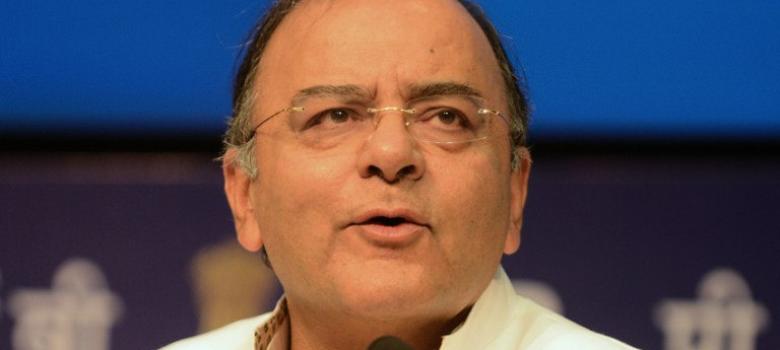
But Jaitley’s move to North Block, the part of the Hill housing the finance ministry, was not easy. Contesting his first Lok Sabha election, he lost the race in Amritsar to the Congress candidate by nearly one lakh votes, raising questions within the party about his eligibility to be granted a key ministry. Jaitley, who has also been given charge of the defence ministry, is a man with as many detractors as admirers in New Delhi and within his own party.

Often teased in Delhi circles as the only Congresswala in the BJP, Jaitley was seen by many as an obvious choice for the crucial portfolio of finance. He got the job because he has a shrewd strategic mind and knows how to work Delhi. In addition, the BJP needed someone who had the nerves to handle a ministry that was practically in the ICU despite valiant, though sometimes questionable, efforts by his predecessor and friend, the Congress’s P Chidambaram.

Both Prime Minister Narendra Modi and Jaitley had only a few days to present their first budget to a Parliament and nation that had been promised big-bang economic reforms. As Jaitley presented the Modi government’s first budget on July 12, many who had expected major reforms were left disappointed even though some praised it for pointing in the right direction.

As a member of the Federation of Indian Chambers of Commerce and Industry said, this was a “benefit of the doubt” budget because of the short period in which Jaitley and his team had to think things over. The real test will come in 2015.

Huge challenges

A change in government is not the only factor that drives ministerial reform. The bureaucracy also needs to endorse the new policies. In getting the bureaucracy on board, Jaitley’s team in North Block has faced plenty of challenges, such as the minister’s inability to address the thorny issue of retrospective taxation.

Other things that kept Jaitley busy as soon as he took over were controlling inflation, India’s stance on subsidies at the WTO and making it easier to do business by removing regulatory hurdles. But the enormity of reforms needed to transform the Indian economy and pushing its growth rate to more than 6% require willpower and the stomach to take politically unpopular measures, especially in sectors such as power.

“There are three or four sectors where we just cannot continue doing business as usual,” said Pratap Bhanu Mehta, president of the New Delhi-based Centre for Policy Research. “In areas such as energy we are too dependent on imports and on carbon-intensive energy sources. If we are not on an alternative energy path soon, which means low carbon and technologically efficient [forms], we could be out of the development game in 15 to 20 years.”

It is the support system for business that requires key changes. Foreign industry remains bullish on India but has made its displeasure known over the slow progress on issues such as foreign direct investment, land acquisition and retrospective taxation.

On the domestic front, many industrialists have asked for a revitalised subsidy regime, one in which the government gives subsidies wherever required instead of using them as a populist measure to get votes. At the same time, as a vital component of the global economy, India could find it increasingly difficult to persist with its subsidy regime even if it makes sense on the domestic front.

Back to the drawing board

Globalisation and climate change will become central to India’s economic story. The Asian Developmental Bank concluded in a recent report that South Asian economies such as India could lose 1.8% of their GDP by 2050 and 8.8% of their GDP by the end of the century to climate change.

via Scroll.in – News. Politics. Culture..

03/09/2014

Six ways in which Narendra Modi has changed Delhi

From: http://scroll.in/article/677239/Six-ways-in-which-Narendra-Modi-has-changed-Delhi

He’s undermined the hierarchy of the BJP, but bureaucrats are reporting to work on time.

Narendra Modi’s first hundred days in power may not have brought big bang economic reforms or sweeping social initiatives, but the shift in dynamics across political, bureaucratic and corporate circles has been huge. Except for the period of the Emergency four decades ago, which turned everything upside down, never have the customary power equations of Lutyens Delhi become so redundant.

1. The Bharatiya Janata Party
The biggest impact of Modi’s arrival at the seat of power has been on his own party. The Bharatiya Janata Party today is looking like a punctured balloon. This was one of the few remaining political outfits in the country that still routinely practiced internal debate. After Modi’s victory, the hush among the BJP leadership has been deafening. The party is under Modi’s thumb and is now feeling the pressure of Amit Shah’s palm as well. Apart from the overwhelming presence of these two leaders, no one is quite sure about the hierarchy in the party. Party members don’t know whom to approach for what, since everybody else seems so powerless. There is surprisingly little triumphalism or celebratory swagger among BJP leaders in the aftermath of such an astounding electoral victory.

2. The council of ministers
In the beginning there was some envy about those who got plum ministerial positions. But a few of them, such as power minister Piyush Goel, and environment and information minister Prakash Javdekar, were reported to have been ticked off like schoolboys. As a result, a ministerial post does not look so inviting anymore. Individual ministers have never before been so devoid of the powers to dispense favours. In the past, some politicians were able to wrangle such favours even if they were in opposition. The ministers are instead driven to work relentlessly from early in the morning to late in the night, driving teams of sleepless bureaucrats, some of whom appear to have more direct access to the prime minister’s office than their political superiors. The word out is that Big Brother is watching and any sign of laxity will not go unpunished.

3. Parliament
There also appears to a conscious decision by the new prime minister to bypass conventional parliamentary processes for policymaking. Standing committees are yet to be set up. Such is the apathy to parliament that even seat allotments to different parties in the new Lok Sabha are yet to begin. Clearly, Modi does not have much inclination for parliamentary debate and review to make policies.

4. The bureaucracy
Significant changes in the corridors of power are also evident. The bureaucracy, from top to bottom, is still struggling to cope with the drastic departure from the slow pace of government. Office hours are not only being imposed in terms of punctuality, but can also get extended indefinitely.

5. India Inc
The relationship between corporate groups and the Modi government in the first hundred days has belied fears, particularly of liberal-left opinion makers, that it would be a willing instrument for crony capitalists. So far this has not been the case. It has become increasingly clear that the country’s largest industrial magnate Mukesh Ambani, who was supposed to be one of the main moneybags to bankroll the Modi campaign, is not calling the shots. Even Gautam Adani, known to have been personally close to Modi when he was Gujarat chief minister, has not been patronised. Power minister Piyush Goel was said to have been pulled up for publicly hobnobbing with the industrialist whose power company was also slapped with a clear energy cess in the budget.

This is not to suggest that the new prime minister has turned his back on industrialists. He has had individual meetings with a number of them including Cyrus Mistry of the Tata group, Anil Agarwal of Vedanta and Anil Ambani, although mysteriously not the latter’s elder brother, Mukesh. The message so far has been clear. The new government was ready to consider all proposals as long as they fit into the regime’s scheme of things, but would not be manipulated through fear or inducement on specific projects or policies. Ever since the new government came to power, the vast army of corporate lobbyists in Lutyens Delhi have been sitting idle.

6. Sycophants and cheerleaders
Finally, the most striking difference between the Modi regime and previous ones, is the way the new prime minister has spurned a long queue of sycophants and cheerleaders who had expected to be rewarded for their services to the Modi campaign. Quite a few of them are in the media, or experts who are hoping to be accommodated in think tanks now that they have been overlooked for plum government posts. The impression, however, is that the prime minister is adamant about horses for courses, and will only elevate someone he feels will be able to do the job.

Those close to Modi have assiduously cultivated the image of a prime minister who has his party leaders by the scruff of its neck, the bureaucracy on tenterhooks and business magnates at an arms distance – “a tough guy who does not dance”.

01/09/2014

Independence for Intelligence Bureau, tackling Maoism are Home Ministry’s biggest challenges

The Home Ministry is possibly the most crucial cabinet portfolio after the prime minister’s seat. Under Narendra Modi‘s leadership, veteran Bharatiya Janata Party stalwart Rajnath Singh bagged the coveted spot on Raisina Hill, an appointment that was widely predicted during post-poll speculation in the capital, New Delhi.

Singh played the part of Modi’s right-hand man for much of the former Gujarat chief minister’s gruelling campaign. But Singh did much more than help with Modi’s election trail; he was effectively Team Modi’s chief executive, managing the power games and personality clashes erupting in the party and, above all, placating the old guard’s resentment toward Modi’s popularity and apprehension about their status.

For many days after the BJP-led National Democratic Front swept the election, Singh said that he would be glad to continue as the party president and was not angling for a cabinet berth. Yet he got possibly the most important cabinet position, besides the prime minister’s, and accepted it with great alacrity.

But many people did advise him against moving to Raisina Hill’s North Block, where the ministry is located, and to stay on as the party president, a position they said was more powerful than a cabinet berth. But Singh has his own political ambitions and the cabinet berth certainly has greater national prestige.

Today, it’s unclear why exactly Modi’s right-hand man is in the government, especially after Singh’s outburst last week following reports that his son had been upbraided by the prime minister for allegedly accepting bribes in exchange for arranging police postings. The battle for that primacy is between Singh and Arun Jaitley, the finance minister who is doubling up as defence minister, both wily politicians who know how to navigate the BJP and its various spheres of influence.

via Scroll.in – News. Politics. Culture..

26/08/2014

Top India court says coal allocations were illegal – Businessweek

India’s Supreme Court said Monday that all government allocations of coal reserves to private companies from 1993 to 2010 were conducted illegally, and it will hold a hearing to decide whether to cancel them.

More than 200 coal blocks, or areas of unmined reserves, were allocated during that period to companies for their use in power plants or steel or cement factories. The companies were allowed to sell excess coal on the open market, but the court said commercial sales from the reserves must be suspended until it makes its decision at a hearing on Sept. 1.

The court’s ruling extends beyond the initial case — dubbed “Coalgate” by the Indian media — in which the previous Congress party-led government was accused of costing the treasury hundreds of billions of dollars by selling or allocating about 155 coal blocks in 2004-09 without competitive bidding. A report by the country’s Comptroller and Auditor General leaked to the media in March 2012 estimated those losses to have been around $210 billion.

The scandal along with other high-profile cases of alleged corruption were seen as a key reason for the Congress party’s loss in this year’s elections to Prime Minister Narendra Modi‘s pro-business Bharatiya Janata Party.

The court said in its ruling Monday that between 1993 and 2010 there had been “no fair and transparent procedure” in the coal allocation process, “resulting in unfair distribution of the national wealth.”

“Common good and public interest have, thus, suffered heavily,” said the court, led by Chief Justice R.M. Lodha.

via Top India court says coal allocations were illegal – Businessweek.

20/08/2014

Wounded Congress desperately seeking alliances for upcoming assembly elections

The Congress party is losing legislators but is keen to show it remains a political force as polls approach in Maharashtra, Jharkhand, Haryana and Kashmir.

Still reeling from its decimation in the Lok Sabha elections, the Congress now has to contend with legislators in several states quitting the party to join the Bharatiya Janata Party. There are rumours that even veteran Delhi Congress leader Dr AK Walia is in talks to join the BJP.

What makes the situation worse is that members of legislative assemblies from regional parties are also joining the BJP, making it hard for the Congress to compete.

The party is now desperately looking to form alliances with regional parties and even independent MLAs to save face in the upcoming state elections in Maharashtra, Haryana, Jharkhand and Jammu and Kashmir.

Jharkhand

With the Jharkhand Vikas Morcha deciding to merge with the BJP, it is becoming increasingly difficult for the Congress to establish any sort of stronghold in the state. The party’s general secretary in the state, BK Hariprasad, says it is looking to put together an alliance with the Rashtriya Janata Dal, with which it has already reached an agreement in Bihar. The party is also working on a tie-up with Janata Dal (United), which split with the BJP before the general elections.

The party already has an alliance with the Jharkhand Mukti Morcha. However, the district presidents in the region are not keen to continue with it, following the JMM’s demand that it be allocated 25-30 of the 81 seats in state polls due at the end of the year.

“The party has a stronghold in the state and it will perform much better if we contest on our own instead of seat sharing,” a district president of the Congress said. “The leadership should not concede to the demands of the regional alliances and deprive our own people of a chance to contest the polls.”

via Scroll.in – News. Politics. Culture..

15/08/2014

Modi Targets Bureaucrats, Manufacturing and Toilets in Independence-Day Speech – India Real Time – WSJ

In his first Independence Day speech Friday, Indian Prime Minister Narendra Modi listed the issues he plans to focus on as the leader of the world’s largest democracy: bickering bureaucrats, women’s rights, manufacturing jobs, trash and toilets.

“You might say Independence Day is an opportunity to talk about big ideas and make big declarations. But sometimes, when these declarations are not fulfilled, they plunge society into disappointment,”said Mr. Modi, who is the South Asian nation’s first prime minister born after India gained independence from Britain 67 years ago. “That’s why I’m talking about things we can achieve in our time.”

Mr. Modi’s Bharatiya Janata Party was propelled to power by Indians who, hungry for better jobs and a higher standard of living, grew frustrated with slowing growth under the previous Congress-led government. Since coming to power in May, Mr. Modi has made some cautious policy moves, disappointing some of his supporters who had expected immediate and bold change from his administration.

Addressing the nation from the ramparts of New Delhi’s regal Red Fort Friday, Mr. Modi said he plans to set the government in order and stop bureaucratic squabbling, underlining his focus on administrative processes rather than economic overhauls. As “an outsider” to New Delhi, he said, he has been shocked since taking office to find that “there were dozens of governments inside the government,” each with “its own fiefdom.”

“Departments are fighting each other, suing each other in the Supreme Court,” Mr. Modi said. “How can they move the country forward?”

In his nearly hour-long speech delivered largely in Hindi, Mr. Modi reiterated his focus on making India a global manufacturing hub and export powerhouse.

Offering a new slogan in English, “Come, make in India,” Mr. Modi invited the world to come to India to manufacture.

“Sell anywhere in the world but make it here,” he said. “Electricals to electronics, chemicals to pharmaceuticals, automobiles to agro-products, paper or plastic, satellites or submarines — Come, make in India.”

Mr. Modi questioned why India needs to import “every little thing,” and urged the country’s youth to open factories and export goods.

Manufacturing makes up only around 15% of India’s gross domestic product as most of its rapid expansion over the last decades has come from the service sector. During spring elections the BJP said it planned to create millions of new jobs if elected. Economists say one of the best ways India can generate employment is through exports.

While India’s labor costs are among the lowest in the world, it has consistently failed to become an export powerhouse like China and Asia’s other largest economies.

Prime Minister Modi also announced initiatives aimed at modernizing India: a nationwide drive for cleanliness that would boost tourism, a program for parliamentarians to transform villages, one by one, into “model villages,” encouraging politicians and companies to build more toilets so people don’t have to use the outdoors and a push to open bank accounts for all Indians.

Mr. Modi also used his speech to address an issue the new opposition has been demanding discussion on: religious violence. A Hindu nationalist leader accused of not doing enough to stop communal violence in the state of Gujarat in 2002 when he was chief minister there, Mr. Modi Friday urged Indians to stop communal fighting. Just this week, opposition parties accused the BJP of polarizing Indians on religious lines and analysts have blamed Mr. Modi of not addressing recent tensions.

“Who benefits from this poison of communalism? It is an impediment to growth,” Mr. Modi said. “Let us choose peace instead and see how it propels our nation forward.”

via Modi Targets Bureaucrats, Manufacturing and Toilets in Independence-Day Speech – India Real Time – WSJ.

13/08/2014

India Wants to Find the Saraswati River and Bring It Back to Life – India Real Time – WSJ

ndia’s new government says it plans to find and possibly bring back to life a long-lost river mentioned in sacred Hindu texts.

In answer to a question in Parliament Tuesday, Uma Bharti, the water resources and river development minister said India wants to “detect and revive,” the Saraswati River, described in Vedic texts.

“There are enough scientific evidences on the presence of the river Saraswati in some parts of the country through which it flowed about five to six thousand years ago,” she said on the floor of the lower house of Parliament. “Saraswati is not a myth.”

Geologists have known for more than 100 years about ancient river beds passing through northern India that could be the Saraswati, said the Times of India. But reviving the river by bringing any underground water to the surface is “an impossible task,” Umesh Chaube, professor emeritus of water resource development and hydrology at IIT –Roorkee told the Hindustan Times.

Critics were quick to suggest it would be a waste of government money and a potential wild goose chase aimed at strengthening the ruling Bharatiya Janata Party’s ties to its Hindu nationalist supporters.

A BJP spokesman did not respond to a request for the party response on Wednesday morning.

It wouldn’t be the first time that scientists have had to follow the hunches of politicians. Last year a team of government archaeologists had to excavate the ruins of an old palace in the state of Uttar Pradesh, after a famed Hindu holy man declared that there was 1,000 tons of gold buried under it. No gold was found.

via India Wants to Find the Saraswati River and Bring It Back to Life – India Real Time – WSJ.

07/08/2014

Rahul Gandhi Wakes Up to New Role as Rebel Leader – India Real Time – WSJ

There’s nothing particularly newsworthy about boisterous Indian lawmakers blocking debate on the floor of Parliament when they don’t get their way, unless one of the lawmakers is the usually-reticent Rahul Gandhi.

The typically uninvolved Parliamentary back-bencher and Congress party vice president made the front pages of Indian newspapers Thursday after he and others mobbed the desk of the lower house of Parliament’s speaker, demanding to be heard.

“Rip Van Winkle Rahul Finally Rises Out of Slumber,” read an Economic Times headline paired with a recent photograph of Mr. Gandhi nodding off during a parliamentary session.

Mr. Gandhi, who is part of a diminished Congress camp of 44 representatives in the 545-member Lok Sabha, also made a rare statement to reporters outside Parliament complaining that opposition parties were not being allowed to speak. He accused speaker Sumitra Mahajan of bias after she shot down a proposal to discuss recent communal violence.

“There is a mood in Parliament that only one man’s voice counts,” Mr. Gandhi said in an apparent reference to Prime Minister Narendra Modi.

On the campaign trail a few months ago, Mr. Gandhi had said a Modi-led government would polarize Indians and trigger religious unrest.

Mr. Gandhi’s outburst was described as “surprisingly belligerent” in the Times of India that also carried a front-page story about what they called his “new-found combativeness.”

The fourth-generation scion’s occasional public outbursts are closely covered by the national media. In October when he called an executive order by his own party’s government “complete nonsense,” his tantrum was reported, discussed and debated for days.

On Wednesday, television news channels questioned what may have prompted a reaction from a leader who in his decade-long career in Parliament has rarely engaged in debate or taken the lead on policy issues.

The governing Bharatiya Janata Party offered one theory.

Finance Minister Arun Jaitley said Mr. Gandhi’s show of aggression was a result of internal rumblings – a “palace coup” – in the beleaguered Congress that is struggling to bounce back after its worst ever electoral defeat in national elections.

The party’s dynastic leadership by president Sonia Gandhi and her son, Rahul, must be struggling and Mr. Gandhi’s actions Wednesday were an attempt “to show they are also capable of aggression,” Mr. Jaitley said.

Congress spokesman Randeep Singh Surjewala said there “wasn’t an iota of doubt or question” within his party on the Gandhis’ leadership. Some “disgruntled elements hankering for immediate power” had abandoned the Congress after the electoral defeat, Mr. Surjewala said, but added that his party had weathered numerous challenges in the past and, like before, would emerge stronger.

He said the Modi-led government couldn’t run away from a discussion on religious violence by making personal attacks against Congress or its leaders.

via Rahul Gandhi Wakes Up to New Role as Rebel Leader – India Real Time – WSJ.

07/08/2014

The BJP’s real opposition turns out to be a far-Left-far-Right combination

When the final results of the general election were tallied up, it was hard not to marvel at the sheer size of the Bharatiya Janata Party’s victory and the unprecedented defeated delivered to the Indian National Congress. With the BJP emerging not just as the single largest party but also the first since 1984 to cross the halfway mark by itself and the Congress not even having enough seats to automatically be given the Leader of the Opposition post, there were genuine concerns about unbridled majoritarianism. Where would the opposition to the BJP come from?

Since the Congress continues to occupy the muddled middle and has pinned all its hopes on  Rajya Sabha numbers, where it has more seats than the BJP, the answer actually turns out to be an unusual combination of players both to the right and the left of the BJP. From labour law reform to the introduction of further foreign direct investment in insurance, it is BJP-affiliated organisations making common cause with pro-labour and Leftist outfits that have caused the most headaches for the new government.

With the Left and Right managing to converge on swadeshi issues, those who fall more in the pro-market camp within the BJP — many of whom were seen as the intellectual leaders of the campaign that brought Prime Minister Narendra Modi to power — are starting to get disconcerted with  government’s actions.

FDI in insurance

This appears to be the new government’s first big legislative battle, as the opposition parties have attempted to use their superior numbers in the Rajya Sabha to stand in the way of an attempt to increase the foreign direct investment cap in insurance from 26% to 49%. The government can resort to a joint sitting of the houses to bulldoze its legislation through the Parliament, but it is the reaction from trade unions and state insurance companies that has got the BJP concerned.

Crucially, the Bharatiya Mazdoor Sangh, the BJP-affiliated organisation that counts itself as the largest centrally organised trade union in the country, has joined forces with an array of other labour organisations as well as employees of state insurance corporations in threatening to strike if the cap is raised. The communist parties have always been staunch opponents of additional foreign investment. They have now come together with outfits like the BMS to prevent a move that finance minister Arun Jaitley has said is crucial to help reinvigorate economic activity.

Genetically modified crops

Shortly after representatives of the Swadeshi Jagran Manch and the Bharatiya Kisan Sangh met with environment minister Prakash Javadekar, he announced that the government was putting field trials of the genetically modified crops on hold. The news prompted loud howls from many who believe GM crops are important for Indian agriculture to take its next step forward. But it was welcomed by both the Sangh Parivar organisations that had met Javadekar as well as by many on the Left who have sought to halt GM crops for years now.

Swadeshi education

The Akhil Bharatiya Vidya Parishad, the BJP’s Youth Wing, sensed during last year’s Delhi University Student Union elections that opposition to the new Four Year Undergraduate Programme could be a key plank in remaining popular on campus. Incidentally, the FYUP had been opposed by the more left-wing organisations on campus from the very get-go, so the ABVP joined up with them to call for a roll-back of the four-year programme. The agitation quickly became a national issue, and eventually the FYUP was rolled back.

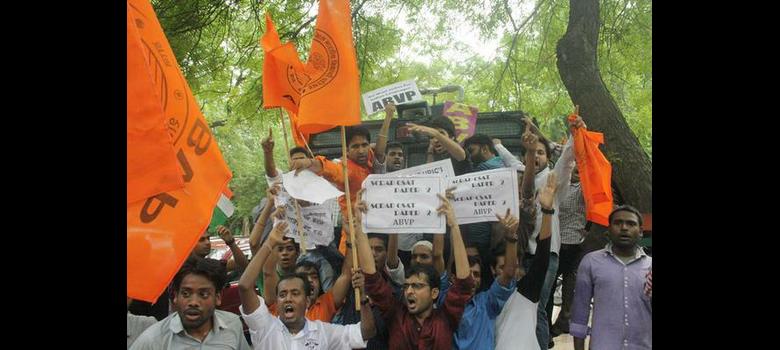
This ABVP-Left combine has now re-emerged in the agitation against the Union Public Service Commission’s Common Scholastic Aptitude Test, which is being fought on grounds that it is biased towards urban students. Yet again, the combined forces have managed to extract a concession from the government — despite opposition from the more reformist sections of the BJP.

Labour law reforms

Trade unions from across the country are meeting this week to try and decide how to approach the issue of labour law reforms, after the Rajasthan government last month passed legislation that made it easier for companies to retrench employees. These unions include both those on the Left, including the Communist Party of India (Marxist)-backed Centre of Indian Trade Unions  as well as the BJP-affiliated Bharatiya Mazdoor Sangh. Any decision to strike or launch a nationwide campaign by these groups could have a significant impact on a government that has insisted it is working primarily for the poor.

Foreign relations

The Modi government’s decision to vote against Israel at a United Nations forum shocked many supporters, who believe that India must be stand with Tel Aviv and remain steadfast against Islamic terrorism. It came as a pleasant surprise to those on the Left, however, who have always pushed India to speak up for those who live under Israeli occupation in Gaza and the West Bank.

The foreign relations convergence of the Left and Right was given a bigger boost after the Modi government decided to stand in the way of the World Trade Organisation’s Bali Package. Although the two factions here are unlikely to work together in pressuring the government to make decisions, particularly in the neighbourhood, the pressure to keep India relatively insulated from the West is likely to gain purchase from both sides.

via Scroll.in – News. Politics. Culture..

06/08/2014

Insurance Bill Struggle Pokes Another Hole in the Notion of Modi Magic – India Real Time – WSJ

The new government in New Delhi is struggling this week to get an insurance-industry liberalization bill— an important part of its campaign to revamp the economy—to the floor of the upper house of Parliament.

Opening up the insurance business to more foreign investment was one of the main deregulation measures unveiled in Prime Minister Narendra Modi’s first budget last month.

But already it is bogged down. Mr. Modi’s Bharatiya Janata Party does not control the upper house and other parties want to stall a vote on the bill.

The legislative tussle is a sign of the challenges Mr. Modi faces, despite his party’s landslide electoral victory and the BJP’s lower-house majority, as he tries to push through even modest changes in the way India manages its economy.

Mr. Modi swept to power this spring on a surge of anti-incumbency sentiment and hope that the BJP could break the policy deadlock in the capital. Supporters expected Mr. Modi bring the “achche din,” or good days, back to Asia’s third-largest economy.

But India’s complicated national politics, its decentralized federal system and Mr. Modi’s own desire not to get too far ahead of public opinion in a country long used to large-scale welfare schemes and a heavy state hand in the economy, is likely to slow any change.

The new administration’s national budget, announced in July, was bland and disappointing to many. It did not include the kind of big-bang reforms many optimists had anticipated.

In response to criticism of the budget, India’s new Finance Minister Arun Jaitley told a television news channel that the government is waiting for the right time to implement some changes.

“You don’t do reforms in a manner that the political system is unwilling to accept them,” Mr. Jaitley said during a July interview on Headlines Today. “The more challenging ones, you go on that course in times to come.”

Last week, Mr. Modi’s government blocked an important trade agreement that all 160 members of the World Trade Organization—including India—had agreed to in December. India demanding more freedom ratchet up market-distorting food subsidies.

“This is an inauspicious start for the new Modi government,” said Orrin Hatch, a Republican U.S. senator from Utah and member of the Senate Finance Committee in response to India’s decision.

M. J. Akbar, a BJP spokesman, says the party is happy with its progress. He said the government has focused on dealing with inflation, encouraging growth and reaching out to neighboring countries.

“On the insurance bill, the government has shown complete firmness in pushing it through,” and will use a joint-session of Parliament to vote on it if the upper house refuses, he said.

Still, the gradual deflation of the Modi bubble can be seen in the stock and currency markets. The benchmark Sensex index, has basically been going sideways for the last two months, after a sharp run up as the scale of Mr. Modi’s election win became clear.

The rupee has also been giving up some of this year’s gains against the dollar.

Of course the less excitable analysts and executives have always said the complexity of running the world’s largest democracy means that decision making will remain a slow and often painful process, even with a majority in the lower house of Parliament.

Many of the biggest challenges to improving the lives for India’s 1.2 billion citizens—such as reducing corruption, building modern infrastructure and providing hundreds of millions of good jobs–will take years, if not decades, surmount, even with the right policies and a charismatic leader.

“If a handful of people decide that (the progress so far) is insufficient, we have to ignore them and recognize that the majority of India is both relieved that the return of governance as well as the return of hope,” said the BJP’s Mr. Akbar. “Files are being cleared after ages of stagnation.”

–Prasanta Sahu contributed to this story.

via Insurance Bill Struggle Pokes Another Hole in the Notion of Modi Magic – India Real Time – WSJ.

Law of Unintended Consequences

continuously updated blog about China & India

ChiaHou's Book Reviews

continuously updated blog about China & India

What's wrong with the world; and its economy

continuously updated blog about China & India