Posts tagged ‘Bhutan’

10/08/2014

Modi has realised that India needs to be a regional power before it can be a global one

One of the many pet projects of those inclined more to the right has been turning the dream of “Akhand Bharat“, or Undivided India, into a reality. The Rashtriya Swayamsevak Sangh’s education saffroniser-in-chief, Dinanath Batra, has even written about the subject in his book Tejomay Bharat, which will now be stocked in Gujarat school libraries. “Undivided India is the truth, divided India is a lie,” Batra writes, referring to a vision of the nation that begins as far west as Afghanistan and goes all the way till Burma, including everything in between. “Division of India is unnatural and it can be united again,” Batra suggests.
Of course, no one in the government has spoken of Akhand Bharat and Prime Minister Narendra Modi has never clearly explained his understanding of the concept. There is no indication that the government intends to implement any policy that aims to reinstate this fanciful notion of what India once was and there is no reason to believe there will be.

But the concept could be a rubric by which to understand the Modi government’s approach to foreign policy, particularly in the neighbourhood. From the very get-go Modi announced his intention to reinvigorate ties with India’s neighbours by inviting to his swearing-in ceremony each of the leaders from the South Asian Association for Regional Cooperation — the primary multilateral forum for subcontinental nations.

Just two-and-a-half-months in, the PM has visited two of India’s neighbours, his foreign minister has visited four, and India is set to become part of multilateral organisations that will give it many more opportunities to project itself as a regional powerhouse. This is Akhand Bharat 2.0.

Regional power

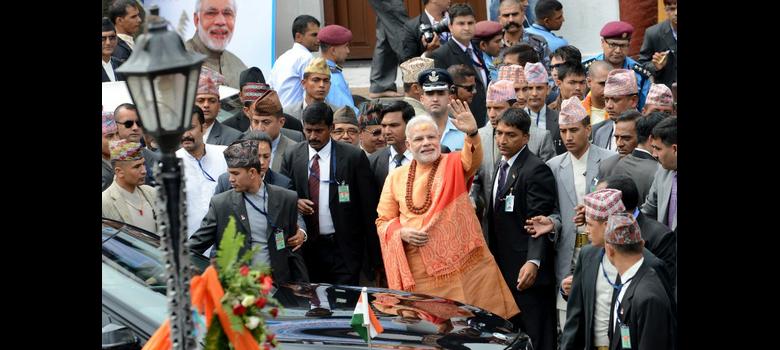
Foreign minister Sushma Swaraj is currently in Myanmar, the fourth neighbourhood country that she has visited in the last three months. But it was the trip made by Modi to Nepal that really sent a statement, since it was the first visit by an Indian prime minister to the country in 17 years. He received an enthusiastic reception.

“All governments that come to power in India feel that we must improve our relationship with the neighbourhood,” said Kanwal Sibal, a former foreign secretary. “But the difference is that, whereas in the past it remained at the level of rhetoric, in this case they are translating it into concrete initiatives. The fact that an Indian PM visited Nepal after 17 years is a testimony to the fact that, despite our professed position about needing a secure neighbourhood, we have actually neglected it… that is changing.”

That message was sent at the very beginning with the invitations handed out to each of the SAARC leaders for Modi’s swearing-in, all of which were accepted — with the exception of Bangladesh’s Sheikh Hasina, but only because she was on another diplomatic visit at the time. The sight of all the leaders in front of Rashtrapati Bhavan, and Modi dedicating his first day in office to bilateral talks with them, sent a very clear signal. The PM made his first foreign visit to Bhutan, a country deeply connected to India but not particularly important in terms of foreign policy.

“It shows that they understand that unless India is a dominant regional power, we can hardly be an extra-regional power or a world power,” said Manoj Joshi, a distinguished fellow at the Observer Research Foundation. “They seem to definitely be working on this understanding, especially because we are facing stiff competition from the Chinese when it comes to projecting power in the neighbourhood.”

Leading South Asia

It’s not just symbolism and rhetoric either. Modi’s visits to Bhutan and Nepal have been accompanied by important agreements, such as a $1 billion line of credit to Kathmandu, as well as the promise of further talks. Discussions with Bangladesh have also indicated progress on key stumbling blocks between the two nations. Modi has also spoken of using the SAARC framework to further cooperation in the neighbourhood. His suggestion of a SAARC space satellite, for example, while criticised by some as a gimmick, certainly sent a message that he is looking beyond the potential disputes towards projects that would allow the countries to work together.

“He has staked his leadership of the region, and this is important,” Sibal said. “There is a gesture to friendship in the neighbourhood, but he has also put across the message that India is leading the region. India is not going to neglect its neighbourhood, and it will take the lead in creating synergies that can benefit all.”

via Scroll.in – News. Politics. Culture..

04/03/2014

Singh to Neighbors: To Boost Trade, Build More Highways to India – India Real Time – WSJ

Indian Prime Minister Manmohan Singh addressed state leaders from South and South East Asia in Myanmar today to emphasize the need to improve trade ties by building highways connecting India and its neighbors.

Mr. Singh is on a two-day visit to the neighboring country for an economic meeting called the Bay of Bengal Initiative for Multi-Sectoral Technical and Economic Cooperation [BIMSTEC] Summit.

Addressing an audience including the leaders of Myanmar, Bangladesh, Sri Lanka, Bhutan, Nepal and Thailand, Mr. Singh said he would like to “improve physical connectivity” with a highway that will connect India to Myanmar and Thailand and with more maritime links with Myanmar. “And even as we develop physical infrastructure, we should simultaneously start developing the supporting architecture of rules and regulations to facilitate cross-country movements,” he said. He arrived yesterday in Myanmar’s capital, Nay Pyi Taw.

via Singh to Neighbors: To Boost Trade, Build More Highways to India – India Real Time – WSJ.

Enhanced by Zemanta
10/12/2013

White-collar jobs for rural women needed to enhance gender equality – new book | India Insight

Family planning, health and education programmes have done a lot to improve the lives of women in rural India, but getting more young rural women to work in jobs that don’t involve wage labour is the next step for gender equality and the country’s economic health, according to Dr. Carol Vlassoff, author of a new book, “Gender Equality and Inequality in Rural India: Blessed with a Son.”

Vlassoff, 69, has been studying the village of Gove in Satara District of Maharashtra state since 1975. She determined through her work there that bringing rural women into the modern economy in India means making more job opportunities available to them, particularly professional, white-collar jobs.

Doing this also could lead to slowing population growth in India, one of the world’s most populous countries with an estimated 1.2 billion people. She found, according to a press statement accompanying the book, “that self-employed and professional rural women were more likely to use contraceptives and delay having their first child than unemployed women with the same amount of schooling.”

This, she said, also helps promote gender equality at a time when parents, although fond of their daughters, consider a son essential. Daughters can be a financial burden on parents because, despite the abolition of dowry, grooms’ parents often expect substantial gifts. As a result, in Gove and elsewhere, parents sometimes choose to abort a female fetus. Half of the women Vlassoff interviewed in the village said they knew of women who have done this, she said.

Vlassoff, who worked at the World Health Organization on women’s empowerment, has been conducting studies in the village, which now has a population of 3,600, since 1975. The nearly 500 women in her latest study are 15 to 49 years old.

via White-collar jobs for rural women needed to enhance gender equality – new book | India Insight.

30/07/2012

* India’s Power Demand Fuels Bhutan’s Economy

WSJ: “When northern India was hit by its worst power outage in a decade early Monday – bringing trains to a standstill, creating massive road jams in the absence of traffic signals, and keeping thousands of offices and factories shut – the country’s leaders turned to its tiny neighbor Bhutan for help.

The Himalayan kingdom responded by releasing additional power from its hydroelectric plants, allowing New Delhi to restore some order while government officials and engineers worked to fix its electricity network.

This example of David coming to Goliath’s rescue speaks of Bhutan’s successful efforts to increase its electricity generation capacity to help boost its modest economy.

Bhutan – which is just 1% of India’s size and has fewer than 800,000 people compared with its neighbor’s 1.2 billion – now provides 1% of India’s electricity needs.

India has a deal to buy 5.480 billion kilowatt hours of power from Bhutan in the year that began April 1. The number might seem small, but it is hugely significant for Bhutan.

The electricity sector’s share of Bhutan’s economy has reached almost 20%, and it now outstrips agriculture as the single-largest contributor to gross domestic product, according to a World Bank report published in September.

Bhutan’s gross domestic product grew 8.1% in the year that ended March 31, 2011, helped by the construction of new hydropower projects, the report added. It anticipated that electricity exports will be the country’s main source of growth in the short-to-medium term.

Bhutan has hydro power potential of 30,000 megawatts, about a fifth of India’s own potential. However, the hydro projects in India aren’t making much progress due to strong protests from environmentalists and other issues.

So New Delhi is focusing on tapping the potential of land-locked Bhutan. India has helped build 96% of the kingdom’s overall hydropower capacity (1,472 megawatts.)

In July 2006, India agreed to develop and import 5,000 megawatt of electricity from Bhutan by 2020. The target was doubled to 10,000 MW in May 2008.

India also has a significant military presence in Bhutan, which it views of strategic importance as it shares a disputed border with China.”

via India’s Power Demand Fuels Bhutan’s Economy – India Real Time – WSJ.

Law of Unintended Consequences

continuously updated blog about China & India

ChiaHou's Book Reviews

continuously updated blog about China & India

What's wrong with the world; and its economy

continuously updated blog about China & India