Assuming that this is the beginning and not the end of state pensions in China, then in no time at all, China may well have better state pensions than many Western countries!
Related articles
- China sinking into pensions black hole (todayonline.com)
continuously updated blog about China & India

You will be living in their world, very soon

Beware the Waking Dragon
Assuming that this is the beginning and not the end of state pensions in China, then in no time at all, China may well have better state pensions than many Western countries!
China Daily: “With the rapid development of China’s economy, Chinese consumers’ appetite for jewellery has continued to grow, resulting in consistent sales growth in the domestic market.

In 2011, spending in China’s retail jewellery market reached 40 billion yuan ($6.3 billion), making it the world’s largest consumer market for platinum and jade, and the second-largest diamond jewellery consumer after the US. But in addition to being one of the world’s largest jewellery consumers, China has gradually emerged as a competitive jewellery maker in the international market.
In fewer than 20 years, China’s jewellery industry has grown rapidly, and Shenzhen, a booming city in South China’s Guangdong province, has played a crucial role in leading this industry.
Thanks to the influence of Hong Kong’s industry, the past two decades have seen Shenzhen evolve into China’s jewellery capital. Since the 1990s, the city has been acknowledged as China’s biggest jewellery manufacturing base and trade distribution center.
According to the Gems and Jewellery Trade Association of Shenzhen, more than 2,000 jewellery companies now call the city home, and their annual output value of more than 50 billion yuan accounts for more than 70 percent of China’s overall jewellery production. In fact, the sales revenue of Shenzhen’s jewellery enterprises is not just ranked first in terms of domestic market share, it makes up about one-third of China’s total.
But jewellers in Shenzhen are no longer content to remain the largest outsourcing base for brands from Hong Kong or other parts of the world. They are trying to reshape old business models by investing heavily in branding their own independently designed products, aspiring to upgrade Shenzhen from an international hub of original equipment manufacturers to the birthplace of famous jewellery brands.
…
Some jewellers in Shenzhen have taken the lead in brand-building campaign. One of the most successful is Chow Tai Seng Jewelry Co Ltd, a large jewellery producer based in the city.
Established in 1966, Chow Tai Seng Jewelry is now one of the largest diamond-jewellery retailers and wholesalers in China. It currently has the largest jewellery chain in the country, with more than 2,000 shops in more than 300 Chinese cities.
The company posted sales revenue of 13 billion yuan (US$2 billion) in 2011, accounting for 7.1 percent of the market. Zhou Zongwen, board chairman of Chow Tai Seng Jewelry, said sales this year are expected to increase by about 30 percent over the previous year, and the company will maintain this robust growth momentum in the next few years.”
via All that glitters is sold |Economy |chinadaily.com.cn.
See also:
China Daily: “A record 1-million-plus people in Beijing competed for fewer than 20,000 registration certificates qualifying them to buy cars through a lottery system on Sunday.
With a fixed number of car registrations issued each month and a lengthening waiting list, many potential car buyers are losing hope.
Some 1.05 million qualified applicants entered the registration lottery in August – 110,000 of them for the first time – and only 19,926 registrations will be issued, the city office in charge of the lottery system said on Saturday.
One in every 53 applicants will get the registrations, 80 percent fewer than in January last year, when Beijing introduced the lottery system to cap new car ownership at 240,000 a year.”
via Car plate applicants exceed 1m in Beijing |Society |chinadaily.com.cn.
From Business in Hong Kong & China blog: PRODUCTION: Rising costs, regulations deter European firms from China.
Related articles & posts:
A finding of cancer-causing chemicals on children’s clothes sparked public fear yesterday, after a report aired on national state broadcaster China Central Television(CCTV).
The station’s Weekly Quality Report investigative programme carried the report, claiming that a recent Beijing Consumer Association test of 63 samples of children’s clothes sold on the mainland revealed that nearly a third failed to meet quality and safety standards.
The association said that problems included excessive levels of formaldehyde and other carcinogenic chemicals.
The investigation began after consumers started complaining that their children had developed skin rashes after wearing the clothes.
From China Daily Mail blog: Tainted children’s clothes scandal in China.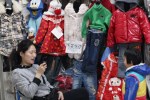
In geopolitical terms, India is lagging behind China in wooing Africa. This is despite a longer history of involvement mainly engendered by British colonialism that imported 100s of thousands of Indian labourers into Africa. Most of whom, a few generations later rose to become the commercial and middle class citizens. Though in Uganda, they ere thrown out by Idi Amin to Britain’s benefit where the Indians have established themselves as excellent business people and professionals at all levels.
Extract from the Hindu: “Noting that economies of developing countries are impacted by climate change, Prime Minister Manmohan  Singh on Monday pitched for greater cooperation between Asian and African countries to address short and long term challenges in this regard.
“I believe that in the future we will need to tackle the short term and long term environmental challenges that our economies face,” Dr. Singh said while addressing the inaugural function of Golden Jubilee Celebrations of Afro-Asian Rural Development Organisation in New Delhi.
Exhorting the scientists and experts to reflect on suitable technology to address the issue, Dr. Singh said, “Our scientists and experts have to reflect on technologies and processes that are most suitable for our rural conditions and circumstances, both in Africa and in Asia.” Underlining the need for African and Asian countries to work jointly, he said, “We have to work together to build a favourable international regime that enables us to access funds and green technologies for rural growth“. …
Noting that three quarters of world’s poor live in Asia and Africa, the Prime Minister said, “Rural reconstruction and poverty eradication are fundamental to our plans for sustainable development and inclusive growth.”
http://www.thehindu.com/news/national/article2963288.ece
See also: https://chindia-alert.org/2012/12/31/question-who-did-china-woo-in-2012/

continuously updated blog about China & India
continuously updated blog about China & India
continuously updated blog about China & India
 CHINDIA ALERT: You'll be living in their world, very soon