Posts tagged ‘capital punishment’

23/09/2016

Guns and ghee | The Economist

TO MANY Indians, their country’s strategic position looks alarming. Its two biggest neighbours are China and Pakistan. It has fought wars with both, and border issues still fester. Both are nuclear-armed, and are allies with one another to boot. China, a rising superpower with five times India’s GDP, is quietly encroaching on India’s traditional sphere of influence, tying a “string of pearls” of alliances around the subcontinent. Relatively weak but safe behind its nuclear shield, Pakistan harbours Islamist guerrillas who have repeatedly struck Indian targets; regional security wonks have long feared that another such incident might spark a conflagration.

So when four heavily armed infiltrators attacked an Indian army base on September 18th, killing 18 soldiers before being shot dead themselves, jitters inevitably spread. The base nestles in mountains close to the “line of control”, as the border between the Indian and Pakistani-administered parts of the disputed territory of Kashmir is known. Indian officials reflexively blamed Pakistan; politicians and pundits vied in demanding a punchy response. “Every Pakistan post through which infiltration takes place should be reduced to rubble by artillery fire,” blustered a retired brigadier who now mans a think-tank in New Delhi, India’s capital.

Yet despite electoral promises to be tough on Pakistan, the Hindu-nationalist government of Narendra Modi has trodden as softly as its predecessors. On September 21st it summoned Pakistan’s envoy for a wrist-slap, citing evidence that the attackers had indeed slipped across the border, and noting that India has stopped 17 such incursions since the beginning of the year. Much to the chagrin of India’s armchair warriors, such polite reprimands are likely to be the limit of India’s response.

There are good reasons for this. India gains diplomatic stature by behaving more responsibly than Pakistan. It is keenly aware of the danger of nuclear escalation, and of the risks of brinkmanship to its economy. Indian intelligence agencies also understand that they face an unusual adversary in Pakistan: such is its political frailty that any Indian belligerence tends to strengthen exactly the elements in Pakistan’s power structure that are most inimical to India’s own interests.

But there is another, less obvious reason for reticence. India is not as strong militarily as the numbers might suggest. Puzzlingly, given how its international ambitions are growing along with its economy, and how alarming its strategic position looks, India has proved strangely unable to build serious military muscle.

India’s armed forces look good on paper. It fields the world’s second-biggest standing army, after China, with long fighting experience in a variety of terrains and situations (see chart).
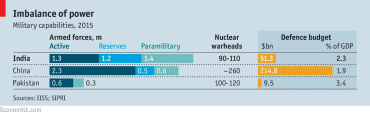
It has topped the list of global arms importers since 2010, sucking in a formidable array of top-of-the-line weaponry, including Russian warplanes, Israeli missiles, American transport aircraft and French submarines. State-owned Indian firms churn out some impressive gear, too, including fighter jets, cruise missiles and the 40,000-tonne aircraft-carrier under construction in a shipyard in Kochi, in the south of the country.

Yet there are serious chinks in India’s armour. Much of its weaponry is, in fact, outdated or ill maintained. “Our air defence is in a shocking state,” says Ajai Shukla, a commentator on military affairs. “What’s in place is mostly 1970s vintage, and it may take ten years to install the fancy new gear.” On paper, India’s air force is the world’s fourth largest, with around 2,000 aircraft in service. But an internal report seen in 2014 by IHS Jane’s, a defence publication, revealed that only 60% were typically fit to fly. A report earlier this year by a government accounting agency estimated that the “serviceability” of the 45 MiG 29K jets that are the pride of the Indian navy’s air arm ranged between 16% and 38%. They were intended to fly from the carrier currently under construction, which was ordered more than 15 years ago and was meant to have been launched in 2010. According to the government’s auditors the ship, after some 1,150 modifications, now looks unlikely to sail before 2023.

Such delays are far from unusual. India’s army, for instance, has been seeking a new standard assault rifle since 1982; torn between demands for local production and the temptation of fancy imports, and between doctrines calling for heavier firepower or more versatility, it has flip-flopped ever since. India’s air force has spent 16 years perusing fighter aircraft to replace ageing Soviet-era models. By demanding over-ambitious specifications, bargain prices, hard-to-meet local-content quotas and so on, it has left foreign manufacturers “banging heads against the wall”, in the words of one Indian military analyst. Four years ago France appeared to have clinched a deal to sell 126 of its Rafale fighters. The order has since been whittled to 36, but is at least about to be finalised.

India’s military is also scandal-prone. Corruption has been a problem in the past, and observers rightly wonder how guerrillas manage to penetrate heavily guarded bases repeatedly. Lately the Indian public has been treated to legal battles between generals over promotions, loud disputes over pay and orders for officers to lose weight. In July a military transport plane vanished into the Bay of Bengal with 29 people aboard; no trace of it has been found. In August an Australian newspaper leaked extensive technical details of India’s new French submarines.

The deeper problem with India’s military is structural. The three services are each reasonably competent, say security experts; the trouble is that they function as separate fiefdoms. “No service talks to the others, and the civilians in the Ministry of Defence don’t talk to them,” says Mr Shukla. Bizarrely, there are no military men inside the ministry at all. Like India’s other ministries, defence is run by rotating civil servants and political appointees more focused on ballot boxes than ballistics. “They seem to think a general practitioner can perform surgery,” says Abhijit Iyer-Mitra, who has worked as a consultant for the ministry. Despite their growing brawn, India’s armed forces still lack a brain.

Source: Guns and ghee | The Economist

10/06/2016

Indian men given life for gang-rape of Danish tourist | Reuters

Five Indian men were sentenced to life in prison on Friday for raping a Danish tourist in the heart of New Delhi‘s tourist district in 2014, in a case that reignited worries about sexual violence against women in India.

The men, all in their twenties, were found guilty by a Delhi court on Monday for robbing and raping the 52-year old Dane at a secluded spot close to New Delhi railway station.

“All the five convicts have been sentenced to rigorous life imprisonment for their offences,” additional public prosecutor Atul Shrivastava, told Reuters at the court. The Dane was walking through an area of narrow lanes near Delhi’s Paharganj district, a tourist area packed with backpacker hotels, on the evening of Jan. 14, 2014, when she asked a group of men for directions to her hotel.

The men then lured the woman to an area near New Delhi railway station where they raped her and robbed her at knife-point, the prosecution said in its chargesheet.

India was shaken into deep soul-searching about entrenched violence against women after the fatal gang-rape in December 2012 of a female student on a bus in New Delhi.

The crime, which sent thousands of Indians onto the streets in protest against what many saw as the failure of authorities to protect women, encouraged the government to enact tougher jail sentences for rapists.

Police accused nine men of attacking the Danish woman in 2014. Three are juveniles being tried in a separate court while a fourth died during the trial.

Lawyer D.K. Sharma, representing the five convicted men, said his clients would appeal against the verdict.

Source: Indian men given life for gang-rape of Danish tourist | Reuters

31/08/2015

Fewer crimes to be subject to death penalty|Society|chinadaily.com.cn

China’s top legislature has adopted an amendment to the Criminal Law removing the death penalty for nine crimes and limiting the ability of those convicted of corruption from continually seeking reduced sentences. The revisions, passed by the Standing Committee of the National People’s Congress on Saturday, will take effect on Nov 1.

Crimes that will no longer subject to the death penalty include: ・ smuggling weapons, ammunition, nuclear materials or counterfeit currency; ・ counterfeiting money and fraudently raising funds; ・ arranging for or forcing another person to engage in prostitution; ・ obstructing military personnel from performing their duties; ・ fabricating rumors to mislead others during wartime. When the law takes effect, the number of crimes subject to capital punishment will be reduced to 46.

Since the late 1990s, there has been a consistent move to reduce the use of the death penalty and gradually reduce the number of capital crimes, said Lang Sheng, deputy head of the Law Committee of the NPC Standing Committee. Lang said the decision to abolish the death penalty in the nine crimes was made after thorough research. “After deliberation on the sentencing of the nine crimes, we found the death penalty was rarely applied,” he said. In other cases, few crimes of that type were prosecuted. The revision reflects the changing views of society and the legal community, Lang said.

The legislature also sought to restrict the ability of people convicted of corruption to repeatedly seek reduced sentences. Currently, those who are convicted of serious corruption offenses might receive a death sentence with a two-year reprieve. During the suspended death sentence period, felons typically apply for sentence reductions, often leading to sentences of life imprisonment. The law allows them, thereafter, to appeal for further reductions-commutation of their sentences, parole or non-prison sentences. The amendment changes that, allowing the courts to decline further sentence reductions. “Courts will be allowed to pass a sentence of life imprisonment without the possibility of commutation or parole in corruption cases,” the Law Committee said in a report to the NPC.

The amendment to the Criminal Law also changed rape laws so that sex with girls under 14, whether consensual or not, is rape. The change comes amid public outrage over recent offenders who were charged with lesser crimes in such cases.

Source: Fewer crimes to be subject to death penalty|Society|chinadaily.com.cn

30/07/2015

India hangs Yakub Memon for 1993 Mumbai bomb blasts | Reuters

India hanged Yakub Memon on Thursday for his role in the country’s deadliest bombings, which killed 257 people in Mumbai in 1993, after the Supreme Court threw out his final plea for a stay of execution.

Memon was convicted as the “driving spirit” behind the serial blasts in India’s financial capital Mumbai, then known as Bombay. He spent two decades in jail before going to the gallows on his 53rd birthday in a jail Nagpur.

The execution drew wide public support but has stirred controversy about whether the punishment adequately reflected the help Memon gave authorities in solving the crime.

Critics question whether Memon’s death serves India’s larger interests, saying it sends the wrong message to potential collaborators with justice agencies.

In the days before his execution, it emerged that Memon had helped Indian intelligence crack the case and establish a link to neighbour and arch-rival Pakistan over the bombings.

“It’s extremely sad that India has gone ahead, we had been hoping India will now call for a moratorium,” said Meenakshi Ganguly, South Asia director for Human Rights Watch.

“But it’s very welcome that now there seems to be a growing debate around this in India.”

In a dramatic sequence of events, a Supreme Court panel held an unprecedented hearing in the early hours of Thursday, before rejecting Memon’s last-ditch plea for a 14-day delay in execution. Several previous pleas had also been rejected.

Police consider Memon’s brother, “Tiger” Memon, and mafia don Dawood Ibrahim to be the masterminds behind the attacks, intended to avenge the destruction of an ancient mosque by Hindu zealots in 1992. Both men remain in hiding.

Memon’s body was released for burial in Mumbai, with police deployed in riot gear to guard against possible street protests and security tightened at the family home.

via India hangs Yakub Memon for 1993 Mumbai bomb blasts | Reuters.

31/12/2014

$330,000 compensation for family of wrongly executed man – China – Chinadaily.com.cn

The parents of Hugjiltu, an 18-year-old who was executed after being wrongly convicted of raping and killing a woman in 1996, will receive 2,059,621.4 yuan ($332,116) in state compensation, the Higher People’s Court of the Inner Mongolia autonomous region ruled on Tuesday.

$330,000 compensation for family of wrongly executed man

The verdict has been delivered to Li Sanren and Shang Aiyun, parents of Hugjiltu, on Wednesday morning, the court said.

The parents of Hugjiltu said they respect the decision of the court.

Hugjiltu’s mother, Shang Aiyun, holds a photo of her son, who was wrongfully executed 18 years ago. [Photo by Guo Tieliu/for China Daily]

On Dec 15, 2014, the Inner Mongolia Higher People’s Court overturned Hugjiltu’s previous conviction and ruled he was not guilty of rape and murder, saying that the facts of his case were unclear and evidence was inadequate. It was 18 years after the man was executed.

The Intermediate People’s Court of Hohhot found Hugjiltu, a member of the Mongolian ethnic group, guilty of raping and fatally choking a woman in a toilet at a textile factory in Hohhot on April 9, 1996. He was sentenced to death and executed in June of the same year.

The case triggered controversy in 2005 when suspected serial rapist and killer, Zhao Zhihong, confessed to the murder after he was arrested.

Zhao allegedly raped and killed 10 women and girls between 1996 and 2005. He was tried in late 2006, but no verdict has been issued.

via $330,000 compensation for family of wrongly executed man – China – Chinadaily.com.cn.

07/12/2014

China to end use of prisoners’ organs for transplants next month | Reuters

China, the only country that still systematically takes organs from executed prisoners for use in transplant operations, plans to end the controversial practice from next month, a state-run newspaper said on Friday.

The government has over the last year flagged plans to end the practice, which has drawn criticism from rights groups, who have accused authorities of taking many organs without consent from prisoners or their families, a claim Beijing has denied.

The official China Daily said that human organ transplants will from Jan. 1 rely on voluntary public donations and on donations from living relatives.

“Harvesting organs from executed prisoners for transplants is controversial, despite written consent being required from donors and their relatives,” Huang Jiefu, head of the China Organ Donation Committee, was quoted as saying.

via China to end use of prisoners’ organs for transplants next month | Reuters.

27/10/2014

China considers abolishing death penalty for nine crimes | Reuters

China is considering trimming nine crimes from the list of offences punishable by death, state media said on Monday, as the ruling Communist Party considers broader reforms to the country’s legal system.

Rights groups say China uses capital punishment more than any other country, raising public concern of irreversible miscarriages of justice.

A draft amendment to China’s criminal law, which includes the use of the death penalty, was submitted for initial review to the country’s National People’s Congress, the official Xinhua news agency said.

Crimes that would be exempt from capital punishment under the amendment include “smuggling weapons, ammunition, nuclear materials or counterfeit currencies; counterfeiting currencies; raising funds by means of fraud; and arranging for or forcing another person to engage in prostitution”, Xinhua said.

The crimes of “obstructing a commander or a person on duty from performing his duties” and “fabricating rumors to mislead others during wartime”, are also under review, the news agency said.

Officials had previously said that China would review the application of the death penalty, which applies to 55 offences, including fraud and illegal money-lending.

China guards the number of people executed every year as state secrets.

The San Francisco-based Dui Hua Foundation, which seeks the release of political prisoners in China, estimated that 2,400 people were executed in 2013. By comparison, 39 people were executed in 2013 in the United States, according to the Death Penalty Information Center.

The reduction in death penalty crimes, however, is not expected to greatly reduce the number of executions per year, scholars have said.

The Communist Party, worried about rising social unrest and anger over land grabs, corruption and pollution unveiled legal reforms aimed at improving judicial independence at a key meeting last week.

The Party has stressed that it will remain in overall control of the judiciary, and despite the move to implement legal reforms, few analysts expect significant political change any time soon.

via China considers abolishing death penalty for nine crimes | Reuters.

13/06/2014

China’s Supreme Court overturns death sentences for two men who raped 11-year-old girl | South China Morning Post

The Supreme People’s Court has overturned the death sentences given to two men convicted of raping and forcing an 11-year-old girl to work in a brothel.

90711f3a78fe2afc4c012fe68c41ddfe.jpg

The court said the high-profile case, which has received national media attention, would be retried.

Tang Hui, the victim’s mother, has campaigned for years believing death sentences should be handed out to all people who were guilty in her daughter’s case.

She has also petitioned local governments to punish officials who she said had been bribed by prostitution gangs to protect their operations.

“The ruling has dealt a heavy blow to us,” Tang told the South China Morning Post yesterday.

“My family just tries to live a normal life. As the case reopens, we’ll experience all the nightmares again. I’m especially worried about my daughter.”

Tang’s daughter has contracted herpes, an incurable sexually transmitted disease, and psychological trauma after she was raped and forced to work as a prostitute at the age 11 for two months in a brothel in Yongzhou in Hunan province in 2006.

Her daughter’s two main kidnappers were sentenced to death in June 2012, four accomplices received life sentences and one was jailed for 15 years.

A representative from the Supreme People’s Court said in an interview with the People’s Daily that the death sentences had been overturned because the crimes were not serious enough to warrant capital punishment.

“The circumstances of the crime had not reached the degree of being extremely serious,” the spokesman said.

Forcing a large number of victims into prostitution, or performing torture on victims that resulted in death or permanent injury might have warranted the death sentence, the official added.

Lu Miaoqing , a lawyer in Guangzhou, said the Supreme People’s Court ruling was understandable as judges tended to avoid capital punishment unless a crime had caused deaths.

via China’s Supreme Court overturns death sentences for two men who raped 11-year-old girl | South China Morning Post.

01/04/2014

The Links Between the Delhi and Mumbai Rape Cases – India Real Time – WSJ

The two crimes were strikingly similar: In both, a young, ambitious woman was gang-raped by a group of impoverished men in one of India’s premier cities.

But their connection didn’t end there.

National outrage at the first case, involving a physiotherapy student who died from her injuries in New Delhi in Dec. 2012, arguably had an impact on how the country reacted to the second, in which a photojournalist in Mumbai was attacked while out on an assignment in an abandoned area of the financial capital.

They are also linked through the law.

The Delhi rape triggered changes to legislation to protect women that were subsequently used to convict the men charged with the attack in Mumbai.

Parts of that toughened up legislation, which made death the maximum penalty for rape in the case of repeat offenders, are also being used, for the first time, against the men guilty of gang-raping the Mumbai photojournalist.

Three of the four men convicted of gang-raping the photojournalist have also been convicted and sentenced to life in prison for gang-raping a telephone receptionist a few weeks earlier at the same location.

This makes them repeat offenders, so eligible for the death penalty, said the public prosecutor when he pressed fresh charges against the men last week in the hope of securing a death sentence for them at a trial court in Mumbai.

In the case of the Delhi victim, the attackers were punished under the previous version of the law, which awarded the death penalty for murder in the rarest of rare cases but set the maximum penalty for rape to a life term of 14 years.

The trial judge in the case in Mumbai allowed the prosecutor to introduce the new charge of repeated offense before sentencing began, but the defense lawyers appealed against the decision in the high court. The defense also challenged the constitutional validity of handing the death penalty to repeat gang-rape offenders.

The Mumbai High Court rejected the defense’s appeal against the fresh charges but refrained from expressing  its view on the “tenability of framing additional charge.”

The judges added that their decision not to interfere in the trial court hearing fresh charges should not be construed as approval.

The High Court judges also observed that sentencing repeat gang-rape offenders to death could bypass the “rarest of rare” criteria, which has long been invoked to prevent judges from using the death penalty too frequently or in an arbitrary manner.

via The Links Between the Delhi and Mumbai Rape Cases – India Real Time – WSJ.

Enhanced by Zemanta
21/11/2013

China Supreme Court rules out confession through torture | Reuters

Using torture to extract confessions must be eliminated, China\’s Supreme People\’s Court said on Thursday, singling out a widespread practice that has long attracted international condemnation.

Policemen guard the entrance outside Shandong Province Supreme People's Court in Jinan, Shandong province, October 25, 2013. REUTERS/Aly Song

\”Inquisition by torture used to extract a confession, as well as the use of cold, hunger, drying, scorching, fatigue and other illegal methods to obtain confessions from the accused must be eliminated,\” the Supreme Court said in a statement posted on its official microblog account.

The Supreme People\’s Court also introduced more stringent rules for death penalty cases, saying adequate evidence must be furnished and that only experienced judges should handle capital punishment trials.

China\’s government said last week it would work to reduce the number of crimes subject to the death penalty.

via China Supreme Court rules out confession through torture | Reuters.

Law of Unintended Consequences

continuously updated blog about China & India

ChiaHou's Book Reviews

continuously updated blog about China & India

What's wrong with the world; and its economy

continuously updated blog about China & India