Posts tagged ‘China’

15/07/2012

* Google Tries Something Retro – Made in the U.S.A.

NYTimes: “Etched into the base of Google’s new wireless home media player that was introduced on Wednesday is its most intriguing feature. On the underside of the Nexus Q is a simple inscription: “Designed and Manufactured in the U.S.A.”

The Google executives and engineers who decided to build the player here are engaged in an experiment in American manufacturing. “We’ve been absent for so long, we decided, ‘Why don’t we try it and see what happens?’ ” said Andy Rubin, the Google executive who leads the company’s Android mobile business.

Google is not saying a lot about its domestic manufacturing, declining even to disclose publicly where the factory is in Silicon Valley. It also is not saying much about the source of many of its parts in the United States. And Mr. Rubin said the company was not engaged in a crusade.

Still, the project will be closely watched by other electronics companies. It has become accepted wisdom that consumer electronics products can no longer be made in the United States. During the last decade, abundant low-cost Chinese labor and looser environmental regulations have virtually erased what was once a vibrant American industry.

Since the 1990s, one American company after another, including Hewlett-Packard, Dell and Apple, has become a design and marketing shell, with production shifted to contract manufacturers in Shenzhen and elsewhere in China.

Now that trend may be showing early signs of reversing.

It’s a trickle, but some American companies are again making products in the United States. While many of those companies have been small, like ET Water Systems, there have also been some highly visible moves by America’s largest consumer and industrial manufacturers. General Electric and Caterpillar, for example, have moved assembly operations back to the United States in the last year. (Airbus, a European company, is said to be near a deal to build jets in Alabama.)

There is no single reason for the change. Rising labor and energy costs have made manufacturing in China significantly more expensive; transportation costs have risen; companies have become increasingly aware of the risks of the theft of intellectual property when products are made in China; and in a business where time-to-market is a competitive advantage, it is easier for engineers to drive 10 minutes on the freeway to the factory than to fly for 16 hours.

That was true for ET Water Systems, a California company. “You need a collaboration that is real time,” said Pat McIntyre, chief executive of the maker of irrigation management systems, which recently moved its manufacturing operation from Dalian, China, to Silicon Valley. “We prefer local, frankly, because sending one of our people to China for two weeks at a time is challenging.”

Harold L. Sirkin, a managing director at Boston Consulting Group, said, “At 58 cents an hour, bringing manufacturing back was impossible, but at $3 to $6 an hour, where wages are today in coastal China, all of a sudden the equation changes.”

The firm reported in April that one-third of American companies with revenue greater than $1 billion were either planning or considering to move manufacturing back to the United States. Boston Consulting predicted that the reversal could bring two million to three million jobs back to this country.”

via Google Tries Something Retro – Made in the U.S.A. – NYTimes.com.

This cost difference is continuing to erode away as China has been increasing its basic wages by between 10-15% per annum for the last 10 years and intends to continue doing so in order to improve the standard of living of the working person thereby passing on the benefits of the improving GDP.

See also:

14/07/2012

* China top leaders vow to better handle people’s petitions

Xinhua: “China’s top leaders on Friday met representatives for a nationwide conference on the work of handling the people’s petitions, vowing to safeguard the people’s rights and interests and strengthen ties between the authorities and the people.

President Hu Jintao, Premier Wen Jiabao, Vice President Xi Jinping and Vice Premier Li Keqiang met the representatives before the conference, extending their greetings to all the government staff handling the people’s letters and calls.

Zhou Yongkang, a member of the Standing Committee of the Political Bureau of the Communist Party of China (CPC) Central Committee, and secretary of the Committee of Political and Legislative Affairs of the CPC Central Committee, also met representatives and delivered a speech at the conference.

The petitioning, also known as letters and calls, is the administrative system for hearing complaints and grievances from Chinese citizens.

The bureaus of letters and calls at all levels are commissioned to receive letters, calls, and visits from individuals or groups, and then channel the issues to respective departments, and monitor the progress of settlement.”

via China top leaders vow to better handle people’s petitions – Xinhua | English.news.cn.

Petitioning has been a historic means for members of the public, however lowly to put forward their grievances to someone high enough to deal with it. Sometimes, a petition would go all the way to the Emperor or, at least, to his chief minister.

The Chinese government is merely reaffirming this historic practice.

See also: http://en.wikipedia.org/wiki/Petitioning_(China)

14/07/2012

* China football fans greet Didier Drogba at Shanghai

BBC: “Ivory Coast football star Didier Drogba has arrived to a hero’s welcome in China, to take up a contract to play for Shanghai Shenhua.

Hundreds of fans of the struggling Chinese Super League team greeted the 34-year-old former Chelsea star at Shanghai’s Pudong airport.

Drogba’s reported $300,000 (£193,000) a week salary makes him one of the world’s highest paid footballers.

Drogba is among many foreign stars who have made recent moves to China.

He joins former Chelsea colleague Nicolas Anelka at Shanghai Shenhua.

Soon after his arrival, Drogba insisted he had not come for the money.

He said: “It would have been easier for me to stay in Europe, but I chose China. Money is not the most important [thing]. I am here for a whole new experience.””

via BBC News – China football fans greet Didier Drogba at Shanghai.

First cheap plastic toys, then mid-level products, onto hi-tech gadgets; and now international football?

13/07/2012

* Chinese couple paid for forced abortion

UPI: “A Chinese couple forced to abort their child at seven months in early June was paid an $11,200 settlement by the local government Wednesday.

Deng Jiyuan said the government agreed to pay $11,200 after already firing two officials, sanctioning five officials and issuing a former apology for forcing Deng’s wife, Feng Jianmei, to have an abortion when she was seven months pregnant, The New York Times reported.

Feng was forced to abort her second child because China limits families to one child per household. Deng could not afford to pay the fine for having a second child, so the government forced Feng to abort her child.

A picture of Feng next to the aborted fetus circulated through the Internet in China, prompting the government to respond.

“We want to return to our home and move on with our life, ” Deng said. “This was a tragedy but life has to continue.””

via Chinese couple paid for forced abortion – UPI.com.

$11,200 may not seem like much for a life. But note that this is the first publicly recorded compensation for such an act. It is the first step towards righting a historic wrong.

See also:

13/07/2012

* China condemns new massacre in Syria

Xinhua: “China on Friday strongly condemned the massacre in Syria’s Hama region on Thursday, which caused the death of more than 200 Syrians, mostly civilians.

Foreign Ministry spokesman Liu Weimin made the remarks at a regular press briefing when asked to comment on the massacre.

Syria’s state TV said Thursday that armed groups committed a massacre in al-Traimseh of central Hama province in order to frame Syrian troops, as activists alleged that at least 200 people had been killed in the town.

“China has always strongly denounced actions that harm innocent civilians,” said Liu, calling on concerned Syrian parties to take concrete measures and fulfill their commitment to cease violence as soon as possible.

Ministers attending the Action Group meeting on Syria that concluded in Geneva on June 30 agreed to establish principles and guidelines to usher the way for a Syrian-led transition.

A joint communique issued after the meeting said that the global community wished to see “an end to the violence and human rights abuses” and that the Syrian people had the right to “independently and democratically determine their own future.””

via China condemns new massacre in Syria – Xinhua | English.news.cn.

China is gradually taking a hard line and moving towards a Western position and away from the Russian one.

13/07/2012

* SE Asia meeting in disarray over sea dispute with China

Reuters: “Southeast Asian nations have failed to reach agreement on a maritime dispute involving China, ending a foreign ministers’ summit in disarray after Beijing appeared to split the 10 countries over the contentious issue.

The Philippines said in a statement on Friday that it “deplores” the failure of the Association of Southeast Asian Nations (ASEAN) summit to address the worsening row, and criticized Cambodia in unusually strong language for its handling of the issue.

China has been accused of using its heavy influence over summit chair Cambodia and several other ASEAN members to block regional-level discussions on the issue and attempts to agree a binding maritime Code of Conduct.

The Philippines said it took “strong exception” to Cambodia’s statement that the non-issuance of a communiqué was due to “bilateral conflict between some ASEAN member states and a neighboring country”.

It said it had only requested that the communiqué mention the recent standoff between Chinese and Philippine ships at the Scarborough Shoal, a horseshoe-shaped reef in waters that both countries claim.

“The Chair has consistently opposed any mention of the Scarborough Shoal at all in the Joint Communiqué and today announced that a Joint Communiqué ‘cannot be issued’,” the Philippine statement said.

The failure to issue a joint statement marks a sharp deterioration in efforts to cool tensions following recent incidents of naval brinkmanship over the oil-rich waters.

China, whose trade and investment ties with Cambodia have surged in recent years, has warned that “external forces” should not get involved in the dispute. Vietnam, Malaysia, Brunei and Taiwan also lay claim to parts of the South China Sea.”

via SE Asia meeting in disarray over sea dispute with China | Reuters.

Despite good intentions, territorial imperatives overcame desire for resolution.

See also: China’s external tensions

11/07/2012

* Socialist market economy turning point for China

Xinhua: “Good education, housing, medical care and insurance are within the reach of more Chinese since the adoption of a market economy, according to a Tuesday commentary in the People’s Daily, the flagship newspaper of the Communist Party of China (CPC).

The formation and improvement of China’s socialist market economy has reshaped the lives of 1.3 billion people and exerted an influence on the future of the whole world, wrote Ren Zhongping.

In the past 20 years, the most populous nation has become the world’s second-largest economy and has stood among middle-income countries in terms of its per capita gross domestic product, Ren said.

China turned itself from a seller’s market to a buyer’s market and became the world’s biggest exporter and a member of the World Trade Organization, Ren said.

At the beginning, China’s transformation faced many obstacles, including domestic prejudice and doubts of foreign countries, Ren said.

However, the “China miracle” surprised everyone, Ren wrote.

“It is said that everything happened in the past 20 years could not be planned in any plan,” Ren said.

Focusing on developing productivity, adhering to the common development of public-owned and private economies and integrating market allocation with the government regulation helped make China successful, Ren said.

However, the problems that have emerged after development are no smaller than those that existed before China’s prosperity, Ren said.

It’s imperative to enhance the quality of economic development, eliminate factors that hamper economic growth mode and smash the administrative monopoly so as to further free development of the private economy, Ren said.

The author called for a sound insurance system that can relieve social anxiety and narrow the income gap, as well as stark government reforms.

Unswerving reform is the only way to realize the goal of “establishing a sound social market economic system by 2020,” Ren said.

Changing China’s economic growth mode, promoting transformation of government functions and boosting equality in public services will allow China to shoulder a sea of challenges both now and in the future, Ren wrote.”

via Socialist market economy turning point for China: People’s Daily – Xinhua | English.news.cn.

A fair summary of the past 20 years and a good prognostication of the next twenty.

Related articles

11/07/2012

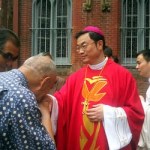
* Ordination of Bishops Increases Tensions Between China and Vatican

NY Times: “In a sign of rising tensions between the Vatican and China, authorities in recent days have ordained one Catholic bishop without Rome’s consent and detained another after he made a dramatic break with the country’s Communist-run religious hierarchy.

On Friday, government officials organized the consecration of the Rev. Joseph Yue Fusheng as bishop in the northern city of Harbin. Bishop Yue’s nomination had not been approved by the Vatican, and reports said bishops loyal to the Vatican were forced to participate — a common practice meant to give Beijing-appointed bishops legitimacy in the eyes of local believers. The Vatican immediately excommunicated him.

Then, on Saturday in Shanghai, the most important city for China’s Catholics, the Rev. Thaddeus Ma Daqin, a man widely seen as acceptable to both Beijing and Rome, was consecrated as auxiliary bishop, which would put him in line to succeed Bishop Aloysius Jin Luxian, 95, who had been approved by both Beijing and Rome.

But Bishop Ma stunned hundreds of worshipers in the city’s Cathedral of St. Ignatius by announcing that he would no longer work for the Chinese Patriotic Catholic Association, the government-run body that oversees Catholics in China.

“In the light of the teaching of our mother church, as I now serve as a bishop, I should focus on pastoral work and evangelization,” Bishop Ma told the crowded church. “Therefore, from this day of consecration, it will no longer be convenient for me to be a member of the patriotic association.”

The announcement, captured on video and posted on foreign and Chinese Web sites, was met with sustained applause from the congregation.

Bishop Ma’s fate is unclear. Catholic Church members in Shanghai said he did not lead Mass on Sunday as scheduled. They say he was taken away after the service and is being held at the Sheshan Catholic seminary, on the outskirts of Shanghai.”

via Ordination of Bishops Increases Tensions Between China and Vatican – NYTimes.com.

In terms of reform and liberalisation and so forth, China often takes two steps forward and one step back. This series of confrontations with the Vatican can be seen by many to be one of its backward steps.

See also: Chinese Christians

10/07/2012

* 5m greener vehicles on the Chinese streets by 2020

China Daily: “China has set a target of producing and selling 500,000 energy-efficient and alternative-energy vehicles a year by 2015, and five million vehicles by 2020.

The blueprint, announced by the State Council on Monday, has outlined generous subsidies to consumers and producers of the new generation of greener vehicles, as it aims to ease the country’s heavy dependence on imported oil, cut emissions, and speed up the restructuring of its automobile sector into a more environmentally sustainable model.

According to the details, there will be heavy government investment in the core technology needed to build a strong and globally competitive new-energy vehicle industry.

The short-term emphasis will be on developing pure electric and plug-in hybrid vehicles, as well as wider usage of hybrid vehicles and energy-saving combustion engine automobiles.

The world’s largest auto market has set an accumulated production and sales target of 500,000 units of pure electric and plug-in hybrid vehicles by 2015, and that will be increased tenfold to more than 5 million units by 2020.”

via 5m greener vehicles on the streets by 2020 |Economy |chinadaily.com.cn.

Continuing on the path to a ‘greener’ China – https://chindia-alert.org/economic-factors/greening-of-china/

Law of Unintended Consequences

continuously updated blog about China & India

ChiaHou's Book Reviews

continuously updated blog about China & India

What's wrong with the world; and its economy

continuously updated blog about China & India