Posts tagged ‘China’

09/05/2012

* China: The world’s cleverest country?

BBC News: “China’s results in international education tests – which have never been published – are “remarkable”, says Andreas Schleicher, responsible for the highly-influential Pisa tests.

These tests, held every three years by the Organisation for Economic Co-operation and Development, measure pupils skills in reading, numeracy and science. Pisa tests – the Programme for International Student Assessment – have become the leading international benchmark. The findings indicate that China has an education system that is overtaking many Western countries. While there has been intense interest in Chinas economic and political development, this provides the most significant insight into how it is teaching the next generation. …

“Even in rural areas and in disadvantaged environments, you see a remarkable performance. “In particular, he said the test results showed the “resilience” of pupils to succeed despite tough backgrounds – and the “high levels of equity” between rich and poor pupils. …

In an attempt to get a representative picture, tests were taken in nine provinces, including poor, middle-income and wealthier regions. The Chinese government has so far not allowed the OECD to publish the actual data.But Mr Schleicher says the results reveal a picture of a society investing individually and collectively in education. On a recent trip to a poor province in China, he says he saw that schools were often the most impressive buildings. He says in the West, it is more likely to be a shopping centre. “You get an image of a society that is investing in its future, rather than in current consumption.

“There were also major cultural differences when teenagers were asked about why people succeeded at school.

“North Americans tell you typically its all luck. Im born talented in mathematics, or Im born less talented so Ill study something else.

“In Europe, its all about social heritage: My father was a plumber so Im going to be a plumber.

“In China, more than nine out of 10 children tell you: It depends on the effort I invest and I can succeed if I study hard.”They take on responsibility. They can overcome obstacles and say Im the owner of my own success, rather than blaming it on the system.”

via BBC News – China: The worlds cleverest country?.

To anyone who knows something about Chinese history, the results are not surprising at all.  If, for over 1,500 years anyone – peasant, labourer, artisan, or scholar – who passed the right exams can become a magistrate, civil servant or governor; then passing exams and studying for them becomes ingrained, part of the tacit cultural norm. And despite two major revolutions, one to overthrow imperialism and the other to lift the masses, exams still play a key role in success. It is no surprise that eight of the nine top CCP leaders are engineers by training.

Related articles:

09/05/2012

* China, Singapore to build 100 bln yuan high-tech zone

Xinhua: “The construction of a 100-billion yuan (16 billion U.S. dollars) high-tech zone was jointly launched Tuesday in southwest China’s Sichuan province by the provincial government and a Singapore company.

The Singapore-Sichuan High-tech Innovation Park, planned to cover 10.34 square kilometers and house 120,000 residents in Gaoxin district and Tianfu district in Chengdu, capital of Sichuan, is expected to attract an investment of 100 billion yuan from 2012 to 2020. Under the guidance of Sichuan government authorities, the project will be operated by the Singapore-Sichuan company Sino-Singapore Chengdu High-Tech Innovation Park Development Company Ltd., with a registered capital of 297 million U.S. dollars, jointly invested by Singapore state-owned company Temasek Holdings and Chengdu High-tech Investment Group, said Tang Hua, deputy director of the development administration of Gaoxin district. …

The park will mainly focus on eight industries including information technology, service outsourcing, digital media, biomedicine, environmental protection, precision machinery, finance and training, Tang said.The park is expected to have 120,000 to 150,000 employees as a new platform for China, Singapore and other countries to invest in western China, said Lim Swee Say, minister of Prime Ministers Office, advisor of Singapore-Sichuan Trade and Investment Committee, secretary-general of Singapore National Trade Union Congress.”

via China, Singapore to build 100 bln yuan high-tech zone – Xinhua | English.news.cn.

Yet another sign of China’s determination to reduce reliance on foreign hi-tech.

Related articles:

08/05/2012

* China’s first deep-water rig to drill in South China Sea

Xinhua: “The first deep-water drilling rig developed in China will be put into service in

 the South China Sea on Wednesday, the countrys largest offshore oil producer said Monday.

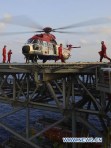
The sixth-generation semi-submersible CNOOC 981 will begin operations in a sea area 320 kilometers southeast of Hong Kong at a water depth of 1,500 meters, China National Offshore Oil Corp. It will be the first independent deep-water oil drilling by a Chinese company, marking “a substantial step” made by the country’s deep-sea oil industry, CNOOC said. About 70 percent of oil and gas reserves in the resource-rich South China Sea is contained in 1.54 million square km of deep-water regions, or sea areas with depths of over 300 meters. However, most of China’s current offshore oil exploration is conducted less than 300 meters below the surface.

The South China Sea is estimated to have 23 billion to 30 billion tonnes of oil and 16 trillion cubic meters of natural gas, accounting for one-third of Chinas total oil and gas resources.”

via Chinas first deep-water rig to drill in South China Sea – Xinhua | English.news.cn.

Another instance of China continuing to reduce reliance on Western hi-tech.
 
Related post:
08/05/2012

* China issues policies to raise wellbeing of working women

Xinhua: “A new regulation, made public Monday, provides employed Chinese women with better welfare policies, including extended maternity leave and higher workplace protection.

A pregnant woman

A pregnant woman (Photo credit: Wikipedia)

According to the regulation adopted by the State Council in April, maternity leave has been extended from 90 days to 98 days, which is in line with the 14-week minimum standard set by the International Labour Organization. The regulation more clearly specifies leave granted to women who have miscarriages. According to it, a female employee will get 15 days of leave if their miscarriage occurs within the first four months of pregnancy and 42 days of leave if it happens later. Under the regulation, female employees should be paid either by the maternity insurance programs they have joined or by employers during their maternity leave.

The regulation also expands the categories of jobs that pregnant women and breastfeeding mothers are banned from working for, while removing restrictions on what jobs married women at the childbearing age should take.It also imposes clear penalties on the offenders, ranging from 1,000 to 300,000 yuan 159 to 47,619 U.S. dollars. And it stipulates that those employers who seriously violate the rules should be suspended from operation.

According to the government, China is estimated to currently have 102 million women in full-time employment.”

via China issues policies to raise wellbeing of working women – Xinhua | English.news.cn.

07/05/2012

* Lenovo Reaches Beyond PC Business

WSJ: “Personal-computer maker Lenovo Group Ltd. said Monday that it plans to spend about $800 million on a new base to house the development, production and sale of mobile products as the Chinese company tries to expand beyond its core PC business.

Lenovo Ideapad U8 MID example

Lenovo Ideapad U8 MID example (Photo credit: Wikipedia)

Lenovo, the world’s second-largest PC maker, said in a written statement on Monday that the five-billion-yuan facility, in the central Chinese city of Wuhan, will have several thousand employees, mainly focused on smartphones, tablet computers and other mobile devices for China and global markets. The company estimates total revenue from the base will reach 10 billion yuan $1.59 billion by 2014, and increase to 50 billion yuan within the next five years. The facility is expected to begin operations in October 2013.

Now, the company is making a mobile-devices push. The investment represents the company’s latest effort to break into new product categories as PC sales lag behind demand for mobile devices, including smartphones and tablets. Lenovo created a business unit last year called the Mobile Internet Digital Home group to focus on developing smartphones, tablets and Internet-connected smart television sets that can communicate with the mobile devices.”

via Lenovo Reaches Beyond PC Business – WSJ.com.

See also: Chinese innovation

07/05/2012

* China, Central Asian countries hold cooperation forum

The proposed Central Asian Union, covering the...

Xinhua: “China and five Central Asian nations held a cooperation forum on Monday in Tongxiang of east China’s Zhejiang province. The forum, themed around mutual trust, cooperation and harmonious development, focused on pragmatic, social and cultural cooperation between China and Kyrgyzstan, Tajikistan, Kazakhstan, Turkmenistan and Uzbekistan.

It also saw the signing of a declaration on further promoting their cooperation. Bai Lichen, vice chairman of the Chinese Peoples Political Consultative Conference, Chinas top advisory body, attended the opening ceremony and met with representatives from the five Central Asian countries.”

via China, Central Asian countries hold cooperation forum – Xinhua | English.news.cn.

Related post: https://chindiapedia.wordpress.com/wp-admin/post.php?post=5753&action=edit

https://chindia-alert.org/political-factors/geopolitics-chinese/

07/05/2012

* Foreign firms bullish about Chinese economy

China Daily: “Germany looking more to China than Europe for overseas investment

Germany has always been the cornerstone of the European economy but Europe is not as important to Germany as it used to be.

For the first time China has become German companies top foreign investment destination, totaling $1.36 billion by the end of last year, according to a survey by the Association of German Chambers of Industry and Commerce. The amount was more than the combined German investment in France, Spain and Italy.

The profound shift is visible in the case of Knauf Gips KG, a German-headquartered plasterboard manufacturer.When asked what helped turn the family-owned workshop into the world’s second-largest gypsum board maker, Mark Norris, the company’s China chief executive officer, said one particular factor stands out – China. After its entry into the Chinese market in the 1990s, Knauf built three plants in Beijing, Shanghai and Guangzhou. The initial investment soon gave Knauf a solid foothold in the country’s dry-wall market. Norris said he was quite bullish about the future and remained committed to continuing investment, despite decelerating economic growth in China, compounded by the European crisis and stagnation in the United States. “In relative terms, China remains a dynamic growth engine compared with places like Spain and Greece, where there is absolutely no growth,” he said. “And people seem to forget that the market is so big, the demand for good quality is there.” As we noticed over the past five years, a mid-to-upper class has emerged and the quality of life is increasing. People are prepared to pay for green building materials. Even though its not comparable to the European or US standard, it is catching up quick.””

via Foreign firms bullish about economy[1]|chinadaily.com.cn.

04/05/2012

* China pledges more support for small, micro-sized firms

Xinhua: “The State Council, or China’s Cabinet, announced on Thursday a slew of measures to enhance the fiscal, financial and taxation support for small and micro-sized enterprises in a bid to ensure their sound development.

China’s small and micro-sized firms are facing increasing operational pressures and rising production costs amid a complicated and uncertain economic situation, and financing difficulties and heavy taxation are adding more pains. Therefore, the State Council issued a document to boost the healthy development of small and micro-sized firms as they play an irreplaceable role in creating jobs and promoting the real economy. The document, including 29 measures in eight aspects, required local authorities to enhance fiscal and tax support for the small and micro-sized firms, relieve their financing difficulties and create a favorable environment for their development.”

via China pledges more support for small, micro-sized firms – Xinhua | English.news.cn.

03/05/2012

* China, Japan, South Korea to boost investment in each others bonds

Reuters: “China, Japan and South Korea agreed on Thursday to boost cross-investment in government bond markets, worth nearly a combined $15 trillion, in a move that will better prepare the countries to protect their financial markets from external shocks.

East Asia blank map China/Japan/Korean peninsu...

East Asia map China/Japan/Korean peninsula (Photo credit: Wikipedia)

The three economic powers sought a formal agreement, a rare one on securities investment, to ease mutual concerns about possibly massive cross-border fund flows and because their capital markets are at different levels of development. The move also comes as many of the heavily exposed economies in East Asia have struggled to find ways to avoid a repeat of the 1997/98 Asian financial meltdown and other turmoil that has struck during times of crises originating outside the region.”

via China, Japan, South Korea to boost investment in each others bonds | Reuters.

03/05/2012

* Unease Mounting, China and U.S. to Open Military Talks

NY Times: “Limited military talks between China and the United States — an arena in which the two sides view each other with mounting unease — open here on Wednesday as a prelude to a wider-ranging economic and strategic dialogue between Secretary of State Hillary Rodham Clinton and Treasury Secretary Timothy F. Geithner and their Chinese counterparts.

Secretary of State Hillary Clinton and Treasur...

Secretary of State Hillary Clinton and Treasury Secretary Timothy Geithner listen as President Barack Obama addresses the opening session of the first U.S.-China Strategic and Economic Dialogue at the Ronald Reagan Building and International Trade Center in Washington on July 27, 2009. (Photo credit: Wikipedia)

Military talks are a prelude to an economic and strategic dialogue. China is increasingly suspicious of what it views as stepped-up spying by American planes and ships along its coast, and the United States is disquieted by China’s growing array of weaponry, analysts on both sides say. The two nations have been unable to agree on a serious agenda for military talks despite an escalation of tensions as China presses territorial claims in the East and South China Seas and the United States fortifies longstanding alliances from Australia to the Philippines.

The meetings, known as the Strategic and Economic Dialogue, will be limited to a one-day session on Wednesday that will cover two subjects, cyberwarfare and maritime issues, Obama administration officials said.”

via Unease Mounting, China and U.S. to Open Military Talks – NYTimes.com.

Law of Unintended Consequences

continuously updated blog about China & India

ChiaHou's Book Reviews

continuously updated blog about China & India

What's wrong with the world; and its economy

continuously updated blog about China & India