Posts tagged ‘China’

18/09/2014

N. Korea, China to open major bridge next month

North Korea and China are set to open a major suspension bridge across the Amnok River in October, paving the way for closer economic relations between the allies, China’s state media reported Thursday.

The 3-kilometer, 2.2 billion yuan (US$357 million) bridge links the North’s border city of Sinuiju to the neighboring Chinese city of Dandong over the river, also called the Yalu River in China. Dandong handles more than 70 percent of bilateral trade with North Korea.

The official China News Service, without citing any sources, reported that the bridge will be opened in October, when the two nations hold a joint trade fair in Dandong.

If the Chinese-funded bridge opens, the report said, “Dandong will become more important in China-North Korea trade.”

The bridge illustrates the view in China that economic engagement with North Korea is a prerequisite to persuading it to abandon its nuclear weapons program, and its resistance to U.S. calls to exert more economic leverage to restrain the regime.

A series of provocations by the North, including last year’s nuclear test, have strained political ties with its last-remaining ally, China. Still, many analysts believe that Beijing will not put strong pressure on Pyongyang due to the risk of aggravating the current situation.

via N. Korea, China to open major bridge next month.

18/09/2014

After Modi-Xi meeting, China agrees to quickly settle border dispute, demarcate LAC – Hindustan Times

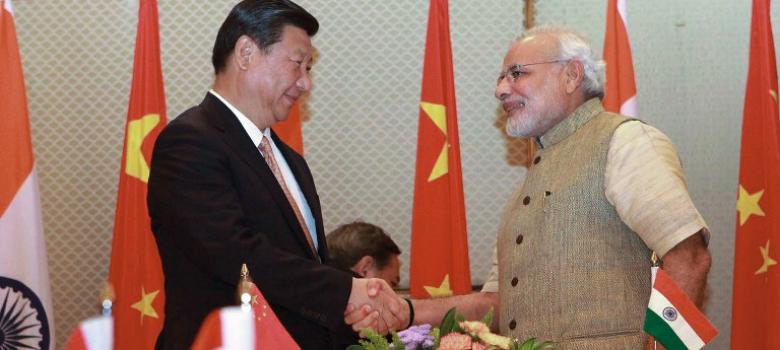
Prime Minister Narendra Modi and Chinese President Xi Jinping on Thursday agreed to quickly resolve the border dispute and demarcate the Line of Actual Control to improve peace and cooperation between both countries.

Addressing the media after the conclusion of one-on-one meeting with visiting Chinese President Xi Jinping, Modi said India is concerned about the frequent incursions along the border. The Line of Actual Control should be demarcated soon to ensure peace and tranquility in the area, he said.

President Xi, in response, said that China will work to settle the border issue at the earliest date. Since the border is not demarcated there will be some incidents, but both countries are capable of settling it at various levels without causing a bigger impact, he said.

President Xi said both countries would be respectful and sensitive to each others concerns. “We also have the sincerity to work with India to maintain peace and tranquility in the border areas before we are finally able to settle the border question,”he said.

The latest incident India was referring to was the  fresh incursion by the Chinese army in Chumar area, even as talks were on between both the leaders.

via After Modi-Xi meeting, China agrees to quickly settle border dispute, demarcate LAC – Hindustan Times.

18/09/2014

Despite the Xi-Modi bromance, Indians and Chinese don’t actually like each other

One in two Indians thinks China is a major threat.

In the last two days alone, Chinese President Xi Jinping has called India an ancient, magic, enchanting, and beautiful land. And Indian Prime Minister Narendra Modi has reciprocated with syrupy adjectives, reminding visiting journalists how ancient Chinese technology was responsible for sugar being called cheeni in India.

The pictures of the two leaders’ bonhomie on Wednesday went even further. By the time you get to the sight of Modi and Xi sitting on a swing by the Sabarmati, most would imagine that India and China are steadfast allies who support each other through thick and thin.

Which is why it might be worth pointing out that we don’t actually like each other very much, and that Indians and Chinese people have very different intentions for the bilateral relationship. And it’s not just about the trade deficit and the border disputes. Ordinary Indians and Chinese people simply aren’t sure whether they like each other.

via Scroll.in – News. Politics. Culture..

17/09/2014

Survey shows 10 problems of Chinese society – China – Chinadaily.com.cn

Twenty-four percent has cited the credibility deficit of the government as a main reason behind the lack of trust in Chinese society, according to a survey conducted by People’s Tribune, a magazine of People’s Daily.

Survey shows 10 problems of Chinese societyThe survey finds more than 80 percent of respondents think of Chinese society as “sub-healthy” and 40.4 percent  believe that a crisis of credibility is sickening society.

The “symptoms” are, in order, distrust in “whatever the government says”, “distrust between people’, “doubt over food and medicine safety” and distrust in “doctors’ professional ethics”.

A lack of faith is the most recognized problem in the survey. When asked to choose which group suffers the most from the symptom, more than half of the respondents chose government officials. In a report of the People’s tribute, the choice was referred to a recent case of the self-styled “qigong master” Wang Lin, who claimed to have supernatural powers. He has been put under the spotlight after his photos with many government officials and celebrities were published online last summer.

The superstition in officialdom mirrors corruption in the government, the report said. In terms of the reason behind the loss of faith, some 50 percent of netizens cited “unethical behaviors have gone unpunished”, while 20.8 percent blame the “mercenary” market economy.

Extreme, violent and anti-social behaviors have been chosen by nearly one third of the netizens as another major illness of society, with the “disadvantaged groups” as the most obvious example. “The growing social inequality and feeling of deprivation” have been cited as the main causes.

The full list of responses of the survey

1 Lack of faith

2 “Bystander attitude”or being indifferent

3 Anxiety over work, life and future

4 Habitual distrust

5 Ostentatiousness

6 Reveling in scandals

7 Hedonism

8 Extreme, violent and anti-social behaviors

9 Addiction to the Internet

10 Masochism, complaints about the Party and state system

via Survey shows 10 problems of Chinese society – China – Chinadaily.com.cn.

17/09/2014

Could India Edge Out China? – Businessweek

China’s President Xi Jinping is due to arrive in India tomorrow, and for a change he’s the one with an economy heading in the wrong direction, not Indian Prime Minister Narendra Modi. After several dismal years, growth in India is rebounding, and the stock prices of companies selling to Indian consumers are benefiting from the surge in optimism that accompanied Modi’s landslide election victory in May. Britannia Industries (BRIT:IN), the Kolkata-based maker of cookies and other food products, is up 55 percent so far this year and today hit a 52-week high. “The Indian consumption story is back,” Credit Suisse analysts Neelkanth Mishra and Ravi Shankar wrote in a report published today.

Electronic ticker boards at the National Stock Exchange in Mumbai, India

Meanwhile, China is struggling as the troubled banking system and property markets put a damper on the economy. Hit by a slump in the property market, the Chinese economy expanded at an annual rate of 6.3 percent in August, a dramatic slowdown from the 7.4 percent growth in July and nowhere close to the government’s target of 7.5 percent. So far this year, the area of new property under development has declined 14.4 percent. The data from last month “made depressing reading,” Bloomberg economist Tom Orlik wrote in a report published yesterday.

The role reversal could lead to a world-turned-upside-down moment as early as 2016. That’s when India, always the laggard, may pull ahead of China and became the fastest-growing of Asia’s giants. India is likely to enjoy 7.2 percent growth in 2016, says Rajeev Malik, senior economist in Singapore with CLSA, compared with China’s 7.1 percent. Given the structural problems Xi faces and the slack Modi inherited, “China has to slow down, and India can do much better,” he says.

India has suffered from a chronically high inflation rate, but there are signs that pressure is easing, albeit slowly. Consumer prices last month rose 7.8 percent, a slight improvement from July’s 7.96 percent. Yesterday, the government reported wholesale prices rose 3.74 percent in August. That’s the best result in five years.

via Could India Edge Out China? – Businessweek.

17/09/2014

Is China Ready to Step Up and Invest in India? – India Real Time – WSJ

While Chinese companies have been great at peddling their products in India, they have been surprisingly reluctant to invest here. China has invested less in India than even Poland, Malaysia or Canada have.

President Xi Jinping’s three-day visit to India starting Wednesday is likely to include some massive pledges to try to remedy this imbalance.

When Prime Minister Narendra Modi visited Japan recently, Japan pledged to invest $35 billion in India. President Xi is expected to try to eclipse Japan’s promises, possibly pledging $100 billion in investment according to some local reports. His meetings with Mr. Modi are predicted to lay the groundwork for a wave of Chinese money to build industrial parks and bullet trains.

Annual trade between India and China has galloped to $66 billion from $3 billion 14 years ago, something that underscores the rise of Beijing as the global manufacturing hub and India’s growing appetite for everything from phones to machinery from China.

While the trade relationship between the two countries has bloomed, foreign direct investment from China has not. According to Indian government statistics, the country has received a total of around $400 million from China in investment in the last 14 years. Even if you add the $1.2 billion of direct investment India received from Hong Kong, China is still well behind the $22 billion in foreign direct investment from the United Kingdom, $17 billion from Japan, $13 billion from the Netherlands and $1.9 billion from Spain.

It’s not that China doesn’t invest abroad. According to data from United Nations Conference on Trade and Development, China was the third biggest source of foreign direct investment last year, having invested more than $100 billion in other countries. In the seven years to 2012, it invested more than $25 billion in the 10 members of the Association of Southeast Asian Nations alone.

Chinese investment has tended to focus on the resources sector to power its economy. Much of it has gone into getting control of oil, natural gas and coal in Africa, Australia, Indonesia and elsewhere. India has not attracted much of this investment as it is a net importer of resources and has a heavily regulated energy sector, said Rajiv Biswas, economist for IHS.

“China wants to increase investment in India and wants Chinese companies on the ground there,” Mr. Biswas said. “Most of it will be in manufacturing and infrastructure space.”

Chinese companies may also be looking to move some of their manufacturing to India as they struggle with rising wages at home, said Ajay Sahai, director general and chief executive at Federation of India Export Organization.

If India can’t find better ways to fix its trade imbalance with China, New Delhi may want to increase taxes on some imports such as auto-components and pharmaceuticals to encourage Chinese companies to set up factories in India, he said.

“This will not only raise Chinese investment in India but also help in fixing the trade imbalance,” said Mr. Sahai.

via Is China Ready to Step Up and Invest in India? – India Real Time – WSJ.

17/09/2014

5 Things to Look Out for During Xi Jinping’s Visit to India – WSJ

Manan Vatsyayana/Agence France-Presse/Getty Images

1 INFRASTRUCTURE

Prime Minister Narendra Modi is looking for foreign capital and expertise to build “smart cities”, high-speed trains and modern airports of the kind that China has built for itself in the past decade. The two leaders are expected to sign a deal to bring bullet trains to India and may also reach an agreement for the building of world-class railway stations and airports.

2 INDUSTRIAL PARKS

The two countries laid the groundwork for Chinese investment in industrial parks in India when Indian Vice-President Hamid Ansari visited Beijing in June. Indian officials say they expect to ink deals worth $5 billion for two parks – one in the western state of Gujarat, Mr. Modi’s home state, and the other in Maharashtra. The idea is to make it easier for Chinese companies to set up shop in India.

3 BORDER TROUBLES

Territorial disputes that have long dogged Sino-Indian ties aren’t the focus of this visit, but are sure to come up. Two reports this week – one about an alleged incursion by Chinese troops in Ladakh and another about protests by Chinese civilians and troops against the construction of an Indian canal along the disputed border – have highlighted the unresolved issues. Even after 17 rounds of talks, no solution has emerged – don’t expect one during this visit either.

4 COMPETITION WITH JAPAN

Indian newspapers have been filled with anticipation about whether China will outdo its Asian rival, Japan, in promising investments for India. Earlier this month, Japan pledged to pour $35 billion into India over five years; China is expected to go further. Expect reams of analysis of Mr. Xi’s rapport with Mr. Modi. When Japanese Premier Shinzo Abe met Mr. Modi, they bear hugged.

5 BREAKING OUT OF THE MOLD

Officials have raised hopes of a “directional change” and an “orbital jump” in Sino-Indian ties, which have long been bogged down by bureaucratic mistrust. Trade relations have flourished in the past decade, but are skewed in China’s favor– and investments have remained very low. Experts are hoping Mr. Modi – who worked with Chinese as chief minister of Gujarat – will adopt a pragmatic approach to push for Chinese money. If he succeeds, the visit may set the stage for an era of economic collaboration between the two Asian giants.

via 5 Things to Look Out for During Xi Jinping’s Visit to India – WSJ.

17/09/2014

Africa’s Ebola Should Be China’s Problem – Bloomberg View

China may be Africa‘s biggest trading partner and one of its biggest investors, but you wouldn’t know that from the size of its contribution toward fighting West Africa’s Ebola outbreak.

China: big on investing, not so much on humanitarianism. Photographer: Dominique Faget/AFP/Getty ImagesIn fact, the contrast between its assistance and that of the U.S. is instructive: Today, President Barack Obama announced that the U.S. would raise the total of U.S. personnel now in Africa dealing with Ebola to 3,000; the U.S. has committed more than $175 million in aid. With much fanfare, China has said it will increase the number of its medical personnel in Sierra Leone to 174 and raise its total amount of assistance to roughly $37 million.

I know, I know: Relative to the U.S., China remains a poor country, and its growing willingness to extend humanitarian assistance outside its borders is a good thing. But consider this: China has close to 20,000 citizens working and living in Guinea, Liberia and Sierra Leone. Setting aside U.S. money flowing into Liberia’s lucrative shipping registry, China’s investment in those three countries dwarfs that of the U.S. (In fact, China’s trading relationship with Africa overall is twice that of the U.S.) It recently signed deals for iron ore mining in the region that collectively run into the billions of dollars.

via Africa’s Ebola Should Be China’s Problem – Bloomberg View.

17/09/2014

Project Mausam, India’s answer to China’s maritime might: Explained – News Oneindia

In a significant move, the Narendra Modi Government will soon launch ‘Project Mausam’ for countering Beijing’s growing influence in the Indian Ocean region. This transnational program is aimed at restoring India’s ancient maritime routes and cultural links with republics in the region.

'Mausam' to check China’s maritime might

Project Mausam: India’s answer to China’s ‘Maritime Silk Road

It is Narendra Modi Government’s most significant foreign policy initiative to counter-balance the maritime silk route of China.

The project emphasises on the natural wind phenomenon, mainly the monsoon winds used by Indian sailors in ancient times for maritime trade.

This initiative will enable India re-connect and re-establish communications with its ancient friends in the Indian Ocean region.

It would lead to an enhanced understanding of cultural values and concerns.

The project purposes to determine the Indian Ocean “world” – expanding from East Africa, the Arabian Peninsula, the Indian subcontinent and Sri Lanka to the Southeast Asian archipelago.

What is China’s maritime silk route?

It an initiative to develop regions along an ancient route connecting Western China with South and Central Asia.

The aim of this initiative is to strengthen China’s economic ties with various nations, including those within Asia and Europe.

It proposes China to work with partners to develop maritime infrastructure, especially ports.

Originally, the “maritime silk road” was proposed to foster cooperation and goodwill between China and the ASEAN countries.

The “maritime silk road” is parallel to the land-based “new silk road,” which runs westward from China through the Central Asian states.

The route is likely to see China further intensify its naval activities in the region.

It extends from its naval base in Hainan Island (South China Sea) to Bagamayo in Tanzania, Africa, with several of the ports encircling mainland India.

Hambantota (Sri Lanka), Gwadar (Pakistan), Chittagong (Bangladesh) and Marao Atoll (Maldives) are the ports being built by China as per the initiative.

What is Silk Route?

It is a series of trade and cultural transmission routes.

It connected the West and East by linking traders, merchants and other persons from China to the Mediterranean Sea.

It derives its name from lucrative Chinese silk trade, a major reason for the connection of trade routes into an extensive transcontinental network.

via Project Mausam, India’s answer to China’s maritime might: Explained – News Oneindia.

17/09/2014

Will Chinese President Xi be able to compete with Japan’s Abe for India’s affections?

Any adjustments in the India-China-Japan triangle will have an impact all across Asia.
East Asia has eagerly set out to court New Delhi’s new government. That’s obvious from the spate of state visits that have taken place of late between India, China and Japan. Earlier this fortnight, Prime Minister Narendra Modi visited Japan. Today, Chinese President Xi Jinping’s begins his first official state visit to India. Trade, investment and infrastructure are the buzzwords on the road towards deepening ties.

The complexities of the India-China-Japan triangle are far too intricate to be spelt out in a simplistic fashion. Will trade and investment become the motive force that will fashion ties, more so at the cost of pressing strategic realities that appear conflicting at times? Going by the school of interdependent liberalism, states will be propelled to adopt a cooperative framework by economic symbiosis and the web of multilateral international institutions and frameworks.

In the case of China, India and Japan, while investments  have taken precedence, the competitive race is far too obvious. Last fortnight, Japanese Prime Minister Shinzo Abe announced that this country’s private and public investment in India will double to $34 billion over the next five years. Within a fortnight comes Xi Jinping with his administration’s plans to invest around $500 billion overseas in the next five years, with big-ticket investments coming India’s way likely to exceed $200 billion. It is being suggested that China could spend $35 billion merely on power and highway projects ‒ almost the same amount as Japan’s total investment in India.

Growing trade deficit

It is apparent that cooperation through economic considerations has its share of hidden problems. India continues to be hurt by  the growing trade deficit with China, which stood at a record $ 36 billion in 2013-’14. In fact, China accounted for more than 50% of India’s current account deficit in 2012-’13. Indian exports to its neighbour fell nearly 10% during that period.

By seeking economic and military clout, could China reject the liberal regional order and seek to replace it with its own Sino-centric Asian order? China’s much-debated rise is always under scrutiny, given its role as Asia’s largest economy and the fact that it is the No. 1 trading partner for almost 120 economies around the world.

More so, in the strategic sphere, are Asian nations, including India and Japan, prepared to recognise such an order? So profound is the presence, rise and status of the People’s Republic of China that one is often confronted with a debate whether a potential Asian century could actually become a Chinese century.

The Chinese government chose to downplay Modi’s earlier indirect reference to China during his visit to Japan, where he took a swipe at the “18th century expansionist mindset of some countries”. But the reaction of state-controlled Chinese media over Modi’s remark was noticeably irate. Chinese media fervently cautioned against any attempt by Tokyo to structure a united front against Beijing with New Delhi as its pivot. All this very palpably falls into the realist paradigm of international relations, which posits that states often find themselves in a zero-sum contest for power and influence, where the prevailing international power balance remains a key determinant of the region’s future stability and strategic order.

Geo-strategic realities

Realignments in any part of the India-China-Japan security triangle will have far-reaching impact all across Asia. It should be remembered that Xi Jinping’s address at the 18th Party Congress of the Chinese Communist Party in 2012 contained a reference to “rejuvenating China”, which has been interpreted as an oblique reference to “reclaiming lost historical territories”. This approach could well have a direct bearing on Japan and India, with whom China contests territories and borders.

On another level, the camaraderie between Modi and Shinzo Abe speaks volumes. Systemic conditions present a favourable platform for the duo to guide their countries to “… the dawn of a new era in India-Japan relations”, as they agreed to in the Tokyo Declaration last fortnight. Moreover, providing cement for this approach, Modi underlined the significance of India and Japan being democracies, which affords them a solid basis to converge at various levels on the Asian stage. As for the ties between China and Japan, there could not have been a worse time for relations between them, with the bitter contest over the East China Sea amidst a rising tide of nationalist sentiment against one another in both countries.

Whether Xi Jinping will manage to find success in making inroads into Delhi and buying a sizeable share of Indian attention is too early to say. However, one thing is for sure ‒ it will not happen at the cost of Japan.

via Scroll.in – News. Politics. Culture..

Law of Unintended Consequences

continuously updated blog about China & India

ChiaHou's Book Reviews

continuously updated blog about China & India

What's wrong with the world; and its economy

continuously updated blog about China & India