Posts tagged ‘China’

27/07/2016

India orders 4 more maritime spy planes from Boeing worth $1 billion | Reuters

India has signed a pact with Boeing Co for purchasing four maritime spy planes at an estimated $1 billion, defence and industry sources said, aiming to bolster the navy as it tries to check China’s presence in the Indian Ocean.

India has already deployed eight of these long-range P-8I aircraft to track submarine movements in the Indian Ocean and on Wednesday exercised an option for more planes, a defence ministry source said.

“It has been signed,” the source familiar with the matter told Reuters. An industry source confirmed the contract, saying it was a follow-on order signed in New Delhi early on Wednesday.

Source: India orders 4 more maritime spy planes from Boeing worth $1 billion | Reuters

25/07/2016

ASEAN breaks deadlock on South China Sea, Beijing thanks Cambodia for support | Reuters

Southeast Asian nations overcame days of deadlock on Monday when the Philippines dropped a request for their joint statement to mention a landmark legal ruling on the South China Sea, officials said, after objections from Cambodia.

China publicly thanked Cambodia for supporting its stance on maritime disputes, a position which threw the regional block’s weekend meeting in the Laos capital of Vientiane into disarray.

Competing claims with China in the vital shipping lane are among the most contentious issues for the Association of Southeast Asian Nations, with its 10 members pulled between their desire to assert their sovereignty while finding common ground and fostering ties with Beijing.

In a ruling by the U.N.-backed Permanent Court of Arbitration on July 12, the Philippines won an emphatic legal victory over China on the dispute.

The Philippines and Vietnam both wanted the ruling, which denied China’s sweeping claims in the strategic seaway that channels more than $5 trillion in global trade each year, and a call to respect international maritime law to feature in the communique.

Backing China’s call for bilateral discussions, Cambodia opposed the wording on the ruling, diplomats said.

Manila agreed to drop the reference to the ruling in the communique, one ASEAN diplomat said on Monday, in an effort to prevent the disagreement leading to the group failing to issue a statement.

The communique referred instead to the need to find peaceful resolutions to disputes in the South China Sea in accordance with international law, including the United Nations’ law of the sea, to which the court ruling referred.

Source: ASEAN breaks deadlock on South China Sea, Beijing thanks Cambodia for support | Reuters

25/07/2016

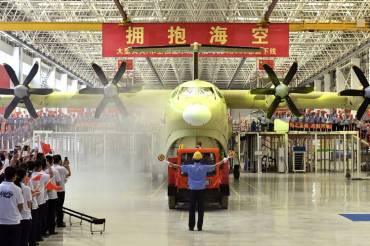
China Unveils ‘World’s Largest Amphibious Aircraft’ – China Real Time Report – WSJ

Chinese media said the AG600 giant aircraft, which rolled off a production line in Zhuhai in southern China on Saturday, will be used for marine rescue missions and forest fire fighting.

Source: Video: China Unveils ‘World’s Largest Amphibious Aircraft’ – China Real Time Report – WSJ

01/07/2016

Our bulldozers, our rules | The Economist

THE first revival of the Silk Road—a vast and ancient network of trade routes linking China’s merchants with those of Central Asia, the Middle East, Africa and Europe—took place in the seventh century, after war had made it unusable for hundreds of years. Xi Jinping, China’s president, looks back on that era as a golden age, a time of Pax Sinica, when Chinese luxuries were coveted across the globe and the Silk Road was a conduit for diplomacy and economic expansion. The term itself was coined by a German geographer in the 19th century, but China has adopted it with relish. Mr Xi wants a revival of the Silk Road and the glory that went with it.

This time cranes and construction crews are replacing caravans and camels. In April a Chinese shipping company, Cosco, took a 67% stake in Greece’s second-largest port, Piraeus, from which Chinese firms are building a high-speed rail network linking the city to Hungary and eventually Germany. In July work is due to start on the third stage of a Chinese-designed nuclear reactor in Pakistan, where China recently announced it would finance a big new highway and put $2 billion into a coal mine in the Thar desert. In the first five months of this year, more than half of China’s contracts overseas were signed with nations along the Silk Road—a first in the country’s modern history.

Politicians have been almost as busy in the builders’ wake. In June Mr Xi visited Serbia and Poland, scattering projects along the way, before heading to Uzbekistan. Last week Russia’s president, Vladimir Putin, made a brief visit to Beijing; he, Mr Xi and Mongolia’s leader promised to link their infrastructure plans with the new Silk Road. At the time, finance ministers from almost 60 countries were holding the first annual meeting in Beijing of an institution set up to finance some of these projects, the Asian Infrastructure Investment Bank (AIIB). Like a steam train pulling noisily out of a station, China’s biggest foreign-economic policy is slowly gathering speed.

Chinese officials call that policy “One Belt, One Road”, though they often eviscerate its exotic appeal to foreigners by using the unlovely acronym OBOR. Confusingly, the road refers to ancient maritime routes between China and Europe, while the belt describes the Silk Road’s better-known trails overland (see map).
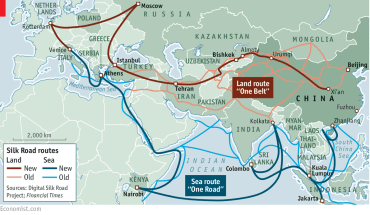
OBOR puzzles many Western policymakers because it is amorphous—it has no official list of member countries, though the rough count is 60—and because most of the projects that sport the label would probably have been built anyway. But OBOR matters for three big reasons.

First, the projects are vast. Official figures say there are 900 deals under way, worth $890 billion, such as a gas pipeline from the Bay of Bengal through Myanmar to south-west China and a rail link between Beijing and Duisburg, a transport hub in Germany. China says it will invest a cumulative $4 trillion in OBOR countries, though it does not say by when. Its officials tetchily reject comparison with the Marshall Plan which, they say, was a means of rewarding America’s friends and excluding its enemies after the second world war. OBOR, they boast, is open to all. But, for what it is worth, the Marshall Plan amounted to $130 billion in current dollars.

Next, OBOR matters because it is important to Mr Xi. In 2014 the foreign minister, Wang Yi, singled out OBOR as the most important feature of the president’s foreign policy. Mr Xi’s chief foreign adviser, Yang Jiechi, has tied OBOR to China’s much-touted aims of becoming a “moderately well-off society” by 2020 and a “strong, prosperous” one by mid-century.

Mr Xi seems to see the new Silk Road as a way of extending China’s commercial tentacles and soft power. It also plays a role in his broader foreign-policy thinking. The president has endorsed his predecessors’ view that China faces a “period of strategic opportunity” up to 2020, meaning it can take advantage of a mostly benign security environment to achieve its aim of strengthening its global power without causing conflict. OBOR, officials believe, is a good way of packaging such a strategy. It also fits with Mr Xi’s “Chinese dream” of recreating a great past. It is not too much to say that he expects to be judged as a leader partly on how well he fulfils OBOR’s goals.

Third, OBOR matters because it is a challenge to the United States and its traditional way of thinking about world trade. In that view, there are two main trading blocs, the trans-Atlantic one and the trans-Pacific one, with Europe in the first, Asia in the second and America the focal point of each. Two proposed regional trade deals, the Trans-Pacific Partnership and the Transatlantic Trade and Investment Partnership, embody this approach. But OBOR treats Asia and Europe as a single space, and China, not the United States, is its focal point.

Source: Our bulldozers, our rules | The Economist

28/06/2016

Pfizer to invest $350 million in China biotech hub, first in Asia | Reuters

Pfizer Inc (PFE.N) will invest $350 million to build a biotech center in China, the latest in a series of moves by pharma industry giants to set up shop in the world’s no. 2 drugs market with the aim of securing faster approvals for their products.

The facility in eastern Hangzhou region – Pfizer’s first biotech center in Asia – is expected to be completed by 2018, the firm said in a statement on Tuesday.

Global “Big Pharma” is increasingly looking for smart ways to tap China’s healthcare market, estimated by consultancy IMS Health to be worth around $185 billion by 2018. From investing in China facilities to acquisitions, licensing deals and joint ventures, the aim is to seek an edge in dealings with domestic regulators and government.

John Young, group president for Pfizer’s essential health division, said in the statement that the Hangzhou facility should “help support China’s aim to increase the complexity and value of its manufacturing sector by 2025”.

Pfizer said it would “work closely” with local regulators to bring the drugs “to market as soon as possible”. The center will mostly on biologic drugs – made from living micro-organisms rather than chemically synthesized – and lower-cost ‘biosimilars’, of generic versions of biologics.

Pharmaceutical executives have long complained about the slow process of getting drugs to market in China, while others have run up against regulatory roadblocks. Pfizer had to close its vaccine business in the country last year after a license for its top-selling vaccine Prevenar was not renewed.

China’s overall healthcare spending is set to hit $1.3 trillion by 2020, but drug market growth has slowed to a low single-digit percentage pace from over 20 percent just four years ago as branded generics have lost their shine and Beijing has looked to drive down prices to keep a lid on costs.

Source: Pfizer to invest $350 million in China biotech hub, first in Asia | Reuters

27/06/2016

China city shuts down waste burning plant over protests | Reuters

A city in central China is shutting down a waste incineration project, it said, after thousands of people protested against the plant over fears it will damage the environment and residents’ health.

Photos posted on social media, which could not be verified by Reuters, showed dozens of riot police marching in the city of Xiantao, located in Hubei province in central China.

About 10,000 people protested in Xiantao on Sunday, the state-backed Global Times reported, citing a local resident, even after the local government said it planned to suspend the project on Sunday morning.

Another resident told Reuters by phone on Monday that the protests continued, and several protesters were injured in clashes with riot police.

“There are hundreds of police here because of the demonstrations,” said the resident, who declined to give his name because of the sensitivity of the matter.

The city government called on residents to refrain from taking “extreme actions” and spreading rumors in a statement on its official microblog.

Tens of thousands of “mass incidents” – the usual euphemism for protests – happen in China each year, spurred by grievances over issues such as corruption, pollution and illegal land grabs, unnerving the stability-obsessed ruling Communist Party.

Last June, thousands of people protested in Jinshan, about 60 km (37 miles) from China’s commercial hub of Shanghai, against plans to build a chemical plant in the district.

A Xiantao official said that the planned plant’s emissions of dioxin, a toxic compound, would have been in line with European Union standards, state media reported.

Source: China city shuts down waste burning plant over protests | Reuters

24/06/2016

Unwanted model | The Economist

MARCHING by the thousands this week in stifling heat through their small coastal village, residents of Wukan carried Chinese flags and shouted out slogans in support of the Communist Party. That was just to protect themselves from retribution by the riot police, who watched them closely but did not intervene. Their real message was in other chants: “Give us back our land!” and “Free Secretary Lin!”

The secretary in question was their village chief, Lin Zulian, whom they elected in 2012 in what was widely hailed at the time as a breakthrough for grassroots democracy. Mr Lin had led Wukan in a months-long rebellion against local authorities. Villagers kicked out party officials and police from their offices in protest against the alleged seizure of some of Wukan’s land by corrupt officials who had lined their pockets with the proceeds of selling it. Police responded by blockading the village, turning it into a cause célèbre—including in some of the feistier of China’s heavily censored media. In the end the government backed down: it allowed Wukan to hold unusually free elections and it promised to sort out the land dispute. The “Wukan model” became Chinese reformists’ shorthand for what they hoped would be a new way of defusing unrest.

They have been disappointed. Villagers did not get their land back, or the money some wanted in lieu of it. Mr Lin, who won another landslide victory in elections two years ago, announced plans on June 18th to launch a new campaign for the return of the land. That was clearly too much for the local government: Mr Lin was promptly arrested on charges of corruption. Angry residents took to the streets again.

Villagers in China often stage protests over land rights; local authorities usually deal with them either with force, or by promising concessions and then rounding up the ringleaders. Restoring calm to Wukan will be tougher. Because of its fame, journalists have poured in, especially from nearby Hong Kong. Local officials may be reluctant to resort to the usual thuggish tactics in front of such an audience.

In an effort to undermine support for Mr Lin, the government has tried blackening his name. On June 21st officials released a video showing him confessing to bribe-taking. But that merely stoked the villagers’ anger. His wife, Yang Zhen, says she is certain the confession was coerced. His halting delivery in substandard Mandarin, she believes, was his way of letting villagers know this. “They are trying to deceive everyone, but no one believes it,” she says. Dozens of furious villagers went to a local school where nervous officials had barricaded themselves behind metal doors and barred windows; they kicked the doors and shouted abuse. As The Economist went to press, Wukan was preparing to embark on its sixth consecutive day of protest.

Many residents say they have lost all faith in the local government, and that only the central authorities in Beijing will be able to find a fair solution. “They took our land. My father and grandfather farmed it, and now I have nothing. No work and no other path forward,” says a 39-year-old villager. “We have a black government, all corrupt. They cannot trick us again with more talk of the ‘Wukan model’. We need our land back,” he fumes.

But the central government will be reluctant to cave in to the protesters’ demands. “Handling the Wukan problem well means much to the rest of China,” said Global Times, a pro-party paper in Beijing. But it warned that if the “drastic actions” of Wukan’s villagers were copied by others, China would “see mess and disturbance” at the grassroots. In a country where many seethe with grievances similar to Wukan’s, officials do not want the village to become a model for revolt.

Source: Unwanted model | The Economist

24/06/2016

China rejects bending rule for India to join nuclear club | Reuters

China maintains its opposition to India joining a group of nations seeking to prevent the proliferation of nuclear weapons by controlling access to sensitive technology, said the head of the arms control department in China’s Foreign Ministry.

The Nuclear Suppliers Group (NSG) met this week in Seoul, but China said it would not bend the rules and allow India membership as it had not signed the nuclear Non-Proliferation Treaty (NPT), the main global arms control pact.

“Applicant countries must be signatories of the Treaty on the Non-Proliferation of nuclear weapons (NPT),” Wang Qun, the head of arms control department in China’s Foreign Ministry, was quoted as saying in Seoul on Thursday night.

“This is a pillar, not something that China set. It is universally recognized by the international community,” Wang said according to a statement released by the Chinese foreign ministry on Friday.China is leading opposition to a push by the United States to bring India into the NSG which aims to prevent nuclear weapons proliferation by stopping the sale of items that can be used to make nuclear arms.

The issue of India’s membership was not formally discussed at the NSG meeting this week, Wang said on Friday.

The United States, which has a nuclear cooperation deal with India, considers it a nuclear power that plays by the rules and is not a proliferator, and wants to bring Asia’s third largest economy into the 48-member group.

India already enjoys most of the benefits of membership under a 2008 exemption to NSG rules granted to support its nuclear cooperation deal with Washington.

On Friday, on the sidelines of the plenary meeting of the NSG, Wang stressed China considered it important to handle new memberships under a consensus and that there was no move yet to allow a non-NPT state to join.

“International rules will have to be respected, big or small,” Wang told Reuters. “Big like NPT. Small like the rules and procedures of this group.”   “The important question of which we are concerned, is how to deal with the question of participation of countries within the group of non-NPT states. It’s a formidable task.”Indian Prime Minister Narendra Modi raised the issue on Thursday at a meeting with Chinese President Xi Jinping at a regional summit in Tashkent, Uzbekistan, but there was no breakthrough.

One diplomat at the NSG plenary in Seoul said the group’s outgoing chairman, Argentinian diplomat Rafael Grossi, would act as a “facilitator” to continue to search for an accession deal.

Opponents argue that granting India membership would further undermine efforts to prevent proliferation. It would also infuriate India’s rival Pakistan, an ally of China’s, which has responded to India’s membership bid with one of its own.Pakistan joining would be unacceptable to many, given its track record. The father of its nuclear weapons program ran an illicit network for years that sold nuclear secrets to countries including North Korea and Iran.

Source: China rejects bending rule for India to join nuclear club | Reuters

24/06/2016

Are fears of mass unemployment in China overblown? | Reuters

Despite its sputtering economy – or perhaps because of it – China’s labor market may be able to provide more jobs for laid off workers than many think.

The working age population is shrinking by several million each year and the number of workers willing to migrate beyond their home province is falling, leaving jobs available for those willing to travel.

This suggests concerns about mass unemployment as China cuts down its industrial capacity and the risk that this could lead to social unrest may be overdone.

Take Li Xi, 34, for instance.After losing his job of 15 years at Highsee Iron and Steel in the slow-growing northern province of Shanxi, Li was not out of work for long.

Encouraged by friends to join them at an electronics factory 1,000 km (620 miles) to the south, he made the journey to Suzhou near Shanghai. The rest was easy.”On the first day I did a health check, and on the second day I was working,” Li said.

China’s economic growth slowed to a 25-year-low in 2015 of less than 7 percent and Beijing has flagged layoffs as it reduces massive surplus industrial capacity and gears the economy more to services and consumption.

Sources said in March that China was expecting to lay off 5-6 million state workers in the next two to three years as it curbs production capacity and pollution in rust-belt provinces.

While there is scant official data to build an accurate picture of Chinese unemployment, Chang Chun Hua, China economist at Nomura, said the jobs market can handle the unemployment pressures for now.

The working age population has been shrinking since 2012. Last year, the number of people between the ages of 16 and 59 shrank by 4.87 million, government statistics show. In 2014, the age group contracted by 3.71 million.

At the same time, the government says a higher-than-expected 5.77 million jobs were created between January and May this year.

“In general, the current unemployment pressure is still manageable for the Chinese government,” Hua said.

Source: Are fears of mass unemployment in China overblown? | Reuters

24/06/2016

Capturing China’s $5 trillion productivity opportunity | McKinsey & Company

It won’t be easy, but shifting to a productivity-led economy from one focused on investment could add trillions of dollars to the country’s growth by 2030.

After three decades of sizzling growth, China is now regarded by the World Bank as an upper-middle-income nation, and it’s on its way to being one of the world’s advanced economies. The investment-led growth model that underpinned this extraordinary progress has served China well. Yet some strains associated with that approach have become evident.

In 2015, the country’s GDP growth dipped to a 25-year low, corporate debt soared, foreign reserves fell by $500 billion, and the stock market dropped by nearly 50 percent. A long tail of poorly performing companies pulls down the average, although top-performing Chinese companies often have returns comparable with those of top US companies in their industries. More than 80 percent of economic profit comes from financial services—a distorted economy. Speculation that China could be on track for a financial crisis has been on the rise.

The nation faces an important choice: whether to continue with its old model and raise the risk of a hard landing for the economy, or to shift gears. A new McKinsey Global Institute report, China’s choice: Capturing the $5 trillion productivity opportunity, finds that a new approach centered on productivity could generate 36 trillion renminbi ($5.6 trillion) of additional GDP by 2030, compared with continuing the investment-led path. Household income could rise by 33 trillion renminbi ($5.1 trillion).

Pursuing a new economic model

China has the capacity to manage the decisive shift to a productivity-led model. Its government can pull fiscal and monetary levers, such as raising sovereign debt and securing additional financing on the basis of 123 trillion renminbi in state-owned assets. China has a vibrant private sector, earning three times the returns on assets of state-owned enterprises. There are now 116 million middle-class and affluent households (with annual disposable income of at least $21,000 per year), compared with just 2 million such households in 2000. And the country is ripe for a productivity revolution. Labor productivity is 15 to 30 percent of the average in countries that are part of the Organisation for Economic Co-operation and Development (OECD).

A new productivity-led model would enable China to create more sustainable jobs, reinforcing the rise of the consuming middle class and accelerating progress toward being a full-fledged advanced economy. Such a shift will require China to steer investment away from overbuilt industries to businesses that have the potential to raise productivity and create new jobs. Weak competitors would need to be allowed to fail rather than drag down profitability in major sectors. Consumers would have more access to services and opportunities to participate in the economy.

Making this transition is an urgent imperative. The longer China continues to accumulate debt to support near-term goals for GDP growth, the greater the risks of a hard landing. We estimate that the nonperforming-loan ratio in 2015 was already at about 7 percent, well above the reported 1.7 percent. If no visible progress is made to curb lending to poorly performing companies, and if the performance of Chinese companies overall continues to deteriorate, we estimate that the nonperforming-loan ratio could rise to 15 percent. This would trigger a substantial impairment of banks’ capital and require replenishing equity by as much as 8.2 trillion renminbi ($1.3 trillion) in 2019. In other words, every year of delay could raise the potential cost by more than 2 trillion renminbi ($310 billion). Although such an escalation would not lead to a systemic banking crisis, a liquidity crunch among corporate borrowers and waning confidence of investors and consumers during the recovery phase would have a significant negative impact on growth.

Our report identifies five major opportunities to raise productivity by 2030:

  • unleashing more than 39 trillion renminbi ($6 trillion) in consumption by serving middle-class consumers better
  • enabling new business processes through digitization
  • moving up the value chain through innovation, especially in R&D-intensive sectors, where profits are only about one-third of those of global leaders
  • improving business operations through lean techniques and higher energy efficiency, for instance, which could deliver a 15 to 30 percent productivity boost
  • strengthening competitiveness by deepening global connections, potentially raising productivity by 10 to 15 percent

Capturing these opportunities requires sweeping change to institutions. China needs to open up more sectors to competition, enable corporate restructuring, and further develop its capital markets. It needs to raise the skills of the labor force to fill its talent gap and to sustain labor mobility. The government will need to manage conflicts among many stakeholders, as well as shift governance and incentives that rewarded a single-minded focus on rising GDP, even as it modernizes its own processes.

Source: Capturing China’s $5 trillion productivity opportunity | McKinsey & Company

Law of Unintended Consequences

continuously updated blog about China & India

ChiaHou's Book Reviews

continuously updated blog about China & India

What's wrong with the world; and its economy

continuously updated blog about China & India