Posts tagged ‘Chinese people’

08/09/2016

A 16-year-old British girl earns £48,000 helping Chinese people name their babies – BBC Newsbeat

Beau Jessup, a British A-level student from Gloucestershire, came up with the idea after a family visit to China.
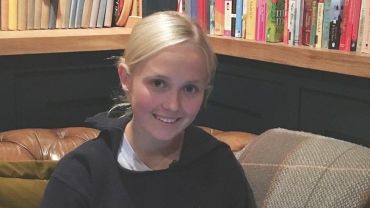
They were out for a meal with friends when she was asked to give an English name to a newborn baby.

In China it is considered important to have an English name for future study or business with the UK.

‘Special Name’ requires the user to pick five of the 12 personality traits which they most hope their baby will grow into

In China they name their child based on the elements and Beau wanted a similarity between how they pick their Chinese name and how they pick their English name.

And she does this by assigning personality traits to each English name.

They also select the gender of the baby and pay the equivalent of 60p.

The three chosen names are then shared with family and friends on We-Chat, China’s WhatsApp equivalent, to help make the final decision.

Each suggestion is printed on a certificate with its meaning and an example of a famous person with that name.

Beau says that when she was first asked to name her father’s friend’s baby, she was surprised.

“I’m not really qualified or relevant enough in that baby’s life to be the person to give it a name.

“But after hearing of some of the “embarrassing” names, Beau decided she needed to act.

There was someone called Rolex

“There are quite a few examples where people have gotten the names wrong.”

Beau explains that the Chinese are fascinated by western culture but their access to it is restricted by the government in China.There isn’t open access to the internet so they can’t use standard baby naming websites that people may use in the UK.

“Being exposed to luxury items and things like Harry Potter, Disney films and Lord of the Rings means they use those for reference.

“I once heard of someone called Gandalf and another called Cinderella.”

Amelia and Oliver were the most popular baby names in England and Wales in 2015
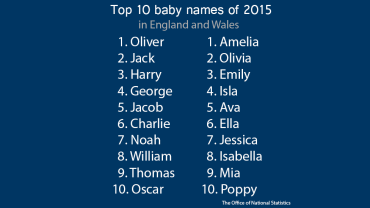
That’s according to the Office for National Statistics which released the complete set of data last week.

But Beau doesn’t know which names are the most popular on her website, and she’s “happy about that”.

“It is called ‘special name’ and it’s based on individual preference and what they personally want their child to be.”

Beau says it’s quite strange to know she’s named more than 200,000 babies

“It’s nice to be a part of such a happy experience and be a part of those young stages in a baby’s life.”The site’s success has been a pleasant surprise.

“I wanted to do it just to see if an idea could turn into more than just simply an idea.”

And I never expected it to become more than just a small project because I never really considered myself very academic.

“It is obviously a nice surprise, but it is definitely a surprise.”

Source: A 16-year-old British girl earns £48,000 helping Chinese people name their babies – BBC Newsbeat
04/11/2015

Are Chinese ‘Too Rational’ for a Second Child? Interview With Mei Fong – China Real Time Report – WSJ

China’s announcement last week that it will let all couples have two children ended one of the most contentious birth restrictions in history–the one-child policy.

Implemented in 1980 to rein in explosive population growth during the Mao Zedong era, the one-child policy and its enforcement had myriad consequences, including forced abortions and sterilization. It placed the burden of elderly care on single children and fueled a gender imbalance. Some researchers also say a new generation of only children – or “little emperors” — are more pessimistic and less competitive than older generations with siblings. Now, the Chinese government is shifting course to offset the effects of a rapidly aging population and to avert labor shortages.

China Real Time spoke to Mei Fong, author of the book “One Child: The Past and Future of China’s Most Radical Experiment” and a former Wall Street Journal reporter, about the one-child policy and the unwinding of it. The book will be published in hardcover in January, but a digital edition was released Tuesday, Nov. 3. Below are edited excerpts of the interview: Mei Fong

Many couples say that despite changes in the policy, they will not have two children. What can the government do to promote births?

There was a recent Internet survey [on Chinese website Sina of 180,000 respondents who were asked if they wanted a second child] saying that 43% of people don’t want children. But there’s a difference of what people say and what they will do. A lot of people ideally want to have two so that they can have both a boy and a girl. The problem is that the one-child policy wasn’t the sole reason people weren’t and aren’t having children. For urban residents, the idea of having just one has been ingrained in them. It’s a social and economic decision and it would take a major mind shift to think of anything else.

People consider it almost it irresponsible to divert resources from any child.

One of the things that demographer Cai Yong said that has always stuck in my mind is that people are too rational for the business of having children.

Who are the likely candidates to have more children?

It’s the rich ones who will add a child. Wealthy people have been traveling to the U.S. for fertility services and U.S. passports , though it’s unclear how many. I know of one couple in Shanghai who had three children by going to the U.S. Houghton Mifflin Harcourt

But it’s hard to make generalities about China. It’s a big place and we all know someone who has had a second child or third child.

Will that mean that a two-child policy will create a bigger upper class? And what will be the consequence? One of the things that the one-child policy has created already is an inequality gap. The spectrum hit the middle class, because the people above the middle class can afford to pay for it, while the ones below were often exempt. The one-child policy is adding to the class-struggle issues. It’s the rich people who have and will have bigger families. They’re the ones that can afford fertility treatment, because fertility is a major problem. They could always afford to pay the penalties [for having more than one child].

Several years ago, there was a study that said China’s single children, its little emperors,  were less competitive and less empathetic than those with siblings. Do you see that changing? I have some doubts about that because there have been many different studies on this. But certainly, they do seem to give themselves more pessimistic labeling, like diao si [roughly translated as loser], than others.

Source: Are Chinese ‘Too Rational’ for a Second Child? Interview With Mei Fong – China Real Time Report – WSJ

28/07/2015

Confucius says, Xi does | The Economist

TWO emerging cults are on display in Qufu, a city in eastern China where Confucius was born. One surrounds the ancient sage himself. At a temple in his honour, visitors take turns to bow and prostrate themselves before a large statue of Confucius seated on a throne. For each obeisance, a master of ceremonies chants a wish, such as for “success in exams” or “peace of the country”. On the other side of the city the tomb of Confucius is the scene of similar adoration—flowers adorn it as if he were a loved one recently lost.

The other cult in Qufu surrounds the country’s president, Xi Jinping. People still recall with excitement the trip he made to the city in 2013. It was the first by a Communist Party chief in more than two decades; in fact, though Mr Xi has visited Qufu he has not, since becoming China’s leader, paid respects at the birthplace of Mao Zedong at Shaoshan in Hunan province. Today plates decorated with Mr Xi’s image are for sale in Qufu’s trinket shops. His beaming face is on display on a large billboard outside the Confucius Research Institute, together with a quotation from the modern sage: “In the spread of Confucianism around the world, China must fully protect its right to speak up,” it begins.

Since he came to power in 2012, Mr Xi has sought to elevate Confucius—whom Mao vilified—as the grand progenitor of Chinese culture. He did not go so far as to pay homage at the Confucius temple in Qufu, where Mao’s Red Guard mobs once wrought havoc (one of their slogans, “Revolution is not a crime”, still survives daubed on a stone tablet). Neither did his few published remarks include explicit praise for Confucian philosophy, which still raises hackles among party hacks brought up to regard it as the underpinning of “feudal” rule in premodern China.

To emperors, who were regular visitors to Qufu, Confucianism was practically a state religion. “Uncle Xi”, for all the mini-cult surrounding him, does not seem keen to be viewed as a latter-day emperor. But like leaders of old, he evidently sees Confucianism as a powerful ideological tool, with its stress on order, hierarchy, and duty to ruler and to family. Unlike the party’s imported, indigestible Marxist dogma, Confucianism has the advantage of being home-grown. It appeals to a yearning for ancient values among those unsettled by China’s blistering pace of change.

Though the party has quietly been rehabilitating Confucius for some time, under Mr Xi the pace has quickened. In February 2014 he convened a “collective study” session of the ruling Politburo at which he said that traditional culture should act as a “wellspring” nourishing the party’s values. Official accounts of the session made no mention of Confucius, but party literature made it clear that the values Mr Xi spoke of—such as benevolence, honesty and righteousness—were those espoused by the philosopher. In September Mr Xi became the first party chief to attend a birthday party for Confucius (who turned 2,565). China, he told assembled scholars from around the world, had always been peace-loving—a trait, he said, that had “very deep origins in Confucian thinking”. In May state media reported that the link between Marxism and Confucianism, which some might consider rather tenuous, was the “hottest topic” in the study of humanities in 2014.

Add plenty of sage

Under Mr Xi the party has tweaked its ideological mantras to sound more Confucian. At the party congress in 2012 that marked Mr Xi’s assumption of power, slogans about “core socialist values” were distilled into 12 words, each formed by two Chinese characters and plastered all over Beijing and other cities. The ideas are a hotch-potch. Some are strikingly Western, such as democracy, freedom and equality. There is a nod to socialism with “dedication to work”. Others, such as harmony and sincerity, look more Confucian. Zhang Yiwu of Peking University notes a similarity with the “shared values” adopted by Singapore’s government in 1991. Authoritarian Singapore, where officials hold Confucianism in high regard, has been an inspiration to China, Mr Zhang says.

via Confucius says, Xi does | The Economist.

15/12/2014

About 300 Chinese said fighting alongside Islamic State in Middle East | Reuters

About 300 Chinese people are fighting alongside the Islamic State in Iraq and Syria, a Chinese state-run newspaper said on Monday, a rare tally that is likely to fuel worry in China that militants pose a threat to security.

China has expressed concern about the rise of Islamic State in the Middle East, nervous about the effect it could have on its Xinjiang region. But it has also shown no sign of wanting to join U.S. efforts to use military force against the group.

Chinese members of the East Turkestan Islamic Movement (ETIM) are traveling to Syria via Turkey to join the Islamic State, also known as IS, the Global Times, a tabloid run by China’s ruling Communist Party’s official newspaper, the People’s Daily, said.

“According to information from various sources, including security officers from Iraq’s Kurdish region, Syria and Lebanon, around 300 Chinese extremists are fighting with IS in Iraq and Syria,” the Global Times reported.

via About 300 Chinese said fighting alongside Islamic State in Middle East | Reuters.

14/02/2014

Chinese luxury spending drops 19% during festival[1]- Chinadaily.com.cn

Chinese people spent $6.9 billion overseas on luxury goods during the Spring Festival holiday (Jan 31 – Feb 6), a drop of 18.8 percent from last year, according to World Luxury Association.

Austerity drive among factors taking toll on luxury market

Luxury outlets lure Chinese at Lunar New Year

And domestic sales of luxury goods were only $350 million, a 57.8-percent drop from 2013 and 80 percent drop from 2012.

The European area tops the destinations by receiving nearly $3.6 billion of total overseas spending during the festival.

Meanwhile the domestic luxury goods consumption also saw a sharp drop in five major cities (Beijing, Shanghai, Guangzhou, Shenzhen and Chonagqing), standing at $350 milion, down 57.8 percent from the same period of last year and 80 percent from 2012.

Insiders said the results were due to the Chinese central government‘s cracking down on corruption, which led to dramatic decrease in government-paid junkets and officials accepting gifts.

via Chinese luxury spending drops 19% during festival[1]- Chinadaily.com.cn.

Enhanced by Zemanta
31/01/2014

China’s Xi Jinping calls for less pollution in year of the horse – FT.com

The Mongolian steppes was where Chinese president Xi Jinping offered his televised New Year’s greeting as Chinese people worldwide celebrated the year of the horse with fireworks and feasting.

While the content of his message varied little from previous years, the choice of setting shed light on the great strains confronting today’s China.

And this year, the message was pollution.

The lunar new year, which began on Friday, is the main holiday in the Chinese calendar. Far-flung families, gathered for holiday meals, inevitably tune to state television, which this year emphasised Mr Xi’s theme of a “Chinese dream” and urged viewers to lay off on fireworks in order to reduce pollution.

Urging “continued struggle with one heart and mind” and prosperity for the motherland, Mr Xi did not address specific policies directly. But Chinese leaders’ New Year’s visits often coincide with priorities for the year ahead, including visits to coal miners, Aids patients and impoverished country villages.

This year the wide-open grasslands framed behind Xi’s dark winter coat and black fur hat are a fitting symbol for the country’s new focus on pollution, which clashes with its enormous appetite for coal.

The herders applauding Mr Xi in the freezing wind at Xilin Gol, Inner Mongolia, have been on the receiving end of a black gold rush, as state-backed mining companies from richer provinces rip up the grasslands in search of coal.

China’s leadership is now trying to reduce coal pollution in wealthier cities, but renewed plans for coal development in the north and west could cause new stresses in arid and ethnically distinct areas like Xilin Gol.

via China’s Xi Jinping calls for less pollution in year of the horse – FT.com.

Enhanced by Zemanta
22/01/2014

* 540 mln Chinese have social security cards – Xinhua | English.news.cn

By the end of 2013, 540 million Chinese people, or roughly 40 percent of China\’s population, had social security cards, which are issued to facilitate medical and other social security services, new data showed on Tuesday.

Hu Xiaoyi, vice minister of human resources and social security, revealed the data at a seminar on Tuesday, adding that the number is expected to reach 650 million by the end of 2014.

The country aims to issue 800 million social security cards by the end of 2015, covering about 60 percent of its total population, according to China\’s 12th Five-Year Plan (2011-2015).

At present, social security cards are mainly used to pay for medical expenses. In the future, services will be expanded to allow card holders to draw pensions and pay for social insurance programs, Hu said.

via 540 mln Chinese have social security cards – Xinhua | English.news.cn.

Enhanced by Zemanta
10/12/2013

China state media under fire for arguing benefits of smog | Reuters

Commentaries by two of China\’s most influential news outlets suggesting that the country\’s air pollution crisis was not without a silver lining drew a withering reaction on Tuesday from internet users and other media.

A man wears a mask while walking on a bridge during a hazy day in Shanghai's financial district of Pudong December 5, 2013. REUTERS/Aly Song

In online commentaries on Monday, state broadcaster CCTV and the widely read tabloid the Global Times, published by the Communist Party\’s official People\’s Daily, both tried to put a positive spin on China\’s smog problem.

The Global Times said smog could be useful in military situations, as it could hinder the use of guided missiles, while CCTV listed five \”unforeseen rewards\” for smog, including helping Chinese people\’s sense of humor.

via China state media under fire for arguing benefits of smog | Reuters.

10/12/2013

Chinese People: Weird Things Foreigners Do

One person’s flower is another person’s weed; or vice versa!

27/05/2013

* Why British schools are a Chinese mecca

The Times: “China’s wealthiest parents want their kids to have a rounded education, in Britain. We go school hunting with them

A group of Chinese parents tour Kingswood School, Bath

On a leafy road high on a hill overlooking Bath, a coach pulls over and 34 Chinese people pile out. Spilling across the road, heedless of the traffic, they start taking photographs and pointing at the imposing crenellated roofs and stained-glass windows of the 19th-century buildings in front of them.

A minder tries to corral them, but he might as well be a herder of cats. “It’s a bit like trying to control children,” says an onlooker. The minder shakes his head. “Worse! Children do as they are told. These people don’t.”

“These people” are members of the wealthy Chinese elite and they are on a mission. Their arrival at Kingswood School is the latest stop on a week-long tour of our nation’s most prestigious public schools. They are here seeking the best education that money can buy.

The popularity of our private education among rich Russians has been well documented. But mainland Chinese are now the second-biggest group of overseas students at British schools, after those from Hong Kong.

There are almost 25,000 non-British students, with parents living overseas, at British schools, and nearly 4,000 are from mainland China. “It’s the biggest growth market,” says Ian Hunt, the managing director of Gabbitas, the education consultancy.

Gabbitas, founded in the 19th century in order to recruit teachers for public schools, numbers H.G. Wells, Evelyn Waugh, Sir Edward Elgar, Amy Johnson and Sir John Betjeman among its long list of hires. Today, it still places teachers, but its core business is in tutoring pupils for entrance to independent schools. It has offices in London, Russia, Japan, South Korea and two in China, in Shanghai and Guangzhou, with a third opening next month in Wenzhou.

Chinese connoisseurs are snapping up Western art and fine French wine, and now they are keen to buy what they regard as another of the world’s most exclusive products: a British education. This week’s tour has already taken them to prep schools, including the Dragon School in Oxford and Caldicott School, Berkshire, and senior schools, such as Abingdon School and Eton College.

For a glimpse as to where these schools might eventually lead, they were shown around Christ Church College, Oxford.”

via Why British schools are a Chinese mecca | The Times.

Law of Unintended Consequences

continuously updated blog about China & India

ChiaHou's Book Reviews

continuously updated blog about China & India

What's wrong with the world; and its economy

continuously updated blog about China & India