Posts tagged ‘Chinese President Xi Jinping’

06/07/2015

Rivals Pakistan, India to start process of joining China security bloc | Reuters

Nuclear-armed rivals Pakistan and India will start the process of joining a security bloc led by China and Russia at a summit in Russia later this week, a senior Chinese diplomat said on Monday, the first time the grouping has expanded since it was set up in 2001.

Photo

The Shanghai Cooperation Organisation (SCO) groups China, Russia and the former Soviet republics of Tajikistan, Uzbekistan, Kazakhstan and Kyrgyzstan, while India, Pakistan, Iran, Afghanistan and Mongolia are observers.

“As the influence of the SCO’s development has expanded, more and more countries in the region have brought up joining the SCO,” Chinese Vice Foreign Minister Cheng Guoping told a news briefing.”India and Pakistan’s admission to the SCO will play an important role in the SCO’s development. It will play a constructive role in pushing for the improvement of their bilateral relations.”

India and Pakistan have fought three wars since 1947, two of them over the divided Muslim-majority region of Kashmir which they both claim in full but rule in part. Pakistan also believes India is supporting separatists in resource-rich Baluchistan province, as well as militants fighting the state.

India applied to join the regional security grouping last year and SCO foreign ministers gave a positive recommendation when they met in June. “We await further developments,” said Sujata Mehta, a senior foreign ministry official.

Prime Minister Narendra Modi will be in Moscow for a summit of the BRICS group of emerging markets and both he and his Pakistani counterpart, Nawaz Sharif, will attend a special SCO “outreach” session as part of the gathering.

Pakistan’s application is being considered, said foreign ministry spokesman Qazi Khalilullah. “We hope they will support us for full membership,” he added.

The grouping was originally formed to fight threats posed by radical Islam and drug trafficking from neighboring Afghanistan.

Cheng said the summit, to be attended by Chinese President Xi Jinping, would also discuss security in Afghanistan.

Beijing says separatist groups in the far western region of Xinjiang, home to the Muslim Uighur minority, seek to form their own state, called East Turkestan, and have links with militants in Central Asia, as well as Pakistan and Afghanistan.

China says Uighur militants, operating as the East Turkestan Islamic Movement (ETIM), have also been working with Islamic State.

“It can be said that ETIM certainly has links with the Islamic State, and has participated in relevant terrorist activities. China is paying close attention to this, and will have security cooperation with relevant countries,” Cheng said.

via Rivals Pakistan, India to start process of joining China security bloc | Reuters.

07/11/2014

China, Japan set aside isle row, paving way for leaders to meet | Reuters

China and Japan agreed on Friday to work on improving ties and signaled willingness to put a bitter row over disputed islands on the back burner, paving the way for their leaders to meet at an Asian-Pacific summit next week.

The agreement, ahead of an expected ice-breaking chat between Japanese Prime Minister Shinzo Abe and Chinese President Xi Jinping at the gathering in Beijing, signals a thaw in ties between the world’s second- and third-biggest economies.

Relations have been soured over the past two years by the territorial row, regional rivalry and the bitter legacy of Japan’s wartime occupation of China.

Abe said the two sides were making final arrangements for one-on-one talks, although neither he nor China’s foreign ministry confirmed that the talks were set.

“Both Japan and China are coming to the view that it would benefit not just the two countries but regional stability if a summit is held,” he told a TV program.

via China, Japan set aside isle row, paving way for leaders to meet | Reuters.

18/09/2014

Trade, investment hopes as China’s Xi visits India – Businessweek

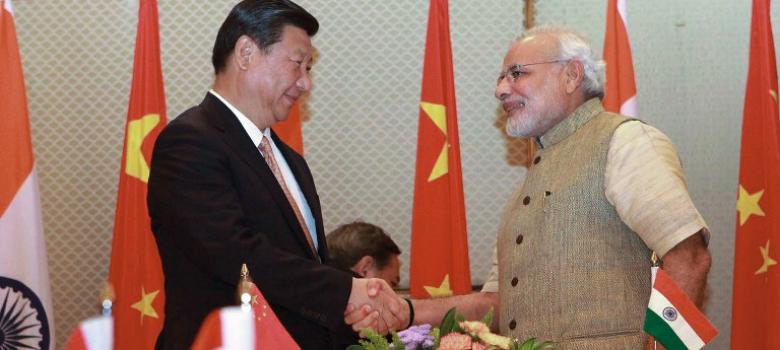
Chinese President Xi Jinping landed in the Indian prime minister‘s home state of Gujarat on Wednesday for a three-day visit expected to focus on India’s need to improve worn out infrastructure and reduce its trade deficit.

Xi was greeted on the tarmac by state officials carrying fringed umbrellas to guard him from the sun in Gujarat’s main financial city of Ahmedabad.

Prime Minister Narendra Modi is expected to court Chinese business and seek investment to upgrade creaky infrastructure, banking on China’s track record at building highways, railways, and industrial zones. India is also eager to address the imbalance in their annual trade, which now totals around $65 billion but is skewed toward imports of Chinese electrical equipment and parts.

Modi and the Gujarat government are staging a lavish welcome for Xi, with billboards across Ahmedabad showing a smiling Modi and Xi. A banquet dinner was being held Wednesday night on the banks of the Sabarmati River in Ahmedabad. Modi was also celebrating his 64th birthday.

Xi has been equally effusive in expressing excitement for the visit.

China-India relations have become one of the most dynamic and promising bilateral relations in the 21st century,” Xi wrote in an article published Wednesday in The Hindu newspaper.

via Trade, investment hopes as China’s Xi visits India – Businessweek.

18/09/2014

After Modi-Xi meeting, China agrees to quickly settle border dispute, demarcate LAC – Hindustan Times

Prime Minister Narendra Modi and Chinese President Xi Jinping on Thursday agreed to quickly resolve the border dispute and demarcate the Line of Actual Control to improve peace and cooperation between both countries.

Addressing the media after the conclusion of one-on-one meeting with visiting Chinese President Xi Jinping, Modi said India is concerned about the frequent incursions along the border. The Line of Actual Control should be demarcated soon to ensure peace and tranquility in the area, he said.

President Xi, in response, said that China will work to settle the border issue at the earliest date. Since the border is not demarcated there will be some incidents, but both countries are capable of settling it at various levels without causing a bigger impact, he said.

President Xi said both countries would be respectful and sensitive to each others concerns. “We also have the sincerity to work with India to maintain peace and tranquility in the border areas before we are finally able to settle the border question,”he said.

The latest incident India was referring to was the  fresh incursion by the Chinese army in Chumar area, even as talks were on between both the leaders.

via After Modi-Xi meeting, China agrees to quickly settle border dispute, demarcate LAC – Hindustan Times.

18/09/2014

Despite the Xi-Modi bromance, Indians and Chinese don’t actually like each other

One in two Indians thinks China is a major threat.

In the last two days alone, Chinese President Xi Jinping has called India an ancient, magic, enchanting, and beautiful land. And Indian Prime Minister Narendra Modi has reciprocated with syrupy adjectives, reminding visiting journalists how ancient Chinese technology was responsible for sugar being called cheeni in India.

The pictures of the two leaders’ bonhomie on Wednesday went even further. By the time you get to the sight of Modi and Xi sitting on a swing by the Sabarmati, most would imagine that India and China are steadfast allies who support each other through thick and thin.

Which is why it might be worth pointing out that we don’t actually like each other very much, and that Indians and Chinese people have very different intentions for the bilateral relationship. And it’s not just about the trade deficit and the border disputes. Ordinary Indians and Chinese people simply aren’t sure whether they like each other.

via Scroll.in – News. Politics. Culture..

17/09/2014

Will Chinese President Xi be able to compete with Japan’s Abe for India’s affections?

Any adjustments in the India-China-Japan triangle will have an impact all across Asia.

East Asia has eagerly set out to court New Delhi’s new government. That’s obvious from the spate of state visits that have taken place of late between India, China and Japan. Earlier this fortnight, Prime Minister Narendra Modi visited Japan. Today, Chinese President Xi Jinping’s begins his first official state visit to India. Trade, investment and infrastructure are the buzzwords on the road towards deepening ties.

The complexities of the India-China-Japan triangle are far too intricate to be spelt out in a simplistic fashion. Will trade and investment become the motive force that will fashion ties, more so at the cost of pressing strategic realities that appear conflicting at times? Going by the school of interdependent liberalism, states will be propelled to adopt a cooperative framework by economic symbiosis and the web of multilateral international institutions and frameworks.

In the case of China, India and Japan, while investments  have taken precedence, the competitive race is far too obvious. Last fortnight, Japanese Prime Minister Shinzo Abe announced that this country’s private and public investment in India will double to $34 billion over the next five years. Within a fortnight comes Xi Jinping with his administration’s plans to invest around $500 billion overseas in the next five years, with big-ticket investments coming India’s way likely to exceed $200 billion. It is being suggested that China could spend $35 billion merely on power and highway projects ‒ almost the same amount as Japan’s total investment in India.

Growing trade deficit

It is apparent that cooperation through economic considerations has its share of hidden problems. India continues to be hurt by  the growing trade deficit with China, which stood at a record $ 36 billion in 2013-’14. In fact, China accounted for more than 50% of India’s current account deficit in 2012-’13. Indian exports to its neighbour fell nearly 10% during that period.

By seeking economic and military clout, could China reject the liberal regional order and seek to replace it with its own Sino-centric Asian order? China’s much-debated rise is always under scrutiny, given its role as Asia’s largest economy and the fact that it is the No. 1 trading partner for almost 120 economies around the world.

More so, in the strategic sphere, are Asian nations, including India and Japan, prepared to recognise such an order? So profound is the presence, rise and status of the People’s Republic of China that one is often confronted with a debate whether a potential Asian century could actually become a Chinese century.

The Chinese government chose to downplay Modi’s earlier indirect reference to China during his visit to Japan, where he took a swipe at the “18th century expansionist mindset of some countries”. But the reaction of state-controlled Chinese media over Modi’s remark was noticeably irate. Chinese media fervently cautioned against any attempt by Tokyo to structure a united front against Beijing with New Delhi as its pivot. All this very palpably falls into the realist paradigm of international relations, which posits that states often find themselves in a zero-sum contest for power and influence, where the prevailing international power balance remains a key determinant of the region’s future stability and strategic order.

Geo-strategic realities

Realignments in any part of the India-China-Japan security triangle will have far-reaching impact all across Asia. It should be remembered that Xi Jinping’s address at the 18th Party Congress of the Chinese Communist Party in 2012 contained a reference to “rejuvenating China”, which has been interpreted as an oblique reference to “reclaiming lost historical territories”. This approach could well have a direct bearing on Japan and India, with whom China contests territories and borders.

On another level, the camaraderie between Modi and Shinzo Abe speaks volumes. Systemic conditions present a favourable platform for the duo to guide their countries to “… the dawn of a new era in India-Japan relations”, as they agreed to in the Tokyo Declaration last fortnight. Moreover, providing cement for this approach, Modi underlined the significance of India and Japan being democracies, which affords them a solid basis to converge at various levels on the Asian stage. As for the ties between China and Japan, there could not have been a worse time for relations between them, with the bitter contest over the East China Sea amidst a rising tide of nationalist sentiment against one another in both countries.

Whether Xi Jinping will manage to find success in making inroads into Delhi and buying a sizeable share of Indian attention is too early to say. However, one thing is for sure ‒ it will not happen at the cost of Japan.

via Scroll.in – News. Politics. Culture..

17/09/2014

Is China’s promised $100 billion India investment more dangerous than its border policy?

Experts believe that China deliberately uses trade as part of its geo-strategic arsenal.

The script is almost predictable. Right before meetings of Indian and Chinese heads of state, something happens on the border to remind everyone that sentiment between the two countries is not exactly neighbourly. Last year it was a standoff in Daulat Beg Oldi about infiltration by the Chinese army. This year, with everyone excited at China’s promise to pump $100 billion into India, there’s another incursion by the Chinese into Demchok in Ladhak.

Chinese President Xi Jinping arrives in India today and will visit Ahmedabad on Prime Minister Narendra Modi’s birthday. But Chinese troops have also been reported to have moved 500 meters into Indian territory.

Beijing’s approach seems to be sweet-talking – this time taking the form of foreign direct investment – coupled with regular pinpricks that remind India that they have the stronger position on the border.

But could the proposed investment be as much of a threat to India as the border dispute?

Trading places

India’s total trade with China was around $65 billion in 2013-’14. Of that, only $14 billion were Indian exports heading into China, leaving India with a trade deficit of $36 billion. If oil imports are included, Chinese imports are responsible for nearly half of India’s overall trade deficit. This is a great many Indian eggs in one Chinese basket.

For many economists, this isn’t a problem. It’s simply the way efficient markets ought to function, with India buying the goods it needs from the most competitive seller. “The more competitive the trading partner, the more India should buy from it, and the bigger should be the bilateral trade deficit,” wrote commentator Swaminathan Aiyar last year. “China is the most competitive exporter of all, so India should run its biggest trade deficit with this country.”

Yet India does feel the need to reduce the trade deficit with China. Answering a question in the Lok Sabha earlier this year, minister of state for commerce Nirmala Sitharaman admitted that the balance of trade was heavily in China’s favour and that India was taking steps to address this.

“With a view to reducing the trade deficit with China, efforts are being made to diversify the export basket,” Sitharaman said.

via Scroll.in – News. Politics. Culture..

16/09/2014

Xi’s India visit highlights changing power dynamic – Businessweek

Chinese President Xi Jinping’s trip to India this week highlights subtle shifts in the regional power dynamic that are bringing warmer ties between the two Asian giants, challenging China’s traditional relationship with Pakistan, and opening a new chapter in Beijing’s ongoing competition for influence with arch-rival Japan.

Xi is due in New Delhi on Wednesday for a three-day visit focused on trade, investment and the resolution of decades-old border disputes. With the world’s second-largest economy and a proven track record at building highways, railways, and industrial zones, China has much to offer India as it seeks to upgrade its creaky infrastructure.

The visit is the latest sign of easing suspicions between the two huge countries — which between them have 2.6 billion people — dating from a month-long border war in 1962 that left around 2,000 soldiers dead. That conflict ended in a standoff with both sides accusing the other of occupying its territory.

Xi’s visit “will definitely enhance the bilateral political mutual trust,” Chinese Assistant Foreign Minister Liu Jianchao told reporters in Beijing last week.

While ties have been steadily growing for years, they’ve been given a major boost under new Indian Prime Minister Narendra Modi, who’s signaled he wishes to pursue a more vigorous foreign policy. Xi is the first Chinese head of state to visit in eight years, while the country’s prime minister, Li Keqiang, made India his first overseas visit shortly after taking office last year.

“Good relations with India are a key part of China’s regional strategy and Xi’s visit creates the opportunity for direct face-to-face communication on the problems that still exist, such as the border issue,” said Zhao Gancheng, Director of the Asia-Pacific Center of the Shanghai Institute for International Studies.

via Xi’s India visit highlights changing power dynamic – Businessweek.

15/09/2014

With eye on China, Modi’s India to develop disputed border region | Reuters

India has eased restrictions on building roads and military facilities along its disputed border with China, as the new government seeks to close the gap on its neighbor’s superior transport network and take a stronger stance on Beijing.

Indian environment minister Prakash Javadekar told Reuters he had relaxed environmental rules within 100 km (62 miles) of the contested border in remote Arunachal Pradesh in order to speed up construction of some 6,000 km of roads.

The move, which also allows for the construction of army stations, arms depots, schools and hospitals in the sparsely populated Himalayan region, was announced days before Chinese President Xi Jinping visits India on Sept. 17-18.

“This is about defense preparedness,” said Javadekar. “On the Chinese side of the border, not only have they built good roads, they are building up their railway network. Our army faces problems because of the bad quality of roads,” he added.

Work on the roads will start in the coming months.

via With eye on China, Modi’s India to develop disputed border region | Reuters.

10/06/2014

Indian PM Modi meets with Chinese FM – Xinhua | English.news.cn

Indian Prime Minister Narendra Modi Monday met here with visiting Chinese Foreign Minister Wang Yi, the special envoy of Chinese President Xi Jinping.

INDIA-NEW DELHI-PM-CHINA-WANG YI-MEETING

During the meeting, Wang conveyed greetings and messages from President Xi and Chinese Premier Li Keqiang to Prime Minister Modi.

The Chinese president said in his message that he believes India will obtain greater development and progress under the leadership of Prime Minister Modi.

The Chinese president said that as two important forces in the process of multi-polarization of the world, China and India share far more common interests than differences and that the two countries are long-term strategic cooperative partners rather than adversaries.

The Chinese president pointed out that the dreams of both China and India to build a strong nation and to upgrade the living standards of their people have a lot of commonalities and the two countries should make an in-depth convergence of their development strategy, support each other with their respective strengths, build a close development partnership, and hold hands to realize peaceful development, cooperative development, and inclusive development, in order to benefit their people and enhance peace, stability and prosperity of Asia and the whole world.

Prime Minister Modi said that the important message from President Xi Jinping has given a clear guidance for developing bilateral relations.

Modi said he highly appreciates the achievements in the field of development made by China and personally cherishes a friendly feeling toward China.

Modi said India’s new government is willing to join China to give a clear signal to the world that the two countries are dedicated to common development.

He suggested that the two countries maintain exchange of high- level visits, consolidate strategic trust, and use each other’s strengths to deepen cooperation in the fields of infrastructure, manufacturing, and IT industry.

Modi also said that India and China should develop their resources of two ancient civilizations to enhance cooperation and increase exchanges in humanity.

On the boundary issue, he said the two countries should commonly maintain peace and tranquility on the border areas in order to provide guarantees to the development of bilateral relations.

Foreign Minister Wang said that China and India are now standing at a new historical starting point of developing their relations and in the meantime are faced with important opportunities of their own development.

He said that China is ready to realize convergence with India in the fields of development theories and ideas, exchange and learn from each other in practice and theories of governance.

Wang said China is also willing to realize convergence of development strategies with India and let the “Look East” policy of India meet and confluence with China’s acceleration of opening its western regions.

The two countries should also use their respective strong points to support and supplement each other in their respective development, he said.

Wang said as the two ancient civilizations, China and India should join each other to make new contributions to human civilization and progress. He also suggested that the two countries properly control and manage their boundary problem to seek a mutually acceptable, fair and reasonable solution to the boundary issue.

via Indian PM Modi meets with Chinese FM – Xinhua | English.news.cn.

Enhanced by Zemanta
Law of Unintended Consequences

continuously updated blog about China & India

ChiaHou's Book Reviews

continuously updated blog about China & India

What's wrong with the world; and its economy

continuously updated blog about China & India