Posts tagged ‘CNNMoney.com’

05/08/2016

Bridge Collapse Is Latest Tragedy on India’s Roads – India Real Time – WSJ

The collapse of a bridge in the western Indian state of Maharashtra this week that left 14 people dead and 18 others missing wasn’t the first road tragedy to hit the area.In 2013, a bus veered off a 80 year-old bridge on the Jagbudi river, which flows parallel to the Savitri about 70 kilometers (43 miles) to the south, killing 37 of the 52 people on board.

That accident happened when a bus flew off the bridge and flipped in midair before landing on its roof 30 feet below.

The Wall Street Journal took a deep look into the tragedy.

Such incidents are alarmingly frequent on India’s roads.

India has been spending more money to improve its bridges, ports and airports, but the Savitri accident is yet another example of how the country’s depleted infrastructure is under increasing strain due to the rising demands of a fast-developing economy.

Its ageing road network, the world’s second-largest after the U.S. but largely made of dirt tracks, is particularly challenging. India’s roads are the most dangerous in the world: In 2015, the country accounted for almost one in 10 road casualties world-wide, according to the World Health Organization.

While India reported 137,000 deaths due to road crashes in 2013, the WHO estimated the figure was much higher. Those deaths cause an approximate 3% loss in economic output, it said.

Two buses and a number of cars plunged into the Savitri river in the early hours of Wednesday when the bridge in Mahad, built before India gained independence from Britain in 1947, crumbled into the waters below amid heavy monsoon rains.

Maharashtra Chief Minister Devendra Fadnavis has ordered a judicial probe into the accident and said government technicians will carry out a safety audit of old bridges in the state.

The bodies of 14 people were recovered from the waters of the Savitri by Friday morning, and 18 more are missing, National Disaster Response Force Commandant Anupam Srivastava said.

Source: Bridge Collapse Is Latest Tragedy on India’s Roads – India Real Time – WSJ
21/12/2015

Panda power | The Economist

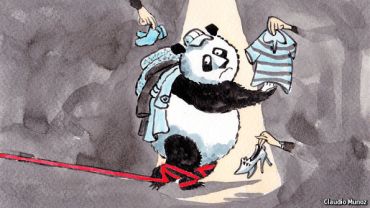
THE feeding frenzy for the pandas comes at nightfall. People furtively approach them, pouring bags of old clothes down their gullets.

By day, the trucks arrive to clean the bears out, leaving them empty for the next big meal. The pandas are plastic. They are large, bear-shaped receptacles, designed to entice people to donate their unwanted garments to those in need.

First deployed in 2012, there are now hundreds around Shanghai, often placed by entrances to apartment buildings. They swallowed about a million items of clothing last year. The procession of donors feeding trousers to pandas is impressive. But they usually do so under cover of darkness. Charitable giving is not yet a middle-class habit. Many people still feel awkward about it, despite their growing prosperity. China’s GDP per person is about one-seventh of America’s.

But in 2014 Chinese gave 104 billion yuan ($16 billion) to charity, about one-hundredth of what Americans donated per person (see chart). This is partly a legacy of attitudes formed during Mao’s rule, when the party liked to present itself as the source of all succour for the poor (to suggest otherwise was deemed counter-revolutionary). Even until more recent years the party was reluctant to encourage charities, worried that they might show up its failings.

The middle classes have worries too—that giving large amounts to charity may draw unwanted attention to their wealth. They do not want to fuel the envy of the have-nots or encourage tax collectors to pay them closer attention.

The top 100 philanthropists in China gave $3.2 billion last year, according to Hurun Report, a wealth-research firm based in Shanghai. That was less than the amount given by the top three in America.

In 2008 when a powerful earthquake hit the south-western province of Sichuan—the deadliest in China in more than 30 years—it seemed that one positive outcome would be a boom in charitable giving. Volunteers poured into the devastated region and donations filled the coffers of aid organisations. Problems soon arose, however. Embarrassed that private relief efforts were proving more effective than official ones, the government reined in citizen-led organisations.

Source: Panda power | The Economist

26/02/2015

To Combat Crowds, India’s McDonald’s Now Lets Diners Order at the Table – India Real Time – WSJ

Tired of having to elbow your way through pushy crowds to get your fast-food fix? McDonald’s MCD +3.87% in India has a solution for you: Skip the long lines and order a Maharaja Mac from your table.

The more than 350 McDonald’s outlets in India each get about 4,000 customers a day on average. That’s twice the number of customers that come to the average Mickey D branches in the rest of the world. As part of an experiment in crowd control, one franchisee has started allowing burger fans to order and pay through roaming cashiers who take orders and payments on Wi-Fi enabled tablets and credit-card machines.

The queue-quelling technology is already being tested at the McDonald’s at Mumbai’s Phoenix Mills mall. It will be rolled out in 200 more branches this year, said Amit Jatia, who runs most of the McDonald’s in India.

“India is changing,” he said. “You have to keep evolving with the changing needs of the consumer.”

Mr. Jatia’s Hardcastle Restaurants runs 202 McDonald’s outlets in western and southern India, while another group controls 166 restaurants in northern and eastern India.

via To Combat Crowds, India’s McDonald’s Now Lets Diners Order at the Table – India Real Time – WSJ.

Law of Unintended Consequences

continuously updated blog about China & India

ChiaHou's Book Reviews

continuously updated blog about China & India

What's wrong with the world; and its economy

continuously updated blog about China & India