Posts tagged ‘communist party of china’

12/09/2015

China’s top graft-buster breaks taboo by discussing Communist Party’s ‘legitimacy’ | South China Morning Post

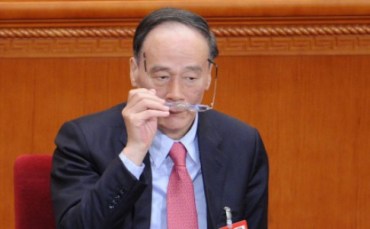
Open discussion by top graft-buster Wang Qishan about the legitimacy of the ruling Communist Party – a topic long deemed unquestionable – has raised the eyebrows of some commentators. Graft-buster Wang Qishan has raised some eyebrows with his comments on the Communist Party's 'legitimacy'. Photo: AFP

“The legitimacy of the Communist Party of China derives from history, and depends on whether it is supported by the will of the people; it is the people’s choice,” Wang said when meeting some 60 overseas attendants of the Party and World Dialogue 2015 in Beijing on Wednesday. ADVERTISING Analysts said the aberration was a step forward but some disagreed with Wang’s interpretation of “legitimacy”.

Zhang Lifan, a Beijing-based commentator, said Wang’s remarks reflected a shift of attitude in the party as a result of intensified social conflicts and increasing pressure from an underperforming economy.

“In the past, the issue was not allowed to be discussed, because the [party] thinks [its rule] is justified unquestionably. As the old saying goes, ‘political power grows out of the barrel of a gun’. They fought their way into the ruling position, instead of being elected into it,” Zhang said. [The Communist Party’s] legitimacy was maintained by relying on economic growth, but now economic growth is facing problemsZHANG LIFAN, COMMENTATOR

“Its legitimacy was maintained by relying on economic growth, but now economic growth is facing problems. In the past people thought [the party] could continue governing and did not have strong opposition to it because they still had money in their pocket. Now the size of their pockets have shrunk,” he said.

Zhang Ming , a political scientist with Renmin University, applauded Wang’s courage, but disagreed with his use of “legitimacy”. “You can’t talk about legitimacy merely from a historical perspective. How to let the people express their approval or disapproval [of the government]? The ballots are the most obvious way,” he said.

Steve Tsang, a senior fellow at the China Policy Institute of the University of Nottingham, said the “legitimacy” Wang mentioned did not mean democratic accountability.

“The will of the people, in China’s political reality, is collected and reorganised into something in line with what the party wants,” he said.

“Then [it] uses the powerful propaganda machinery to ensure the people embrace the newly reformulated views as their own.”

Source: China’s top graft-buster breaks taboo by discussing Communist Party’s ‘legitimacy’ | South China Morning Post

12/07/2015

13 Million Guangdong Migrants Could Gain Permanent Residence By 2020 – China Real Time Report – WSJ

Faced with a persistent influx of rural workers, China’s most populous province plans to allow more migrant residents to settle permanently in its cities, in its latest effort to ease decades-old curbs on rural-urban migration.

Under new guidelines published this week, Guangdong authorities aim to grant local household registration to roughly 13 million migrant workers by 2020, allowing them to access public services—spanning housing, health-care, social security and education—that are typically reserved for urban residents.

Guangdong has often taken the lead in efforts to liberalize the hukou system, a national household-registration regime that curbs rural-urban migration by tying benefits like health care and pensions to a person’s place of birth. Experts say the system forces many rural migrants to live as second-class citizens in urban areas, aggravating social inequality while fueling tensions between locals and outsiders.

Hukou reforms are a pressing matter for Guangdong, a southern Chinese manufacturing hub that hosts the country’s largest transient population. Among its roughly 110 million residents, more than 24 million are migrants from other regions, while another 10.6 million have relocated within the province.

“Reforming the household-registration system will speed up our province’s urbanization process, and facilitate the coordinated development of the Pearl River Delta region,” Peng Hui, deputy director-general of Guangdong’s public security department, told a news briefing this week.

As part of the reforms, provincial officials will aim to “equalize” the provision of public services and ensure “balanced” economic development between rural and urban areas, according to the new guidelines.

China has used the hukou system since the 1950s to keep people from moving to the cities and forming the sort of slums that plague other developing nations. In recent decades, however, rural migrants have increasingly bucked the system to seek better opportunities in urban areas, without approval to live there.

Beijing, for its part, has since changed tack and pushed to urbanize its population of nearly 1.4 billion people, of which about 45% still in live in rural areas. But experts say the government must speed up its dismantling of the hukou system, warning that social tensions could fester and even boil over in the coming decade as China’s “floating population” of more than 250 million continues to expand.

Last year, Beijing pledged some changes to the hukou system, with restrictions to be lifted first in small towns. More stringent requirements will remain on those who want to live in larger cities, which are generally more attractive to migrants.


Guangdong’s plan follows a similar approach. Provincial officials say they plan to “fully liberalize” settlement rules in small, county-level cities and so-called “administratively designated towns,” where migrants with legal and stable places of residence will be allowed to apply for permanent residency.

via 13 Million Guangdong Migrants Could Gain Permanent Residence By 2020 – China Real Time Report – WSJ.

02/07/2015

China National Security Law Aims to Create ‘Garrison State,’ Experts Say – China Real Time Report – WSJ

China has adopted a sweeping national-security law that the government says is needed to counter emerging threats but that critics say may be used to quash dissent and exclude foreign investment. As WSJ’s Chun Han Wong reports:

Its passage marked the latest signpost in Beijing’s intensifying crackdown on activism and dissent during the past two years, featuring repression of civil-society groups, heightened monitoring of social media, and sharpened warnings against the spread of Western ideas and influences.

The new legislation forms the centerpiece of a series of proposed security laws, including draft laws on counterterrorism and the management of foreign nonprofit groups. Together, experts said, the laws underpin a push by President Xi Jinping to consolidate his and Beijing’s power and promote a notion of rule of law that doesn’t undermine the Communist Party’s authority.

These laws “reflect the party’s determination to create a garrison state,” said Jerome Cohen, a veteran China legal scholar at New York University. The national security law, he said, is “an ideological platform that guides domestic and foreign policies.”

via China National Security Law Aims to Create ‘Garrison State,’ Experts Say – China Real Time Report – WSJ.

01/07/2015

China’s Communist Party: Still Big, and Getting Bigger – China Real Time Report – WSJ

Quality over quantity. Less is more.

Those have been the watchwords of the Chinese Communist Party ever since its top leaders declared in early 2013 that its membership would be controlled in a bid to improve the organization’s “vigor and vitality.”

Two years later, the upper echelons of Chinese leadership appear to have come face to face with a realization that’s true all the world over: slimming down is hard to do.

In a communique released Tuesday, the Organization Department of the Communist Party’s Central Committee said that the party boasted 87.793 million members as of the end of 2014. The figure – which exceeds the entire population of Germany – represents a net increase of 1.1 million from a year earlier.

China is in the midst of a sweeping anti-graft campaign under President Xi Jinping, with announcements of corrupt officials’ investigation and ouster from the party a near-weekly occurrence. Along with that crackdown has come a steady stream of warnings for party members to rein in behavior ranging from their mahjong playing to the use of terms like “dude” or “boss” when addressing their superiors.

At its heart is the pursuit of the party’s survival. Xi and other top leaders have made a point of reminding cadres that the Chinese Communist Party must avoid the same pitfalls that brought about the demise of the former Soviet Union – particularly disloyalty to Communist ideals – with some Chinese scholars warning that the Soviet collapse came when the ranks of its Communist Party had swollen to an unwieldy 19 million, or nearly 10% of the Soviet Union’s adult population.

The membership of the Chinese Communist Party currently stands at about 7.8% of China’s adult population.

Yet despite a vow by China’s Politburo leaders to limit the party’s size and purge “unqualified members,” statistics released by the Organization Department show that membership has actually grown over each of the past four years, albeit at an increasingly slower rate.

via China’s Communist Party: Still Big, and Getting Bigger – China Real Time Report – WSJ.

11/05/2015

U.S. Congressman says engagement with China has diminished under Xi | Reuters

A United States Congressman told reporters that China’s engagement with U.S. lawmakers has diminished under President Xi Jinping in a marked change from the policy of his predecessors.

Chinese President Xi Jinping speaks with U.S. State Secretary John Kerry (R) during a lunch banquet in the Great Hall of the People in Beijing November 12, 2014.     REUTERS/Greg Baker/Pool

He also said that Chinese and Hong Kong officials were looking for a scapegoat when they blamed last years’ pro-democracy protests on “foreign forces”.

“I think it has diminished,” Congressman Matt Salmon said of China’s engagement with U.S. lawmakers under President Xi. “This president has a whole different philosophy. In fact I think if anything, this president is moving in the other direction, (away) from constructive engagement from the past two presidents.”

Salmon is chairman of the subcommittee on Asia and the Pacific under the House Committee on Foreign Affairs. The Republican representative from Arizona is in the middle of his fifth term in Congress.

Salmon was in Hong Kong as the head of a U.S. Congressional delegation, which also visited Vietnam and discussed political, trade and economic issues.

Salmon said he had not been contacted by anyone from the Chinese Embassy since he became chairman of the Asia Pacific subcommittee.

“It’s kind of strange because every other embassy in the region has reached out to me, and their ambassadors have asked for an audience with me, every one of them except for China,” he said.

The United States and China are the world’s two biggest economies. Chinese President Xi is scheduled to make his first state visit to the United States in September as the countries seek to ease tensions over issues ranging from trade and human rights to Internet hacking and theft.

Salmon said he and his delegation had met Hong Kong Chief Executive Leung Chun-ying and told him the United States had not played any role in last year’s pro-democracy protests, in which tens of thousands of people occupied major highways for two and a half months to demand open nominations in the city’s next chief executive election.

Chinese and Hong Kong officials have blamed “foreign forces” for instigating the unrest, which Salmon said was “a convenient way to scapegoat someone else”.

via U.S. Congressman says engagement with China has diminished under Xi | Reuters.

07/05/2015

Corruption: Not so far away | The Economist

“THE mountains are high; the emperor is far away,” goes a Chinese saying that has always given comfort to bureaucrats who play fast and loose with the law in remote parts of the country. But often, these days, distance is not enough. Those who hanker after the added protection of a foreign jurisdiction are often called “naked officials”. The term describes people who have moved families and assets abroad in readiness for escape themselves. Now, however, anti-graft officers are trying to extend their reach beyond China’s borders.

Since late last year, as part of the most intense and sustained anti-corruption drive in the history of Communist-ruled China, officials have been stepping up efforts to persuade foreign countries to send back those who have fled with their ill-gotten gains. On April 22nd they released a wanted list, together with mugshots, of 100 such people, as part of a new operation called Sky Net. The list was compiled by a Communist Party body, the Central Commission for Discipline Inspection (CCDI), whose agents often hold suspects in secret detention and torture them. “We will apprehend them no matter where they flee to,” Fu Kui, a member of the CCDI, told state media. The operation involves other agencies such as the police, the central bank and the foreign ministry.

Among the wanted fugitives, for whom Interpol has issued arrest warrants, 48 were the most senior officials in their workplaces. One was the deputy head of a provincial construction bureau accused of fleeing to America with 250m yuan ($40m) in embezzled funds. Another was a county-level finance official who allegedly took 94m yuan to Singapore.

Officials say that Sky Net is a new phase of Operation Fox Hunt, a campaign launched by the police last year to secure the repatriation of criminals (not just the corrupt). Officials say the exercise has been a success, having secured the repatriation of 680 fugitives from 69 countries. On April 27th the state prosecutor’s office said a further 61 people suspected of “dereliction of duty” had been arrested after spending time on the run abroad. Many had turned themselves in.

But anti-corruption officials have a big problem: the 39 countries with which China has extradition treaties do not include America, Australia or Canada, which are among the favoured destinations of corrupt fugitives. China has been pressing these countries for more co-operation. After a visit to Beijing in April by Jeh Johnson, America’s secretary for homeland security, state media said America “actively” supported China’s efforts. The Americans say they have agreed to a more “streamlined” procedure for handing back Chinese nationals whom they decide to repatriate. But they insist that such cases be handled according to American law and “values”.

China says it has sent 61 agents abroad (it has not said where) to “persuade” accused fugitives to return and face justice. It has also been trying a new tactic: scaring them with horror stories. State media last month reported one fugitive in America who dared not even see a doctor, so worried was he that his identity might become known. He returned home of his own will, a broken man.

via Corruption: Not so far away | The Economist.

14/04/2015

Why the Trial of Former Chinese Oil Executive Jiang Jiemin Matters – China Real Time Report – WSJ

A court in central China’s Hubei province today began hearing the case of Jiang Jiemin, the former chairman of China’s biggest oil company who also briefly headed a government commission that oversees state-owned firms.

Though Mr. Jiang may not be a household name, his trial marks the most senior-level prosecution of a Communist Party official in President Xi Jinping’s anticorruption drive, which has targeted both large state industries and their political backers over the past two years.

Far more important than his past role as head of the State-owned Assets Supervision and Administration Commission was Mr. Jiang’s previous tenure as chairman of China National Petroleum Corp. Following his appointment to that role in 2011, CNPC’s revenue rose, and it grew to rival Exxon Mobil Corp. in total market value.

Mr. Jiang was tapped to head Sasac in 2013, just as several other oil-company executives were becoming ensnared in corruption allegations or disappeared from view.

While Sasac oversees state-owned companies, in practice analysts say it is weaker than the larger, clout-wielding companies it supervises.

Mr. Jiang’s trial is being closely watched in part to see if it yields any details about the circumstances surrounding the downfall of Zhou Yongkang, the country’s granite-faced former security chief, who was formally charged with bribery and abuse of power earlier this month. Mr. Jiang had risen through the ranks of the country’s oil industry under Mr. Zhou.

It is also being watched for further details of corruption investigations involving other politicians and officials in the country’s oil industry, a key target for Mr. Xi’s campaign. The trial began at 8:30 a.m. Monday and was announced in a brief notice on the Hubei Hanjiang Intermediate People’s Court Weibo account. Without elaborating, the court said Mr. Jiang faces charges in connection to bribe-taking, holding a large amount of property that came from unidentified sources and abuse of power.

The court said Mr. Jiang has a lawyer and didn’t object to the charges that include taking bribes, holding assets from unexplained sources and abusing his power.

Like Mr. Jiang, Mr. Zhou had previously served as the head of CNPC. A wide network of Mr. Zhou’s acquaintances and family members have been caught up in a far-flung investigation involving deals in areas where Mr. Zhou oversaw power, involving deals worth tens of millions or more.

Officials of Mr. Zhou’s standing have traditionally been considered off limits, but under Mr. Xi, that is changing.

Mr. Zhou is expected to face trial as are other associates, including Li Chuncheng, former deputy party secretary of Sichuan, who worked under Mr. Zhou from 1999-2002

via Why the Trial of Former Chinese Oil Executive Jiang Jiemin Matters – China Real Time Report – WSJ.

10/04/2015

Banyan: Where all Silk Roads lead | The Economist

NOT content with both purifying the Chinese Communist Party which he heads and with reforming his country, China’s president, Xi Jinping, also wants to reshape the economic and political order in Asia. With the flair that Chinese leaders share for pithy but rather bewildering encapsulations, his vision for the continent is summed up in official jargon as “One Belt, One Road”. As Mr Xi describes it, most recently last month at the Boao Forum, China’s tropical-beach imitation of Davos’s ski slopes, the belt-road concept will “answer the call of our time for regional and global co-operation”. Not everybody is convinced. Some see it as no more than an empty slogan; others as a thinly disguised Chinese plot to supplant America as Asia’s predominant power. Both criticisms seem misplaced. Mr Xi is serious about the idea. And it is less a “plot” than a public manifesto.

Mr Xi first floated the idea in 2013, in Kazakhstan. He mooted a “a Silk Road economic belt” of improved infrastructure along the main strands of what, centuries ago, was the network of overland routes used by silk traders and others to carry merchandise to and from China through Central Asia and Russia to northern Europe and Venice on the Adriatic. In Indonesia, Mr Xi proposed “a 21st-century maritime Silk Road”, reaching Europe by sea from cities on China’s south-eastern seaboard via Vietnam, Indonesia itself, India, Sri Lanka, east Africa and the Suez Canal. At the time, the proposals sounded rather fluffy—the sort of thing travelling leaders often trot out, harking back to a distant past of supposedly harmonious exchanges.

In the past few months, however, the idea has been given a real push. China has gone further toward putting its money where Mr Xi’s mouth is. It has promised $50 billion to its new Asian Infrastructure Investment Bank, which despite American opposition has sparked a race in which 47 countries have applied to join as founding shareholders. China has earmarked a further $40 billion for a “Silk Road fund”, to invest in infrastructure along the land belt and the maritime road. One motive for this splurge is self-interest. Chinese firms hope to win many of the engineering projects—roads, railways, ports and pipelines—that the new “connectivity” will demand. Improved transport links will benefit Chinese exporters. And helping its neighbours’ development will create new markets. That China seems to have realised this has led to comparisons with the Marshall Plan, America’s aid to help western Europe rebuild after the second world war.

China does not like that analogy, since it sees the Marshall Plan as part of America’s containment of the Soviet Union. It insists that its initiatives are for the benefit of all of humanity and are—favourite catchphrase—“win-win”. But it certainly hopes money and investment can win friends. Yan Xuetong, a prominent Chinese international-relations expert, has argued that the country needs to “purchase” friendly relationships with its neighbours.

In Central Asia, battered by low oil prices and plummeting remittances from migrant workers in Russia, the prospect of greater Chinese involvement is welcomed. Russia itself, though wary of China’s steady erosion of its influence in the former Soviet states of the region, is now too dependent on Chinese goodwill to do other than cheer. On the maritime route, however, suspicion of Chinese intentions is rife. Its arrogant behaviour in the South China Sea, where it is engaged in a construction spree to turn disputed rocks into disputed islands, has given the impression that it feels it can simply bully its smaller neighbours.

So the initial reaction in South-East Asia to the belt and road has been sceptical. In Malaysia, where the government’s usual response to a proposal from China is to applaud first and ask questions later, the defence minister, Hishamuddin Hussein, has said the maritime Silk Road has “raised questions” and that it must come across as a joint (that is, regional) initiative, rather than as a solely Chinese one. Indonesia’s president, Joko Widodo, who says he wants to turn his country into a “global maritime fulcrum”, was doubtful at first. But he now seems inclined to help—unsurprisingly since his own plan involves massive investment in ports and other infrastructure to which, he hopes, China will contribute. A visit to China last month yielded a joint statement promising a “maritime partnership” and describing his and Mr Xi’s visions as “complementary”. But Mr Joko had also made clear before arriving in Beijing that Indonesia did not accept China’s territorial claims in South-East Asian waters.

In India, another new leader, Narendra Modi, the prime minister, has his own approach to these issues. He visited Sri Lanka, Mauritius and the Seychelles last month, three Indian Ocean countries to which he promised greater co-operation and spelled out India’s own interests as a maritime power. This was not presented as a riposte to China’s plans. But in January Mr Modi and Barack Obama produced a joint “strategic vision”. Implicitly, India’s response to China’s maritime ambitions has been to reinvigorate ties with small neighbours and to cleave closer to America.

via Banyan: Where all Silk Roads lead | The Economist.

08/04/2015

Ikea bans customers sleeping on showing beds – China – Chinadaily.com.cn

Ikea has introduced new rules that forbid store visitors from sleeping on showroom sofas and beds, but the rule is proving hard to enforce, the Beijing Youth Daily reported Monday.

Ikea bans customers sleeping on showing beds

The world’s largest furniture retailer introduced the rule because many customers, both adults and children, have been sleeping in stores, creating a scene and affecting the experience of other customers.

A middle-aged woman said Ikea beds are comfortable so her friends “take a nap” there sometimes, according to the newspaper.

Pictures also show young couples lying on the sofas, their faces covered by pillows.

The newspaper said some customers take off their shoes and lie on the beds as if they were in their own homes.

Ikea encourages customers to sit or lie on beds for a short while to experience their quality, but many sleeping customers occupy the display pieces for too long, a staff member says.

The air-conditioned megastore in Beijing is known for attracting customers in summer who are looking to escape the heat.

Workers in Ikea said it is hard to enforce the no-sleeping rule as many of the perpetrators are often elderly or young children, and some customers simply ignore their requests.

via Ikea bans customers sleeping on showing beds – China – Chinadaily.com.cn.

04/04/2015

Poverty in China: Just a little bit richer | The Economist

THE villagers of Dingjiayan subsist on corn, potatoes, sunflowers and the few vegetables they grow. They sell the surplus and buy meat and a few other necessities in the nearby county town of Tianzhen. Its mud-and-brick buildings, and its setting among dusty hills in the north-eastern corner of Shanxi province, offer little to the occasional visitor to distinguish it from countless other parts of China where hard work brings but a meagre living. Yet Tianzhen county, of which Dingjiayan is a part, is one of just 592 areas that the central government designates as “impoverished”.

China’s official threshold for rural poverty is an annual income of 2,300 yuan ($370) per person. But the criteria for classifying a village or county are complex and often revised. They include comparisons of poverty rates and average incomes with those of the province, adjustments for inflation, quotas on the number of villages that may count as poor and a ban on including villages that own collective enterprises, whatever their income level. Though dozens of places have been listed and delisted every few years since the 1990s, the total has remained curiously fixed—at 592.

An “impoverished” designation brings substantial subsidies. But Ding Tianyu, who has lived in Dingjiayan for all his 73 years, says he hardly notices. Most households earn about 10,000 yuan a year, he says, and get a subsidy of 80 yuan for each mu (614 square metres) of land they farm. “I have five mu,” Mr Ding says. “When there is enough rain I am fine, and when I get the subsidy I feel just a little bit richer.”

With bustling shops and a fair number of pricey cars on its roads, Tianzhen’s county town does not, by Chinese standards, feel impoverished. There is little disclosure about how subsidies are used, says a restaurant owner. “We are told a lot of it goes into the local credit union and that we can apply for loans there, but they only lend to people with good connections.”

In 2012, when the list was last updated, Xinshao county in Hunan in south-central China was added. Local officials used the county’s official website to trumpet this “exceptional good tidings” after two years of “arduous efforts” and “untold hardships”. A large roadside board added its “ardent congratulations”. After nationwide criticism, the officials accepted that their words had been badly chosen. But their cheer was understandable: the official designation was worth an extra 560m yuan for the county each year from the central government.

The episode caused many to question the value of the system and the perverse incentives it creates for local governments. A commentary last year in the Legal Daily claimed that many places were misusing the funds and had fudged their figures to qualify as impoverished. Officials from the State Council Leading Group Office of Poverty Alleviation and Development, which manages the list, have acknowledged widespread abuses. In February it banned lavish new buildings and “image projects” in officially designated poor areas.

State television reported on two counties, one in Ningxia and one in Hubei, where local governments spent 100m yuan each on new headquarters. In March, during China’s annual full legislative session, the council’s poverty head, Liu Yongfu, raised a different question about the programme. He told the Southern Metropolis, a newspaper, that hundreds of counties would be taken off the list by 2020. “If a poor area as big as a county still exists, then can Chinese society still be called moderately prosperous?” he asked.

Attainment of a “moderately prosperous society” is a goal that previous Chinese leaders set and that Xi Jinping, the current president, has adopted as well. Much progress has been made since reforms began in earnest in the late 1970s. China claims to have lifted 620m people out of poverty since then. Others may quibble over that number—the World Bank puts it at 500m—but few question the premise that China deserves immense credit for alleviating so much poverty.

Much still remains, however. A little uphill from Dingjiayan sits a smaller village, Dingyuanyao. Its higher elevation means it gets less water, and a resident says most of its 90 residents will clear just 1,000 yuan a year after paying for seeds and fertiliser. Some own motorbikes and televisions, and they are grateful for the basic health insurance they receive. They laugh in unison when asked if they receive subsidies. The arrival of electricity 30 years ago was a vast improvement, they agree. But little has changed in their lives since then.

via Poverty in China: Just a little bit richer | The Economist.

Law of Unintended Consequences

continuously updated blog about China & India

ChiaHou's Book Reviews

continuously updated blog about China & India

What's wrong with the world; and its economy

continuously updated blog about China & India