Posts tagged ‘Davos’

16/01/2017

Davos 2017: Can Xi Jinping be star of the show? – BBC News

China’s President Xi Jinping heads to Davos this week.
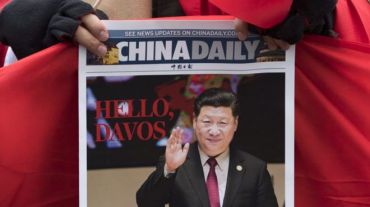
It’s the first time a Chinese head of state is attending the global forum and he’ll be star of the show.

But besides the allure of snow-capped alpine peaks and tasty cups of hot chocolate, why is he doing this? And why now?

First off, let’s not kid ourselves. Davos is a venue where little meaningful gets done.

It has struggled to shake its reputation as a very expensive talking shop that sees the rich and powerful of global business, politics, arts and society meet every year to sip cocktails and connect.

Along the way they’re supposed to think big thoughts about how to improve the world economy.

But given that their wealth and lifestyles are precisely what many parts of the developed world is seeing a backlash against right now, it’s not clear how much their solutions will help.

Davos: Are the global elite in retreat?

Globalisation and free trade are being attacked in the US and Europe. And with a new president about to enter the White House, President Xi’s speech will be watched very carefully.

According to Jiang Jianguo, a minister in China’s State Council Information office, President Xi will be “offering Chinese remedies for the world’s economic ailments”.

So what might he say, and why is this important? Here are three things I’ll be watching for:

1) Free trade is good trade

Globalisation has arguably benefited China more than any other country in the world.As the US pulls out of free trade agreements, President Xi is likely to laud its merits, and position China as the world’s newest and friendliest trading partner.

Of course, there’s always the criticism that China only opens up its economy just enough to benefit itself.But President Xi is likely to tackle that too. Chinese leaders tend to make big announcements in speeches abroad, so watch out for any further possible access to China’s economy.

2) China as a force for peace, not war

China’s growing military might in the South China Sea is a potential flashpoint

It’s part of China’s public diplomacy to convince the world that China’s rise is a good thing for everyone.

President Xi will be likely to present an image of China to the world “as a friend to everyone, a big wonderful panda that everyone should hug, and that everyone should just relax,” says Prof Kerry Brown of the Lau China Institute at King’s College London.

But this may be a hard sell, especially given the lingering concerns about China’s growing military might in the South China Sea.

Davos is a good opportunity to challenge these perceptions, says Jia Xiudong, at the China Institute of International Affairs in Beijing.

“Other countries may see China as an aggressive, assertive country. But this is a misunderstanding. That’s why it’s such a good opportunity for the president to communicate his message.

“Oh, and that no-one will be unfurling Free Tibet flags or heckling him (at least not inside the venue) will probably be an added benefit.
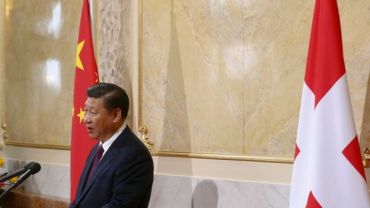
3) It’s all about symbolism, silly

President Xi’s speech comes just three days before Donald Trump is inaugurated as the 45th president of the United States.

“America is downgraded slightly in the eyes of the world because of the election,” says Prof Brown. “And China is more prominent – so it’s quite significant.”

Vanity is also a factor. President Xi enjoys massive popularity at home, and, as you might expect, would like to see that level of respect paid to him on the international stage.

What better way to do that than to praise the virtues of China’s economic wisdom to a receptive crowd, at a time when faith in the US’s ability as the de facto superpower is being questioned and dissatisfaction for the free market system – and the inequality it has created – is rising.

But while President Xi may enjoy being thrust into the spotlight on the Davos stage, it won’t erase some of the hard truths he has to deal with back home.

China’s economy is slowing down and its currency, the yuan, is weakening to lows not seen since 2008.

All of this has Beijing extremely concerned. China knows better than most that a growing gap between the haves and the have nots is devastating for social stability.

Source: Davos 2017: Can Xi Jinping be star of the show? – BBC News

07/09/2015

India ranks low on inclusive growth, development in WEF report – The Hindu

Ranked in the bottom half of the 38 countries that make up our lower middle income bracket. India has been ranked very low, mostly in the bottom half, globally on most of the parameters for inclusive growth and development even as it fares much better internationally when it come to business and political ethics. India’s overall place in the Global Competitiveness Index 2014–2015 rankings is 71 out of 144 countries.

Growth and Development Report is the first inclusive report ever by World Economic Forum that assess countries’ efforts to foster economic growth that raises the living standards of entire societies.In a first of its kind global rankings, across different groups of countries in terms of their per capita income levels, the World Economic Forum (WEF) found that most countries are in fact missing major opportunities to reduce income inequality and same is the case with India. WEF said that the new study, which was conducted over the past two years, seeks to identify the various ways policymakers can drive economic growth and equity at the same time and assesses them on their relative success in implementing these measures. “Our message is unequivocally that leaders must pursue economic strategies that are at the same time pro-growth and pro-labour,” said the Geneva-based think tank known for its economic conclaves held in different parts of the world including in Davos, Switzerland and in India. India has mostly been ranked in the bottom half of the 38 countries that make up our lower middle income bracket.

Particularly disappointing is its position in terms of Fiscal Transfers, where it ranks 37th out of 38. It also ranks very low at 32nd for Tax Code and 36th for social protection. WEF said that another area that policymakers in India would need to prioritise improvement would be ‘Asset building and entrepreneurship’, in particular the Small business ownership, where India ranks bottom among its peers at 38th place. However, India does demonstrate ‘leadership’ in some areas, WEF said, while naming areas like corruption and rent where it comes 8th.

For business and political ethics, India ranks 12th, while it ranks 11th on the Financial intermediation of real economy investment pillar, which suggests that money invested in the economy generally gets directed towards productive uses. WEF said its first Inclusive Growth and Development Report present a new framework for assessing countries’ efforts to foster economic growth that raises the living standards of entire societies. “Around the world, no bigger policy challenge preoccupies political leaders than expanding social participation in the process and benefits of economic growth,” WEF said while releasing the report that covers 112 economies.

Source: India ranks low on inclusive growth, development in WEF report – The Hindu

10/02/2015

Pollution: The cost of clean air | The Economist

A DESOLATE scene surrounds Little Zhang’s Tyre Repair in the dusty rock-mining township of Shijing, in the northern province of Hebei. Zhang Minsheng, the owner, still gets some business from passing traffic. But the recent closure of nearby rock quarries, because of air-pollution restrictions, has taken its toll. He reckons his monthly income has fallen by 30-40% to around 4,000 yuan ($640). Next door a wholesale coal business has closed. So too have a small family-owned barbecue restaurant and an alcohol, tobacco and grocery store. Red characters posted by their entrances still forlornly proclaim their “grand opening”.

Last year on a typically smoggy day in Beijing, Li Keqiang, the prime minister, declared “war” on air pollution—a problem that has become a national fixation. Smog remains a grave danger in most Chinese cities, but environmental measures are beginning to show teeth. Regulators in the most polluted provinces are ordering mass closures of offending enterprises. In some areas officials are being punished for failing to control pollution. Policymakers are placing less emphasis on GDP growth—long an obsession of officials at all levels of government—and talking up greenness.

The transformation will be painful. China’s new toughness on polluting quarries, mills and factories coincides with an economic slowdown that will make it harder to create new jobs for those laid off. Slower growth is in line with the government’s efforts to curb wasteful investment, and with it a dangerous build-up of debt. The slowdown also happens to be helpful in curtailing pollution: China’s consumption of coal, a huge contributor to smog as well as to climate-change emissions, fell slightly in 2014 after 14 years of growth.

Mr Li’s war is especially bloody in Hebei, which is blamed for much of the smog in Beijing. Keeping the air of the capital clean is a political priority. Chinese leaders have been embarrassed by the damage caused to China’s international image by the city’s relentlessly grey skies. They worry that the smog could fuel dissatisfaction with the government and undermine stability in the capital, as well as affect their own and their families’ health. Dutifully, Hebei, which surrounds Beijing, has been trying to clean up. Since the beginning of 2013 it has reported closing down 18,000 polluting factories. In January Hebei Daily, a state-run newspaper, said that in Mancheng county, to which Shijing township belongs, 37 rock quarries and rubble pits had been shut.

via Pollution: The cost of clean air | The Economist.

25/01/2014

BIS – Press Releases – New government support to encourage manufacturing production back to the UK

This initiative will only work if people like Sir James Dyson stop using lack of UK skills as an excuse to offshore.  Fortunately, very recently Sir James has done just that – see – http://www.telegraph.co.uk/finance/newsbysector/industry/engineering/10590729/Sir-James-Dyson-to-create-jobs-for-3000-engineers.html 

See also https://chindia-alert.org/2013/11/03/china-theyll-make-it-cheaper-in-yorkshire-the-sunday-times/

UK Trade & Investment (UKTI) has joined forces with the Manufacturing Advisory Service (MAS) to launch Reshore UK, a new one-stop-shop service to help companies bring production back to the UK.

UK companies are increasingly looking to reshore manufacturing, textiles, software production and call centre work to the UK instead of outsourcing overseas. This is due to the combination of a strong and stable economy, competitive corporate tax rates, a good regulatory environment, strong legal frameworks and a dynamic labour market.

UKTI has identified 1,500 manufacturing jobs reshored in the UK since 2011 and a MAS survey shows companies citing costs, quality and reducing lead times as the top three reasons for moving production back to the UK.

Reshore UK will provide a matching and location service, access to advice and support and a named individual to help each company. MAS’s role is to help support small and medium sized businesses to be globally competitive and to ensure there is capacity in the UK supply chain to take advantage of the reshoring opportunities. UKTI will use its global networks to attract foreign companies to invest.

By joining up the range of support available, the new service Reshore UK will be accessible for both UK and international firms and will ensure that they get the right support, when they need it most. It sees government working in partnership with industry in line with the Industrial Strategy, giving business the confidence to invest, creating more jobs and growth in the UK.

Prime Minister David Cameron who is speaking at the World Economic Forum in Davos this morning said:

English: DAVOS/SWITZERLAND, 29JAN10 - David Ca...

“For years UKTI has played a vital role helping our businesses to export and encouraging inward investment. Now, as part of our long-term economic plan, I also want us to help businesses bring back production to Britain. This new service will offer dedicated support for businesses that want to capitalise on the opportunities of reshoring, creating new jobs and ensuring that hard-working people can reap the benefits of globalisation.””

via BIS – Press Releases – New government support to encourage manufacturing production back to the UK.

Enhanced by Zemanta
18/12/2013

Toward a uniquely Indian growth model – excerpted from Reimagining India: McKinsey & Company

From: http://www.mckinsey.com/insights/asia-pacific/toward_a_uniquely_indian_growth_model 

India can’t afford to emulate China. Mahindra Group chairman Anand Mahindra says the country’s states must compete, not march in lockstep, if India is to develop its own path to sustainable prosperity.

November 2013 | byAnand Mahindra

According to this way of thinking, India is an underachiever, perversely holding itself back—and needs only to fire some particular afterburner in order to get its rocket to full speed. The government needs to go on an infrastructure building spree, or open the door to big-box retailers. Political parties need to crack down on corruption and nepotism. Farmers need to adopt smartphones. Something will trigger the long-awaited boom, and the billions in foreign direct investment (FDI) that have flowed to China over the last two decades will at last head south.

If we continue to judge India’s progress by China’s, using metrics like FDI and GDP growth, or statistics like the kilometers of highway and millions of apartments built, we will continue to be branded a laggard. India’s messy coalition governments are not suddenly about to become as efficient and decisive as China’s technocrat-led Politburo. Nor should that be the goal.

Moreover, India simply cannot afford to grow like China has over the last two decades. In authoritarian, tightly controlled China, the costs of that headlong economic expansion are obvious. Unbreathable air and undrinkable milk, slick-palmed officials and oppressive factory bosses provoke tens of thousands of protests each year. In a society as diverse as India’s—riven by religious, community, and caste divides—those kinds of tensions can easily erupt in violence and disorder. Already the battle between haves and have-nots is driving a powerful rural insurgency across nearly a third of the country. Labor riots can turn into religious pogroms. Farmer protests can turn into class wars.

For India’s economy to expand as rapidly and yet more sustainably than China’s, we need to make our differences into virtues rather than vulnerabilities. For too long we have clung to a mind-set shaped by the early independence years, when the areas in the northwest and northeast had become Pakistan, and India’s first government was struggling to weave a patchwork of provinces and maharaja-run kingdoms into a nation. In those days, the risk that India might break apart was very real. One of India’s great accomplishments is that no one worries about that anymore. Indeed, the idea of a united India runs so broad and deep that it allows us to consider a counterintuitive way of thinking about growth—that the best way to propel the economy may be to encourage different parts of the country to go their own way.

I’m not suggesting secession, of course. But there’s no sense in pretending that “India” is a single investment destination or even a coherent, unified economic entity. India’s 28 states and seven territories are as different from one another—as varied in language, food, culture, and level of development—as the nations of Europe. In some ways, Gujarat has more in common with Germany than with Bihar. Companies understand this. When they make decisions about where to locate factories or R&D hubs, they’re looking at the tax policies, physical and legal infrastructure, or labor costs in the particular state they’re considering—not at some mythical “India” visible only at Davos. We should be celebrating and encouraging these differences.

India needs to find a way to distribute growth—to create new urban hubs all over the country that can attract talent and money. Even if government had the power to bulldoze neighborhoods and erect forests of skyscrapers, as some seem to wish, it would struggle to surmount the challenges currently facing big cities like Mumbai and Bangalore. At double or triple the population, those megacities would become ungovernable. We need to break these problems into manageable pieces, developing hundreds, even thousands of smaller cities around the country where the problems of water, transit, power, and governance can be negotiated at the local level. India’s sprawling subcontinent can never become a plus-size Singapore. But perhaps we can weave together an urban web that is the equivalent of a thousand Singapores.

Technology is making this more than a fantasy. Given how much India has benefited from the way fiber-optic cables have already shrunk the world, we should be quick to see the opportunities in shrinking the subcontinent, too. With widespread 4G connectivity, many businesses will be able to operate from anywhere. That will create an advantage for locations emphasizing efficiency and livability. Workers will be able to perform their tasks closer to home, if not actually at home, thus relieving pressure on India’s roads and bridges. Even manufacturing can be distributed, once technologies like 3-D printing become more widespread. Populations of laborers will no longer need to cluster around big factories. Indeed, once every home can become a manufacturing hub, the kind of small enterprises that have been the backbone of the traditional Indian economy could find ways to thrive in the modern world.

Forced to compete for talent and for business, cities will have to experiment and innovate. Several corporations, including Mahindra, have begun exploring new ways to live, work, and play in planned enclaves like Mahindra World City outside Chennai. While these efforts are continuing, the government, too, should foster and support such experimentation as a matter of urban policy. Already the government taxes coal and fossil fuels used in the power and transportation industries, and offers tax incentives for renewable energy and nonpolluting vehicles. But we can go further, finding new ways to use technology to improve and expand the delivery of government services. The government’s Unique Identification project, which uses biometric data such as photographs, fingerprints, and retinal scans to create cost-effective and easily verifiable ID numbers for all Indian residents, is an excellent example of how government can leverage technology to help India’s citizens. These new numbers will make it easier for Indians to pay taxes, collect government benefits, and receive other government services. They also will help prevent fraud, bribery, vote rigging, and illegal immigration, as well as facilitate the delivery of many private-sector services.

India’s new cities will be its afterburners, the catalysts sparking new bursts of growth. The innovations developed in each scattered enclave will be emulated and improved upon elsewhere, and thus give rise to innovation. Rather than directing where capital should go, or funding white-elephant infrastructure projects, the central government should set the rules of the game and then step back.

What India needs from the world as much as investment dollars are bold thinkers who can help to define these new ways of living. We should seek out these visionaries, give them a platform to test their theories, and invite them not to build gaudy skyscrapers but to help develop new ways for the human race to live. Foreign direct ideas should be as valued a commodity as traditional FDI.

The world has a stake in India’s success—and not just because of the need for someone to pick up the slack from a slowing China. Much of the developing world faces the same challenges India does. The solutions developed here—the answers to almost metaphysical questions about how societies should work and grow—will have worldwide relevance.

For better or worse, India is where the future will be made. Let’s get it right.

About the author

Anand Mahindra is chairman and managing director of global conglomerate Mahindra. This essay is excerpted from Reimagining India: Unlocking the Potential of Asia’s Next Superpower. Copyright © 2013 by McKinsey & Company. Published by Simon & Schuster, Inc. Reprinted by permission. All rights reserved.

23/01/2013

* Mahindra Sees IT Revival

WSJ: “It is good to do the first interview in Davos with someone who can feel the pulse of the global economy, and Anand Mahindra, chairman and managing director Mahindra & Mahindra Ltd. 500520.BY -0.19%, can to an extent do that.

Sure, the giant Mahindra federation of companies—don’t call it a conglomerate, please—has many large businesses focused on its home market of India. But its information technology business relies on the investment decisions taken in the boardrooms of New York, London and Frankfurt—and the feeling of Mr. Mahindra is positive.

“The IT companies are going to see a revival,” says the Harvard-educated Mr. Mahindra. “I have been surprised at how strong the recovery has been.”

“What we are seeing is that customers in the west, by which I mean U.S., U.K. and Western Europe, these companies have not shied away in the last year from making the necessary investments in IT that they need to improve their businesses.”

That would be good news for the broader IT sector in India, which started the year with upbeat corporate results from some of the big players, but then some of the shine diminished when No. 3 player Wipro Ltd. 507685.BY +0.75% said it didn’t see any significant increase in demand.

It would also be good news for the broader global economy. Mr. Mahindra says, “I don’t think anyone in the world uses Indian IT companies as a barometer, but I think it’s a very interesting one.”

Mahindra & Mahindra has an incredibly diverse range of businesses, from tractors to parts for jet fighters to rural lending.

Mahindra Group has two software services companies—Tech Mahindra Ltd. and Satyam Computer Services Ltd. 500376.BY -0.30% The two companies have already announced a merger, which will create the fifth biggest Indian software services company by sales.

For the domestic business environment, he says he is more optimistic now than he has been for a couple of years.”

via Mahindra Sees IT Revival – India Real Time – WSJ.

Law of Unintended Consequences

continuously updated blog about China & India

ChiaHou's Book Reviews

continuously updated blog about China & India

What's wrong with the world; and its economy

continuously updated blog about China & India