Posts tagged ‘Delhi’

16/12/2014

India’s Senseless Ban on Uber: Rape Is the Real Problem – Businessweek

The alleged rape of an Uber passenger by her driver in New Delhi on Friday and his arrest over the weekend is another sad chapter in India’s ongoing battle with violence against women. While official statistics suggest the country witnessed 25,000 rapes in 2012, survey evidence suggests numbers perhaps 10 times as high.

Police escorting the hooded Uber driver following his court appearance on rape charges

The government’s response to the incident was to immediately ban Uber operations in Delhi. Alhough this might offer a welcome sign of political commitment to tackle violence, it doesn’t make sense. The police in India have been accused of multiple rapes, and tourists have been raped on a train and in a traditional Delhi taxi this year; the government has not shut down the police force, the railways, and traditional taxi services. It has singled out Uber, perhaps more because it is a high-profile, politically weak service than because of any risks riders may face.

In fact, there are good reasons to think Uber can provide a safer experience than India’s traditional transportation options do. Unlike the vast majority of rape cases in the country, the alleged perpetrator in the Uber case was arrested within hours of the incident. That’s not a surprise: Uber’s procedures guaranteed that there was considerable information available on the suspect. The company provided police with the name, age, and photo of the driver, along with his bank verified address, car details, and trip and route data. That’s a much higher level of knowledge than passengers have when they hail a cab off the street.

via India’s Senseless Ban on Uber: Rape Is the Real Problem – Businessweek.

15/12/2014

This Is What India’s Radio Cabs Are Doing to Make Women Safer – India Real Time – WSJ

Indian authorities and radio taxi operators in the national capital have stepped up security measures to ensure passenger safety in the aftermath of an alleged rape of a female passenger by a driver contracted to the international car booking service Uber Technologies.

Transport authorities in New Delhi have ordered radio fleet taxi companies and web-based operators to submit database of their drivers whose credentials need to be checked and have asked them to come up with a revised safety plan to be put in place by early next year, a Delhi police official, who did not wish to be named said Monday.

“A list of around 20,000 drivers has been submitted so far out of which the background details of more than 10,000 still need to be verified,” he said.

Last week, Delhi’s transport department barred Uber from operating its ride-hailing system in the national capital until it got the proper licenses. Uber on Thursday said it would suspend its service in the capital while it reviewed its screening processes. The department had stated that only six registered radio taxi companies would now be allowed to continue operating in New Delhi.

The cab operators in New Delhi, for their part, said they have certain safety rules in mind that they would submit by Dec. 31 to the transport department.

via This Is What India’s Radio Cabs Are Doing to Make Women Safer – India Real Time – WSJ.

04/12/2014

End of the road for Delhi’s old cars as India battles smog | Reuters

The National Green Tribunal has banned all vehicles older than 15 years from the streets of the capital, New Delhi, in a bid to clean up air that one prominent study this year found to be the world’s dirtiest.

Heavy traffic moves along a busy road during a power-cut at the traffic light junctions in New Delhi July 31, 2012. REUTERS/B Mathur/Files

The ruling hits up to a third of the 8.4 million motorbikes, trucks, cars and auto-rickshaws that ply the traffic-choked roads of Delhi and its surrounding areas, transport officials estimate.

Cities across the world are ordering older vehicles off the road or restricting private car use to tackle growing air pollution. Mexico City introduced a ban on older vehicles driving on Saturdays this year, while in March, France briefly enforced the most drastic traffic curbs in 20 years.

“It is undisputed and in fact unquestionable that the air pollution of … Delhi is getting worse with each passing day,” the National Green Tribunal ruled in a judgment last week banning older vehicles from city streets.

Vehicular emissions are the cause of close to three-quarters of Delhi’s air pollution, the Delhi government estimates, and a World Health Organization study of 1,600 cities released in May found India’s capital had the world’s dirtiest air. India rejected the report.

The ban in Delhi lacks incentives to encourage drivers to trade in their older vehicles but eventually could boost sales for carmakers like Maruti Suzuki India and Tata Motors, as the capital accounts for 17 percent of India’s new car sales, said IHS automotive analyst Puneet Gupta.

via End of the road for Delhi’s old cars as India battles smog | Reuters.

04/12/2014

Modi seeks to draw line under row over minister’s pro-Hindu comments | Reuters

Prime Minister Narendra Modi sought on Thursday to draw a line under a row sparked by a ministerial colleague’s derogatory comments about non-Hindus, urging angry parliament deputies to accept her apology and move on.

A supporter of Bharatiya Janata Party (BJP) holds a placard with a picture of India's Prime Minister Narendra Modi as he attends a rally addressed by the party president Amit Shah (not pictured) in Kolkata November 30, 2014. REUTERS/Rupak De Chowdhuri

The opposition, led by the Congress, has demanded the dismissal of Niranjan Jyoti, the junior minister for food processing industries, for telling voters this week that they must “decide whether you want a government of those born of (Hindu god) Ram, or those born illegitimately”.

The saffron-clad minister apologised a day later after her remarks drew outrage and calls that she be prosecuted for violating the secular spirit of India’s constitution.

Critics say that Modi’s nationalist Bharatiya Janata Party has a deep-seated bias against Muslims and that it is pursuing Hindu-dominant agenda.

Modi urged the upper house of parliament to accept Jyoti’s apology amid a third straight day of protests.

via Modi seeks to draw line under row over minister’s pro-Hindu comments | Reuters.

03/12/2014

A New Look for Indian Railways – India Real Time – WSJ

Indian Railways is trying to get a makeover.

“We want to improve passenger amenities,” said Suresh Prabhu, India’s new minister for railways, via a video conference at an event organized by the Asia Society in Mumbai Wednesday.

India’s nationalized rail network carries around 30 million passengers a day and has a budget for 2014/15 of 654 billion rupees ($10 billion.)

So what will the new railways look like? Mr. Prabhu gave some clues Wednesday.

Better food: Train travelers have long grumbled about the quality of food served on Indian trains including watery dal (lentil soup) and thick rotis (Indian bread.)

Mr. Prabhu said he’s considering a plan to set up base kitchens that will make good quality food to supply trains.

He’s also exploring an option to tie up with restaurants along train routes, so that commuters can order food from those restaurants, and the food would be delivered onto the train by Railway staff.

Some private websites have lately started  offering this facility on their own, such as travelkhana.com,  yatrachef.com and railtiffin.com.

Mobile ticket booking: The Indian Railways’ website irctc.co.in, which allows travelers to book tickets online, is one of the most-frequently visited websites in India.

Now, Indian Railways wants to introduce an option for travelers to be able to book train tickets on their cellphones. Mr. Prabhu didn’t clarify if he was referring to a new app for this booking.

He said Wednesday that a technical glitch has delayed the launch, but passengers can expect it soon.

Cleanliness: The Railways are looking to improve the quality of toilets and waiting spaces at train stations, said Mr. Prabhu. “We also want to improve the coaches,” he said. The plan is to retrofit existing train coaches and set up a factory for making new coaches, he added.

“In the next few months we should be able to put in place a complete blueprint” to achieve these goals without denting the rail finances, said Mr. Prabhu.

via A New Look for Indian Railways – India Real Time – WSJ.

29/10/2014

Pollution in Delhi Prompts U.S. Embassy Warning – India Real Time – WSJ

If you have children in New Delhi, you might not want to let them play outside today. The U.S. Embassy in the Indian capital said air quality – as measured at a monitoring station in the embassy compound – had reached “very unhealthy” levels on Wednesday morning.

On Wednesday at 10 a.m., the embassy said its air-quality index was 255 – a measure based on the amount of fine particulate, or PM 2.5, in the air. Such small particulates can enter the lungs and blood stream. They have been linked to severe health problems such as lung cancer.

The U.S. Embassy’s website said that an air-quality index reading between 201 and 300 can cause “significant aggravation of heart or lung disease” and a “significant increase in respiratory effects in general population.”

“Older adults and children should avoid all physical activity outdoors,” it said. “Everyone else should avoid prolonged or heavy exertion.”

The message though hadn’t got through to the American Embassy School in Delhi on Wednesday morning. Kailash Sharma, a staff member at the school, which is located across the road from the embassy, said by telephone that “kids were playing outside.”

The U.S. embassy in Beijing, China, also monitors air pollution.

Delhi’s air quality often deteriorates in winter, particularly in the days after the festival of Diwali when residue from fireworks displays adds to pollution levels.

India’s Ministry of Earth Sciences on Wednesday said its air-quality index was 121, a level described as “poor.”

via Pollution in Delhi Prompts U.S. Embassy Warning – India Real Time – WSJ.

04/10/2014

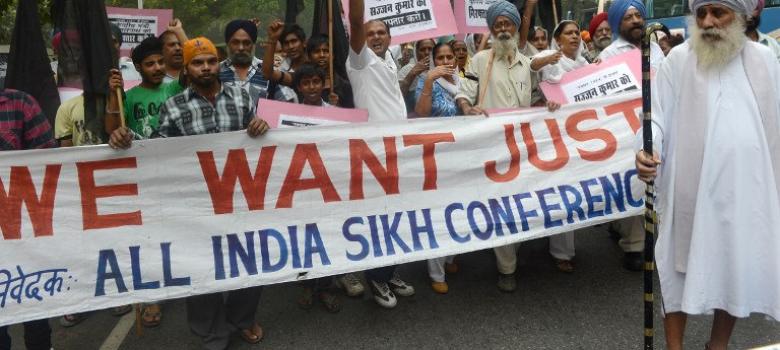
1984 anti-Sikh riots were an organised massacre, says ‘Caravan’ article

Avtar Singh Gill, the former petroleum secretary, alleged that Rajiv Gandhi aide Arun Nehru had sanctioned the violence.

Did disparate groups of rioters act spontaneously during the anti-Sikh riots of 1984, or was the violence orchestrated at the behest of the top leadership of the Congress? This question has dogged Congress governments since Delhi’s Sikh comunity was devastated by one the bloodiest bouts of communal carnage after Independence. The Congress has long maintained that the violence was an unplanned response to the assassination of Prime Minister Indira Gandhi by two Sikh bodyguards on October 31, 1984. The riots continued until November 3.

Now, a recent statement by a senior government official of the time has added credence to the allegation that the violence was indeed orchestrated, and that the clearance came from the top. Avtar Singh Gill, the former petroleum secretary, has told Caravan magazine that Arun Nehru, a cousin and confidant of Rajiv Gandhi, had given clearance for Sikhs to be attacked and killed in Delhi.

In an article by the magazine’s political editor Hartosh Singh Bal in the latest issue, Gill is quoted as saying that on November 1, 1984, “Lalit Suri of Lalit Hotels, who used to come and see me often, dropped by. He was the errand boy for Rajiv Gandhi, and since he often needed some work done, he was close to me. He came to me in the ministry and said, ‘Clearance has been given by Arun Nehru for the killings in Delhi and the killings have started.  The strategy is to catch Sikh youth, fling a tyre over their heads, douse them with kerosene and set them on fire. This will calm the anger of the Hindus.”

Gurudwara lists

Gill is also quoted as saying that Suri “told me that I should be careful even though my name is not in the voters’ list, the Delhi Gurdwara voters’ list. ‘They [the rioters] have been provided this list. This will last for three days. It has started today, it will end on the third [of November].’”

Gill’s revelations also appear to put to rest the long-term speculation about Arun Nehru’s role in the violence. “That Arun Nehru had a role in the violence has long been widely rumoured, but Gill’s statement marks the first time a senior government official has put the accusation on record,” writes Bal. “His story offers the first coherent explanation for the nature of the violence in Delhi,”

Gill and Nehru

Gill’s revelations have greater significance because he was often consulted by Arun Nehru on Punjab and Sikh issues. “As one of the few Sikhs in a senior position in the government – even though I was clean shaven, he [Nehru] wanted to know my views,” the former petroleum secretary is quoted as saying.

Gill’s also explains – again for the first time – how rioters could easily identify Sikh houses. Lawyer HS Phoolka, who is leading the legal battle to secure justice for the victims of the 1984 riots, is quoted in the article saying “the ease with which Sikh houses were identified would make sense if Gurdwara voters’ lists were available”.

Gurdwara voter lists contain the names of people eligible to vote in the elections to the Delhi Sikh Gurdwara Management Committee. That these lists were already available to “people in the higher ranks” is made clear by another contention Phoolka makes in this article.

via 1984 anti-Sikh riots were an organised massacre, says ‘Caravan’ article.

18/09/2014

Chinese Views of India: Culturally Rich but Backward – China Real Time Report – WSJ

From China’s side of the Himalayas, the view of India isn’t always that great.

“This place is like China from 20 years ago. It’s much, much worse than I’d imagined,” said Tony Jiang, 29, an employee at an electronics-parts maker in Hangzhou visiting New Delhi this week.

Reshma Patil, an Indian journalist who spent more than three years based in Beijing reporting on China for the Hindustan Times newspaper, writes in a recently published book that Chinese she met tended to view India as poor and unsanitary.

In “Strangers Across the Border: Indian Encounters in Boomtown China,” Ms. Patil argues that ties between the two countries are hampered by their citizens’ mutual ignorance of each other.

A survey by the Pew Research Center published this year found that 30% of Chinese have a “favorable” view of India and 55% an “unfavorable” one. By contrast, 50% of Chinese have a favorable view of the U.S., according to Pew. Just 8% of Chinese hold a favorable view of Japan.

More Chinese are getting first-hand knowledge by visiting India as tourists or on business trips.

But the numbers are still small. India’s Ministry of Tourism says that about 175,000 Chinese tourists visited India in 2013, a 46% increase from around 120,000 in 2010. Tourism experts say China’s newly affluent prefer traveling to Europe, the U.S. and Southeast Asia.

India Real Time interviewed some Chinese visitors to India to get their impressions of the country as the two nations focus on bolstering ties that have long been strained by territorial disputes. Chinese President Xi Jinping arrived in India on Wednesday for a three-day trip aimed at deepening economic relations.

For some Chinese, the allure of India is its cultural heritage, especially its connection to Buddhism.

Mario Tang, a 26-year-old store manager from Shanghai who traveled across north India, said he came to see India’s centuries old history — against the advice of family and friends.

“My parents thought I was crazy. Most people I know think India is a poor, dirty, backward place,” Mr. Tang said.

He found it magical. “India is one of my favorite places on the planet,” he said. He visited Buddhist holy sites and even took a dip in the Ganges, India’s sacred river. He said Indians he spoke to seemed happy, something he attributed to “the power of belief and culture.”

Di Wenjie, a 32-year-old Chinese magazine editor who has visited India several times, said the country is “beyond imagination and full of color.” She says she studied meditation and yoga and plans to come again soon.

Others take a dimmer view.

“We didn’t have high hopes coming here,” said Mr. Jiang, the electronics-company employee, who was visiting Delhi for a trade fair. “Our impression was that Indian people are dirty and disorderly,” he said, while working on his laptop at a Starbucks in the center of the Indian capital this week.

Mr. Jiang also questioned Indians’ dedication to their jobs. “Indians are still eating breakfast at 10 a.m. Then they go home by 5 to 6 p.m.,” he said. “This is why this country is developing so, so slowly.”

His colleague, Ray Zhang, 28, said that his experience in New Delhi had been “terrible.” But he said he wouldn’t rule out returning to India to see the sights. “I’ve heard a lot about the Taj Mahal,” he said.

via Chinese Views of India: Culturally Rich but Backward – China Real Time Report – WSJ.

17/09/2014

Indian President flies out of Vietnam

President Pranab Mukherjee Wednesday wrapped up his four-day state visit to Vietnam and flew back to India.


Embed from Getty Images

During the President’s visit, India and Vietnam called for a peaceful, unfettered South China Sea, inked seven agreements including for direct Delhi-Hanoi flights and an extended line of credit for purchase of military equipment. Both countries also set a target of $15 billion bilateral trade by 2020

via President flies out of Vietnam.

15/09/2014

India’s Economy Looks a Lot Like China’s — In 2001 – India Real Time – WSJ

India today doesn’t look quite like the economic dynamo that, just a few years ago, some predicted would overtake China as emerging-markets champion.

But the race looks a lot closer if you account for one key fact: China got a 13-year head start on India in opening its economy and giving companies greater freedom to invest and produce. In exports, capital spending and foreign investment, India today is remarkably similar to China circa 2001.

That should both console and concern India as it gets back on its feet after three years of weak growth and high inflation. Console, since it suggests the country’s economy could remain on a China-like trajectory for years to come. But concern, because India’s delay could mean that the country has missed out on some big advantages that catalyzed China’s boom.

The latter point is especially worth considering given how assiduously India’s recently elected prime minister, Narendra Modi, is working to follow the blueprint for China’s export- and investment-driven success.

When Chinese President Xi Jinping visits the Indian capital this week he will encounter a recipe for economic revival that ought to look very familiar. Delhi is aiming to boost exports and raise India’s share in world trade by 50% over the next five years. “Sell anywhere,” Mr. Modi said in an Independence Day exhortation to global business last month. “But manufacture here.”

via India’s Economy Looks a Lot Like China’s — In 2001 – India Real Time – WSJ.

Law of Unintended Consequences

continuously updated blog about China & India

ChiaHou's Book Reviews

continuously updated blog about China & India

What's wrong with the world; and its economy

continuously updated blog about China & India