Posts tagged ‘East Asia’

07/11/2014

Myopia: Losing focus | The Economist

SPARKLY, spotted or Hello Kitty: every colour, theme, shape and size of frame is available at Eyeglass City in Beijing, a four-storey mall crammed only with spectacle shops. Within half an hour a pair of prescription eyeglasses is ready. That is impressive, but then the number of Chinese wearing glasses is rising. Most new adoptees are children.

In 1970 fewer than a third of 16- to 18-year-olds were deemed to be short-sighted (meaning that distant objects are blurred). Now nearly four-fifths are, and even more in some urban areas. A fifth of these have “high” myopia, that is, anything beyond 16 centimetres (just over six inches) is unclear. The fastest increase is among primaryschoolchildren, over 40% of whom are short-sighted, double the rate in 2000. That compares with less than 10% of this age group in America or Germany.

The incidence of myopia is high across East Asia, afflicting 80-90% of urban 18-year-olds in Singapore, South Korea and Taiwan. The problem is social rather than genetic. A 2012 study of 15,000 children in the Beijing area found that poor sight was significantly associated with more time spent studying, reading or using electronic devices—along with less time spent outdoors. These habits were more frequently found in higher-income families, says Guo Yin of Beijing Tongren Hospital, that is, those more likely to make their children study intensively. Across East Asia worsening eyesight has taken place alongside a rise in incomes and educational standards.

The biggest factor in short-sightedness is a lack of time spent outdoors. Exposure to daylight helps the retina to release a chemical that slows down an increase in the eye’s axial length, which is what most often causes myopia. A combination of not being outdoors and doing lots of work focusing up close (like writing characters or reading) worsens the problem. But if a child has enough time in the open, they can study all they like and their eyesight should not suffer, says Ian Morgan of Australian National University.

Yet China and many other East Asian countries do not prize time outdoors. At the age of six, children in China and Australia have similar rates of myopia. Once they start school, Chinese children spend about an hour a day outside, compared with three or four hours for Australian ones. Schoolchildren in China are often made to take a nap after lunch rather than play outside; they then go home to do far more homework than anywhere outside East Asia. The older children in China are, the more they stay indoors—and not because of the country’s notorious pollution.

via Myopia: Losing focus | The Economist.

09/05/2014

Wheat vs. Rice: How China’s North-South Culinary Divide Shapes Personality – China Real Time Report – WSJ

In China, as in many countries, the north-south divide runs deep. People from the north are seen as hale and hearty, while southerners are often portrayed as cunning, cultured traders. Northerners are taller than southerners. The north eats noodles, while the south eats rice—and according to new research, when it comes to personality, that difference has meant everything.

A study published Friday by a group of psychologists in the journal Science finds that China’s noodle-slurping northerners are more individualistic, show more “analytic thought” and divorce more frequently. By contrast, the authors write, rice-eating southerners show more hallmarks traditionally associated with East Asian culture, including more “holistic thought” and lower divorce rates.

The reason? Cultivating rice, the authors say, is a lot harder. Picture a rice paddy, its delicate seedlings tucked in a bed of water. They require careful tending and many hours of labor—by some estimates, twice as much as wheat—as well as reliance on irrigation systems that require neighborly cooperation. As the authors write, for southerners growing rice, “strict self-reliance might have meant starvation.”

Growing wheat, by contrast, the north’s staple grain, is much simpler. One Chinese farming guide from the 1600s quoted in the study advised aspiring farmers that “if one is short of labor power, it is best to grow wheat.”

To produce their findings, the authors evaluated the attitudes of 1,162 Han Chinese students in Beijing and Liaoning in the north and in Fujian, Guangdong, Yunnan and Sichuan in the south. To control for other factors that distinguish the north and south—such as climate, dialect and contact with herding cultures—the authors also analyzed differences between various neighboring counties in five central provinces along China’s rice-wheat border.

According to the authors, the influence of rice cultivation can help explain East Asia’s “strangely persistent interdependence.” For example, they say South Korea and Japan have remained less individualistic than Western countries, even as they’ve grown more wealthy.

The authors aren’t alone in observing the influence various crops have on shaping culture. Malcolm Gladwell in his 2008 book “Outliers” also drew connections between a hard-working ethic (measured by a willingness to fill out long, tedious questionnaires) to a historical tradition of rice cultivation in places such as South Korea, Taiwan and Japan, given that the farming of such crops is arguably an equally tedious chore.

But what will happen to such differences after people move away from tending such crops, as is now happening across China? The study cites findings that U.S. regions settled by Scottish and Irish herders show more violence even long after most herders’ descendants have found other lines of work as evidence that cultural traits stubbornly resist change, even over time. (Herders, psychologists theorize, are ready to put their lives on the line to protect their animals against thieves or attack.)

“In the case of China,” the authors conclude, “only time will tell.”

via Wheat vs. Rice: How China’s North-South Culinary Divide Shapes Personality – China Real Time Report – WSJ.

Enhanced by Zemanta
16/04/2014

A Green Group Sees Hope in ‘The End of China’s Coal Boom’ – NYTimes.com – NYTimes.com

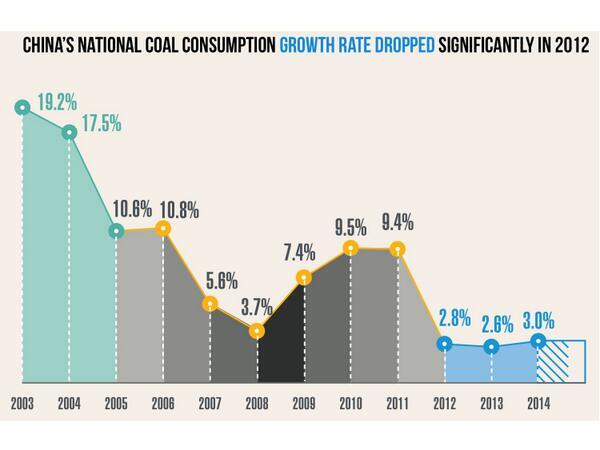
A report from Greenpeace charts slowing growth in China’s coal use.

Through much of its history, Greenpeace has been big on what I call “woe is me, shame on you” messaging on the environment. As I explained at a TEDx event in Portland, Ore., over the weekend, fingerpointing (including Greenpeace’s) is appropriate in many instances, but doesn’t work well with human-driven global warming. The blame game too often ends up resembling a circular firing squad.

This is why “The End of China’s Coal Boom,” a valuable new report from Greenpeace’s East Asia office, is so refreshing and worth exploring. I was led to it by a Twitter item from the group’s outgoing director, Phil Radford, that focused on a telling graphic:

View image on Twitter

via A Green Group Sees Hope in ‘The End of China’s Coal Boom’ – NYTimes.com – NYTimes.com.

Enhanced by Zemanta
10/04/2014

Chinese Exports Plummeted Last Month. Puzzled? We Have You Covered – China Real Time Report – WSJ

China’s exports were down 6.6% on year in March, confounding economists, many of whom expected growth of over 4%.

What’s going on?

First, it’s important to remember that China’s trade statistics in the first quarter are often skewed by the Chinese Lunar New Year holidays, when activity slows down in much of East Asia.

But economists expected exports to show signs of a pickup in March, the first month not affected by the holidays, which this year fell in late January and early February.

One explanation is the March data was warped by over-invoicing. This is a practice by which Chinese companies dodge capital controls by using fake export invoices to get money into the country to benefit from relatively high onshore interest rates.

Beijing cracked down on the practice last spring, but over-invoicing was still prevalent in March 2013. Since then it has decreased because of tighter regulatory controls. The government’s efforts to guide the yuan currency lower this year also has diminished the attraction of such a carry trade.

That could mean the year-ago comparison was artificially boosted, making March 2014’s numbers look poor by comparison.

“Do not worry about the export data,” wrote Louis Kuijs, an economist at RBS in Hong Kong, in a note to clients.

RBS estimates year-on-year export growth in March 2013 was inflated by 11.8 percentage points due to over-invoicing. The bank also thinks export growth on-year in March this was 5.2% adjusting for over-invoicing.

“The competitiveness of China’s manufacturing sector is still solid, allowing its export sector to benefit from global demand growth,” Mr. Kuijs wrote.

Andrew Tilton, an economist at Goldman Sachs in Asia, agreed with this assessment.

“The main reason is that the over-invoicing distortions were peaking last year around this time,” he said. Now, “the increased currency volatility and deprecation is discouraging that activity from a financial incentive perspective.”

via Chinese Exports Plummeted Last Month. Puzzled? We Have You Covered – China Real Time Report – WSJ.

Enhanced by Zemanta
12/03/2014

China tries a new role in the missing plane saga—Asia’s policeman – Quartz

In the aftermath of the March 8 disappearance of a Malaysia Airlines plane with 239 people on board, 153 of them Chinese nationals, Beijing is flexing its muscles. The Chinese government has dispatched two warships, 10 satellites, over 50 marines to the South China Sea, and—although the Malaysian government didn’t formally invite them—a 13-member delegation to advise search and rescue efforts from Kuala Lumpur.

The assertive response marks a new stage in China’s ascension as a regional superpower, a role the country hasn’t fully embraced despite its expanding military and trade power in East Asia. While China has made claims over disputed territory (in the air, the sea, and in passports), it has rarely deployed its military and officials in such a public way.

+

On March 10, Chinese officials said they had “a responsibility to demand and urge the Malaysia side to step up search efforts…and provide relevant information to China correctly and in a timely manner.” In response, the Malaysian government re-issued its pledge to fly Chinese relatives of the passengers on board to Malaysia.

+

China’s show of strength may simply be an effort to show angry Chinese families that their government is actively pushing for answers and participating in, if not leading, search operations. Chinese officials have already been pelted with water bottles thrown by the frustrated relatives of passengers. But the crisis is also an occasion for Beijing to continue what has been a decade-long expansion (pdf) of militarily and diplomatic engagement in Southeast Asia, a region that’s traditionally been part of the United States’ realm of influence.

+

Some observers have hailed the last few days of cooperation between the countries more accustomed to arguing over islands and shoals as a hopeful sign for future negotiations. But it’s not likely that China’s stance toward its neighbors has softened much over that time.

+

Just last week, Chinese officials said that peace in the region could only be “maintained by strength.” Part of that strength, it seems, involves an aggressive Chinese response when disaster strikes.

via China tries a new role in the missing plane saga—Asia’s policeman – Quartz.

Enhanced by Zemanta
01/12/2013

China, Japan and America: Face-off | The Economist

China’s new air-defence zone suggests a worrying new approach in the region

THE announcement by a Chinese military spokesman on November 23rd sounded bureaucratic: any aircraft flying through the newly designated Air Defence Identification Zone (ADIZ) in the East China Sea must notify Chinese authorities in advance and follow instructions from its air-traffic controllers. America’s response was rapid. On November 26th Barack Obama sent two B-52 bombers to fly through the new zone without notifying China (see article). This face-off marks the most worrying strategic escalation between the two countries since 1996, when China’s then president, Jiang Zemin, ordered a number of exclusion zones for missile tests in the Taiwan Strait, leading America to send two aircraft-carriers there.

Plenty of countries establish zones in which they require aircraft to identify themselves, but they tend not to be over other countries’ territory. The Chinese ADIZ overlaps with Japan’s own air-defence zone (see map). It also includes some specks of rock that Japan administers and calls the Senkaku islands (and which China claims and calls the Diaoyus), as well as a South Korean reef, known as Ieodo. The move is clearly designed to bolster China’s claims (see article). On November 28th Japan and South Korea sent aircraft into the zone.

Teenage testosterone

Growing economic power is bound to go hand-in-hand with growing regional assertiveness. That is fine, so long as the behaviour of the rising power remains within international norms. In this case, however, China’s does not; and America, which has guaranteed free navigation of the seas and skies of East Asia for 60 years, is right to make that clear.

How worrying China’s move is depends partly on the thinking behind it. It may be that, like a teenager on a growth spurt who doesn’t know his own strength, China has underestimated the impact of its actions. The claim that America’s bombers had skirted the edge of the ADIZ was gawkily embarrassing. But teenagers who do not realise the consequences of their actions often cause trouble: China has set up a casus belli with its neighbours and America for generations to come.

It would thus be much more worrying if the provocation was deliberate. The “Chinese dream” of Xi Jinping, the new president, is a mixture of economic reform and strident nationalism. The announcement of the ADIZ came shortly after a party plenum at which Mr Xi announced a string of commendably radical domestic reforms. The new zone will appeal to the nationalist camp, which wields huge power, particularly in the armed forces. It also helps defend Mr Xi against any suggestions that he is a westernising liberal.

If this is Mr Xi’s game, it is a dangerous one. East Asia has never before had a strong China and a strong Japan at the same time. China dominated the region from the mists of history until the 1850s, when the West’s arrival spurred Japan to modernise while China tried to resist the foreigners’ influence. China is eager to re-establish dominance over the region. Bitterness at the memory of the barbaric Japanese occupation in the second world war sharpens this desire. It is this possibility of a clash between a rising and an established power that lies behind the oft-used parallel between contemporary East Asia and early 20th-century Europe, in which the Senkakus play the role of Sarajevo.

via China, Japan and America: Face-off | The Economist.

19/08/2013

A gaffe-prone Japan is a danger to peace in Asia; China concerned

Are we inching towards a military confrontation between thes two East Asian powers?

18/10/2012

* Feuds in the Pacific over islands: it’s not simply a case of China against everyone else

Unfortunately for China, its recent military posturing has obscured the fact that territorial claims in the South China Sea is not only between China and its neighbours but endemic.

WorldTimes: “When it comes to feuds in the Pacific over islands and what lies beneath, it’s not simply a case of China against everyone else. Depending on the dispute, it’s also South Korea vs. Japan, Japan vs. Taiwan, Taiwan vs. Vietnam, Vietnam vs. Cambodia and numerous other permutations — for many of the same reasons supposedly behind China’s actions. Resource grab. Patriotic posturing. Historical baggage (mostly to do with Japan’s brutal occupation of most of East Asia before and through World War II). Referring to the South China Sea, former ASEAN secretary general Rodolfo Severino, who now heads Singapore’s Institute of Southeast Asian Studies, wrote recently that “all claimants feel their footholds are essential to what they consider their national interests … This clash of national interests … makes it most difficult even to appear to be making compromises on national integrity or maritime regimes and, thus, almost impossible to resolve [the] disputes.””

Read more: http://world.time.com/2012/08/19/why-asias-maritime-disputes-are-not-just-about-china/#ixzz29dhhV78F

03/05/2012

* China, Japan, South Korea to boost investment in each others bonds

Reuters: “China, Japan and South Korea agreed on Thursday to boost cross-investment in government bond markets, worth nearly a combined $15 trillion, in a move that will better prepare the countries to protect their financial markets from external shocks.

East Asia blank map China/Japan/Korean peninsu...

East Asia map China/Japan/Korean peninsula (Photo credit: Wikipedia)

The three economic powers sought a formal agreement, a rare one on securities investment, to ease mutual concerns about possibly massive cross-border fund flows and because their capital markets are at different levels of development. The move also comes as many of the heavily exposed economies in East Asia have struggled to find ways to avoid a repeat of the 1997/98 Asian financial meltdown and other turmoil that has struck during times of crises originating outside the region.”

via China, Japan, South Korea to boost investment in each others bonds | Reuters.

02/04/2012

* Sino-ASEAN ties key to peace in S. China Sea

China Daily: “China and the Association of Southeast Asian Nations should work hard to boost practical cooperation and maintain peace and stability in the South China Sea, said a joint statement due to be issued on Monday by China and Cambodia. According to the statement, the two countries agreed that “China and ASEAN countries shall continue to abide by the purpose and spirit of the Declaration on the Conduct of Parties in the South China Sea and give full play to all the existing mechanisms including the guidelines for the implementation of the DOC to make it a sea of peace, friendship and cooperation for China and ASEAN countries”.

Monday is the final day of President Hu Jintao’s four-day state visit to Cambodia, which holds the rotating chair of ASEAN in 2012 and plays an important role in East Asian cooperation and China-ASEAN relations. It also comes just two days ahead of a two-day regional summit of ASEAN in Phnom Penh.”

via Sino-ASEAN ties key to peace in S. China Sea|Politics|chinadaily.com.cn.

Given the increasing tension in the South China Seas due to conflicting oceanic territoriual claims, where large depositis of oil and gas are predicted, this must be good news.

Law of Unintended Consequences

continuously updated blog about China & India

ChiaHou's Book Reviews

continuously updated blog about China & India

What's wrong with the world; and its economy

continuously updated blog about China & India