Posts tagged ‘Economic inequality’

18/01/2017

This Is Just How Unequal India Is – India Real Time – WSJ

New report from Oxfam highlights how the country’s wealth is concentrated in the hands of a few

Country Percentage of wealth top 1% has
Global

51

Australia

22

Belgium

18

Brazil

48

Canada

26

Denmark

31

France

25

Germany

31

India

58

Italy

25

Mexico

38

Netherlands

24

New Zealand

20

South Africa

42

Sweden

36

U.K.

24

U.S.

42

The richest 1% of Indians hold 58% of the country’s total wealth, according to Oxfam India.

The stark inequality in India is worse than the global data put out by the organization, which show that the richest 1% have more than 50% of the total world wealth, Oxfam said.

It said recently improved data on the distribution of wealth, particularly in countries like India and China, indicate that the poorest half of the world has less wealth was previously thought. Oxfam singled out India repeatedly in the report.

It said that companies are increasingly driven to pay higher returns to their shareholders. In India, the amount of profits corporations share with shareholders is as high as 50% and growing rapidly, the report said.

A family sits atop a pile of hay on a horse cart on a highway near Amritsar, India, Nov. 4, 2016.

The report said the annual share dividends paid by from Zara’s parent company to Amancio Ortega – the world’s second richest man – are equal to around 800,000 times the annual wage of a worker employed by a garment factory in India.

Oxfam said that the combined wealth of India’s 57 billionaires is equivalent to that of the country’s poorest 70%.“India is hitting the global headlines for many reasons, but one of them is for being one of the most unequal countries in the world with a very high and sharply rising concentration of income and wealth,” Nisha Agarwal, chief executive of Oxfam said in a statement.

Oxfam said India should introduce an inheritance tax and raise its wealth levies as well as increasing public spending on health and education. It said it should end the era of tax havens and crack down on rich people and corporations avoiding tax.

Source: This Is Just How Unequal India Is – India Real Time – WSJ
21/12/2015

Panda power | The Economist

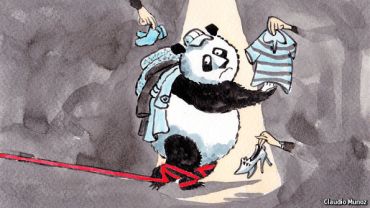
THE feeding frenzy for the pandas comes at nightfall. People furtively approach them, pouring bags of old clothes down their gullets.

By day, the trucks arrive to clean the bears out, leaving them empty for the next big meal. The pandas are plastic. They are large, bear-shaped receptacles, designed to entice people to donate their unwanted garments to those in need.

First deployed in 2012, there are now hundreds around Shanghai, often placed by entrances to apartment buildings. They swallowed about a million items of clothing last year. The procession of donors feeding trousers to pandas is impressive. But they usually do so under cover of darkness. Charitable giving is not yet a middle-class habit. Many people still feel awkward about it, despite their growing prosperity. China’s GDP per person is about one-seventh of America’s.

But in 2014 Chinese gave 104 billion yuan ($16 billion) to charity, about one-hundredth of what Americans donated per person (see chart). This is partly a legacy of attitudes formed during Mao’s rule, when the party liked to present itself as the source of all succour for the poor (to suggest otherwise was deemed counter-revolutionary). Even until more recent years the party was reluctant to encourage charities, worried that they might show up its failings.

The middle classes have worries too—that giving large amounts to charity may draw unwanted attention to their wealth. They do not want to fuel the envy of the have-nots or encourage tax collectors to pay them closer attention.

The top 100 philanthropists in China gave $3.2 billion last year, according to Hurun Report, a wealth-research firm based in Shanghai. That was less than the amount given by the top three in America.

In 2008 when a powerful earthquake hit the south-western province of Sichuan—the deadliest in China in more than 30 years—it seemed that one positive outcome would be a boom in charitable giving. Volunteers poured into the devastated region and donations filled the coffers of aid organisations. Problems soon arose, however. Embarrassed that private relief efforts were proving more effective than official ones, the government reined in citizen-led organisations.

Source: Panda power | The Economist

01/05/2014

China’s Income-Inequality Gap Widens Beyond U.S. Levels – Businessweek

The gap between China’s rich and poor is now one of the world’s highest, surpassing even that in the U.S., according to a report being released this week by researchers at the University of Michigan.

The metric used in these studies, the Gini coefficient, would be zero in a society in which all income is equally distributed, while a score of one would reflect a society in which all income is concentrated in the hands of a single individual. Over a three-decade period starting in 1980—shortly after China’s economic reform and opening commenced—the Gini coefficient has grown from 0.3 to 0.55 in 2010.

In the U.S., by contrast, the index reads 0.45. Anything over 0.50 is considered “severe disparity,” says the report in the Proceedings of the National Academy of Sciences. The authors used data from seven separate surveys conducted by a number of Chinese university-affiliated organizations, including Peking University’s Institute of Social Sciences.

via China’s Income-Inequality Gap Widens Beyond U.S. Levels – Businessweek.

Enhanced by Zemanta
06/12/2013

One Silver Lining of China’s Lopsided Labor Market: Shrinking Income Inequality – Businessweek

In the same week that international educators are debating the comparative merits of global school systems—and whether China’s PISA scores are overhyped—a new report from China Economic Quarterly sheds light on an unintended consequence of China’s recent push to expand higher education.

The annual supply of fresh college graduates far exceeds the number of white-collar positions available in China. Meanwhile a dwindling pool of young people willing to work in Chinese factories has driven up assembly-line wages. The result, conclude GK Dragonomics analysts Andrew Batson and Thomas Gatley, is an unexpected narrowing of China’s worryingly high level of income inequality.

Over the past decade, China has rapidly expanded access to higher education. University enrollment tripled from 2000 to 2010, from 2.2 million to 6.6 million students. Unfortunately, job creation didn’t keep pace. According to survey results from China’s labor ministry obtained by China Economic Quarterly, there were 100 job applicants in mid-2013 for every 80 white-collar jobs in China. For blue-collar positions, however, the scenario was reversed: There were 100 applicants for every 125 slots in China.

via One Silver Lining of China’s Lopsided Labor Market: Shrinking Income Inequality – Businessweek.

10/12/2012

* China wealth gap continues to widen, survey finds

This is the kind of disparity that is most worrying to the Party. Unless it gets the support of the majority, including the poor, its mandate is suspect.

SCMP: “The chasm between China’s rich and poor has widened to alarming levels, according to survey results released by the Survey and Research Centre for China Household Finance.

china-economy-property_mrr328_23611263.jpg

The survey, released on Sunday, reported a rise in China’s Gini coefficient, a key yardstick of income or wealth inequality, to 0.61 in 2010, the latest year for which there is data on China.

That number is significantly higher than the global average of 0.44 and 50 per cent above the “risk level” for social unrest, the Beijing Times reported.

The figure was 0.56 for urban households and 0.60 for rural households.

Measured on a scale of 0 to 1, a Gini coefficient of 0 represents perfect equality in which everyone has the same income, and 1 represents maximal inequality in which just one person holds all the wealth.

Since China first published data on the Gini-coefficient in 2000, the official figure has stayed level at 0.412. In 2005, the World Bank data put the figure at 0.425, the last year it published a Gini index for the country.

Li Shi, executive dean of Beijing Normal University’s China Institute of Income Distribution, who compiled his own Gini survey in 2007, told Bloomberg News in September that a poll of 20,000 households gave an index of 0.48.

“A high Gini coefficient is a common phenomenon in the process of rapid economic development. It is the natural result of the market allocating resources efficiently,” said Gan Li, the director of the research centre, at a briefing in Beijing.

“Relying on market forces alone can’t narrow the gap so China must change the structure of income distribution and rely on massive fiscal transfers to narrow the yawning disparity.””

via China wealth gap continues to widen, survey finds | South China Morning Post.

Law of Unintended Consequences

continuously updated blog about China & India

ChiaHou's Book Reviews

continuously updated blog about China & India

What's wrong with the world; and its economy

continuously updated blog about China & India