

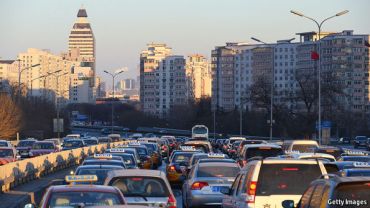
LATE last month a black-and-white photograph of a professor from Beijing Jiaotong University spread on social media. His image was edged by a black frame, like those displayed at funerals in China, and trimmed with white flowers of mourning. Though Mao Baohua is still very much alive, he had angered netizens enough to depict him as dead. His crime? To suggest that Beijing should follow the likes of London and Stockholm, by charging drivers 20-50 yuan ($3-7.50) to enter the capital’s busiest areas in the hope of easing traffic flow in the gridlocked city.
Most Chinese urbanites see buying a vehicle as a rite of passage: a symbol of wealth, status and autonomy, as it once was in America. Hence their outrage at any restraint on driving. Since car ownership is more concentrated among middle- and high-income earners in China than it is in richer countries, any attack on driving is, in effect, essentially aimed at the middle class, a group the Communist Party is keen to keep on side. That makes it hard to push through changes its members dislike.
Since 2009 officials in Beijing and the southern city of Guangzhou have repeatedly aired the idea of introducing congestion charges. Netizens have fought back, accusing their governments of being lazy, brutal and greedy. Many also gripe that the policy would be “unfair” because the fee would have less impact on the super-rich. Complaints about the inequality of congestion charging echo those made in London and other cities before they launched such schemes. But the party, nervous of being accused of straying from socialism, is particularly sensitive to accusations that it is favouring the wealthiest.
Because of such objections, city governments have not pushed their proposals very hard. But that is now changing in Beijing, where officials face a dilemma. Traffic jams in the city and appalling air pollution—30% of which comes from vehicle fumes, by official reckoning—may end up causing as much popular resentment as any surcharge. The local government is trying to work out how close it is to this tipping point. It is conducting surveys to “pressure test” how people would react to a congestion fee, says Yuan Yue of Horizon, China’s biggest polling company (the results will not be made public). It is likely that a concrete plan for a congestion charge will be announced soon. Beijing’s environmental and transport departments (not usual partners) are collaborating on a draft. State media have recently published a flurry of articles about this, not all in favour.
Public opinion is not the only challenge a congestion scheme faces. The urban planners who conceived Beijing’s layout, and that of other Chinese cities, never imagined that so many people would want to drive. The capital now has 3.6m privately owned cars: the number per 1,000 people in Beijing has increased an astonishing 21-fold since 2000, according to our sister company, the Economist Intelligence Unit (see chart).
On most days large tracts of the capital are now bumper to bumper amid a cacophony of car horns. Beijingers have the longest average commute of any city in China, according to data collected by Baidu, a Chinese search engine. The problem is not confined to Beijing. The capital has higher vehicle ownership than any other Chinese city, but car use is rising rapidly across the country. Many second- and third-tier cities are already clogged.
Beijing’s congestion scheme would be the first outside the rich world, where a handful of cities now charge drivers to enter a designated area. (Singapore has a different form of road pricing, with tolls on individual arterial roads.) Such measures have been credited with reductions in downtown car-use, improved traffic flow and greater use of public transport. They have also cut pollution, including emissions of the tiny PM2.5 particles that are particularly dangerous to health and abundant in Beijing’s air.
Transport planners reckon a congestion zone would have similar effects in Beijing, and complement existing attempts to restrict car use. In 2008, after Beijing staged the Olympic games, the city launched the current system whereby each car is banned from the urban core one workday per week, depending on the last digit of its licence plate. Beijing is now one of 11 Chinese cities with similar restrictions.
But some drivers choose to pay the 100 yuan fine, which is far higher than the congestion charge that Beijing is now mulling (around the sums suggested by Professor Mao). People also drive without plates, or buy second cars, to bypass the rules. In 2011 the capital introduced a lottery for obtaining new licence plates (six other cities do this). In Beijing the scheme has slowed the increase in car ownership, but not enough to cut congestion; some residents use vehicles registered elsewhere. Also in 2011 the capital raised parking fees, hoping to deter drivers. But people often park on pavements and traffic islands instead, usually with impunity.
Source: The great crawl | The Economist


 CHINDIA ALERT: You'll be living in their world, very soon