Posts tagged ‘Economy of India’

28/09/2016

This Is How India Is Keeping Its Place as Asia’s Fastest-Growing Large Economy – India Real Time – WSJ

What a contrast! See pair of articles – this on on India, the other on China, both from WSJ.

India is on track to keep its spot as Asia’s fastest-growing large economy, the Asian Development Bank said Tuesday.

The Manila-based development lender expects the Indian economy to grow by 7.4% in the year that ends next March, keeping its earlier forecast unchanged in an update to its regional outlook.

The ADB lifted its forecast for China’s growth this calendar year slightly, to 6.6%, but it still expects India’s economic growth to broadly outpace its neighbors’ through 2017. (The comparison isn’t exact. India and other South Asian countries report economic data on a fiscal-year basis. China and others use calendar years.) In Asia, only Myanmar, which is opening up after decades of isolation but remains small by comparison, is expected to expand more quickly, at 8.4%.

The ADB said India’s growth prospects have been buoyed thanks to the enactment of “long-awaited structural reform.”

The bank lauded “strong progress” in restructuring Indian lenders’ balance sheets, which for years have been weighed down by bad loans. Large corporations are also finding ways to reduce debt, the bank said, which could also help resuscitate long-stagnant lending and investment.

Recent legislation that creates a national goods-and-services tax, the ADB said, is “a key step toward a much more integrated, productive economy.”

Other factors, the bank said, should keep Indian consumers spending.Government workers are due to receive a big boost to their pay and pensions, while abundant monsoon rains this summer will likely lift rural incomes.

There are risks, though, the ADB said.

Much of India’s recent growth has been driven by government spending. But that has slowed after a burst of public investment last year. New Delhi this financial year wants to shrink its budget deficit, but so far, it hasn’t raised as much money as expected from selling off stakes in state companies and other assets. That means expenditure may need to be reined in even further.Investment by private companies, meanwhile, has been “listless,” the ADB said.

Foreign direct investment in India has remained strong, the bank noted, and New Delhi has been raising limits on foreigners’ stakes in Indian enterprises. But the $63 billion flood of foreign investment seen last year “would be difficult to replicate,” the bank said.

Rapid price growth, too, could continue to weigh on Indian consumers and investors. Inflation in India, which the ADB forecasts at 5.4% this year, remains among the highest in Asia.The nation’s central bank is now actively mandated, for the first time in its history, to keep consumer inflation within a government-set range. “While this is a ground-breaking monetary policy reform, the target of 4% would seem somewhat ambitious,” the bank said.

Source: This Is How India Is Keeping Its Place as Asia’s Fastest-Growing Large Economy – India Real Time – WSJ

04/08/2016

5 Sectors That Will Benefit From India’s Proposed Tax Overhaul – WSJ

5 Sectors That Will Benefit From India’s Proposed Tax OverhaulIndia’s upper house of Parliament on Wednesday approved an overhaul of the country’s tax system that, if passed in the lower house, will lead to the implementation of a nationwide goods-and-services tax, or GST.

Here are five sectors that stand to gain.

1 Automobiles

The GST will make cars more affordable in India as it will reduce the taxes levied on the vehicles.India currently has four factory-gate tax rates of 12%, 24%, 27% and 30%, depending on the vehicle’s specifications. On top of that, there are value-added taxes, which range from 12.5% to 14.5%.

The GST will subsume all theses levies into one and passenger vehicles will likely fall into one of  two tax bands: 18% to 20% for regular cars, and up to 40% for luxury autos.

2 Logistics

Haulage and logistics companies will be able to reduce transit hours because the simplified system will mean that their drivers won’t have to wait for so long at borders to pay levies.

Currently, some companies use smaller transporters that charge lower fees because they are able to avoid paying taxes due to the inefficient system. But a more transparent tax system will mean the smaller companies are more likely to pay, leveling the field for larger players.

India’s leading 10 listed logistics companies command less than 5% of the overall market, according to a KPMG report. Stocks of some companies such as AllCargo Logistics Ltd. and Transport Corp of India Ltd. have gained more than 15% in the past month in anticipation of the passage of the GST legislation.

3 Media and entertainment

Cinema multiplex operators now pay entertainment taxes as well as several other levies to federal and state governments. The entertainment tax can be as high as 27% and operators must pay that as well as a service tax of about 15% on advertising revenue.

GST is expected to cut that tax bill, lowering operational costs and boosting margins.

Motilal Oswal Securities says that a GST rate of 18% may improve operating profit of PVR, the largest listed multiplex operator, by as much as 26%.

4 Retail

Consumers’ disposable income is expected to rise in the medium term if the GST rate turns out to be lower than current levies, boosting demand.

A more efficient tax system will also mean that market-stall owners and roadside vendors are more likely to pay tax, analysts say. That will create a more level playing field for larger shops and retailers who already pay.

The retail sector will likely also benefit from lower logistics costs as well as a fall in rental costs. Retailers currently shell out about 10%-15% of their operating expenditure on rent and infrastructure services, on which service tax is levied. But that levy would be reduced post-GST, benefiting retail companies like Future Enterprises Ltd. and Shoppers Stop Ltd.

5 Cement

Overall tax for the cement sector will likely to come down if the GST rate is set at 18%, Kotak Securities says.

After the implementation of the uniform tax, cement companies would likely pay about 920 rupees ($13.78) in tax per ton, down from about 1,320 rupees currently, the broker says. It also expects cement firms to benefit from a more efficient logistics system. This will cut costs for consumers and also help the government achieve its aim to provide housing for all by 2022.

Source: 5 Sectors That Will Benefit From India’s Proposed Tax Overhaul – WSJ

03/08/2016

India’s biggest tax reform GST looms, many companies unprepared | Reuters

Throughout years of political gridlock, the risk that India might pass its biggest tax reform since independence appeared reassuringly remote for many businesses.

Until now.Suddenly, the prospect that a new Goods and Services Tax (GST) could enter force next year has bosses panicking at the likely impact and seeking advice on how to cope.

The expected passage by parliament on Wednesday of a key constitutional amendment would resolve crucial issues needed to transform India’s $2 trillion economy and 1.3 billion consumers into a single market for the first time.

The amendment is likely to clear the Rajya Sabha after the opposition Congress party, which originally proposed the GST while in power, wrung concessions from Prime Minister Narendra Modi‘s government.

Yet the vote will only fire the starting gun in a legislative marathon in which the national parliament and India’s 29 federal states have to pass further laws determining the – still unknown – rate and scope of the tax.

At the same time, a huge IT system needs to be set up, tax collectors trained and companies brought up to speed on a levy that experts say will force them to overhaul business processes from front to back.

One boss who isn’t ready is G.R. Ralhan, head of Roamer Woollen Mills in the northern city of Ludhiana.

“Companies, particularly smaller ones, are apprehensive,” Ralhan told Reuters, calling for more time to adjust and saying a high rate of GST could put his firm out of business.

Countries that have introduced GST in the past have often faced a relative economic slowdown before the benefits of a unified tax regime feed through.

India is already the world’s fastest growing large economy, expanding by 7.9 percent year-on-year in the March quarter. Economists at HSBC forecast a boost of 0.8 percentage points from the GST within three to five years.

80-20 RULE

Tax experts say that only 20 percent of – mostly big – firms are getting ready for the GST. The rest are taking things as they come in a country where coping with a changing tax regime has been a way of life for decades.

Yet even those actively preparing must contend with a series of unknowns as the national and state parliaments tackle the task of transforming a “model” GST law into the real thing.

The first hurdle will be for a majority of state parliaments to pass the GST amendment, which would establish a GST Council to finalise key terms of the new tax.

That could take until November and mean that the legislation to put the GST into force would only come before the national parliament’s winter session.

Hitting the government’s target launch date of next April 1, the start of the fiscal year, looks ambitious. Slippage to July or October 2017 is increasingly likely, say experts.

Source: India’s biggest tax reform GST looms, many companies unprepared | Reuters

24/11/2015

Modi woos investors in Singapore – The Hindu

Promising more reforms to make India more attractive for foreign investments, Prime Minister Narendra Modi on Tuesday assured investors that he would “carefully hold” their hands and expressed hope that the GST would be rolled out in 2016.

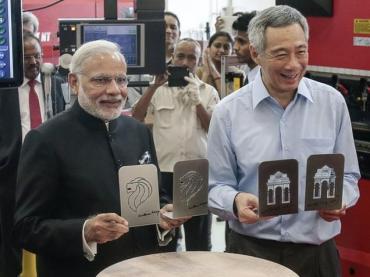
Prime Minister Narendra Modi and Singapore Prime Minister Lee Hsien Loong at the Institute of Technical Education College in Singapore on Tuesday.

Speaking at the India Singapore Economic Convention, Mr. Modi said India is exploring a potential partnership with Singapore’s Changi Airport for developments of two Indian airports and invited companies to join in building smart cities.

“In the last 18 months, the runways for the take-off of the economy have been made. Reforms are happening in a big way. They are now reaching to the last mile. Reform is to transform the system so that they perform. They aim at helping people realise their dreams. It means more charm on the faces and less forms in the offices. Efforts to deepen financial markets have been made,” he said.

‘Most open economy

The Prime Minister said his government began to liberalise FDI laws soon after coming to power last year and the latest round of FDI reforms have made India the “most open economy” in the world.

“We are also conscious of last mile operational issues in such matters and we are fine tuning the norms. Recently, we further eased FDI norms, after which India is the most open economy in terms of FDI,” he added.

While talking about 40 per cent increase in FDI and improvement in rankings like ease of doing business and world competitiveness index, Mr. Modi said, “Perceptions are turning into positive outcomes”.

“We are hopeful to roll out GST regime in 2016. The company law tribunal is being set up. FDI inflows have gone up by 40 per cent compared with previous year’s comparative period. Perceptions are turning into positive outcomes. FDI commitments are translating into reality,” he noted.

Modi also outlined 14 decisive steps taken to address regulatory and taxation concerns and said that India offers tremendous opportunities for investments, ranging from affordable housing to smart cities, railways to renewable energy.

Source: Modi woos investors in Singapore – The Hindu

09/09/2015

Modi Tells Nervous Business Leaders the Global Shakeup Is India’s Time to Shine – India Real Time – WSJ

Prime Minister Narendra Modi called Indian business leaders to his official residence Tuesday to discuss how to bulwark the country as China’s slowdown continues to send shock waves through the global economy.

In the three-hour summit, executives and economists ran through a long-standing wish list that includes investing more in infrastructure, expediting government clearances and lowering capital costs. Some executives suggested an interest-rate cut was overdue from the central bank, and that domestic companies should be given more protection from inexpensive imports.

“We have to be cautious, while we take some bold steps on the economy to increase growth,” Rana Kapoor, chief executive of Yes Bank Ltd., told reporters after leaving the meeting. “At the same time, you have to make sure that India has a soft landing after the severe impact of the yuan devaluation.” There has been a jump in foreign direct investment in India this year. But the executives told Mr. Modi that local companies need to see long-delayed improvements in economic management before they can ramp up capital spending. “Domestic investment is at a standstill, and that’s largely because there is no demand,” said Jyotsna Suri, president of the Federation of Indian Chambers of Commerce and Industry.

Mr. Modi reiterated that the world-wide turbulence is an opportunity to highlight India’s resilient growth, vast domestic market and government policies geared toward promoting investment, Finance Minister Arun Jaitley said.

Source: Modi Tells Nervous Business Leaders the Global Shakeup Is India’s Time to Shine – India Real Time – WSJ

01/04/2015

India aims to raise exports to $900 billion by 2019/2020 | Reuters

India aims to raise its exports to $900 billion by fiscal year 2019/20, the government said in a statement on Wednesday.

A man walks past steel rims and parked cars at a dock yard at Mumbai Port Trust in Mumbai November 17, 2014.  REUTERS/Shailesh Andrade/Files

India’s total exports were $465.9 billion in the 2013/14 fiscal year that ended on March 31, 2014, the statement said.

In the first 11 months of the 2014/15 fiscal year that ended on Tuesday, merchandise exports stood at $286.58 billion, government data showed.

Merchandise exports account for about one-fifth of the $2 trillion Indian economy.

via India aims to raise exports to $900 billion by 2019/2020 | Reuters.

24/02/2015

Retail dilemma in India – nice malls are few and far between | Reuters

A severe shortage of attractive malls has made setting up shop in India easier said than done, crimping expansion plans for both foreign retailers such as Lacoste and domestic giants like department store chain Shoppers Stop (SHOP.NS).

A private security guard stands guard inside the premises of the MGF mall in New Delhi February 23, 2015.  REUTERS/Adnan Abidi

India’s searing heat, heavy traffic and cluttered pavements make malls the most popular option for urban middle class consumers looking for a day out. But many centres – despite having been built in the last decade – are struggling to draw shoppers or retailers because of poor design or because they are difficult to manage.

P.S. Puri, CEO of MGF Mall Management, which runs MGF Metropolitan, knows this all too well. Located in a posh district in the south of New Delhi, security guards and sales staff outnumbered shoppers last Tuesday evening in what was once a bustling mall.

It has restaurants but lacks popular attractions like a food court and a cinema. The sale of shop ownership piecemeal has made management difficult and now only one quarter of the space is occupied by fashion retailers – about the same amount that is vacant.

via Retail dilemma in India – nice malls are few and far between | Reuters.

31/01/2015

India’s economic growth revised up by almost 50 percent | Reuters

India’s economy grew almost 50 percent faster in 2013/14 than earlier thought, the government said on Friday after changing a formula, a reminder of the challenges that unreliable statistics present to Indian policymakers.

Kashmiri farmers thrash paddy crop in Srinagar October 22, 2013. REUTERS/Danish Ismail/Files

In the year leading up to the elections that brought Prime Minister Narendra Modi to power last May, the economy grew 6.9 percent, not the 4.7 percent reported earlier, chief statistician T.C.A. Anant told reporters.

Modi’s campaign succeeded partly because of the widespread feeling that his predecessors from the Congress party had plunged the economy into the country’s longest deceleration in growth in a generation.

The revised formula, showing a faster recovery, includes under-represented and informal sectors as well as items such as smartphones and LED television sets in gross domestic product.

That could boost India’s growth figure in the year ending in March 2015, which the Reserve Bank of India (RBI) has projected to be around 5.5 percent.

Some in government predict the change will

via Economic growth revised up by almost 50 percent | Reuters.

08/07/2014

India to be 3rd largest economy next to China by 2030: PwC – daily.bhaskar.com

India is set to become the third largest economy in the world by 2030, according to latest estimates by a PricewaterhouseCoopers (PwC) report.


The London-headquartered accountancy giant said the rapid rise of the Indian economy with its young workforce would push it up from being the 10th largest economy in 2013 to the third largest by 2030, pushing the UK back into sixth place.


“In the longer run, other emerging markets may overtake the UK, but only India looks set to do so before 2030 according to our latest projections,” PwC said in its latest economic outlook.


China, the world’s second largest economy, is expected to close the gap with America by 2030, while Mexico is predicted to be the 10th largest economy by 2030, above Canada and Italy, both G7 nations.


Only a couple of years ago there were forecasts that Britain would rapidly become a second-class economic power and would need to defer to the BRIC countries of Brazil, Russia, India and China in the near future.


China has ranked above Japan for a decade as the world’s second-biggest economy.

By some calculations Brazil leapfrogged the UK in 2012, with Russia and India close behind.

Britain’s fall was partly related to the costs of the banking crisis and the recession that followed, coupled with a sharp decline in the exchange rate, which knocked about a quarter off the country’s value in relation to its main rivals.


But since the beginning of last year the economy has recovered all the lost ground from the recession and banks have begun lending again.


The pound has bounced back from about US$ 1.40 in 2009 to US$ 1.71 today.


Brazil, by contrast, has suffered a rocky couple of years that have slowed GDP growth and pushed down the value of the real.


Russia will close the gap on the top eight, but its reliance on the oil and gas industry for growth and its rapidly ageing population will prevent it jumping up the table as quickly as previously thought.


Only India will move ahead of the UK by 2030, though it will be sharing a projected GDP of US$ 6.1 trillion among more than 1.5 billion people, only half as much again as the UK’s predicted output of US$ 4 trillionn, produced by a population less than a 20th the size.

via India to be 3rd largest economy next to China by 2030: PwC – daily.bhaskar.com.

03/07/2014

Keys to Successful Reform in India – India Real Time – WSJ

India’s new Prime Minister, Narendra Modi, won a decisive mandate from an electorate yearning for effective leadership. His government’s first budget due out next week will be an important indicator of how forcefully Mr. Modi intends to translate this mandate into actions to put India’s economy back on track.

Of course, despite his clear mandate, Mr. Modi will not have a free hand to impose reforms by decree. He is constrained by a democratic system of government and accountability to the electorate. Hence, both the strategy and the specifics of reform will be crucial to making the program a success.

A key priority is to signal greater fiscal discipline. High levels of public deficits and debt, exacerbated by wasteful subsidies and an inefficient tax system, have created many market distortions and contributed to high inflation. Populist sops have also reduced resources available for expenditure on infrastructure, education and other areas that could boost long-term productivity.


The government needs to commit to long-term fiscal discipline. It should move aggressively to reduce fuel subsidies, implement a goods and services tax, and step up the pace of privatization of state enterprises. These measures would not only improve the fiscal position of the government but also enhance overall economic efficiency by shifting the focus away from purely redistributive policies.

It will also be helpful to signal that the government will not look for easy targets, such as foreign firms, to raise revenues by changing the rules whenever convenient. Policy certainty is as important for domestic investors as it is for foreign ones.

via Keys to Successful Reform in India – India Real Time – WSJ.

Law of Unintended Consequences

continuously updated blog about China & India

ChiaHou's Book Reviews

continuously updated blog about China & India

What's wrong with the world; and its economy

continuously updated blog about China & India