Posts tagged ‘Ethiopia’

25/08/2016

China’s logistic hub in Djibouti to stabilize region, protect interests – Global Times

About 7,700 kilometers away from Beijing, in Djibouti in the Horn of Africa, China’s first overseas installation for naval vessels is under construction.

Scheduled to be completed in 2017, the base is set to resupply Chinese warships, according to government statements.

But despite Beijing’s insistence that the facility will simply help with escort missions, peacekeeping and humanitarian rescues in the Gulf of Aden and the waters off Somalia, many have argued this move represents Chinese “military expansion” beyond the Asia-Pacific region.

“Through exaggerating or distorting, they attempt to hype the ‘threat of China’ and tarnish China’s image, so as to suppress China’s efforts to build maritime power,” Li Jie, a Beijing-based maritime expert, told the Global Times.

“The base is far less than a military base in its scale and function,” said Zhang Junshe, a researcher from PLA Naval Military Studies Research Institute. “The base will be a logistic hub for Chinese vessels to get replenishment and temporary rest. It differs from US-style military bases, which have become bridgeheads for the country to easily and quickly wield military deterrence or intervention to other territories,” Li noted. The Republic of Djibouti, located in a strategically important position between the Indian Ocean and the Red Sea, hosts the military facilities of several countries, including the US, Japan and France, the country’s former colonial ruler. Italy and Spain also have permanent military installations in the country, according to a recent report by Hong Kong-based Phoenix TV.

These countries have stationed a variety of assets in these bases, including personnel, ships, UAVs and surveillance aircraft which are used for anti-terror and anti-piracy operations in Africa and the Middle East.
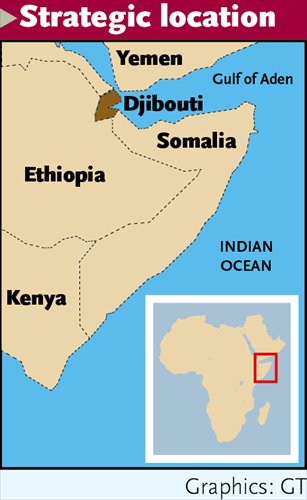
International obligations

The news that China will build a “military base” in Djibouti was first revealed in May last year, when Djiboutian President Ismail Omar Guelleh told AFP that “discussions are ongoing,” and China’s presence would be “welcome.

“Since then, it has aroused wide attention and concern. The US even reportedly protested against it. “Washington protested against the China-Djibouti pact and expressed concern over China’s plans to build a military base in the Obock region, but to no avail,” according to an article published in April on foreignaffairs.com, a US-based international affairs news portal.

At a regular press briefing on November 26, 2015, China’s foreign ministry first confirmed that China was negotiating with Djibouti over the construction of a “logistics facility.” Spokesman Hong Lei citied the need to resolve resupply difficulties for Chinese escort vessels, adding “[The facility] will be significant for Chinese army to fulfill its international obligations and safeguard global and regional peace and stability.”

Three months later at a press briefing by Chinese defense ministry on February 25, spokesman Wu Qian told media that China had reached an agreement with Djibouti to build a facility and construction had already begun. According to official figures, China has deployed more than 30,000 personnel on peacekeeping missions, the most of any of the five permanent members of the UN Security Council.Since 2008, China has sent 22 escort fleets, a total of more than 60 vessels, to the Gulf of Aden and Somali waters, escorting more than 6,000 ships from home and abroad.

In March last year, hundreds of Chinese nationals threatened by escalating violence in Yemen were evacuated to Djibouti by their government.

But currently, these fleets need to dock in the ports of other countries to get rest and food supplies. “They need to organize people to purchase food locally. Besides, due to different types of fuels, refueling is also a problem,” Zhang said.

The new base will help China save money. Yang Huawen, a captain from China’s Northern Theater Command who joined a 10-month peacekeeping operation in Mali in 2014, is happy this facility is being built.

“In those tropical areas, the food goes bad quickly. The cost of mending equipment and maintenance is high,” Yang told the Global Times. “Building a logistic hub in the region can provide stable supplies efficiently and economically.”

Djibouti, with a landmass of 23,200 square kilometers of which 90 percent is volcanic desert, is poor in natural resources. Its ability to produce fruits, vegetables, and seafood is limited, according to a Chinese national who has spent time in the country. “Most of its vegetables are imported from its neighbor Ethiopia. Vegetables sell for there as much as five to 10 times what they do on the domestic market in China,” said the person.

Zhang also cited another advantage of the new facility – the Chinese government needn’t conduct diplomatic negotiations with the host country each time its vessels dock in their port.


Source: China’s logistic hub in Djibouti to stabilize region, protect interests – Global Times

02/12/2014

India’s Farming Women Use Cameras to Share Lessons – Businessweek

Kavita Devi has spent 50 years farming the way her elders taught her. Until recently, that meant working other people’s land in the northeastern Indian village of Gosaibigha in exchange for 10 pounds of rice once a season. But since July, twice a month she’s been joining about 30 women neighbors in saris who file into a makeshift movie theater in a buffalo shed, where they watch videos from a battery-powered, handheld projector shown on a fuzzy brown blanket hung on a wall. In the videos, which run for 8 to 10 minutes, women from nearby villages demonstrate ways to boost rice yield by spacing the seedlings farther apart and using compost instead of fertilizer. “They look very successful,” Devi says later. “I would like to be one of them.” Since July she’s been leasing a small patch to plant her own crops.

A videographer watches as farmers demonstrate techniques in Uttar Pradesh

Technology is transforming the way women like Devi farm. In rural India, impoverished women do most of the labor using methods passed down for millennia. About 100,000 (mostly male) government and private agricultural experts roam the country to teach farmers modern techniques. But fewer than 6 percent of farmers have ever seen one, according to the World Bank, and women are often excluded from those training sessions because they lack legal rights to their husbands’ land.

Digital Green, a nonprofit founded by Microsoft (MSFT) researchers, is trying to change that. The group distributes pocket cameras and tripods to local women and trains them to storyboard, act in, shoot, edit, and screen videos demonstrating farming innovations. Because the villages where the women work often lack reliable electricity, it’s all done via battery-powered projectors. Women who screen the videos keep track of attendee questions and monitor adoption of the practices to help directors improve later versions. Using the audience’s peers as actors is particularly important, says Rikin Gandhi, Digital Green’s co-founder and chief executive officer. “Viewers identify with those featured in videos based on dialect and appearance, etc., to determine whether it is someone they can trust,” he says. Villagers will tune out if they see items that aren’t common in their communities, such as a plastic bucket or a watch.

via India’s Farming Women Use Cameras to Share Lessons – Businessweek.

25/07/2014

Ethiopia Vies for China’s Vanishing Factory Jobs – Businessweek

Ethiopian workers walking through the parking lot of Huajian Shoes’ factory outside Addis Ababa in June chose the wrong day to leave their shirts untucked. The company’s president, just arrived from China, spotted them through the window, sprang up, and ran outside. Zhang Huarong, a former People’s Liberation Army soldier, harangued them in Chinese, tugging at one man’s polo shirt and forcing another worker’s into his pants. Amazed, the workers stood silent until the eruption subsided.

Turning Ethiopia Into China's China

Zhang’s factory is part of the next wave of China’s investment in Africa. It started with infrastructure, especially the kind that helped the Chinese extract African oil, copper, and other raw materials to fuel China’s industrial complex. Now China is getting too expensive to do the low-tech work it’s known for. African nations such as Ethiopia, Kenya, Lesotho, Rwanda, Senegal, and Tanzania want their share of the 80 million manufacturing jobs that China is expected to export, according to Justin Lin Yifu, a former World Bank chief economist who teaches economics at Peking University. Weaker consumer spending in the U.S. and Europe has prompted global retailers to speed up their search for lower-cost producers.

Shaping up employees is one part of Zhang’s quest to squeeze more profit out of Huajian’s factory, where wages of about $40 a month are less than 10 percent of what comparable Chinese workers may make. Just as companies discovered with China when they began manufacturing there in the 1980s, Ethiopia’s workforce is untrained, its power supply is intermittent, and its roads are so bad that trips can take six times as long as they should. “Ethiopia is exactly like China 30 years ago,” says Zhang, 55, who quit the military in 1982 to make shoes from his home in Jiangxi province with three sewing machines. He now supplies such well-known brands as Nine West and Guess (GES).

Almost three years after Zhang began his Ethiopian adventure at the invitation of the late Prime Minister Meles Zenawi, he says he’s unhappy with profits at the plant, frustrated by “widespread inefficiency” in the local bureaucracy, and struggling to raise productivity from a level that he says is about a third of China’s. Transportation and logistics that cost as much as four times what they do in China are prompting Huajian to set up its own trucking company, according to Zhang. That will free Huajian from using the inefficient local haulers, but it can’t fix the roads. It takes two hours to drive 30 kilometers (18 miles) to the Huajian factory from the capital along the main artery. Oil tankers and trucks stream along the bumpy, potholed, and at times unpaved road. Goats, donkeys, and cows wander along, occasionally straying into bumper-to-bumper traffic. Minibuses and dented taxis, mostly blue Ladas from Ethiopia’s past as a Soviet ally, weave through oncoming traffic, coughing exhaust.

via Ethiopia Vies for China’s Vanishing Factory Jobs – Businessweek.

07/05/2014

China’s Premier Li Goes to Africa – Businessweek

Chinese Premier Li Keqiang is visiting Ethiopia, Nigeria, Angola, and Kenya this week in his first trip to Africa since assuming office. Accompanying him is his wife, Cheng Hong, who is making her first public appearance on a diplomatic mission—and a splash in China’s domestic media, given the relative novelty of top leaders’ wives appearing in public in official roles.

Li speaking on May 5 in Ethiopia

Over the past decade, China’s economic ties to Africa have grown quickly. Trade has risen (PDF) from $10 billion in 2000 to $166.3 billion in 2011. Meanwhile China’s foreign direct investment in Africa has jumped from $392 million in 2005 to $2.5 billion in 2012, according to figures from China’s commerce ministry. Much of that money has gone to infrastructure projects, including roads, dams, mines, and oil rigs.

On Monday in Addis Ababa, Ethiopia’s capital, Li laid out his vision for the future of China-Africa relations. Speaking at the headquarters of the African Union, he said he imagined a day when all African capitals would be connected by high-speed rail—quickly adding that China’s experience and technology could “help make this dream come true,” according to state-run newswire Xinhua.

via China’s Premier Li Goes to Africa – Businessweek.

Enhanced by Zemanta
Law of Unintended Consequences

continuously updated blog about China & India

ChiaHou's Book Reviews

continuously updated blog about China & India

What's wrong with the world; and its economy

continuously updated blog about China & India