Posts tagged ‘European Commission’

03/10/2016

How Google’s Bicycle-Riding Internet Tutors Are Getting Rural Indian Women Online – India Real Time – WSJ

The internet fails to reach millions of women in the small towns and villages of India, so Google is trying to deliver it to them — by bicycle.

The Alphabet Inc. unit has built an army of thousands of female trainers and sent them to the far corners of the Subcontinent on two-wheelers, hoping to give rural woman their first taste of the web. Each bike has a box full of connected smartphones and tablets for women to try and train on.

The idea is to give people who have never even sent an email a better understanding of how being connected could improve their lives. Families that can afford to be online often chose not to be because they do not see the value. Meanwhile women are sometimes blocked by their families from new technology.

ENLARGEA web trainer who is taking part in Internet Saathi, the joint program of Alphabet, Inc.‘s Google and local philanthropy Tata Trusts, in the village of Habibwala, in Rajastan, India, Sept. 28, 2016. PHOTO: GOOGLE

Bhagwati Kumari Mahawar got her very first taste of the internet just a month ago.

The 19-year-old used a smartphone Google brought to her remote village in the desert state of Rajasthan to search for designs of mehndi, the elaborate henna designs Indian women get on their hands and feet. Then she looked up information on how to sew a blouse.

ENLARGEBhagwati Kumari Mahawar in the village of Habibwala, in Rajastan, India, Sept. 28, 2016. PHOTO: GOOGLE

“I really wanted to learn,” she said, sitting in the shade near the Google bicycle and a water buffalo.In the project, called Internet Saathi, Google partnered with local philanthropy Tata Trusts to show women in rural India how to connect to the web.

Instructors are trained in how the web works, and then are given bicycles with large boxes on the back containing internet-enabled devices running Google’s Android mobile operating system. The newly equipped “saathis” — or “partners” in Hindi — then cycle from village to village providing instruction to their peers.

“I wasn’t sure if I could do it or not,” said the instructor who helped Ms. Mahwar get online, 30-year-old Kamla Devi Mahawar, who is unrelated to her pupil.

She never used the web until she began her Saathi training ten months earlier, but since then has enjoyed showing women how to search for information like recipes and stitching guides, and showing them how to use voice queries if they are unable to type in text.

ENLARGEWomen look at cell phones as part of Internet Saathi, the joint program of Alphabet, Inc.’s Google and local philanthropy Tata Trusts, in the village of Habibwala, in Rajastan, India, Sept. 28, 2016. PHOTO: NEWLEY PURNELL/THE WALL STREET JOURNAL

In a demonstration, she sat on the ground while half a dozen women circled around her, watching as she searched for images of nearby temples and forts. Some women want to learn how to use Facebook Inc.’s WhatsApp messaging service, while others simply want to make phone calls, she said.

Since the program’s launch last year, about 9,000 guides have helped reached 1 million women, Google said, noting that the program fits its mission of helping expand internet access globally.

India is an increasingly important commercial market for the Mountain View, Calif. search titan given its nascent internet economy.

While the country is home to more than 1.2 billion people, consultancy McKinsey & Co. reckons some one billion people still lack regular web access. More online consumers in the years ahead could mean more users of Google’s services, like its search engine, email and Android.
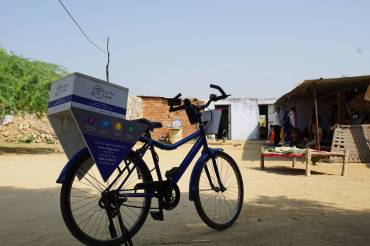
A bike used by an instructor who teaches women how to use the web, part of Internet Saathi, the joint program of Alphabet, Inc.’s Google and local philanthropy Tata Trusts, in the village of Habibwala, in Rajastan, India, Sept. 28, 2016. PHOTO: GOOGLE

Last week, at an event in New Delhi, Google executives said they are expanding their efforts to reach Indians with products and features like a new version of its YouTube app designed to work even on India’s often sluggish mobile networks.

Asked how her work with others could be made easier, Ms. Mahwar, the trainer, was quick to point out that better web connectivity is key.

“The internet doesn’t work half the time,” she said. Fixing that “would help a lot.”

Source: How Google’s Bicycle-Riding Internet Tutors Are Getting Rural Indian Women Online – India Real Time – WSJ

02/12/2013

BBC News – David Cameron promises China ‘growth partnership’

David Cameron has promised to create a \”partnership for growth and reform\” as he visits China on a trade mission with more than 100 UK business leaders.

The prime minister also pledged to put his \”full political weight\” behind a proposed agreement to free up trading between China and the European Union.

He is due to hold talks with premier Li Keqiang on a separate China-UK deal said to be worth £1.8bn a year.

Some EU states fear a flood of cheap imports if a wider pact is approved.

However, the European Commission is due to begin investment treaty negotiations in the New Year.

Meanwhile, Labour leader Ed Miliband is to warn the government not to compete with China in a \”race to the bottom\” on pay, but to focus on creating a \”high-skill, high-tech, high-wage\” economy.

Mr Cameron\’s promise now to \’respect\’ and \’understand\’ China is the price he has had to pay to thaw what was a diplomatic deep freeze ”

Writing in Chinese magazine Caixin, Mr Cameron declared his ambition to use this week\’s visit to help forge \”a partnership for growth and reform that can help to deliver the Chinese dream and long-term prosperity for Britain too\”.

He welcomed signals from last month\’s third plenum of the ruling Communist Party that China wanted to open up more under the leadership of President Xi Jinping, who took up office a year ago.

Mr Cameron said he wanted to show that \”an open Britain is the ideal partner for an opening China\”.

He added: \”Britain is uniquely placed to make the case for deepening the European Union\’s trade and investment relationship with China.

My visit to China can plant the seeds of a long-term relationship which will benefit China, Britain and the world for generations to come”

\”Building on the recent launch of EU-China negotiations on investment, and on China\’s continued commitment to economic reform, I now want to set a new long-term goal of an ambitious and comprehensive EU-China free trade agreement.

\”And as I have on the EU-US deal, so I will put my full political weight behind such a deal which could be worth tens of billions of dollars every year.\”

Mr Cameron believes that eliminating tariffs in the 20 sectors where they are highest, such as vehicles, pharmaceuticals and electrical goods, could save UK exporters £600m a year.

During the first day of his second trip to China as prime minister, he is scheduled to attend the official opening of a new academy in Beijing for training technicians, salesmen and service staff for Jaguar Land Rover, which is signing a £4.5bn agreement to provide 100,000 cars to the National Sales Company over the next year.

via BBC News – David Cameron promises China ‘growth partnership’.

See also:https://www.asian-studies.org/eaa/watt.htm – Are there any parallels?

Qianlong meets MacCartney:

Collision of two world views

By JohnR Watts

The Macartney mission of 1792–94 is a defining episode in the modern encounter between China and the West. It is the first major event in which British diplomats well read in the ideas of the European Enlightenment came face to face with the leadership of the world’s greatest and most populous land power. 

On the British side, the Macartney mission came armed with a series of goals appropriate to an industrializing nation that was rapidly developing a world-wide trading system. As Adam Smith had pointed out, the British were a nation of shopkeepers and traders, and trade was becoming the key to their access to power and prosperity. In the 1790s the British government of Pitt and Dundas was busy reconstructing the British mandate in India to reduce the political power of the East India Company and create a less mercantile and more open trading system. Because trade with China had become a significant factor in the development of British power in India, they wanted to cut through the restrictions of the Canton trading system imposed by the Qianlong government on European merchants in 1760 and negotiate a freer trade environment with China as a whole. They also wanted to establish a direct liaison—along European diplomatic lines—with the Qing Court. Because of his erudition, diplomatic experience, and familiarity with British policy in India, Macartney was in principle an ideal person to represent the British government on such a mission.

But beyond these goals, Macartney and his associates came to China with perceptions about trade and national intercourse which were certain to cause friction with their Chinese hosts. As heirs of Galileo, Newton, and Locke, and contemporaries of the French Enlightenment philosophers, they regarded themselves as representatives of a modern, rational and specifically scientific world outlook. Within their lifetimes British technicians had developed chronometers needed to determine longitude, which would greatly increase the power and profitability of British navigation. They lived in a world in which Adam Smith had worked out the advantages of trade, James Watt had harnessed the power of steam, and Captain Cook had explored vast reaches of the Pacific Ocean. Buoyed by such developments, the Macartney mission came to China not just to promote trade and diplomacy, but to assess China’s status as a rational order and to collect data on matters of interest to scientific as well as political colleagues. These latter goals were to some extent achieved, although not in a manner favorable to China’s reputation in Europe.

…”

28/06/2013

EU opens new front in China trade battle with stone case

Is it a case of shooting oneself in the foot?

Reuters: “The European Union has opened a new front in its trade battle with China by launching an investigation into alleged dumping by Chinese producers of stone used for counter tops and tiles.

The European Commission said on Friday it was starting the study after a complaint lodged last month by A.St.A., the European association of manufacturers of agglomerated stones.

The association accuses Chinese manufacturers of dumping – selling products below fair value or even cost price.

The EU market is worth an annual 480 million euros ($624 million), according to a source familiar with the case, with Chinese importsrepresenting some 9 percent of that, making it a small to medium case for Commission investigators.

In the past two months, the Commission has imposed duties to counter dumping of Chinese solar panels and told Beijing it is prepared to launch an investigation into anti-competitive behavior by producers of mobile telecoms equipment.

via EU opens new front in China trade battle with stone case | Reuters.

16/05/2013

* China in innovation challenge to Europe

FT: “Europe’s business leaders fear its industry will fall behind China in technological innovation within a decade as the economic crisis undermines one of the continent’s competitive advantages.

More than two-thirds of business leaders surveyed by Accenture, the consultancy, on behalf of BusinessEurope, the business lobby group, said China would reach or pull ahead of Europe in innovation by 2023.

Weak demand caused by Europe’s economic crisis has sent industrial production into decline, while corporate reluctance to delve into cash reserves is holding back new investment, training and R&D.

Rising unemployment threatens labour flexibility and Europe’s ability to maintain a highly skilled workforce. Fewer than half of those surveyed said Europe’s workforce remained a competitive advantage for industry.

European policy makers are determined to reverse industry’s decline. The European Commission last year proposed by 2020 to raise industry’s share of EU gross domestic product from 15.6 per cent to 20 per cent.

“We cannot continue to let our industry relocate outside Europe,” said Antonio Tajani, vice-president of the European Commission.

European companies remain leaders in sectors ranging from automotive to aerospace, engineering to pharmaceuticals, and two-thirds of surveyed business leaders said European industry was still competitive internationally.

But some Chinese companies such as Huawei, the telecoms equipment maker, are drawing level in innovation capability and gaining share in Europe. Some 61 per cent of those surveyed said they feared Europe would struggle to recover from its economic crisis for at least three years.

Some 90 per cent of German business leaders said Europe’s industry was competitive compared with only half of business leaders in Spain.

The Accenture study identified two areas to support growth: rebuilding Europe’s skills base and reinvigorating industry’s access to finance, including better access to capital markets and venture capital funding for start-ups.

Although Europe is mired in recession, there remain opportunities in areas ranging from low-carbon technology and smart grid networks to biotechnology and advanced manufacturing.

“The China machine is definitely going to invest a lot of money in technology innovation over the next 10 years . . . [But] there’s a sense that if we get our act together Europe can remain successful in manufacturing,” said Mark Spelman, strategy chief at Accenture.

“Just because there is zero growth across Europe doesn’t mean there are not segments of good growth within that . . . So it’s about how you place bets in an intelligent way.

To address the innovation deficit, business leaders want to see more public funding for R&D, reduced tax for R&D and capital investment and improved financing conditions.

European executives raised a variety of other worries ranging from the cost of energy to labour costs.

A majority of respondents were pessimistic that European industry would be cost-competitive in energy compared with markets such as the US, Russia and China in three years’ time.

US industry is enjoying cheap energy courtesy of discoveries of shale gas that permit new investment in gas-intensive industry, such as petrochemicals.

In contrast, Europe remains dependent on more expensive Russian gas, and costly regulation and investments in renewable energy are adding to the burden.”

via China in innovation challenge to Europe – FT.com.

See also: https://chindia-alert.org/prognosis/how-well-will-china-and-india-innovate/

29/10/2012

* Under Chinese, a Greek Port Thrives

If only this phenomenon can be replicated across Greece and other Euro PIGS (Portugal, Italy, Greece, Spain) countries …

New York Times: “The captain gazed from his elegant office overlooking this port on the Aegean Sea and smiled as towering cranes plucked container after container from a giant ship while robotic transport vehicles fanned out to transfer the cargo to smaller vessels bound for the Mediterranean.

The cargo volume here is three times the level it was two years ago, before the captain, Fu Cheng Qiu, was put in charge by his employer, Cosco, a global shipping giant owned by the Chinese government.

In a 2010 deal that put 500 million euros ($647 million) into the coffers of Greece’s cash-starved government, Cosco leased half of the port of Piraeus and quickly converted a business that had languished as a Greek state-run enterprise into a hotbed of productivity.

The other half of the port is still run by Greece. And the fact that its business lags behind Cosco’s is emblematic of the entrenched labor rules and relatively high wages — for those lucky enough to still have jobs — that have stifled the country’s economic growth.

“Everyone here knows that you must be hard-working,” said Captain Fu, under whose watch the Chinese-run side of the port has lured new clients, high-volume traffic and bigger ships.

In many ways, the top-to-bottom overhaul that Cosco is imposing on Piraeus is what Greece as a whole must aspire to if it is ever to restore competitiveness to its recession-sapped economy, make a dent in its 24 percent unemployment rate and avoid being dependent on its European neighbors for years to come.

As the Greek government contemplates shedding state-owned assets to help pay down staggering debts, it might be tempting to consider leasing or even selling the rest of the port to China. But if the Cosco example is representative, the trade-offs — mainly a sharp reduction in labor costs and job protection rules — might be ones many Greeks would be loath to accept.

“Unionized labor will push back to keep the protection it has enjoyed,” said Vassilis Antoniades, the chief executive of Boston Consulting Group in Greece. But the Cosco investment, he said, “shows that under private management, Greek companies can be globally competitive.”

Captain Fu, for his part, says Greece has much to learn from companies like his.

“The Chinese want to make money with work,” he said. In his view, too many Europeans have pursued a comfortable, protected existence since the end of World War II. “They wanted a good life, more holidays and less work,” he said. “And they spent money before they had it. Now they have many debts.”

Greece’s troika of foreign lenders — the International Monetary Fund, the European Central Bank and the European Commission — has made similar arguments. Among other things, they are urging Prime Minister Antonis Samaras to end blanket protections for workers and unions and to require Greece itself to operate more like a productive modern business.

Besides the $647 million that put half of the port of Piraeus into Chinese hands, the Greek government is receiving more income from taxes as a result of the port’s pickup in business.

Other than a handful of Chinese managers, moreover, Cosco’s operation is providing around 1,000 jobs to Greek workers — compared with the 800 or so who work the dock that is still under Greek management.

On Cosco’s portion of the port, cargo traffic has more than doubled over the last year, to 1.05 million containers. And while profit margins are still razor thin — $6.47 million last year on sales of $94.2 million — that is mainly because the Chinese company is putting a lot of its money back into the port.

Cosco is spending more than $388 million to modernize its dock to handle up to 3.7 million containers in the next year, which would make it one of the world’s 10 largest ports. Beyond that, workers are also laying the foundations for a second Cosco pier.

The Greek-run side of the port, which endured a series of debilitating worker strikes in the three years before Cosco came to town, has been forced by the Chinese competition to seek its own path to modernization. Still, only about a third of its business consists of cargo handling; the rest is made up of more lucrative passenger traffic.

For years, the container terminal was a profitable operation. But Harilaos N. Psaraftis, a professor of maritime transport at the School of Naval Architecture and Marine Engineering in Athens, said it was inefficient “because worker relations were very cumbersome.”

The salaries of some workers reached $181,000 a year with overtime; Cosco is typically paying less than $23,300. On the Greek side of the port, union rules required that nine people work a gantry crane; Cosco uses a crew of four.

“It was just crazy,” recalled Mr. Psaraftis, who was the chief executive of the port from 1996 to 2002. “I told them, ‘If you keep this up, this thing will be privatized.’ But they didn’t listen.”

Since Cosco arrived, “competition has forced us to take initiatives to find better ways of working,” said Stavros Hatzakos, the general director of Piraeus Port Authority, which runs the Greek operation. “Employees think twice about strikes and labor action now,” he said. And the ones still on the job have taken salary reductions as part of the across-the-board wage cuts of 20 percent or more that the government has placed on public employees.

On the other side of the chain-link fence that separates the Chinese and Greek operations, Captain Fu said he would love for Cosco to run all of Piraeus if the government put it up for sale. That expansion would cement Chinese dominance of one of the most strategic shipping gateways to Southern Europe and the Balkans.

Such a move, though, might meet stiff opposition from Greek unions and officials at the Piraeus Port Authority, who criticize Cosco’s approach to labor.”

17/09/2012

* China, EU face dumping claim

China Daily: “Beijing said Brussels has agreed to begin dialogue and cooperation to resolve the multi-billion-dollar anti-dumping investigation towards China’s solar panel manufacturers.

But Brussels refused to go into details of such a stance, revealed by Chong Quan, China’s deputy representative for international trade talks, after three-hour intensive talks with senior officials of European Commission on Friday afternoon.

“They (Brussels) agreed (to hold dialogues) – and I found they are very candid and pragmatic,” Chong told China Daily. “I respect my negotiation partner.”

But when asked how strong Brussels’ intention is, Chong said: “I don’t know.”

Brussels was part of Chong’s three-stop mission to send a clear message from Beijing, which wants to solve this dispute through “consultation, dialogues and cooperation.” Before holding talking with Jean-Luc Demarty, the European Commission’s director general for trade, he was negotiating in Germany and has now moved on to talks in France.

EU trade spokesperson John Clancy refused to elaborate about the three-hour discussion in Brussels. Clancy said the European Commission has begun an “open” anti-dumping investigation on China’s solar panel exports, as it is required to do under the WTO framework and EU law.

He said input “from all stakeholders” is now welcome.

Clancy also confirmed that EU and Chinese trade officials discussed preparations for next week’s EU-China summit in Brussels.

Chong confirmed that China’s Minister of Commerce Chen Deming will be in Premier Wen Jiabao’s delegation that will attend the summit during a one-day visit to Belgium.

Wen and Chen are expected to urge Brussels to negotiate. Chong said both sides are eager to resolve this dispute through dialogue and both sides need to make every effort to avoid a trade war.

In the face of a severe economic slowdown and the magnitude of this dispute, Chong said: “Both of us will become losers if a trade war occurs and the situation is out of control.””

via China, EU face dumping claim |Economy |chinadaily.com.cn.

Law of Unintended Consequences

continuously updated blog about China & India

ChiaHou's Book Reviews

continuously updated blog about China & India

What's wrong with the world; and its economy

continuously updated blog about China & India