Posts tagged ‘Facebook’

10/11/2016

How the Trump Win Played Out in South Asia – India Real Time – WSJ

As Donald Trump was winning his first states in the U.S., South Asia was getting up to follow the results.In Pakistan, Javed Hassan, a former investment banker who previously worked in London and Hong Kong, got up early, at 4 a.m. local time (6 p.m. Tuesday ET), to watch election results come in at his home in the city of Karachi. On Whatsapp, he started trading messages with his son, Ali, a 20-year-old studying economics and politics at New York University.
The younger Mr. Hassan, Ali, watching TV with friends at his dorm at NYU, started his evening telling his worried father that there was no chance of a Trump victory.

“Trump won’t get enough votes in the north and the American people will not go for his racism,” he told his father.

The elder Mr. Hassan, however, was switching between CNN and BBC coverage and was seeing “long queues of white people” waiting to vote, he said, and seeing the state-by-state projections.

By 7 a.m. Pakistan time (9 p.m. Tuesday ET), father and son started to see the trends in states like Michigan.

“What really did it was when Hillary started losing in Wisconsin,” said Mr. Hassan, 51, who now runs a non-governmental organizational that provides vocational training across Pakistan. His son, enveloped in a New York bubble, with all his friends voting for Mrs. Clinton, could not see it coming, said Mr. Hassan.

Meanwhile in India, Sagar Chordia, executive director of Panchshil Realty, a real estate firm which this year built the country’s first Trump Towers in the western city of Pune, had gotten up at 5 a.m. (6.30 p.m. Tuesday ET) to watch the results on television.

Mr. Chordia said he tracked the Twitter and Facebook updates of Donald Trump Jr., who was instrumental in signing the deal with his company.

Mr. Chordia typically leaves for the office around 9 a.m. (10.30 p.m. Tuesday ET), but on Wednesday he stayed at home in Pune, glued to the TV for another hour or so, until Mr. Trump had garnered 220 electoral votes. “Now, I know he’s the winner,” he thought at the time.

Mr. Chordia said that once he got to the office, he found his staff were happy with the result, as many of them met Mr. Trump when he visited Pune in 2014. Then, Mr. Chordia said, he and his team threw a big party for Mr. Trump, with 800 guests.

He said Mr. Trump’s election is good for India, because the president elect has traveled to the country and has praised Indian Prime Minister Narendra Modi. “They really love India and they want to do more and more projects in this country,” he said of the Trumps.

In Mumbai, India, Alok Churiwala, a 48-year-old stock broker, was waiting for the benchmark stock index to open at 9.15 a.m. (10.45 p.m. Tuesday ET). Mr. Churiwala was tracking the election results on television, as well as Twitter and on his Whatsapp account.

He prepared for the market to open down, given that the Dow Jones futures were already trading lower, but he wasn’t ready for the 5% fall.“We were horrified when the markets opened,” he said.

At his morning meeting with dealers, Mr. Churiwala told his staff that clients should be kept from doing anything reckless. They were not to encourage clients to short the market, bet against it, or borrow for day trades.

As stocks swooned, he was swamped by clients calling to ask what was happening.

“Phones were ringing off the hook, because everybody was worried,” he said. “You’d think that this is apocalypse,” said Mr. Churiwala.

He skipped lunch.

He said one client who is based in the U.K. called. “What is it about Trump that is so horrifying for the market?” he said she asked him.

He said that he was neutral to both U.S. presidential candidates and he believed that Mr. Trump may not carry through on some drastic steps he had suggested on the campaign trail. “Politicians are known to make promises before elections when they want to woo voters,” he said.

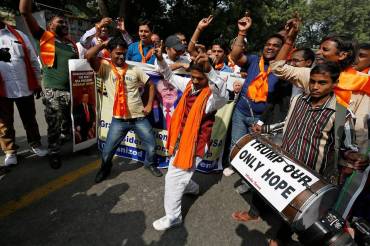
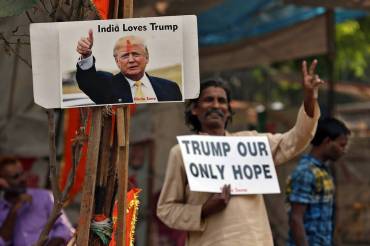
In India’s capital New Delhi, members of a small Hindu nationalist group were ready for the news of Mr. Trump’s win. They began gathering at 11 a.m. (12:30 a.m. Wednesday ET) to celebrate a Trump lead they were certain would result in a victory. The group, known as the Hindu Sena, or Hindu army, had hosted a prayer ritual for such an outcome a few months ago. It even held a birthday celebration for Mr. Trump in June.
A member of Hindu Sena celebrated Mr. Trump’s victory, in New Delhi, India, Nov. 9, 2016. PHOTO: CATHAL MCNAUGHTON/REUTERS

More than four dozen supporters gathered at a prominent square on Wednesday. They distributed Indian sweets to passers-by and beat traditional drums. Modifying a popular slogan from Indian Prime Minister Narendra Modi’s election campaign two years ago, they chanted in Hindi, “this time, a Trump government.”

Vishnu Gupta, who founded the group in 2011, said he’d sent out text messages at 7 p.m. (8:30 a.m. Tuesday ET) the previous day, asking supporters to watch the news closely and gather in the late morning. Mr. Gupta himself hadn’t slept all night, he said, glued to the television as Americans cast their ballots.

To Mr. Gupta, Mr. Trump, represents strong leadership against what he called Islamic terrorism, much like India’s Mr. Modi, he said. “Many people criticized Trump’s proposals to stop radical Muslims from entering the U.S. and mocked us for celebrating the man,” he said. “But today, we’ve come out ahead.”

Back in the U.S., the younger Mr. Hassan didn’t wait up for Trump’s victory speech. “Screw this,” he told his father in Pakistan and went to sleep at around midnight in New York.

The elder Mr. Hassan said that he was worried about his holdings on the local Karachi Stock Exchange, which plunged 2% early on Wednesday, before recovering.

Source: How the Trump Win Played Out in South Asia – India Real Time – WSJ

03/10/2016

How has India changed a year after Dadri beef lynching? – BBC News

It has been a year since a Muslim man in northern India was lynched over rumours that his family had slaughtered a cow and eaten beef.

Hindus consider cows to be sacred, and for many, eating beef is taboo. The slaughter of cows is also banned in many Indian states.But Mohammad Akhlaq’s death sparked widespread outrage and contributed to changing the social and political discourse of the country. The BBC’s Ayeshea Perera looks at some of the most significant things that happened in India following his death.

The ‘intolerance’ furore

Image copyright AFP: The government began to be haunted by allegations of intolerance

Perhaps the largest fallout of Mohammad Akhlaq’s death in Uttar Pradesh state was the accusation of “intolerance” that began to haunt Prime Minister Narendra Modi’s ruling Hindu nationalist BJP.

Critics of the BJP have often accused it of being Hindu majoritarian in its outlook and of being hostile to ethnic and religious minorities, particularly Muslims. And this incident only strengthened those voices.

The fact that Mr Modi did not immediately condemn the incident, choosing to remain silent even as state party leaders jumped to the defence of the accused, caused even more anger.

It prompted an unprecedented movement by writers and poets who had been celebrated by the government – they started returning their prestigious Sahitya Akademi awards to protest at intolerance in India. More than 40 writers from all across the country returned their awards and were soon joined by a group of film makers who said they would not be “guilty of flattening diversity” in the country.

Leading writer Nayantara Sehgal, a niece of India’s first prime minister Jawaharlal Nehru, wrote that “… India’s culture of diversity and debate is now under vicious assault… The prime minister remains silent about this reign of terror. We must assume he dare not alienate evil-doers who support his ideology.

“But “intolerance” was not limited to returning awards – it found its way into popular discourse as well. Bollywood superstar Amir Khan also created a furore when he expressed concern over the “growing intolerance” in India. He was later joined by fellow star Shah Rukh Khan who said he “respected” people returning awards to protest against intolerance.

Later, the arrest of a student leader from India’s prestigious Jawarhalal Nehru University on sedition charges over a rally condemning the hanging of a man convicted of attacking the Indian parliament also sparked cries of “intolerance” on a massive scale.

The BJP loses Bihar

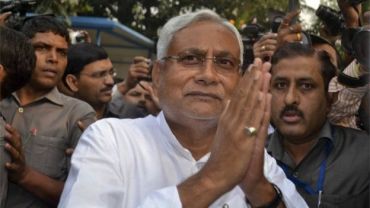
Image copyright AP: Nitish Kumar led an alliance which defeated PM Narendra Modi’s BJP in the Bihar polls

A second outcome that can be linked back to the Dadri killing is that the BJP went on to lose state elections in the neighbouring northern state of Bihar – a poll it was widely expected to win.Incumbent chief minister Nitish Kumar, who was on his second term, had already suffered a crushing defeat to Mr Modi’s party in the 2014 parliamentary elections, and another “Modi wave” was expected to sweep the state elections as well.

But in a masterstroke, Mr Kumar and his allies positioned themselves as a “secular” alliance, in direct opposition to the “communal” BJP.

The fact that Mr Modi and BJP party chief Amit Shah raised the sensitive issue of cow slaughter and consumption of beef during election rallies in the state also did not seem to help.

When Mr Kumar’s party won, it was called a “historic verdict” and hailed as proof that running a poll campaign along religious and ethnic lines would not bring results.

The rise of cow protection vigilante groups

Image copyright MANSI THAPLIYAL: These self styled cow protectors created headlines after they lay in wait for and then badly beat up a number of truck drivers transporting cattle for slaughter

The death of Mr Akhlaq seemed to put new focus on “cow protection” groups who took it upon themselves to ensure that cattle would not be slaughtered or consumed.

Mostly members of militant Hindu groups like the Bajrang Dal, Vishwa Hindu Parishad (World Hindu Council) and Shiv Sena, these self-styled cow protectors created headlines after they lay in wait for and then beat up a number of truck drivers transporting cattle for slaughter.

In another attack, two Muslim woman were beaten up after they were accused of carrying beef. And most significantly, in an incident which led to massive caste unrest, four low-caste Dalit men trying to skin a dead cow were thrashed by vigilantes in the western state of Gujarat.A video of the incident went viral and led to huge protests and an uproar in parliament.

After again being accused of silence, Mr Modi used a radio address almost a full month later to criticise vigilante attacks, saying such people made him “angry”, and any attacks must be investigated.

Eating as an act of defiance

Beef fry is an essential part of the diet in south India’s Kerala stateThe right to eat beef became another huge talking point in

Source: How has India changed a year after Dadri beef lynching? – BBC News

30/09/2016

Glass loos with a view open in China – BBC News

Whatever will the Chinese think of next?

China’s recent obsession with glass tourist attractions has gone round the U-bend with the opening of some see-through treetop public toilets.

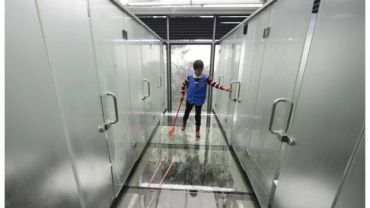
The loos, near Shiyan Lake in southern Hunan province, have fabulous views of both the forest below and other people using the facilities.

Cubicle walls, even those between the men’s and women’s sections, are only separated by lightly frosted glass.

But state media said few visitors dared use the loos on their opening day.

Image copyrightBARCROFT IMAGESImage caption

Shy users of the urinals may take comfort from the privacy barriers between them, though not in the fact they are made of glass

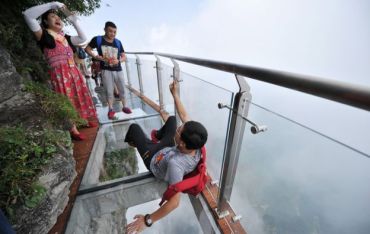
Despite a boom in the construction of glass bridges and walkways in scenic locations in China in recent years – in some cases so popular they had to be closed – these are thought to be the first entirely glass public bathrooms in the country.

However, it not the first time those busting to go have been exposed a little more than they might like by the enthusiasm for glass.

There were reports recently of some male toilets in a university dorm in Hunan which included one very public cubicle.

Image copyrightBARCROFTImage captionUnusually, a head for heights is a requirement for a job as a cleaner there

Image copyrightBARCROFTImage caption Awkward: cubicle walls are only lightly-frosted, even between the men’s and women’s sections

News of the wide-view WCs at Shiyan Lake sparked a range of reactions online.Responding to a Facebook post about it by state television channel CCTV, Ejike Nnadi summed up the feelings of many: “Hell no.”

Others were more taken by the idea. “You’ll be surprised by what you can tolerate when you really, really need to go,” said one post.

Another nodded towards another modern use for restrooms: “I’d be in there ’til my battery hit zero if there was signal in there!”

Image copyrightBARCROFTImage captionThe well-lit lavs are built on a steep hillside

Tina Chen took a dimmer view of all such projects though. “(It) is not about being shy, just again someone had extra money to waste.”

Image copyrightGETTY IMAGESImage caption Unusual glass structures have provided popular photo ops for tourists across China

Awkward or not, it is hoped that these bathrooms for the brave will encourage tourists to visit the countryside around Changsha city and admire the spectacular autumn colours of its forests.

Source: Glass loos with a view open in China – BBC News

13/08/2016

U.S. and UK tech startups welcome in China – with a little supervision – The Stack

U.S. and UK tech startups welcome in China – with a little supervision Martin Anderson. Editor, The Stack, Friday 12th August

On August 1st Travis Kalanick, CEO and co-founder of Uber, finally admitted defeat regarding the company’s three-year crusade to gain a foothold in China, with the ‘merging’ (most consider it a ‘sale’) of Uber’s Chinese operations with local incumbent Didi Chuxing. Whatever Kalanick may have recovered from the concession, it seems unlikely that Uber will recoup the billions it has already poured into its most distant territory. But there was no alternative – by January of this year, the Uber board was urging that the ride-sharing giant – such an indefatigable combatant in so many contested territories – throw in the towel.

Ultimately Didi was going to win this battle; despite cash and equity of $28 billion vs Uber’s $68 billion, Didi had reserved $10 billion to strengthen its grip on this fundamental societal change in China – almost on a par with what the  better-financed Uber was willing to invest.

A headline-grabbing contest of this nature gives the false impression of China as isolationist in terms of cooperating with global tech startups – it isn’t. The country runs a UK-China tech incubator in Shenzhen, backed by Tencent and providing crucial advice on the peculiarities of the Chinese market to Brit startups. The deal even offers free office space, business counsel and pitch opportunities. Whilst willing to repel boarders on the scale of Uber, China has no problem in contributing to a post-Brexit UK brain drain.

Likewise Alibaba runs a similar scheme to increase tech migration from the United States – almost impossibly tempting for new companies dazzled by the economy-of-scale that Chinese success promises, and struggling for attention in saturated home markets. Perhaps the most useful aspect of these international schemes is the business advice from native sources – western entrepreneurs see huge opportunities in Chinese numbers, yet fail to take account of national psychology; either on an individual level (the Chinese consumer), or at the level of a state which is well aware of its riches – and needs only as much western genius to exploit them as serves its future interests in the post-sharing economy.

Source: http://email.thestack.com/q/11mUpgMA6G1pvcOkWw5ppxj/wv

09/05/2016

Facebook Wins a Trademark Battle in China – China Real Time Report – WSJ

The court battles on American trademarks in China keep coming. But this time, a U.S. company has walked away with a win.

Late last month, the Beijing Higher People’s Court ruled in favor of U.S. social media giant Facebook in a trademark case against a Chinese beverage company that owned the trademark “face book.”

Zhongshan-based Zhujiang Beverage, which sells products like milk-flavored drinks and porridge, said it registered its trademark, “face book,” or 脸书, (lian shu) in 2011. The company faced objections from Facebook, but gained approval from the Trademark Review and Adjudication Board, the country’s trademark authority, in 2014 to use it.

In a verdict posted on its verified Weibo account, the Beijing court said that the trademark authority’s approval had been revoked and that it is now up to the regulator to revisit its decision. While the verdict was issued last month, it has gotten wider attention in recent days on Chinese social media.

“Lian shu is something very Chinese,” said Liu Hongqun, marketing manager of Zhujiang Beverage. “We have lian shu in traditional operas,” he added, referring to the intricate masks — called “face books” in China — that are used to indicate a historical character in traditional Chinese opera, especially Peking opera.

Facebook naturally wasn’t happy and went back and forth with the trademark authority before eventually bringing the matter to the Beijing court. Facebook won the original lawsuit; Zhujiang then appealed, and, as of the most recent ruling, lost again.

Facebook declined to comment on the case.

Mr. Liu argued that even though Facebook is a known brand around the world, it’s blocked here in China – and has been since 2009.

“How many Chinese customers get access to or sign up for Facebook in mainland China?” Mr. Liu said. “Where can we get access to this product in mainland China?”

The Facebook win is a bright spot for U.S. companies, which lately have been under the trademark gun.

In late March, a Beijing court ruled that a Chinese handbag manufacturer can continue using the trademark “IPHONE,” in a setback to Apple Inc.’s iPhone trademark.

The court said Apple failed to prove that its brand was famous in China before the accessories company applied for its trademark in 2007, even though Apple first registered its iPhone trademark here in 2002.

Athletic gear maker Under Armour, meanwhile, is contemplating legal action against a Chinese sports apparel company called Uncle Martian, which last month unveiled an eerily similar logo to that of the Baltimore-based business.

On social media, Chinese internet users speculated that Facebook co-founder Mark Zuckerberg’s adulation for China may have helped his company win. Mr. Zuckerberg has gained media attention for, among other things, his jog on a heavily-polluted day in Beijing this spring and his prominent placement of Chinese President Xi Jinping’s “The Governance of China” on his desk during a U.S. visit by China’s internet czar.

“[Facebook] shook hands with a standing committee member, after all,” wrote one online user, referring to a meeting in March between Mr. Zuckerberg and Liu Yunshan, a member of China’s top circle of leadership. “How could you dare not to give them the trademark?”

Source: Facebook Wins a Trademark Battle in China – China Real Time Report – WSJ

22/01/2016

Chinese president offers remedies for Mideast predicaments, aid to Arab development – Xinhua | English.news.cn

Out-of-the box thinking.  Hope other major powers start to subscribe to this point of view. The current ones  of taking sides and partisan fighting isn’t working.

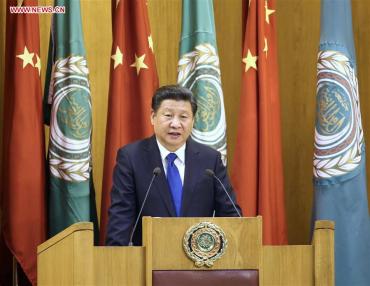
“Visiting Chinese President Xi Jinping on Thursday prescribed his remedies to restore peace in the Middle East and promote development in the Arab world.

EGYPT-CAIRO-CHINA-XI JINPING-VISIT

While delivering a speech at the headquarters of the Arab League, Xi described the Middle East region, which in many’s eyes is almost an equivalent to wars and tumult, as a “land of abundance.”

PATH TO PEACE

The Chinese leader concluded in the remarks that dialogues and development are the key factors that can help bring peace and stability back in this part of the world.

He said use of force offers no solution to problems, neither will zero-sum mentality bring enduring peace, adding that for the success of talks, there is need for utmost patience and flexibility.

Speaking of the Syrian crisis, he said there will be no winner out of a conflict, and to address the hot-spots, what is the most urgent, is to bring about cease-fire and start political talks.

Xi also believed that turmoil in the Middle East stems from the lack of development, while the ultimate solution will depend on development, saying that only when young people are able to live a fulfilled life with dignity can hope prevail in their heart. Only then will they voluntarily reject violence, extremist ideologies and terrorism.

Mahmoud Allam, former Egyptian ambassador to China, admitted that many of the deep-rooted problems the Arab world is grappling with have been the result of failures to achieve a successful development model, saying development is no doubt the most viable path of mobilizing people toward achieving their common interests and overcoming disagreements.

TANGIBLE HELP

Also in his speech, the Chinese president introduced a host of fresh moves including loans, financial aid and common investment fund to help improve livelihood, fight terrorism and promote development in the Arab world.

The Chinese government has decided to pledge 50 million RMB (7.53 million U.S. dollars) to help improve the lives of the Palestinians and 230 million RMB (about 35 million dollars) for Syria, Jordan, Lebanon, Libya and Yemen as humanitarian assistance, said Xi.

Beijing also wants to promote the industrialization in the Middle East. To achieve that end, China is going to hand out a number of loan programs, including a 15-billion exclusive loan, a 10-billion business lending, and 10 billion concessional loans so as to facilitate production capacity cooperation between China and the regional countries, according to the president.

Meanwhile, China also prepares to work with the United Arab Emirates and Qatar to set up a common investment fund worth 20 billion dollars that focuses on traditional sources of energy in the Middle East, infrastructure, and high-end manufacturing.

Xi also offered in his speech 300 million dollars for law enforcement cooperation, police training so as to help build up the abilities of the regional countries to maintain stability.China also planned to provide 1,000 training opportunities for young Arab leaders, and strengthen exchanges among their think tanks, experts and scholars.

CHINA’S DOS AND DON’TS IN MIDEAST

The Chinese leader also said his country will neither look for proxies nor try to fill any “vacuum” in the Middle East, adding that Beijing has no intention of building any sphere of influence in the region.

“Instead of looking for a proxy in the Middle East, we promote peace talks; instead of seeking any sphere of influence, we call on all parties to join the circle of friends for the Belt and Road Initiative; instead of attempting to fill the ‘vacuum’, we build a cooperative partnership network for win-win outcomes,” he said.

Meanwhile, Xi promised that China will not link terrorism with any specific ethnic group or religion, as doing so will only create ethnic and religious tensions, adding that there should be no double standards in battling terrorism.

Also, he said the Middle East is the meeting place of ancient human civilizations and home to diverse and splendid cultures. China will continue to unswervingly support Middle East and Arab states in preserving their ethnic and cultural traditions, and oppose all forms of discrimination and prejudice against specific ethnic group and religion.”

Source: Chinese president offers remedies for Mideast predicaments, aid to Arab development – Xinhua | English.news.cn

30/11/2015

Smog chokes Chinese, Indian capitals as climate talks begin | Reuters

The capitals of the world’s two most populous nations, China and India, were blanketed in hazardous, choking smog on Monday as climate change talks began in Paris, where leaders of both countries are among the participants.

China’s capital Beijing maintained an “orange” pollution alert, the second-highest level, on Monday, closing highways, halting or suspending construction and prompting a warning to residents to stay indoors.

The choking pollution was caused by the “unfavourable” weather, the Ministry of Environmental Protection said on Sunday. Emissions in northern China soar over winter as urban heating systems are switched on and low wind speeds have meant that polluted air has not been dispersed.

In New Delhi, the U.S. embassy’s monitoring station recorded an air quality index of 372, which puts air pollution levels well into “hazardous” territory. A thick smog blanketed the city and visibility was down to about 200 yards (metres).

Air quality in the city of 16 million is usually bad in winter, when coal fires are lit by the poor to ward off the cold. Traffic fumes, too, are trapped over the city by a temperature inversion and the lack of wind.

However, the government has not raised any alarm over the current air quality and no advisories have been issued to the public. Thirty thousand runners took part in a half marathon at the weekend, when pollution levels were just as high.

In Beijing, a city of 22.5 million, the air quality index in some parts of the city soared to 500, its highest possible level. At levels higher than 300, residents are encouraged to remain indoors, according to government guidelines.

The hazardous air underscores the challenge facing the government as it battles pollution caused by the coal-burning power industry and will raise questions about its ability to clean up its economy at the talks in Paris.

Chinese President Xi Jinping and Indian Prime Minister Narendra Modi are both in Paris and both were scheduled to meet U.S. President Barack Obama on Monday to give momentum to the two-week negotiations.

Source: Smog chokes Chinese, Indian capitals as climate talks begin | Reuters

15/11/2015

How Modi Dealt With Pointed Questions From the British Press – India Real Time – WSJ

Narendra Modi hasn’t given a news conference in India since becoming prime minister last year.

So when he arrived in the U.K. on Thursday and addressed the media with his counterpart, David Cameron, British reporters seized the opportunity to ask a few pointed questions.

Referring to recent incidents of religious violence, BBC correspondent Justin Rowlatt kicked off by asking Mr. Modi: “India is becoming an increasingly intolerant place. Why?”

Mr. Modi answered, in Hindi: “India is the land of Buddha. India is the land of Gandhi. And so, it is in our culture and blood that we don’t accept anything against the basic values of society.”

He continued: “For us, every incident is serious. We don’t tolerate it under any circumstances. Law takes strict action and will continue to do so. India is a vibrant democracy, and its constitution provides for the safety of people from all strata of society. We are committed to protecting freedom of thought.”

A little later in the news conference, Guardian reporter Nicholas Watt asked Mr. Cameron what he felt about the visit. “How comfortable do you feel welcoming Prime Minister Modi to this country given that for the first two years of your premiership he was not permitted to visit this country because of his record as chief minister of Gujarat?”

The U.K. distanced itself from Gujarat and Mr. Modi after religious riots in the state that killed more than 1,000 people, mostly Muslims, in 2002, when Mr. Modi was the state’s top official. Mr. Modi has denied wrongdoing and court investigations have said there isn’t enough evidence to prosecute him.

Mr. Watt then asked about Europe’s migrant crisis and the U.K.’s referendum on European Union membership before turning back to India.

“Prime Minister Modi, can I ask you: Tomorrow night you will obviously have a rapturous reception at Wembley Stadium. But there are a number of protesters out today who are saying—and I am wondering what you say to them—that given your record as chief minister of the state of Gujarat, you do not deserve the respect that would normally be accorded to the leader of the world’s largest democracy.”

Mr. Cameron answered by citing Mr. Modi’s “record and historic majority” in the Indian parliament after the 2014 election. Mr. Modi then said he was never denied entry to the U.K. The U.S. refused him a visa in 2005 based on his response to the riots but issued him one in 2014, after he became prime minister.

“To keep the record straight, I would like to give some information,” Mr. Modi said. “I came here in 2003 and received a big welcome and respect, and participated in several programs. The U.K. has never stopped me from coming here, has never imposed any restrictions. I couldn’t come here due to a lack of time. That’s a different issue. So this is a wrong perception. Please correct it.”

Mr. Modi then spoke on the British referendum and proceeded to take a question on trade and economic cooperation from an Indian reporter. He never directly addressed the last part of Mr. Watt’s question.

Source: How Modi Dealt With Pointed Questions From the British Press – India Real Time – WSJ

12/11/2015

LIVE: PM Modi arrives in UK – The Hindu

Indian Prime Minister Narendra Modi’s Air India aircraft made touchdown this morning at 10 a.m. in Heathrow for his long-awaited bilateral level visit to the United Kingdom — his first since becoming Prime Minister.

Prime Minister Narendra Modi and his British counterpart David Cameron with their delegations during talks at 10, Downing Street in London on Thursday. Photo: PMO

He was met at the airport by Hugo Swire, Minister of State for the Foreign Office, and Priti Patel, Minister for Employment and Diaspora Champion in the David Cameron government. His visit carries expectations for agreements and partnerships worth billions of dollars across defence, security, finance and sectors like education, research and health.

Mr. Modi is accompanied by a high power business delegation that included Cyrus P. Mistry, chairman, Tata Sons, Sunil Bharti Mittal, chairman, Bharti Enterprises Limited and N. Chandrasekaran, CEO and managing director of Tata Consultancy Services.

Mr. Modi will be greeted by a Guard of Honour at Westminster,which will be followed by delegation level talks at 10 Downing Street with Mr. Cameron. The two Prime Ministers will address a joint press conference after which Mr. Modi will deliver his speech in parliament. He will also garland the statue of Mahatma Gandhi in Parliament Square. The evening will see important agreements between the two country delegations finalised at Guildhall, City of London. Mr. Modi will stay the night at the Prime Minister’s country residence at Chequers.

The pomp and ceremony attached to the visit is expected to include a special tricolour flypast by the Red Arrows Royal Air Force (RAF) Aerobatic Team over the Buckingham Palace before the Prime Minister sits down for lunch with Queen Elizabeth II ahead of his mega diaspora address at the iconic Wembley Stadium in north London.

Source: LIVE: PM Modi arrives in UK – The Hindu

30/07/2015

Behind the Surge in Chinese Tech Startups – China Real Time Report – WSJ

In 2009, then-Google executive Kai-Fu Lee wrote a letter to Chinese college students discouraging them from the start-up world. Young people then simply weren’t ready to strike out on their own, he said. The gist, he said: “Don’t start a company. It’s tough. There are wolves out there.”

Today, he says, China’s young people are themselves proving to be an innovative pack. Internet availability, manufacturing know-how and the smartphone revolution have fueled a surge of Chinese startups in China over the past few years, many run by members of a post-digital generation of youngsters. The rush has led to a wave of investment in Chinese startups by investors looking for the next Alibaba, and thrown into question China’s longtime reputation as a market dependent on copycatting.

Back then, “there were so few serial entrepreneurs in China,” he said on Thursday at Converge, a technology conference co-hosted by The Wall Street Journal and f.ounders. “We really had to find either very young people or find professional managers or senior engineers out of companies like Google and Baidu and help them start a company.” Now, he says, “there are serial entrepreneurs everywhere.”

In some places, the rush may be getting ahead of itself. Mr. Lee—now chairman and chief executive of investment firm and tech incubator Innovation Works—sees “totally crazy” valuations among Chinese tech initial public offerings. Many of the best already went public overseas, including in the U.S. The few left in China “have been blown out of proportion,” he said, adding, “everybody’s chasing those few stocks.”

But overall, he says, “I’m very bullish about the future.”

Mr. Lee, famous in China for his roles at Google and Innovation Works, is also a social-media presence. He says that since forming Innovation Works in 2009 he has seen attitudes change among young Chinese.

“They grew up their total lives on the Internet, unlike us, who have all this baggage,” he said.

That’s potentially good news for Beijing, which is looking to sustain growth by broadening the world’s No. 2 economy, making it more than the world’s factory floor.

Innovation may take a different form than what the U.S. expects, Mr. Lee said. Innovators in China and elsewhere, rather than inventing the next iPhone, “can change the world because of a very clever business idea.”

“China is completely ready to build a Facebook-equivalent type of company, an Uber-equivalent type of company, in many other areas, because the market is very large and the people are very innovative,” he said.

Innovation Works currently sees promise in startups with products like a piano that can teach the user how to play, a household robot and even an online joke platform “for people to share the embarrassing moments in their lives.” And then there’s a venture built around a Chinese girl band, SNH48, that takes a page from Japan’s AKB48 and hopes to make money selling virtual products to an online community of fans.

Even if many of the ideas from China’s startups are themselves derivative, he said, “they will wow people.”

via Behind the Surge in Chinese Tech Startups – China Real Time Report – WSJ.

Law of Unintended Consequences

continuously updated blog about China & India

ChiaHou's Book Reviews

continuously updated blog about China & India

What's wrong with the world; and its economy

continuously updated blog about China & India