Posts tagged ‘Forbidden City’

12/05/2014

First directory of Beijing’s traditional ‘siheyuan’ courtyard homes to be published | South China Morning Post

The first ever official directory of siheyuan – the traditional courtyard homes of Beijing – is expected to be published by the end of this year.

courtyard.jpg

Nearly 1,000 siheyuan have been logged, with owners’ details, floor plans, photographs, and accounts of their construction.

The directory, compiled by the Office of Beijing Geographical History, will provide the fullest record yet of what were the capital’s most important dwellings before the modern era.

But 100 have been omitted because their owners refused to collabourate.

Tan Liefei, the office’s deputy director and an editor of the directory, said some of these were well preserved, “structurally very complete” contained valuable ancient artifacts.

But they were owned or used by organisations or individuals who were not “cooperative” to the survey, he said.

However, more than 10 courtyards built in the Qing Dynasty had been discovered in the mountains, he added.

They were well preserved with grand structures and sophisticated decorations, some rivalling similar buildings in urban areas.

It is believed that Beijing has a total of more than 3,000 courtyard houses, but how to preserve them has become a controversial subject.

While some argue that they should be commercialised and converted into hotels or restaurants, some say their structures and interior decorations should be strictly preserved and used for non-profit purposes such as museums.

The condition of many siheyuan has deteriorated overt the years, with families adding illegal structures such as additional rooms or kitchens.

But well preserved and updated siheyuan have become the residences of the privileged, with average prices exceeding 100 million yuan (HK$126 million).

via First directory of Beijing’s traditional ‘siheyuan’ courtyard homes to be published | South China Morning Post.

Enhanced by Zemanta
21/03/2014

Michelle Obama starts landmark trip[1]- Chinadaily.com.cn

After a long journey from Washington, US first lady Michelle Obama landed in Beijing on Thursday evening, starting her long-awaited trip to China with a big smile and a wave.

Michelle Obama starts landmark trip

When Obama, in an elegant black dress, stepped out of the plane with her mother and two teenager daughters, dozens of reporters that had waited in the airport for hours incessantly clicked their camera shutters.

Though nobody from the delegation spoke to the media, the first lady’s brief debut spread quickly on Chinese media and micro blogs, where users discussed what she would wear and eat, and how she will interact with Chinese first lady Peng Liyuan.

“It is another innovation in the history of Chinese diplomacy” and helps both sides’ leaders strengthen their personal relations, said Ruan Zongze, vice-president of the China Institute of International Studies.

Ruan was referring to the latest “creative” laid-back meeting between President Xi Jinping and his US counterpart, Barack Obama, at the Sunnylands resort in California last June, soon after Xi assumed office.

Peng, Xi’s wife, accompanied her husband on the Sunnylands visit but did not meet Michelle Obama, who was in Washington. Her absence left some Chinese disappointed and more excited about the “make-up” meeting.

On Friday, Michelle Obama, a Harvard-educated lawyer, is to spend almost the whole day with Peng. The two first ladies will visit a high school in Beijing, stroll inside the Forbidden City, eat Peking duck and watch a performance together.

“The meeting of the two first ladies shows that China is more open and is getting more involved with the international community,” Ruan said.

via Michelle Obama starts landmark trip[1]- Chinadaily.com.cn.

Enhanced by Zemanta
20/01/2013

* Beijing to lend Taiwan historical artefacts from Forbidden City

SCMP: “Beijing has agreed to lend art exhibits for a major joint exhibition in Taipei, the head of Taiwan’s top museum said on Sunday, as the two former rivals push ahead with detente.

museum.jpg

Feng Ming-chu, director of Taipei’s National Palace Museum, will fly to Beijing on Monday, the first such trip since 2009 when the chiefs of the museum and of Beijing’s Palace Museum made landmark exchange visits.

Feng will meet her mainland counterpart Shan Jixiang to discuss the loan of more than 30 artefacts from the museum, also known as the Forbidden City, for the exhibition in Taipei in October.

“The Palace Museum in Beijing has agreed to our proposal for loaning artefacts,” she said.

The exhibition, which will also include some items from the Taipei museum, features the artistic tastes of Qianlong (1735-1796), an emperor in China’s last dynasty Qing.

“Hopefully the co-operation between the two museums will be further enhanced through the visit, following the 2009 ice-breaking exchange of visits by the curators of the two sides,” Feng said.

The 2009 visits resulted in the loan of 37 works from the Beijing museum to the Taiwanese museum later that year.

It was the first joint exhibition by the two museums, highlighting warming relations between Beijing and Taipei which have been ruled separately since the end of a civil war in 1949.”

via Beijing to lend Taiwan historical artefacts from Forbidden City | South China Morning Post.

19/05/2012

* Rich in kindness

China Daily: “Billionaire behind major philanthropic projects says there’s always more to do.

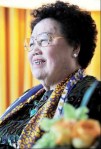
Entrepreneur and philanthropist Chan Laiwa, also known as Chen Lihua, is no stranger to lists of the world’s richest people, from Forbes to Hurun. But the self-made billionaire finds there is “so much” beyond wealth. “While wealth does come through our hard work and efforts, it is not the ultimate goal and is not above everything,” Chan, 71, says in her Manhattan hotel room the day before she was honored at an April gala as one of Time magazine’s 100 Most Influential People for 2012.

Such sentiments might seem standard from any rich person concerned with public image, but Chan in person – sincere, humble and thoughtful – makes people around her feel at ease. She impresses most with her passion for art, particularly of sandalwood, a medium she has loved since she was a girl. Born into a family of Manchu, the ethnic group that led Chinas last imperial dynasty, the Qing 1644-1911, Chan spent most of her childhood in the Summer Palace in Beijing. She is a descendant of a noble Manchu family of the Yellow Banner Clan, some members of which were ministers of state under the Qing emperor.

Chan’s childhood home was furnished with red sandalwood, a material used in the emperors’ palace in bygone times. “As I grew older, I felt the need to preserve this important part of Chinese culture,” recalls Chan, who opened a furniture factory in the 1980s and began making old-style pieces modeled after those from Beijing’s Palace Museum, more widely known as the Forbidden City.

In 1999, Chan fulfilled a childhood dream by investing in a $16 million red sandalwood museum in the capital. The thousands of treasures displayed there include a scale model of a corner tower in the Forbidden City, a reproduction of the memorial gateway carved with 320 dragons from Longquan Temple in Shanxi province, and a number of intricate furniture pieces and sculptures.

She made her fortune in the 1990s through a series of real estate ventures involving her Fu Wah International Group, the Hong Kong company fashioned out of Chan’s furniture store. The businesswoman later moved to Beijing for more opportunities. Chan was recently voted among Time magazines 100 Most Influential People in the World for 2012.

via Rich in kindness|People|chinadaily.com.cn.

Law of Unintended Consequences

continuously updated blog about China & India

ChiaHou's Book Reviews

continuously updated blog about China & India

What's wrong with the world; and its economy

continuously updated blog about China & India